
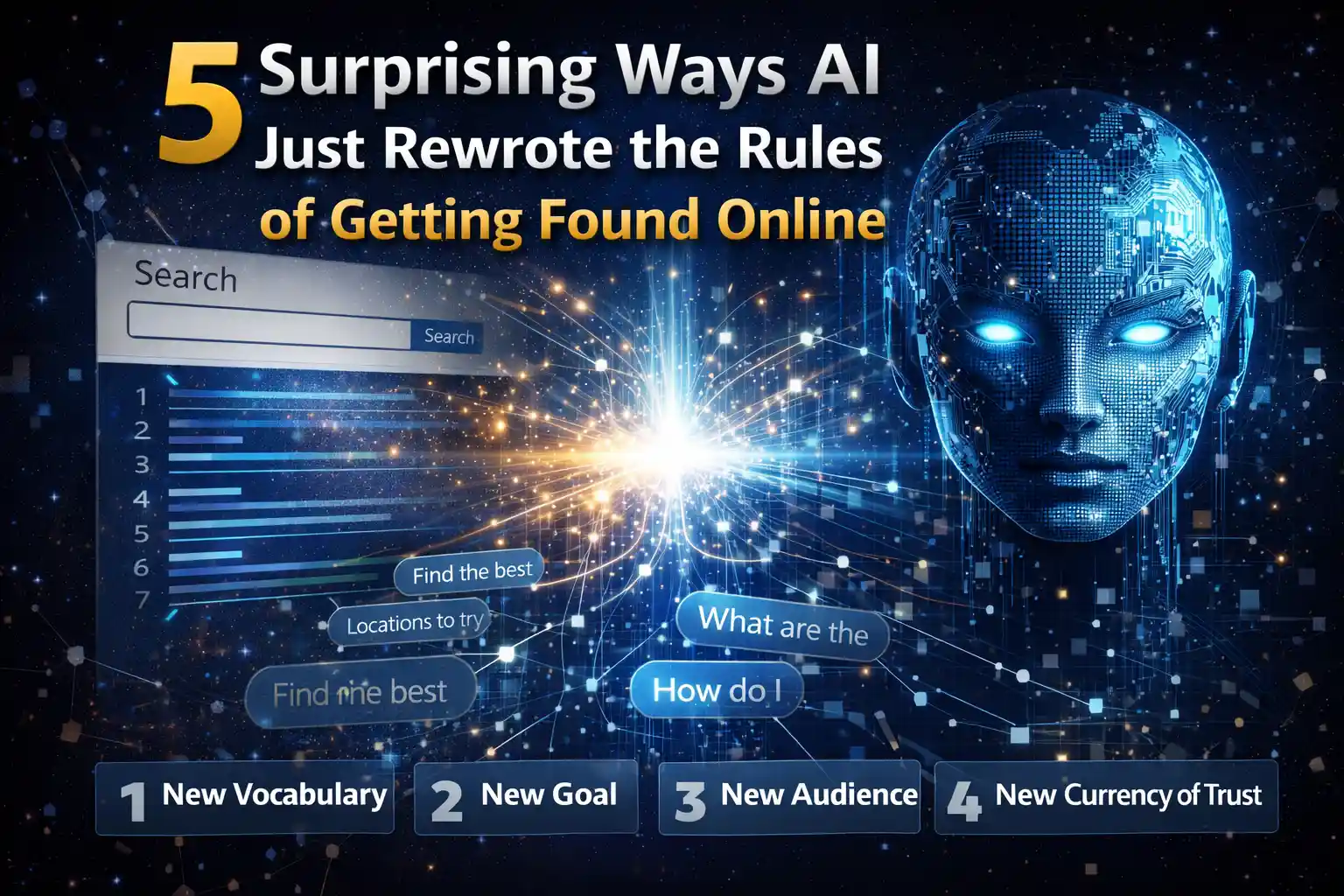
Introduction: The End of the Ten Blue Links
For decades, the ritual was universal: type a few words into a search box, hit enter, and scan the familiar list of ten blue links. We became experts at deciphering which link might hold the answer we needed. That era is rapidly coming to an end. Today, millions of people bypass the list entirely, asking a direct question to an AI like ChatGPT or Google’s Search Generative Experience (SGE) and receiving an instant, synthesized answer.
This fundamental shift from “searching” to “asking” has profoundly changed the rules for any brand, creator, or business wanting to be found online. The game is no longer about climbing a list; it’s about becoming the answer itself. This new reality demands a new vocabulary (Point 1), a new goal (Point 2), a new audience (Point 3), a new currency of trust (Point 4), and an understanding of the powerful feedback loop that powers it all (Point 5). Here are the five new rules of discovery. Ignore them at your peril.
1. It’s Not Just SEO Anymore: Welcome to the Optimization Alphabet Soup
For years, Search Engine Optimization (SEO) was the all-encompassing term for getting seen online. That simple acronym is no longer enough to describe a landscape that has fragmented into multiple, distinct disciplines. Optimizing for visibility now requires a more nuanced approach.
- Answer Engine Optimization (AEO) focuses on becoming the source of truth for AI-driven engines that provide direct answers, such as voice assistants and Google’s AI Overviews. The goal is to provide content that is so clear and authoritative that an AI chooses to cite it directly in its response.
- Generative Engine Optimization (GEO) specifically targets influencing how large language models (LLMs) like ChatGPT and Gemini retrieve, summarize, and present information. This involves adapting content to be easily processed and synthesized by these generative AI platforms.
Think of it this way: AEO is about becoming the fact; GEO is about shaping the story. One provides the raw, citable data point, while the other influences the narrative the AI weaves around it.
These strategies are not competing; they are complementary aspects of a modern, unified content strategy, a point echoed by industry practitioners who see them as complementary aspects of a unified strategy. This new complexity simply reflects how diverse our methods of finding information have become, moving beyond a single search box to a whole ecosystem of AI assistants and answer engines.
2. The Goal Isn't to Rank #1—It's to Be the Answer
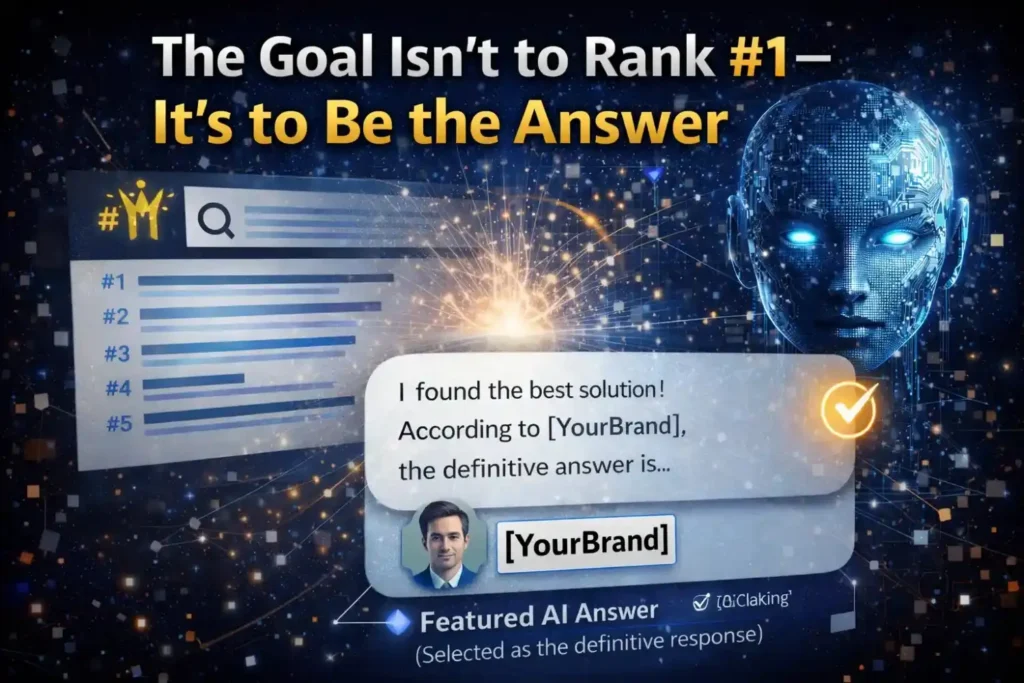
For decades, the primary objective of any digital strategy was to rank at the top of a search engine results page. That goal has been fundamentally replaced. In the new era of AEO and GEO, the ultimate prize is to have your content selected, synthesized, and presented directly to the user by an AI as the authoritative answer.
This position provides unmatched visibility and credibility. It moves your brand from being one option among many to being the definitive expert in the conversation. When an AI quotes you, it’s a powerful endorsement that builds immediate trust with the user.
The future of visibility belongs to the content that’s clear, credible, and ready to be quoted.
This is far more powerful than a simple link click. It is about owning the conversation and earning trust at the exact moment a user is looking for a solution, positioning your brand as the primary source of knowledge.
3. Your Audience Is No Longer Just Human
One of the most counter-intuitive shifts is that marketers are no longer optimizing just for human eyes. We are now creating content for AI systems that act as intermediaries, interpreting and repackaging information for a human end-user. This demands a radical shift in how we structure and present information.
This focus on user intent and conversational language, a trend identified by both marketing strategists and AI-era SEO experts, is paramount. To do this effectively, content must be structured for machine readability. Key tactics include:
- Frame content around questions with direct, sharp answers that an AI can easily extract and quote.
- Use schema markup (structured data) to explicitly tell AI systems the context of your content. Think of schema markup as standardized, machine-readable labels for your content. It’s like telling an AI, ‘This string of text is a product name,’ ‘This number is a price,’ and ‘This section is a step-by-step guide.’ This removes ambiguity and makes your content far easier for the AI to process and feature.
- Prioritize clarity and factual accuracy over “robotic keyword stuffing.” AI models are designed to identify and surface high-quality, reliable information, not just pages with the right keywords.
But structuring content for machine readability is only half the battle. Once an AI can understand your content, it must then decide if it can trust it, which brings us to the new currency of authority.
4. Trust and Authority Are the New Backlinks
In traditional SEO, as detailed in numerous analyses of its history, link-building was a cornerstone strategy. The number of high-quality websites linking to your page was a powerful signal to search engines that your content was valuable. In the new AI-driven era, this is changing. While links still matter, trust and authority now matter more than backlinks.
AI engines are being trained to evaluate signals of expertise and credibility directly from your content, not just from external links. Building this trust requires a focus on transparency and verifiable expertise. Actionable strategies include:
- Adding expert bylines and credentials to content to show who is behind the information.
- Citing reputable sources within your articles to demonstrate that your claims are well-researched.
- Keeping content updated with the latest data and insights to ensure it remains fresh and reliable.
This represents a positive evolution, rewarding genuine expertise and the creation of high-quality, trustworthy information over the ability to manipulate ranking algorithms.
5. AI Isn't Just Changing Search—Search Is Actively Building AI
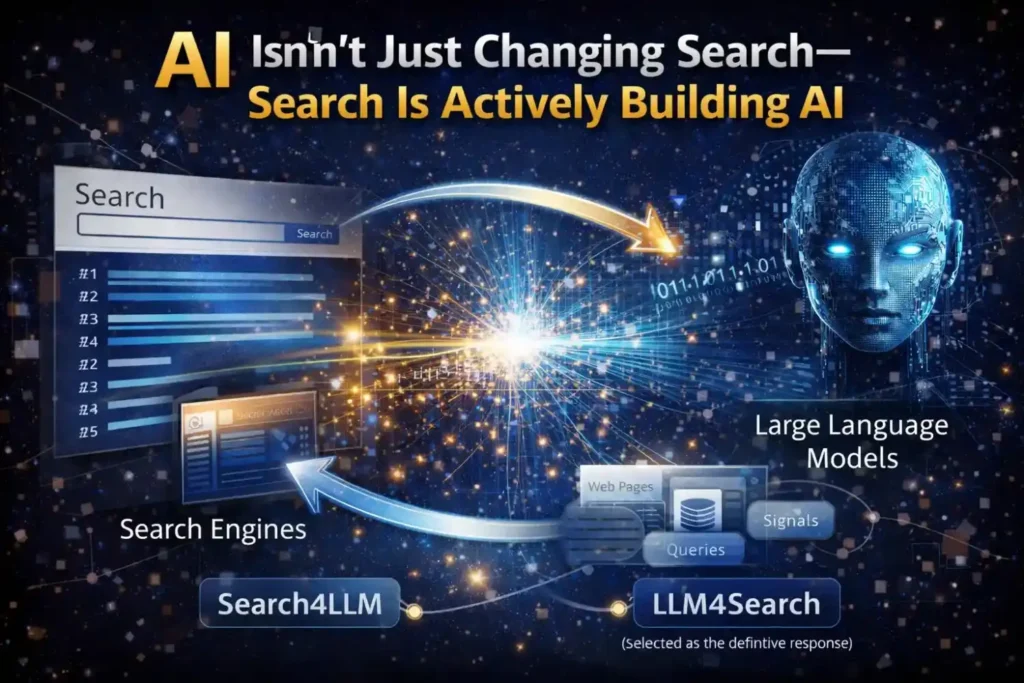
Most of the conversation today is about how Large Language Models (LLMs) are changing search engines (a concept known as LLM4Search). But in a surprising twist, the influence flows powerfully in the other direction as well.
This is the concept of Search4LLM: the massive, high-quality, and well-organized data from search engines is being used to pre-train, fine-tune, and align the very LLMs that are powering this new era. In simple terms, decades of search engine data—the trillions of web pages, user queries, and click-through signals—provide the vast corpus of human knowledge that teaches AIs how to understand intent, answer questions, and determine what a “good” answer actually looks like.
This isn’t just an academic curiosity; it’s the engine of co-evolution. The high-quality, intent-driven content you publish today is not just a ranking signal—it’s a direct contribution to the intelligence of the AIs you’ll be optimizing for tomorrow.