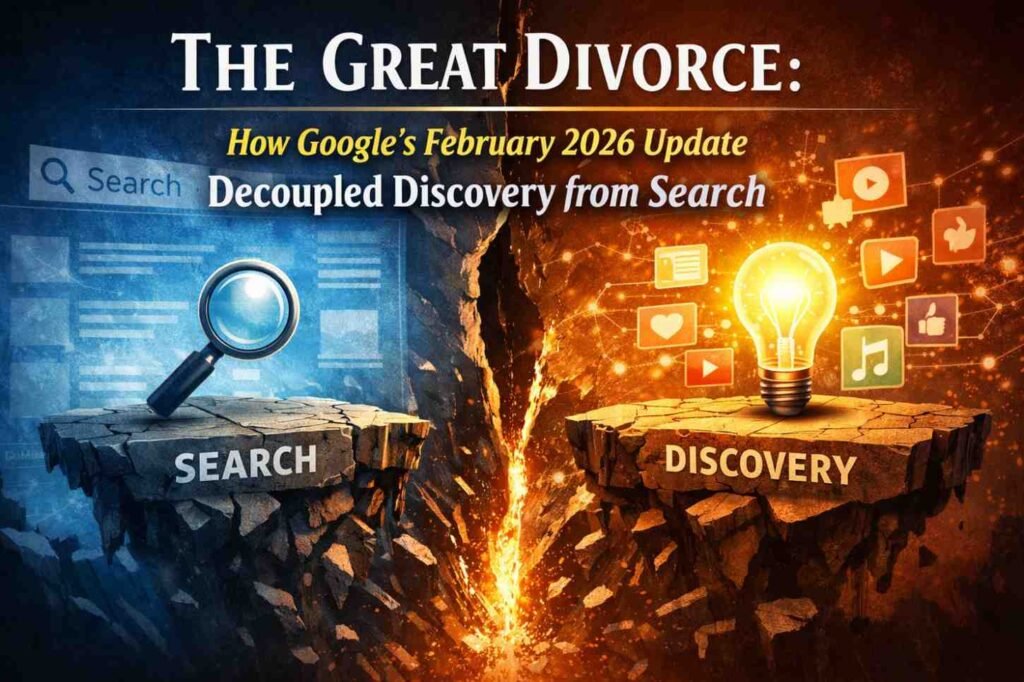
At exactly 09:00 PST on February 5, 2026, the digital publishing landscape underwent a philosophical realignment. Across the United States, major publishers watched their analytics with a sense of vertigo—community reports confirmed that high-volume feeds were in freefall, with many seeing traffic drops between 90% and 95% in a single morning.
This was not a typical algorithmic tremor. The
February 2026 Discover Core Update represents the first time in Google’s history that a core update has targeted the Discover feed exclusively. By leaving traditional Search untouched, Google has finalized a “Great Divorce,” signaling that the rules of intent-based search no longer apply to the world of proactive recommendation.
The Separation of Powers: Discover vs. Search
As an SEO historian, I view this as the logical conclusion of a journey that began with Discover’s launch in 2018. For years, publishers operated under the assumption that a #1 ranking in
Search was a golden ticket to the Discover feed. This update renders that assumption obsolete.
Discover has fully transitioned from a “query engine” to a “recommendation engine.” While Search prioritizes relevance to a specific keyword, Discover now prioritizes
confidence in the source. A site can dominate the SERPs for its primary vertical yet remain entirely invisible in the feed. In Google’s own words, the goal is to make the experience:
“more useful and worthwhile for users by prioritizing quality over mere engagement.”
The “Local First” Mandate
The most aggressive shift in this update is the end of geographic arbitrage. Google is now employing a “Local First” mandate, favoring publishers that are physically and legally anchored in the user’s own country. For international publishers who have long relied on the U.S. market for Discover volume, this is an “algorithmic redistribution” of massive proportions.
This isn’t a penalty for foreign sites; it is a realignment toward cultural and geographic relevance. To pass this new localization filter, Google is tracking specific “trust signals” that confirm a publisher’s domestic presence:
- Entity Registration: Verifiable company registration within the target country.
- Physical Address Transparency: Disclosure of a domestic office (not a PO Box) on “About” and “Contact” pages.
- Structured Data: Explicit use of PostalAddress or LocalBusiness schema to signal headquarters.
- Editorial Bylines: Author bios that mention specific regional expertise or city-based locations.
The Death of “Authority Parasitism”

For the last decade, high-authority generalist sites have practiced what we call “Authority Parasitism”—using their massive domain-level trust to rank for trending topics outside their core expertise. This update effectively kills that strategy, shifting the focus from “Domain-level trust” to “Topic-level confidence.”
Google’s systems now evaluate expertise on a topic-by-topic basis. A general news giant can no longer expect to outrank a specialist simply because of its size.
Google Algorithms Search Advocate John Mueller articulated this paradigm shift with a stark example:
“A local news site with a dedicated gardening section could have established expertise in gardening, even though it covers other topics. In contrast, a movie review site that wrote a single article about gardening would likely not.”
Headline Reform: Prioritizing the Essence
Google is now actively demoting content that relies on “Curiosity Gaps” or emotional manipulation. The algorithm has moved beyond rewarding the “click” and is now optimizing for a “satisfied user journey” that begins with an honest framing of the content.
| Clickbait Approach (Withholding Info) |
Essence-Focused Approach (Informative) |
| “This Celebrity Did Something SHOCKING” |
“Celebrity X Announces Retirement After 15-Year Career” |
| “Doctors HATE This Simple Trick” |
“New Study: Mediterranean Diet Reduces Diabetes Risk by 23%” |
| “Delete These Apps NOW” |
“Security Researchers Identify 7 Apps with Privacy Flaws” |
This is a move toward a “quality + engagement” hybrid model. If your headline promises more than the content delivers, the system is now trained to deprioritize your domain almost instantly.
The Technical “Ticket to Entry”
In the 2026 landscape, technical compliance is no longer a recommendation; it is the minimum “ticket to entry.” If you fail these specifications, your content is ineligible for the feed regardless of its editorial merit.
- Visual Authenticity: Original photography and custom infographics are now primary trust signals. Google explicitly labels stock photos as “trust killers” in this new environment.
- Feature Image Dimensions: Images must be at least 1,200px wide.
- The Robots Mandate: The max-image-preview:large setting is non-negotiable for high-quality card display.
- Core Web Vitals: Page experience is now an explicit eligibility requirement for Discover, with a focus on stable, fast-loading visual elements.
Conclusion: The Trust-Weighted Future
The February 2026 update marks the end of the “viral traffic lottery.” Discover is becoming a sustainable distribution channel reserved for localized, original experts. While the initial rollout targets U.S. English-language users, a global expansion is confirmed for the months ahead. International publishers should consider this a final warning: your ability to arbitrage traffic across borders is reaching its expiration date.
The question for
digital strategists is no longer how to “hack” the feed, but how to define your editorial purpose. Are you merely a content creator chasing the next viral moment, or are you a subject matter authority building a deep, localized foundation of trust? In the new era of discovery, only the latter will survive.