
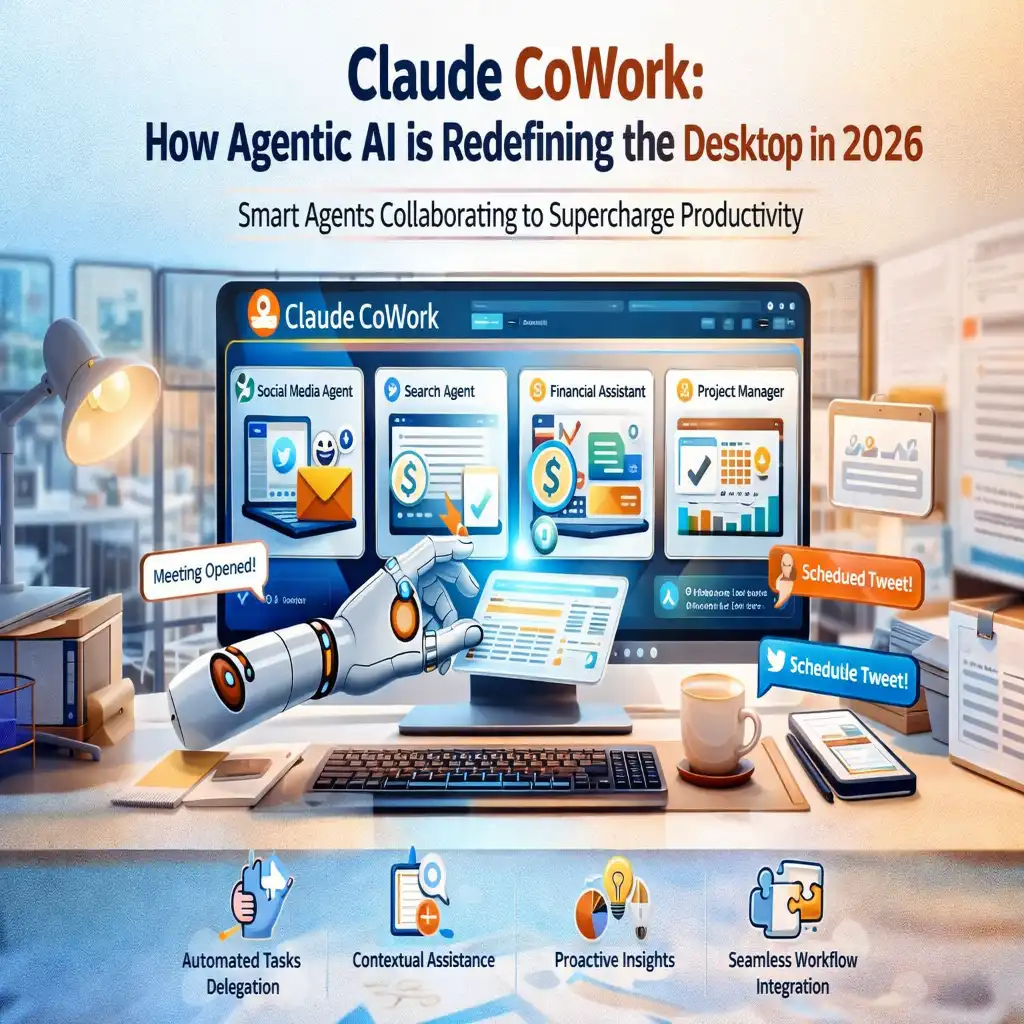
For years, digital work has been defined by repetition—downloading files, organizing folders, copying data between tools, and manually turning raw information into usable output. Even with the rise of AI, most tools have simply assisted us rather than actually doing the work. But in 2026, that paradigm is rapidly changing. The shift from manual digital effort to AI-driven execution is no longer theoretical—it’s happening in real time.
Enter Claude CoWork, a breakthrough in agentic AI that moves beyond conversation and into action. Instead of just responding to prompts, it actively interacts with your desktop, manages files, executes workflows, and completes tasks on your behalf. This marks a major evolution—from AI as a tool to AI as a true collaborator.
In this blog, we’ll explore everything you need to know about Claude CoWork. You’ll discover its core features, practical use cases across industries, potential risks (including security concerns), and what this innovation means for the future of work.
Understanding Digital Marketing: Definition and Scope
The Era of “AI That Talks”
The first wave of modern artificial intelligence was dominated by conversational tools like ChatGPT and Google Gemini. These platforms transformed how we interact with technology, making it easier to generate content, answer questions, and brainstorm ideas in seconds. However, despite their intelligence, they remained largely passive.
Users still had to take action—copying responses, organizing files, executing workflows, and bridging the gap between insight and implementation. In other words, AI could think and suggest, but humans still had to do. This limitation created a bottleneck in productivity, especially for repetitive digital tasks that consumed valuable time.
The Rise of Agentic AI
Agentic AI represents the next leap forward. Unlike traditional chatbots, agentic systems are designed to act autonomously, execute multi-step workflows, and interact directly with digital environments. Instead of just providing answers, they complete tasks from start to finish with minimal human intervention.
This is where Claude CoWork changes the game. It brings agentic capabilities into a user-friendly desktop interface, allowing professionals to delegate real work—file management, reporting, and data processing—without needing technical expertise.
The year 2026 marks a turning point because AI is no longer confined to conversations. It is becoming an active participant in daily workflows, signaling the beginning of a new era where humans focus on strategy while AI handles execution.
What is Claude CoWork?
Claude CoWork is a next-generation AI workspace developed by Anthropic that transforms how users interact with their computers. Unlike traditional AI tools that are limited to chat-based responses, Claude CoWork is designed to actively participate in your daily tasks. It operates as a true digital collaborator, capable of understanding instructions and executing them directly within your desktop environment.
At its core, the platform combines intelligence with action through several powerful capabilities. First, it has controlled access to your local file system, allowing it to organize folders, rename files, and manage documents efficiently. Second, it enables advanced task automation, where repetitive activities such as data entry, report generation, and file sorting can be handled without constant supervision. Third, it supports full workflow execution—meaning it can complete multi-step processes like gathering data, processing it, and delivering a finished output in formats like spreadsheets or documents.
What truly sets Claude CoWork apart from traditional AI tools like ChatGPT is its ability to move beyond conversation into real-world action. Instead of just suggesting what to do next, it actually does the work for you. This shift from passive assistance to active execution is what defines the new era of agentic AI.
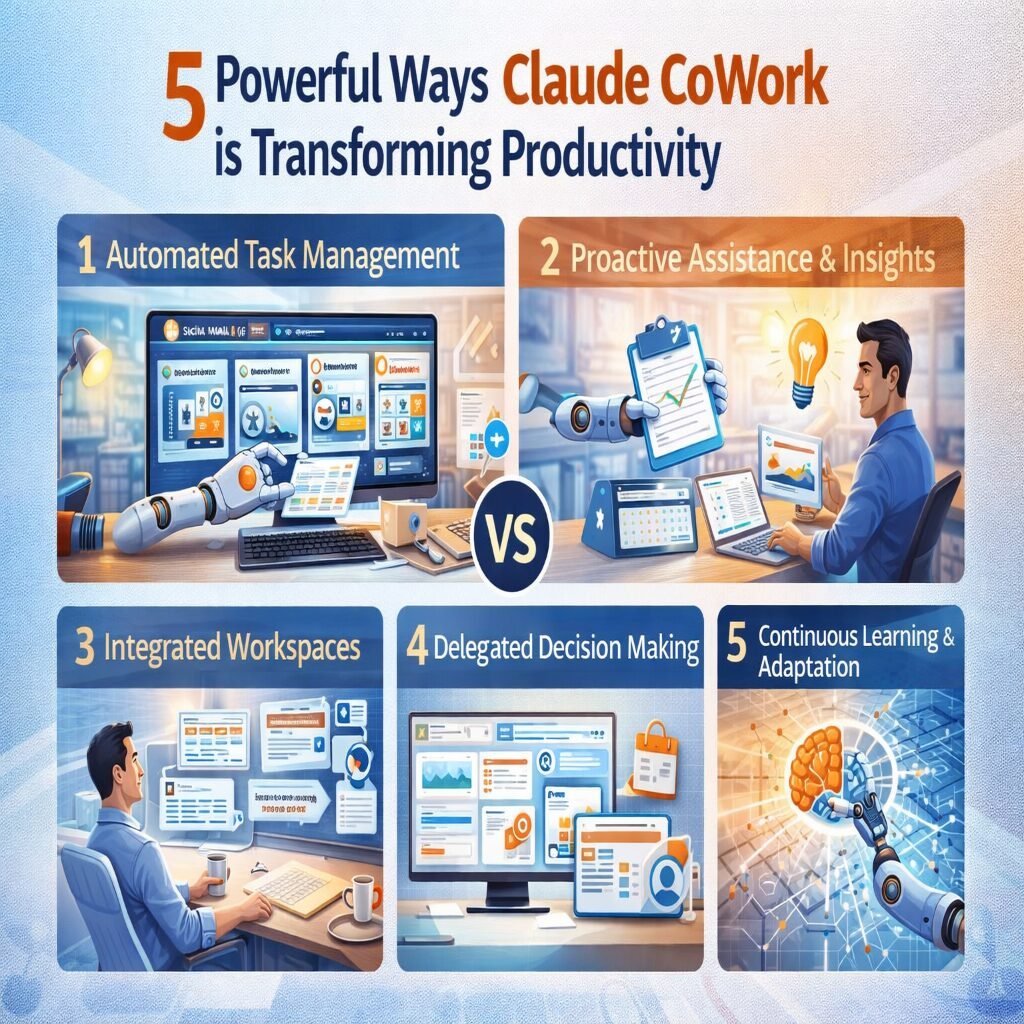
5 Powerful Ways Claude CoWork is Transforming Productivity
1. Eliminating Manual Digital Work
One of the biggest productivity drains in modern workflows is repetitive digital labor—sorting files, renaming documents, organizing folders, and cleaning up cluttered desktops. Claude CoWork removes this burden by handling these tasks automatically. Instead of spending hours managing your system, you can simply instruct the AI to organize everything based on your preferences.
For example, your messy Downloads folder can be transformed in minutes. Claude CoWork can identify duplicate files, categorize documents, rename items with consistent formats, and even delete unnecessary clutter—all without manual effort. This not only saves time but also ensures a consistently organized workspace.
2. Terminal-Free AI for Everyone
Previously, accessing powerful AI automation required technical knowledge, often involving command-line tools and coding skills. Claude CoWork eliminates this barrier completely. Built by Anthropic, it brings advanced agentic capabilities into a simple, user-friendly interface.
This means anyone—from business owners to marketers—can leverage AI without writing a single line of code. The democratization of AI tools opens doors for non-technical users to automate complex workflows, boosting productivity across industries. It’s no longer just developers who benefit from automation; it’s everyone.
3. Autopilot Mode with Scheduled Tasks
A standout feature of Claude CoWork is its ability to run tasks on autopilot through scheduled execution. This introduces asynchronous workflows, where work gets done in the background without requiring constant input.
Imagine setting up tasks once and letting them run automatically:
- Daily reports: Extract data and generate summaries every evening
- Weekly cleanup: Organize and declutter files every Monday morning
- Email summaries: Compile important updates into a single document
This shift from reactive work to proactive automation allows users to focus on higher-value tasks while the AI handles routine operations.
4. Turning Visual Data into Structured Output
Claude CoWork goes beyond text-based understanding by interpreting visual data such as screenshots, scanned documents, and images. It can convert unstructured information into organized formats like Excel sheets or Word documents.
For instance, a folder full of receipts or screenshots can be transformed into a clean financial spreadsheet with categorized entries and formulas. This has powerful applications across industries:
- Finance: Expense tracking and report generation
- E-commerce: Extracting product or sales data from dashboards
- Administrative work: Converting notes and documents into structured files
This capability bridges the gap between raw visual data and actionable insights.
5. Seamless Integration with Tools
Modern workflows rely on multiple platforms, and Claude CoWork connects them into a unified system. It integrates with tools like Google Drive, Slack, and Notion, allowing it to pull and push data across environments effortlessly.
Additionally, its browser capabilities (such as a Chrome extension) enable it to interact with web-based tools, gather information, and complete tasks directly from online sources. The result is a seamless workflow ecosystem where data flows smoothly between platforms, eliminating the need for manual transfers and significantly improving efficiency.
Real-World Use Cases Across Industries
For Business Owners
For business owners, Claude CoWork acts like a virtual operations assistant. It can automate reporting by pulling data from multiple sources, organizing it, and generating ready-to-use summaries. Instead of manually compiling spreadsheets or tracking performance metrics, owners can rely on AI to deliver accurate reports on a daily or weekly basis.
Additionally, data aggregation becomes effortless. Claude CoWork can collect information from emails, cloud storage, and dashboards, combining everything into a single, structured format. This helps business owners make faster, data-driven decisions without getting lost in scattered information.
For Marketers
Marketing professionals often deal with large volumes of campaign data across platforms. Claude CoWork simplifies this by automatically creating campaign summaries, highlighting key performance metrics, and presenting actionable insights.
It can also extract analytics from tools and dashboards, saving hours of manual work. Whether it’s tracking ad performance, social media engagement, or email campaign results, marketers can quickly access organized data and focus more on strategy rather than reporting.
For Designers & Creatives
Designers and creative professionals benefit from improved file organization and asset management. Claude CoWork can sort design files, categorize assets, and maintain a clean folder structure, making it easier to locate and reuse creative work.
Instead of wasting time searching for files or managing versions, creatives can focus on innovation and design. The AI ensures that everything is systematically stored and easily accessible.
For Enterprises
At the enterprise level, Claude CoWork enables large-scale workflow automation. Teams can automate repetitive internal processes such as document handling, reporting, and data transfers between systems.
This leads to a significant boost in internal productivity, as employees spend less time on routine tasks and more on strategic initiatives. By integrating with tools like Slack and Notion, it also improves collaboration and streamlines communication across departments.
Security, Privacy & the “Audit Gap” Explained
Secure Sandbox Model
When it comes to granting AI access to your desktop, security is a top concern. Claude CoWork addresses this through a secure sandbox model—a controlled, isolated environment where the AI operates without unrestricted access to your entire system.
In simple terms, the sandbox acts like a protective boundary. Claude CoWork can only interact with the files, folders, or applications you explicitly अनुमति or share. It doesn’t freely roam your system. Additionally, the platform is designed to require user confirmation before performing critical or destructive actions, such as deleting or overwriting files. This ensures that users maintain full control over what the AI can and cannot do, reducing the risk of accidental data loss or misuse.
The Audit Gap Concern
Despite these safeguards, a key challenge remains—the so-called “audit gap.” Currently, many actions performed within Claude CoWork are not fully recorded in standard compliance logs, especially in enterprise environments.
This lack of visibility can create risks for organizations that rely on strict auditing and regulatory compliance. Without detailed logs, it becomes difficult to track who initiated an action, what changes were made, and how data was handled. For industries like finance, healthcare, and legal services, this gap can raise serious concerns around accountability, transparency, and governance.
Enterprise Security Strategies
To address these concerns, organizations are adopting different security approaches based on their risk tolerance. Some choose a lockdown mode, completely disabling AI access in sensitive environments until stronger audit controls are introduced.
Others prefer controlled access, where the tool is enabled with strict limitations—such as read-only permissions, restricted integrations, and approved data sources.
Meanwhile, innovation-focused teams often adopt open experimentation, allowing broader access while relying on internal monitoring systems and employee training. This balanced approach enables companies to explore the benefits of AI while managing potential risks effectively.
Pricing and Accessibility – Is It Worth It?
Claude CoWork is positioned as a premium productivity tool, and its pricing reflects the advanced capabilities it offers. Currently, access is available through team-based plans ranging from approximately $20 to $125 per seat per month, while individual power users may need the higher-tier “Max” plan, which can go up to $200 per month. This makes it a significant investment, especially for freelancers or small businesses just starting out.
Another important limitation is platform availability. As of now, Claude CoWork is primarily a macOS-exclusive tool and is still in its research preview stage. This means access may be restricted, features are still evolving, and a wider rollout—including Windows support—is yet to come.
So, is it worth it? For early adopters, tech-savvy professionals, and businesses looking to gain a competitive edge through automation, investing now can deliver substantial productivity gains. However, for casual users or those with limited budgets, it may be wiser to wait until the platform becomes more widely available, affordable, and feature-complete.
Pros and Cons of Claude CoWork
Claude CoWork brings a powerful shift in how work gets done, but like any emerging technology, it comes with both advantages and limitations.
Pros
One of the biggest benefits is time savings. By automating repetitive digital tasks such as file management, reporting, and data processing, Claude CoWork allows users to focus on higher-value work. Another major advantage is that it requires no coding skills, making advanced AI accessible to non-technical users. This lowers the barrier to entry and enables professionals across industries to leverage automation. Additionally, its powerful workflow automation capabilities set it apart from traditional AI tools, as it can execute multi-step tasks independently rather than just providing suggestions.
Cons
On the downside, the tool is relatively expensive, with pricing that may not suit individuals or small businesses with limited budgets. It also has limited availability, currently restricted to macOS and still in a research preview phase, which means not everyone can access it yet. Lastly, there are security and compliance concerns, particularly around the “audit gap,” which may make enterprises cautious about full-scale adoption.
Claude CoWork vs Traditional AI Tools
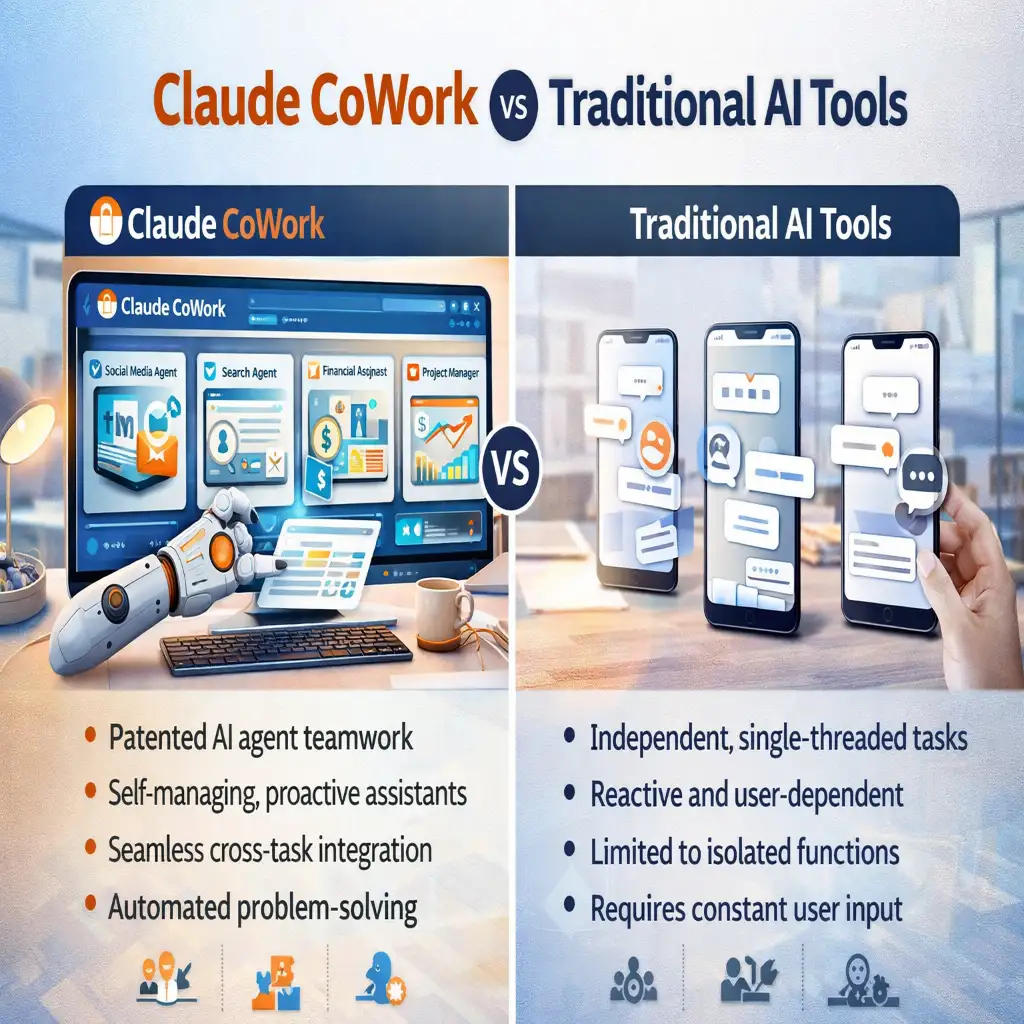
The difference between traditional AI tools and Claude CoWork lies in how work actually gets done. Tools like ChatGPT are primarily chat-based, meaning users interact through prompts and receive responses or suggestions. While these tools are powerful for generating ideas, content, or answers, they still rely heavily on human effort to execute tasks.
Claude CoWork, on the other hand, is action-based. It doesn’t just tell you what to do—it performs tasks directly on your system. This enables a much higher level of automation, where repetitive and multi-step processes can be handled independently without constant input.
Another major difference is file access. Traditional AI tools operate in isolated environments without direct interaction with your local files. In contrast, Claude CoWork can securely access and manage your file system, allowing it to organize, edit, and process documents in real time.
Finally, when it comes to workflow execution, traditional AI requires manual follow-through, while Claude CoWork operates autonomously. This shift from assistance to execution is what truly defines the next generation of AI productivity tools.
The Future of Work – Humans + AI Collaboration
The rise of Claude CoWork signals a fundamental shift in how work is performed. Instead of spending hours on repetitive digital tasks, professionals are moving from a role of doing to one of managing. AI is no longer just a tool that assists—it becomes a collaborator that executes tasks, while humans focus on guiding outcomes and making decisions.
This transformation is driving the emergence of a hybrid workforce, where humans and AI systems work side by side. In this model, AI handles data processing, automation, and routine workflows, while humans bring creativity, judgment, and strategic thinking. Businesses that embrace this collaboration will gain a significant competitive advantage, as they can operate faster and more efficiently with fewer manual bottlenecks.
As this shift continues, new skillsets are becoming essential. Prompting is evolving into a core competency, where clearly communicating instructions to AI determines the quality of results. Validation is equally important, as humans must review and refine AI-generated outputs to ensure accuracy and reliability. Finally, strategy becomes the most valuable skill—deciding what tasks to automate, how to structure workflows, and where human insight adds the most value.
In this new era, success will depend not on how much work you can do, but on how effectively you can collaborate with AI.
Final Thoughts – Is This the Beginning of Autonomous Workspaces?
The emergence of Claude CoWork marks a clear turning point in the evolution of digital work. We are moving away from a world where humans handle every small task toward one where AI systems take on execution, and people focus on direction, creativity, and decision-making. This shift from manual effort to autonomous workflows is not just a productivity upgrade—it’s a complete redefinition of how work gets done.
In the long term, the impact will be profound. Businesses will operate faster, individuals will reclaim hours previously lost to repetitive tasks, and entire roles will evolve to prioritize strategy over execution. As agentic AI becomes more advanced and widely accessible, autonomous workspaces will likely become the norm rather than the exception.
The real question isn’t whether this transformation will happen—it already is. The more important question is how you choose to adapt to it. As AI takes care of the routine, a new kind of opportunity opens up.
What will you do with your extra time?
FAQ
1. What is Claude CoWork?
Claude CoWork is an advanced AI workspace developed by Anthropic that goes beyond simple chat interactions. It can access your desktop environment (with permission), automate tasks, manage files, and execute complete workflows, acting as a virtual co-worker rather than just a conversational assistant.
2. How is it different from ChatGPT?
Unlike ChatGPT, which is primarily chat-based and provides suggestions or responses, Claude CoWork is action-based. It doesn’t just tell you what to do—it actually performs tasks such as organizing files, generating reports, and automating workflows, making it more powerful for productivity.
3. Is Claude CoWork safe to use?
Claude CoWork is designed with security in mind, using features like a secure sandbox environment and user permissions to control access. However, there are still concerns around compliance and audit logging (known as the “audit gap”), so businesses—especially in regulated industries—should evaluate its use carefully before full adoption.
4. Who should use Claude CoWork?
Claude CoWork is ideal for professionals who deal with repetitive digital tasks, such as business owners, marketers, designers, and enterprise teams. It is especially useful for those looking to automate workflows, improve efficiency, and reduce manual work without needing technical skills.
5. Is Claude CoWork available for Windows?
As of now, Claude CoWork is primarily available on macOS and is still in a research preview stage. A Windows version and broader cross-platform support are expected in the future but have not yet been fully released.
6. How much does Claude CoWork cost?
Pricing for Claude CoWork varies depending on the plan. Team plans typically range from $20 to $125 per user per month, while individual premium plans (such as the “Max” tier) can cost between $100 and $200 per month, reflecting its advanced capabilities.