
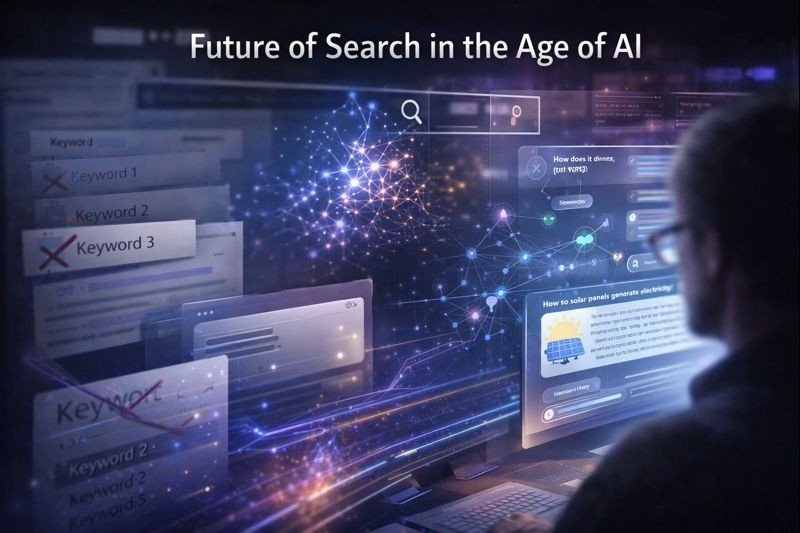
Introduction: Beyond the Buzzwords
If it feels like the entire internet woke up one day and started every sentence with "AI," you're not alone. Marketers are overwhelmed by a daily wave of hype, half-baked hacks, and promises that generative AI will either 10x your productivity or take your job entirely. The confusion is understandable.
This article cuts through the noise. It provides a clear-eyed look at the fundamental, often counter-intuitive, shifts in how information is found and consumed online. The old rules of SEO are being rewritten, and the changes go far deeper than most realize. It's time to ask a new question: What if the goal of SEO is no longer to get a click?
1. The New Goal: From Clicks to Citations
The most profound change in the AI era is the technical evolution from search engines to answer engines. Traditional search operates on a deterministic ranking model, where content is parsed and displayed in a relatively static list of "10 blue links." In contrast, AI-powered systems like Google's AI Overviews use a probabilistic ranking model, synthesizing direct answers by incorporating reasoning, memory, and dynamic data.
This has supercharged the trend of "zero-click searches," where a user gets their answer directly on the results page without ever visiting a website. Because of this, the key performance indicators (KPIs) for visibility are shifting away from traffic and rankings. The new metrics that matter are "answer share," citations, and brand mentions within AI-generated responses. This is a critical shift: success is no longer about winning a traffic game, but about prevailing in an authority and data-ingestion game where you become the trusted source an AI cites.
2. AI Doesn't Just Match Keywords, It Reasons

While traditional search relied on matching keywords to documents, modern AI models perform complex reasoning to understand intent. They employ a technique called "query fan-out," where a single user question is deconstructed into dozens or even hundreds of related sub-queries. This allows the engine to build a comprehensive, custom corpus of content to formulate its answer.
AI also uses "reasoning chains" to interpret a user's goal, formulate the intermediate steps needed to solve it, and synthesize a coherent answer from multiple sources. This is possible because underlying systems have moved far beyond simple synonyms. For example, Google uses Neural Matching, a "super-synonym system," to understand that "why does my TV look strange" relates to "the soap opera effect." It also uses RankBrain to "relate pages to concepts," even when they don't share the exact keywords. This means that building deep topical authority and covering a subject comprehensively is now far more important than targeting a single keyword on a single page.
Related Insight: Understanding how AI interprets content is just as important as following traditional algorithm updates. See how Google's latest core update in December 2025 further rewards expertise and experience in 5 Key Lessons from Google’s December 2025 Core Update.
3. Your Website Is Now a Database for Machines
Here is a counter-intuitive truth: one of your website's most important audiences is no longer human. Increasingly, a site's primary audience is the AI models that crawl it. To succeed, your website must now function as a well-structured "data hub" for machines.
This requires a focus on "passage-level" or "chunk-level retrieval." AI engines don't rank entire pages; they extract and rank smaller, highly relevant chunks of content to build precise answers. Content must be broken down into formats that are easy for an LLM to quote without losing context, such as scannable sections (H2/H3), bullet lists, tables, and short TL;DR/FAQs. Equally important are machine-readable signals like structured data (schema markup), which help AI engines understand content context, entities, and relationships between concepts.
"Content is judged on how well it supports inference and problem-solving, not just keyword presence."
4. This Isn't Just a "Google Thing"—It's an "Everything" Thing
Optimizing for AI interpretation, known as Artificial Intelligence Optimization (AIO), is a discipline that applies far beyond public web search. It is becoming essential across any sector that relies on structured, machine-readable information.
- In corporate settings, AIO is used to structure internal documents and knowledge bases. This ensures that enterprise AI tools, often built on retrieval-augmented generation (RAG) frameworks, can provide accurate and reliable answers to employees.
- In healthcare, AIO is critical for ensuring AI systems represent providers ethically and accurately. Without it, LLMs might "misattribute qualifications or oversimplify complex offerings." AIO techniques are used to "disambiguate professional designations" and "clarify service boundaries" to prevent dangerous misrepresentations.
- In the legal field, AIO helps structure content that often includes "dense, domain-specific language that can be misinterpreted." In a domain where precision is essential, AIO minimizes ambiguity, which is critical for AI-supported legal research platforms where "hallucinations can carry legal risk."
5. The Line Between Persuasion and Manipulation Is Vanishing
The rise of AI-powered marketing also introduces a new ethical dimension. While persuasion is a normal part of marketing, AI's ability to create hyper-personalized content at scale raises new concerns about where influence ends and manipulation begins.
Techniques like "digital nudging" are used to gently influence consumers toward a desired action. When powered by predictive AI, however, these techniques can "exploit consumer vulnerabilities and potentially override rational decision-making processes." This capability has led to real-world ethical breaches, most famously the Cambridge Analytica scandal, which used detailed user profiles for targeted political advertising and significantly eroded consumer trust. As we get better at optimizing content for machines, we have a greater responsibility to ensure the technology serves human interests ethically and preserves consumer autonomy.
Understand the AI Search Landscape
To fully grasp the opportunities and risks of AI in search, it's crucial to see the bigger picture. Explore the chaotic reality and surprising consequences of Google's AI-driven search shift in our detailed analysis: 5 Shocking Truths About Google's AI Search Chaos.
Conclusion: A New Era of Search
The Ultimate Takeaway
The old SEO playbook is obsolete because the game has fundamentally changed. We have moved from an era of optimizing for discoverability—making content easy to find—to an era of optimizing for interpretability—making content easy for a machine to understand, process, and cite. The new goal is not to win a click, but to become the trusted source for the answer engine. This requires a deeper focus on topical authority, structured data, and ethical responsibility.
This transition leaves us with a critical challenge. As we race to make our content perfectly legible to machines, how do we ensure it still speaks with a human voice?
Need Expert Guidance?
Adapting your strategy for the age of AI requires expert insight. For professional guidance on navigating this new landscape, you can find our location and get in touch.
Find Us on Google Maps