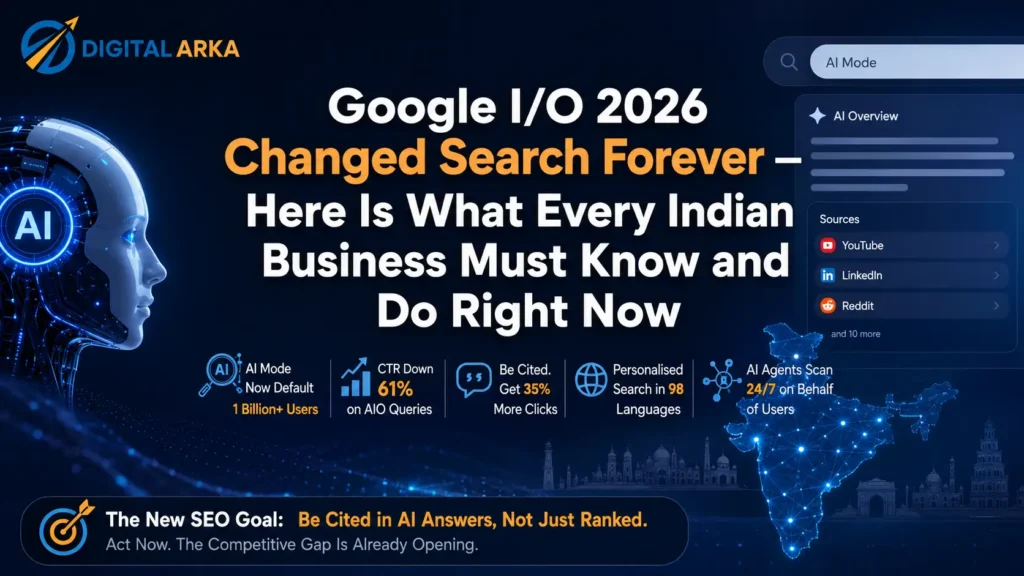

On May 19, 2026, Elizabeth Reid took the stage at Google I/O and made an announcement that the search industry had been anticipating and dreading simultaneously: Google’s AI Mode is now the default search experience for over one billion monthly users. The traditional list of ten blue links — the interface that has defined how people discover businesses online since 1998 — is no longer the primary discovery surface.
This is not a future scenario. It is not a beta test. It is the current state of Google Search in July 2026, and the data that has emerged in the weeks since I/O confirms that the impact on organic traffic is both real and severe — with CTR on AI Overview queries falling 61% — while also revealing something that most coverage missed: the businesses that are cited inside AI answers are actually getting more clicks, not fewer.
Understanding this distinction — the difference between businesses that are visible in the new AI-first search and businesses that are invisible — is the most important strategic question in Indian digital marketing right now. This blog explains exactly what changed, what the data shows, and what Indian businesses of every size need to do before the competitive gap becomes insurmountable.
The central insight from Google I/O 2026: Ranking #1 on Google no longer predicts AI Overview inclusion. Citation overlap between AI Overviews and the organic top-10 has dropped from 76% to between 17% and 54%. Being cited in AI answers is now a separate discipline from traditional SEO — and it is more valuable than a top-10 ranking on the same query.
What Google Actually Announced at I/O 2026
Five announcements from Google I/O 2026 directly and structurally change how businesses are discovered online. Understanding each one is essential context for the strategy that follows.
1. AI Mode Is Now the Default for 1 Billion Users
AI Mode — powered by Gemini 3.5 Flash — generates synthesised answers as the first thing users see when they search. It blends Google’s search index with a conversational AI model, presenting information in synthesised form with citations rather than a ranked list of links. Users can ask follow-up questions, making the interaction conversational rather than transactional.
The scale of adoption is unprecedented. AI Mode went from launch to one billion monthly users in under one year — the fastest adoption of any new Google feature in the company’s history. AI Mode user numbers are doubling every quarter. At this growth rate, AI Mode will be the primary interface for the vast majority of Google’s search volume before the end of 2026.
2. The Search Box Was Redesigned for the First Time in 25 Years
Google redesigned its search interface for the first time since 1998. The new search field expands to accommodate longer, conversational queries. Users can attach images, documents, videos, and Chrome tabs directly to a search — asking questions that reference visual or file context. 16% of AI Mode searches are already multimodal, meaning users are supplying images or documents alongside their text queries.
This is not a cosmetic change. It means the queries entering Google’s system are fundamentally different from anything SEO teams have optimised for. Query lengths have tripled inside AI Mode. Follow-up queries are up 40% monthly in the US. Planning queries are growing 80% faster than overall AI Mode usage. The user who was typing two-word queries into Google Search is now having multi-turn conversations with Gemini.
3. Information Agents Now Scan the Web 24/7 on Behalf of Users
Google launched autonomous Search Agents — AI systems that monitor content continuously on behalf of users across finance, shopping, news, and services. These agents search for, evaluate, and surface content without any user actively searching. A user who told Google’s agent to “monitor the best deals on laptop bags” will receive a proactive notification when the right product appears — without ever typing a search query.
The SEO implication is significant: your content now needs to be discoverable and evaluable by AI agents operating without human intent signals. The traditional keyword-to-page optimisation model assumes a human types a query. Agents have no query — they have an objective.
4. Generative UI Removes the Click Entirely
Google’s Antigravity platform builds interactive dashboards, tables, and mini-apps directly inside search results. A user asking for a comparison of two products may receive a fully functional comparison table — built by Google’s AI from scraped product data — without ever visiting a product page. A user asking for a travel itinerary receives a complete interactive plan without visiting a travel site.
5. Personal Intelligence Expanded to 98 Languages Including Indian Languages
Google’s Personal Intelligence — which uses a user’s search history, Gmail data, and prior engagement to personalise AI responses — expanded to nearly 200 countries and 98 languages, free of charge. For Indian businesses, this means AI responses in Hindi, Tamil, Telugu, Bengali, Marathi, and other Indian languages now reflect personal context alongside keyword relevance. A brand that a user has engaged with before is more likely to surface in their AI responses. This makes first-party data and repeat user engagement a direct SEO variable.
The Data: What Google I/O 2026 Has Already Done to Search Traffic
The statistics emerging from the post-I/O period are the most significant data on organic search performance since the introduction of featured snippets. Here is the complete data picture, with sources:
AI Overviews now appear on 48% of all Google queries (Ahrefs, March 2026) — up from 34.5% in December 2025. A 58% increase in three months.
Organic CTR on AI Overview queries fell from 1.76% to 0.61% at its lowest — a 65% collapse (Seer Interactive). It subsequently rebounded to 2.4% by February 2026 as users adapted.
AI Mode shows 93% zero-click rate. Of all searches conducted in AI Mode, 93% end without a click to any external website (Semrush).
Brands cited inside AI Overviews earn 35% more organic clicks than non-cited brands on the same SERP, and 91% more paid clicks (Seer Interactive).
Citation overlap between AI Overviews and the organic top-10 has dropped to 17–54% depending on query type (various studies, 2026). Ranking #1 gives you, at most, a 54% chance of AIO inclusion — often much lower.
AI Overviews now contain an average of 13.34 sources per response — up from 6.82 in 2024. The pool of potential citations is expanding even as individual click-through from any one citation is declining.
Reddit holds 21% of AIO citations. LinkedIn is the most-cited domain for professional and B2B queries across AI surfaces. YouTube has overtaken Reddit as the most-cited source in LLM answers overall (Adweek, January 2026).
Alphabet Q1 2026 earnings: Google Network revenue (third-party publishers via AdSense/AdMob) fell 4% year-on-year to $6.97B — direct evidence that AI Overviews are reducing publisher click-throughs. Meanwhile Google’s own search revenue grew 19% to $60.4B.
The key insight hidden in this data: AI is not uniformly destroying organic traffic. It is redistributing it toward cited brands. Sites not cited in AI answers lose clicks. Sites cited inside AI Overviews gain clicks — 35% more than uncited competitors on the same SERP. The strategic objective has changed from “rank in the top 10” to “be named in the AI answer.”
What This Means Specifically for Indian Businesses
The global data reveals the pattern. Understanding how it applies specifically to Indian businesses — across categories, cities, and languages — is where the actionable strategy lives.
Category Impact Varies Enormously
AI Overviews are not uniformly distributed across all query types. AI Overviews appear in only about 7% of local searches — meaning searches like “best restaurant near me” or “dentist in Rohini” are largely unaffected. For businesses that depend on local search (clinics, restaurants, salons, home services), the AI Mode disruption is real but limited.
The categories most affected are informational, research-heavy, and comparison queries. A healthcare provider whose website generates traffic from “symptoms of vitamin D deficiency” or “what is the process for GST registration” will see these informational queries absorbed by AI answers. A law firm whose traffic comes from “how to register a company in India” is highly exposed. A real estate company generating traffic from “Noida property market 2026 trends” is at significant risk.
The categories least affected by zero-click search are transactional and local-intent queries: “dentist in Sector 50 Noida,” “best CA firm in Lajpat Nagar,” “buy running shoes online India,” “book hotel in Jaipur walled city.” These queries retain high click-through rates because the user intends to transact, not just get information.
The Hindi and Regional Language Opportunity
Personal Intelligence’s expansion to 98 languages including Indian languages creates a specific opportunity that is not yet widely understood. AI responses in Hindi, Tamil, and Telugu now reflect personal context — meaning a brand that has had previous engagement with a user in their regional language is more likely to surface in their AI responses.
This reinforces the vernacular content strategy we have been recommending throughout 2026: businesses with genuine Hindi, Tamil, Telugu, Bengali, and Marathi content are more likely to be cited in AI responses for users searching in those languages. This is a competitive advantage that is currently captured by almost no Indian business outside of media companies.
YouTube and LinkedIn Are Now SEO Channels
The citation source data from AI Overviews is one of the most strategically important — and most frequently overlooked — findings from July 2026. YouTube is now the most-cited source in LLM answers overall. LinkedIn is the most-cited domain for professional and B2B queries across AI surfaces. Reddit holds 21% of AIO citations.
For Indian businesses, this has a direct implication: YouTube videos and LinkedIn posts are now SEO assets, not just social media content. A coaching institute’s YouTube channel covering JEE topics is now a potential AI citation source for JEE-related queries. A Delhi CA firm’s LinkedIn articles about GST compliance are potential AI citation sources for business compliance queries. Building these off-site content presences is no longer optional for businesses serious about AI-era search visibility.
The New SEO Objective: Earn Citation, Not Just Ranking
The strategic shift that Google I/O 2026 demands is not incremental. It is a redefinition of the primary objective of SEO activity. Here is what the new objective looks like in practice:
Old Objective: Rank in the Top 10 for Target Keywords
Under the old model, the primary measure of SEO success was position in the organic list. Page 1 visibility was the goal because most users clicked results in positions 1–5. Achieving top-10 positions for target keywords was the SEO team’s primary deliverable.
In July 2026, this objective is necessary but no longer sufficient. Citation overlap between AI Overviews and the organic top-10 has dropped to 17–54%, meaning a significant proportion of AI citations come from pages that are NOT in the organic top 10. The inverse is also true: many top-10 ranked pages are NOT being cited in AI Overviews. Ranking and citation are now two separate performance dimensions.
New Objective: Earn Citation in AI Surfaces on Your Priority Queries
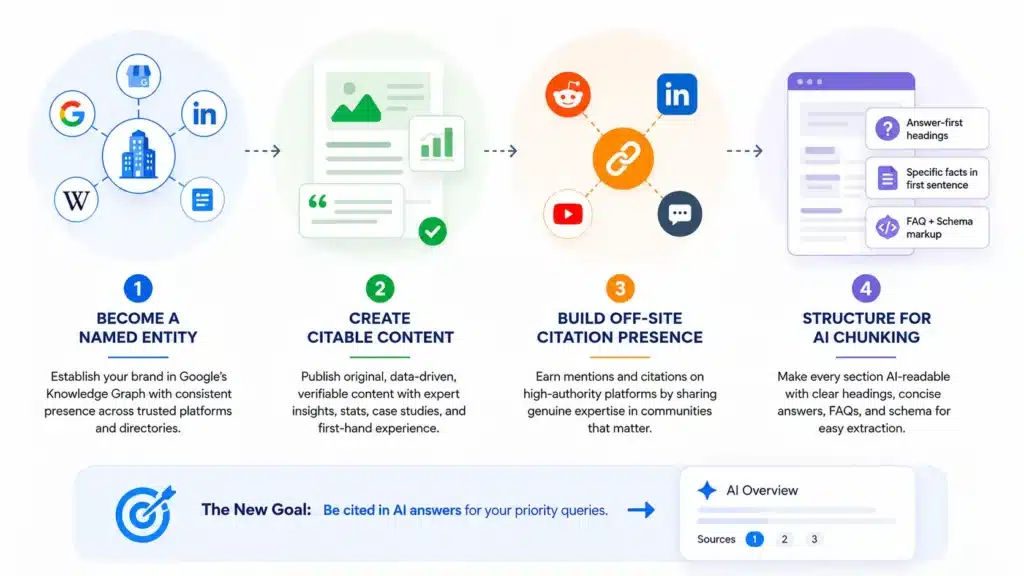
The new primary objective is for your brand to be named — cited as a credible source — in the AI-generated answers for the queries your potential customers are using. This requires a different set of activities from traditional keyword ranking optimisation:
- Become a named entity: Your business must be a clearly defined entity in Google’s Knowledge Graph — with consistent naming, Organisation schema, and entity presence across your website, Google Business Profile, LinkedIn, Wikipedia (if applicable), and credible third-party directories
- Create citable content: Every piece of content should contain specific, verifiable, original facts or data that an AI system would want to cite as evidence. Generic explanations are not cited. Original statistics, specific case study outcomes, named expert analysis, and first-hand experience data are cited.
- Build off-site citation presence: Reddit, LinkedIn, YouTube, and niche forum communities are now primary AI citation sources. Contributing genuine expert knowledge on these platforms — not spam, not promotional content, but genuine knowledge — creates citation opportunities outside your own website
- Structure for AI chunking: Every page section must be independently extractable. Answer-first headings, specific facts in the first sentence of each section, FAQ architecture, and FAQ schema markup make your content AI-readable at the chunk level
A Practical Action Plan for Indian Businesses: The Next 90 Days
Given the scale of the change and the urgency of the competitive window, here is a prioritised 90-day action plan calibrated for Indian businesses:
Days 1–30: Measure Your Current AI Visibility
- Open Google Search Console and check your AI performance report (available since June 2026). Identify which pages are receiving AI Overview impressions and which are completely absent from AI surfaces.
- Segment your top 50 organic queries into three buckets: informational (how/what/why queries — highest AI exposure), transactional (buy/hire/book/price queries — lowest AI exposure), and local (city/near me queries — mostly unaffected by AI Mode). This tells you where your current traffic risk is concentrated.
- Search your top 10 most important queries in Google and observe whether an AI Overview appears. If it does, are you cited in it? If competitors are cited and you are not, you have an explicit citation gap to address.
- Check your YouTube channel and LinkedIn company page. Are they publishing content on your primary service topics? If not, these are now SEO gaps, not just social media gaps.
Days 30–60: Build the Citation Foundation
- Implement Organisation schema on your homepage with complete entity data — name, URL, logo, address, phone, social profile links, and sameAs links to authoritative directories. This is the machine-readable identity declaration that Google’s AI systems use to verify your brand as a credible entity.
- Add FAQ sections with FAQPage schema to your top 10 service and product pages. Write each FAQ question in the natural language your customers actually use, not keyword-optimised headings. Each answer should be 40–80 words — complete enough to stand alone but concise enough to be extracted.
- Restructure the top 5 highest-traffic pages for AI chunking: convert vague section headings to specific answerable questions, move the answer to the first sentence after each heading, add specific statistics or case study outcomes, and include named expert attribution for all claimed expertise.
- Publish three original data pieces: customer survey results, internal case study with specific outcome numbers, or market observation with India-specific data. These are your most powerful citation magnets.
Days 60–90: Expand Off-Site Citation Presence
- Begin a systematic LinkedIn content programme. For B2B businesses, publish one expert insight post per week on your primary service topic. Tag relevant industry terms, link to your original research, and engage with comments. LinkedIn is the most-cited domain for B2B queries across AI surfaces.
- Create 2 YouTube videos addressing the most commonly asked questions in your industry. Even basic production quality is sufficient — the content’s substantiveness matters more than production value. Embed these videos on your corresponding service pages.
- Identify 3 credible Indian industry publications and pitch one expert contribution each. A genuine expert article in Economic Times SME, YourStory, or a sector-specific publication earns an editorial link and builds entity authority simultaneously.
- Set up brand mention alerts (Google Alerts, Mention.com). Convert every unlinked brand mention to a linked citation with a single polite email to the publisher. Your easiest AI citation expansion comes from making your existing mentions machine-readable through links.
The Bottom Line: The Window Is Open but Closing
Google I/O 2026 did not start the shift to AI-first search. It confirmed it, accelerated it, and removed any remaining argument for waiting. The businesses that respond to this shift in the next 90 days — building entity clarity, citation-worthy content, and off-site AI presence on YouTube and LinkedIn — will compound their advantage through the rest of 2026.
The businesses that continue optimising for keyword rankings without building AI citation presence will increasingly find themselves in a position where they rank in the top 10 but receive a fraction of the traffic they once did — because the AI answer above their listing has already satisfied the user’s query.
The new SEO success statement for Indian businesses in July 2026 is not “we rank #1 for our keywords.” It is “we are cited in the AI answer for our priority queries.” That is the standard that drives brand authority, leads, and revenue in the era of AI-first search.
Brands cited inside AI Overviews earn 35% more organic clicks than uncited competitors on the same page. 91% more paid clicks. The AI answer is not the end of your visibility — it is the beginning of a new, higher-quality visibility channel. The question is only whether your brand is in it.
DigitalArka helps Indian businesses build AI Overview citation presence alongside traditional SEO. Get a free AI visibility audit at digitalarka.com