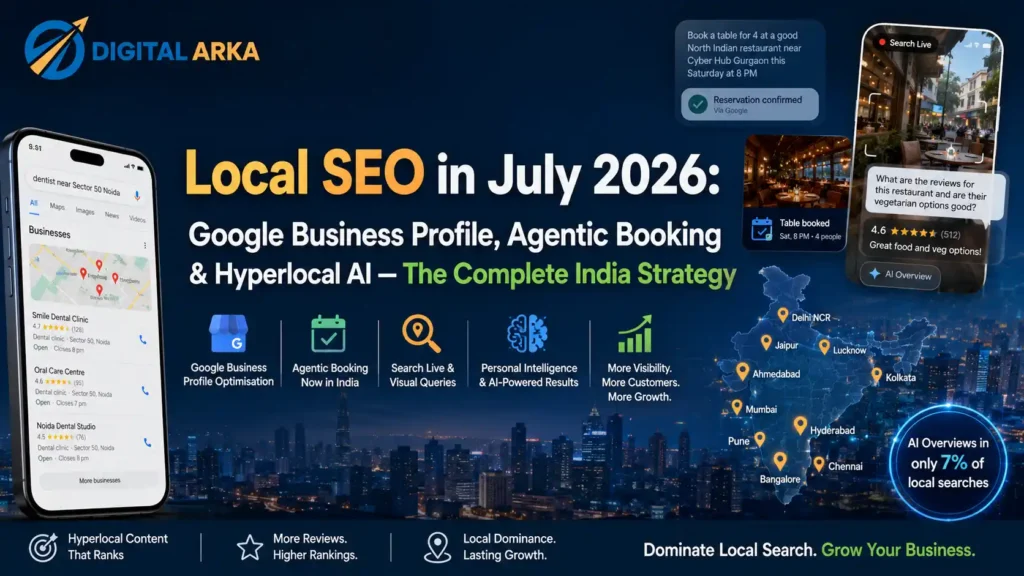

While most of the SEO conversation in July 2026 has focused on AI Overviews, zero-click search, and the collapse of informational traffic, there is a counterintuitive data point that deserves far more attention than it is receiving: AI Overviews appear in only about 7% of local searches.
That is the number every Indian local business needs to understand. The AI search disruption that is driving 34–65% organic CTR collapses on informational queries is, by and large, not happening in local search. When someone searches “dentist near Sector 50 Noida,” “best biryani restaurant open now in Kondapur,” or “CA firm in Lajpat Nagar,” they see a local pack with a map and three business listings — not an AI Overview that answers their question before they click.
This makes local SEO the most resilient SEO channel available to Indian businesses in July 2026. While content marketers and publishers are grappling with traffic losses from AI absorption, local businesses that invest in Google Business Profile optimisation, citation consistency, review acquisition, and local content are in one of the few corners of SEO where the fundamental channel mechanics have not been disrupted.
At the same time, local search is not standing still. Google has expanded agentic restaurant booking to India. Search Live is enabling real-world visual local queries. Personal Intelligence is personalising local results based on user history. AI Overviews in local searches — while rare — are 100% tailored to the searcher’s specific location and personal context. The local SEO landscape in July 2026 is more valuable, more complex, and more full of opportunity than it has ever been.
The most important local SEO fact in July 2026: AI Overviews appear in only 7% of local searches. This means local search retains near-full click-through rates in an environment where informational search has lost 34–65% of clicks. Local SEO is the highest-ROI SEO investment available to most Indian businesses right now.
The July 2026 Local Search Landscape: What Is New and What Has Changed
Agentic Booking Has Arrived in India
One of the most significant July 2026 local search developments for Indian businesses is Google’s expansion of agentic restaurant booking to India — alongside Australia, Canada, Hong Kong, New Zealand, Singapore, South Africa, and the UK. This means Google’s AI agents can now complete restaurant reservations in India on behalf of users, directly from voice or text queries, without the user visiting the restaurant’s website.
A user who says to Google “book me a table for 4 at a good North Indian restaurant near Cyber Hub Gurgaon this Saturday at 8 PM” receives a synthesised recommendation and, for restaurants with compatible booking integrations, the AI agent completes the reservation autonomously. The restaurant never appears in the user’s browser history. The user never visits the website. The booking happens through Google’s intermediary layer.
For Indian restaurants that are already Google Business Profile verified with booking integration, this is significant new footfall. For restaurants without GBP booking setup, it is a channel that is completely invisible to them. The competitive gap between businesses with complete, integrated GBPs and those without one is widening faster in July 2026 than at any previous point in GBP’s history.
Search Live Enables Real-Time Visual Local Queries
Google Search Live — voice + live camera, now expanding to 200+ countries — is introducing a category of local query that has no text search equivalent. A user walking through Connaught Place can point their camera at a restaurant’s menu board and ask Google “what are the reviews for this restaurant and are their vegetarian options good?” A shopper in T. Nagar can point their camera at a fabric and ask “is there a store nearby that sells this type of material at a lower price?”
These real-world visual local queries are answered from a combination of GBP data, website content, and Google’s visual understanding AI. Businesses with comprehensive GBP listings, rich photo collections, complete menu or service information, and high-quality website content are significantly more likely to be surfaced in Search Live responses to visual local queries about their category.
Personal Intelligence Makes Local Results Personal
Google’s Personal Intelligence — now available in 98 languages including Indian languages — personalises local search results based on a user’s prior engagement history. A brand that a user has previously visited, reviewed, or engaged with is more likely to appear in their personalised local results, even in a geographically competitive market where multiple competitors are equally optimised for the same local query.
For Indian businesses, this creates a compounding effect: the first visit a customer makes based on local SEO visibility leads to a review or engagement, which then improves the probability of that customer returning and of similar customers finding the business. Local SEO is no longer purely a discovery channel — it feeds into a personalisation loop that compounds over time.
Google Business Profile Optimisation in July 2026: The Complete Playbook
The Google Business Profile remains the single most impactful local SEO asset for Indian businesses — and the majority of Indian GBPs remain significantly underoptimised. Here is the complete July 2026 GBP optimisation playbook:
1. Primary and Secondary Category Selection
Category selection is the most commonly underoptimised element of Indian GBPs. Your primary category is the most important signal Google uses to determine which local queries your business is eligible to appear for. Selecting “Restaurant” when you should select “North Indian Restaurant” or “Biryani Restaurant” reduces your visibility for the specific queries your actual customers use.
Secondary categories allow you to capture additional query eligibility. A clinic can be both “Medical Clinic” (primary) and “General Practitioner” and “Paediatric Clinic” (secondary). A coaching institute can be “Tutoring Service” (primary) and “Test Preparation Center” and “Educational Institution” (secondary). Review the complete Google Business category list and select every category that legitimately applies to your business — Google allows up to 10 secondary categories.
2. Business Description Optimised for Local Voice Queries
The GBP business description (750 characters) should be written in the natural conversational language that describes your business the way your best customers would describe it. Do not write a marketing statement. Write an answer to the voice query “what is [Business Name] and what is it best for?”
A dental clinic in Pitampura Delhi: “Dr. Kapoor’s Dental Clinic in Pitampura Delhi provides general dentistry, cosmetic dental treatments, and orthodontic services. We are open Monday to Saturday 10 AM to 8 PM, and on Sundays 10 AM to 2 PM. We accept cashless insurance from major providers including Mediassist and Star Health. Located 200 metres from Pitampura Metro Station.” Every sentence answers a common voice query.
3. Google Business Profile Q&A: Your Voice Search Asset
The GBP Q&A section is the most underused feature in Indian local SEO — and one of the most valuable for voice search. Google allows both businesses and users to post questions and answers. The Q&A section appears in local pack results and is directly surfaced in voice search responses.
Every Indian business should proactively add the 10 most commonly asked questions about their business — with complete, specific answers. For a coaching institute: “What JEE ranks have your students achieved in the last 3 years?” For a clinic: “Do you accept walk-in patients or is advance appointment mandatory?” For a restaurant: “Is there parking available nearby and is it paid or free?” These are the exact voice queries Indian consumers use.
4. Photo Strategy for Visual Local Search
GBP photos are now both trust signals and visual search assets. Businesses with 10+ high-quality, regularly updated photos get significantly more map views and direction requests than those with 3–4 photos or outdated images.
The complete GBP photo strategy for Indian businesses in July 2026:
- Exterior photos in daylight: showing the entrance, sign, and surrounding context clearly — these are used in visual local queries where users are trying to identify your location
- Interior photos: showing your actual working environment — clinic consultation room, coaching classroom, restaurant dining area, salon treatment room
- Team photos: named staff members in professional context — doctor profile shots, coaching faculty photos, restaurant chef photos
- Product or service in action: food being prepared and served, medical procedure being explained to a patient, coaching session in progress — authentic process images
- Menu/price list photos: restaurants and service businesses should upload clear, legible menu or price list photos — these are directly used in queries asking about pricing
5. Google Posts for Freshness and Topical Signals
Google Posts — short content updates published directly in GBP — signal active business management and provide freshness signals that influence local pack ranking. In July 2026, weekly Google Posts have become a meaningful local ranking signal — particularly for competitive local markets where multiple businesses are equally optimised on traditional GBP factors.
For Indian businesses, the most effective Google Post types are: offer announcements (discounts, seasonal packages, festival promotions), event announcements (open days, health camps, demos), product/service highlights (new services, featured courses, seasonal dishes), and direct CTA posts that link to booking or enquiry forms.
Local Citation Building for India: The 2026 Standard
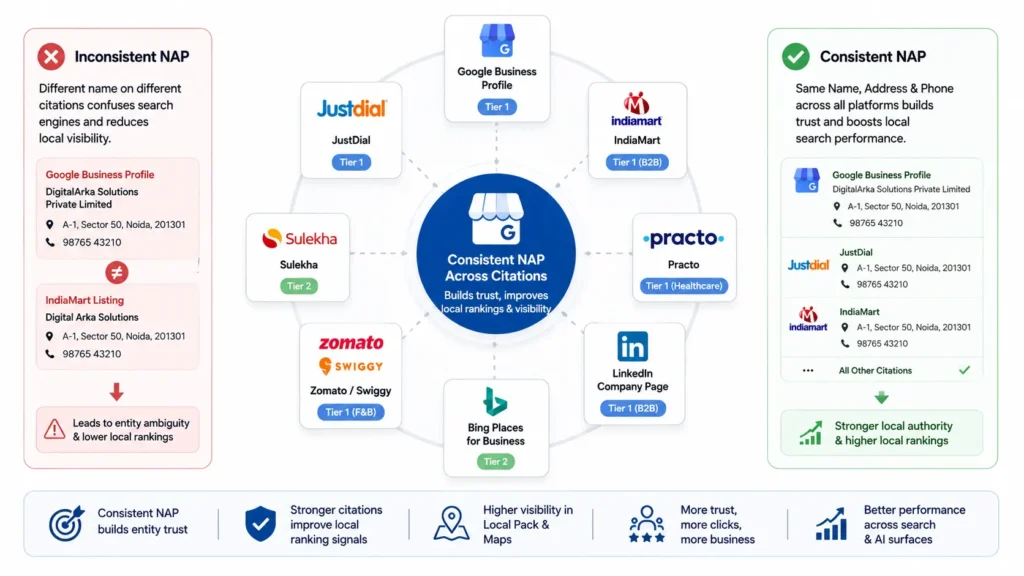
Local citations — mentions of your business name, address, and phone number (NAP) across the web — remain a foundational local ranking signal in July 2026. The citation consistency requirement has become more important, not less, because Google’s AI systems now parse entity data from multiple sources to verify a business’s identity, legitimacy, and location accuracy.
An inconsistency between your GBP name (“DigitalArka Solutions Private Limited”) and your IndiaMart listing (“Digital Arka Solutions”) signals entity ambiguity to Google’s systems — which reduces your local ranking trust score and can suppress local pack visibility.
The Priority Citation Stack for Indian Businesses
Not all citation sources are equal. Here is the priority citation stack for Indian businesses in July 2026, ordered by authority and local signal strength:
- Google Business Profile (Tier 1) — the most authoritative local signal source; must be verified, complete, and consistent with all other citations
- JustDial (Tier 1) — India’s largest local business directory; extremely high authority for Indian local search; NAP must match GBP exactly
- IndiaMart (Tier 1 for B2B) — primary B2B local signal source; critical for manufacturers, suppliers, and professional services
- Sulekha (Tier 2) — significant authority for service businesses, home services, and professionals across Indian cities
- Practo (Tier 1 for Healthcare) — the authoritative citation source for clinics, hospitals, and healthcare professionals; also functions as a patient review platform
- Zomato/Swiggy (Tier 1 for F&B) — restaurant presence and review volume on Zomato directly influences Google local pack rankings for food queries
- LinkedIn Company Page (Tier 1 for B2B) — LinkedIn is the most-cited source for professional B2B queries across AI surfaces; exact business name, address, and description must match GBP
- Bing Places for Business (Tier 2) — Bing’s local search is used by a non-trivial minority of Indian users; free verification, direct GBP import available
Google Review Strategy in July 2026: Volume, Velocity, and Response Rate
Google reviews are the local ranking factor with the most direct and measurable impact on local pack position — and the one most Indian businesses systematically neglect.
The review performance metrics that matter for local pack ranking in July 2026:
- Total review count: businesses with 50+ reviews significantly outperform those with fewer than 20 in competitive local categories
- Review recency: Google weights recent reviews more heavily than older ones; a business with 10 reviews from the past 3 months outperforms a business with 50 reviews from 2023
- Average star rating: 4.5+ is the threshold for competitive visibility in most Indian local search categories; below 4.0 significantly suppresses local pack eligibility
- Response rate: businesses that respond to every review — including negative ones — signal active management and earn ranking preference over non-responding businesses
- Review content quality: reviews that mention specific services, staff names, and location signals are weighted more heavily than generic “great place” reviews
Building a Systematic Review Acquisition Strategy
Most Indian businesses that have weak review profiles are not receiving bad service — they are simply not asking for reviews. The businesses with 100+ reviews are not better than those with 10 reviews; they have a systematic process for requesting reviews from every satisfied customer.
The three-channel review acquisition system that works in India:
- WhatsApp follow-up: 24 hours after service delivery, send a WhatsApp message to the customer: “[Name], thank you for visiting us today. If you were happy with [specific service], would you be able to leave us a quick Google review? It would help us a great deal.” Include a direct link to your GBP review form. Response rates are 20–30% for WhatsApp review requests vs under 5% for email.
- QR code at point of service: A printed QR code linking directly to your Google review page, placed at the reception desk, payment counter, or exit area. Simple instruction: “Liked your experience? Scan to leave a Google review.” Easy to implement, passive, and consistently generates reviews from engaged customers.
- Staff training and incentivisation: Train front-line staff to verbally mention the review request at natural conversation moments (“If you’re happy with today’s session, we’d really appreciate a Google review — it takes only 2 minutes and helps other students find us.”). Identify one team member as the “review champion” responsible for tracking weekly review acquisition targets.
Hyperlocal Content: Building Neighbourhood-Level SEO Authority
The final dimension of local SEO that most Indian businesses overlook is hyperlocal content — content that demonstrates genuine knowledge of the specific neighbourhood, city area, or locality your business serves. In July 2026, hyperlocal content serves two purposes simultaneously: it builds traditional local organic rankings for neighbourhood-specific queries, and it provides the locally-specific content that AI systems preferentially cite in personalised local search responses.
What Hyperlocal Content Looks Like for Indian Businesses
Hyperlocal content is not just mentioning your city in a service page. It is content that only makes sense if you are a genuine local presence — content that demonstrates actual knowledge of the neighbourhood, its residents, its infrastructure, and its specific characteristics.
Examples of genuine hyperlocal content for Indian businesses:
- A JEE coaching institute in Sector 50 Noida: “Why Students from Sector 100, 110, and Noida Expressway Choose Our Sector 50 Centre” — covering transport access, residential proximity, and area-specific parent concerns
- A restaurant in Indiranagar Bangalore: “The Complete Guide to Dining in Indiranagar: What’s Near Our Restaurant and How to Spend an Evening in the Area” — placing the restaurant in genuine neighbourhood context
- A dental clinic in Pitampura Delhi: “Dental Care Near Pitampura Metro Station: How Patients from Rohini, Shalimar Bagh, and Kohat Enclave Reach Our Clinic” — covering local transport and catchment area specifics that genuine local patients search for
- An auto component manufacturer in Ballabhgarh Faridabad: “Sourcing Auto Components from Ballabhgarh: Delivery Timelines to NCR, Gurgaon, and Pan-India” — covering the location-specific logistics that procurement teams in neighbouring areas search for
Neighbourhood Landing Pages for Multi-Area Businesses
For businesses serving multiple areas, neighbourhoods, or sectors within a city, separate location-specific landing pages are the most effective way to build hyperlocal ranking depth. Each neighbourhood page should have content unique to that area — not a template with the location name replaced.
The minimum viable neighbourhood page in July 2026 contains: the specific address and Google Maps embed for that location, opening hours and contact information specific to that branch, a unique description of what makes that branch distinctive (specialist staff, specialist services offered at that location only, parking/transport access), genuine patient/client/customer testimonials that mention the specific area, and hyperlocal FAQ content addressing questions specific to that neighbourhood’s audience.
The Bottom Line: Local SEO Is the Highest-ROI SEO Investment in July 2026
In an SEO environment where informational traffic is being absorbed by AI Overviews, where organic CTR is declining across keyword categories, and where the measurement framework is being fundamentally rewritten — local SEO stands out as the channel that has been least disrupted and most immediately valuable.
AI Overviews appear in only 7% of local searches. Local pack results retain near-full click-through rates. Agentic booking is creating new conversion channels for businesses with complete GBPs. Search Live is enabling real-world visual local queries that surface GBP-rich businesses. And Personal Intelligence is building a personalisation loop that compounds the advantage of businesses that earn positive first interactions with local customers.
For Indian businesses, the local SEO opportunity in July 2026 is unprecedented. The majority of competitors remain significantly underoptimised on GBP, citations, reviews, and hyperlocal content. The businesses that invest in this channel now — building complete GBPs, systematic review acquisition, citation consistency, and genuine hyperlocal content — will establish dominant local search positions that will be extremely difficult for late-moving competitors to displace.
The local search advantage compounds. Every review earned this month improves next month’s local ranking. Every GBP Q&A answer published this week is answering a voice query next week. Every neighbourhood page published today is earning hyperlocal citations and rankings next quarter. Start now, before your competitors do.
The most defensible competitive advantage in Indian SEO in July 2026 is local search dominance. It is unaffected by AI zero-click disruption, it is compounding in value through agentic and Search Live developments, and it is underinvested by the vast majority of Indian businesses. The window to establish dominant local positions is open now — but it will not stay open indefinitely.
DigitalArka builds local SEO dominance for Indian businesses across 12 cities. Get a free local SEO audit at digitalarka.com