

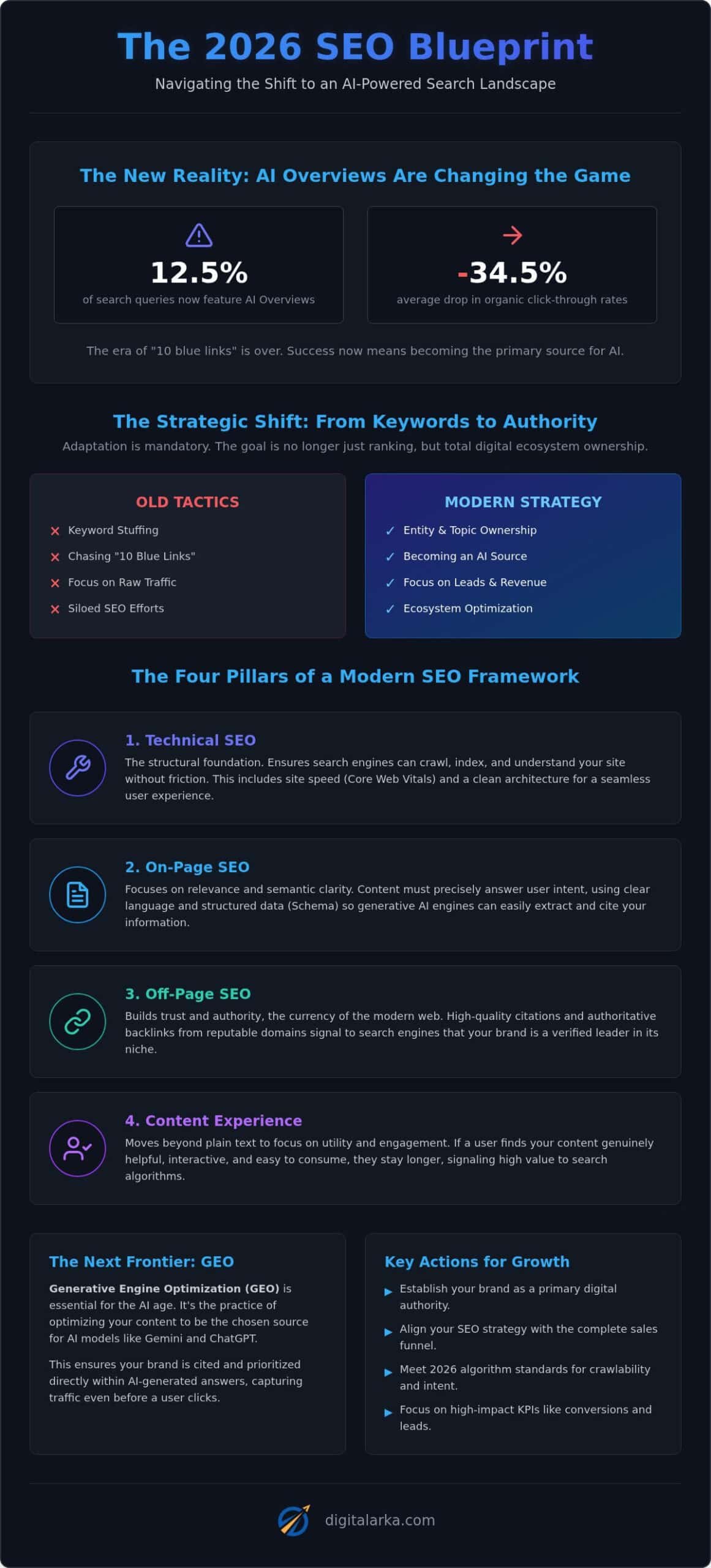
With AI Overviews now appearing in up to 12.5% of queries and slashing organic click-through rates by an average of 34.5%, the era of ranking for 10 blue links is officially over. You’ve likely noticed that traditional tactics are no longer enough to maintain visibility in the competitive Indian digital market. It’s frustrating to watch hard-earned traffic dip because a generative summary answered the user’s question before they even saw your link. Adapting your seo strategy is no longer optional; it’s a requirement for survival in a search landscape that rewards authority over simple keyword matching.
We’ll help you master a blueprint for sustainable organic growth that turns these technological shifts into a competitive advantage. This guide provides the practical steps to evolve from basic optimization to comprehensive entity ownership. You’ll learn how to leverage the composite Core Web Vitals scores introduced in the March 2026 update and use the latest Search Console platform properties to track performance across social channels. We’re here to show you how to dominate local search in Delhi and future-proof your brand against any algorithm changes the year brings.
Key Takeaways
- Transition from traditional search to ecosystem optimization to establish your brand as a primary digital authority in the AI era.
- Implement Generative Engine Optimization (GEO) to ensure your content is cited and prioritized by AI models like ChatGPT and Gemini.
- Build a robust seo strategy that aligns with the Indian sales funnel, moving users from initial discovery to high-intent conversions.
- Prioritize technical foundations and on-page clarity to meet the latest 2026 algorithm standards for crawlability and user intent.
- Scale your growth through data-driven monthly management, focusing on high-impact KPIs like conversion rates and organic lead generation.
Defining SEO Strategy in the 2026 Search Landscape
An effective seo strategy in 2026 is no longer just a checklist of technical fixes or a collection of keywords. It’s a comprehensive blueprint designed to establish digital authority and, more importantly, drive measurable revenue. We’ve moved beyond the traditional boundaries of Search Engine Optimization (SEO). Today, we practice “Ecosystem Optimization.” This shift acknowledges that your brand must be visible across a variety of surfaces, from traditional search results to AI-driven summaries and platform-specific discovery engines. Success is now measured by how well you own your niche across the entire digital ecosystem.
The introduction of the Search Generative Experience (SGE) has fundamentally altered user behavior in India and across the globe. Instead of clicking through multiple links, users often find their answers directly within AI-generated overviews. This means your goal isn’t just to rank; it’s to be the source that the AI trusts and cites. If your strategy still prioritizes vanity metrics like raw traffic over business outcomes like qualified leads and conversion rates, you’re building on a fragile foundation. A modern approach focuses on the practical benefits of digital transformation, ensuring every piece of content serves a specific stage in the buyer’s journey.
The Evolution of Search: Keywords vs. Entities
Google’s algorithms now prioritize “entities” over simple keyword strings. In 2026, the search engine understands concepts, brands, and the relationships between them through the Knowledge Graph. It doesn’t just see “best SEO agency in Delhi”; it sees your brand as a verified entity with specific expertise and a history of performance. This shift requires a more sophisticated content model that emphasizes topical depth rather than just high search volume. To define your brand as an entity, you must ensure your Schema markup is robust and your brand mentions across the web are consistent. Mapping your content to specific “topics” rather than individual keywords signals deep expertise to the Knowledge Graph and builds long-term sustainability.
Why a Documented Strategy is Non-Negotiable
Relying on a loose collection of tactics is a recipe for failure when algorithm updates hit. A documented seo strategy ensures that every team member, from content creators to web developers, is aligned with the same growth objectives. It provides a framework for resource allocation, ensuring you don’t waste budget on “tactic chasing” every time a new AI feature rolls out. Research consistently shows a direct correlation between documented strategies and higher marketing ROI. By sticking to a structured plan, you maintain a steady hand while competitors scramble to react to updates like the June 2026 Spam Update or the March 2026 Core Update. A documented plan prevents panic and keeps your efforts focused on predictable monthly traffic growth.
A professional strategy acts as a North Star for your business. It turns your digital presence into a predictable engine for lead generation, providing a clear path from your current state to a more successful, digitally optimized future. Whether you are a Delhi startup or an established enterprise, having a clear roadmap is the only way to scale effectively in the AI era.
The Four Pillars of a Modern SEO Framework
Building a resilient seo strategy requires more than just high-quality writing. It demands a balanced approach across four distinct pillars that ensure your brand is accessible, relevant, and trustworthy. These pillars work together to create a digital presence that search engines can easily interpret and users find genuinely valuable. Without structural integrity in each area, your organic growth will remain stagnant regardless of how much content you produce.
- Technical SEO: This is your structural foundation. It ensures that search engines can crawl, index, and understand your site without friction. It also encompasses the user experience, focusing on how quickly and efficiently a page loads.
- On-Page SEO: Optimization here focuses on relevance and semantic clarity. In the era of AI overviews, your content must answer user intent so precisely that generative engines can easily extract and cite your data.
- Off-Page SEO: Trust is the currency of the web. High-quality citations and authoritative backlinks from reputable Indian domains signal to search engines that your brand is a verified leader in its niche.
- Content Experience: Modern SEO goes beyond the text. It focuses on utility and engagement. If a user finds your page helpful and stays to interact with it, search engines receive a strong signal of quality.
Technical Excellence and Core Web Vitals
By 2026, Google’s performance standards have evolved to use a holistic Core Web Vitals score. This composite metric aggregates Largest Contentful Paint (LCP), Interaction to Next Paint (INP), and Cumulative Layout Shift (CLS) into a single, high-stakes performance indicator. Site speed and mobile responsiveness are no longer optional features. They’re entry requirements. Implementing Schema Markup (JSON-LD) is equally essential. It helps search engines understand the context of your data, leading to rich snippets and higher visibility in AI-generated answers. A high-performance custom website development in Delhi that meets these architectural standards is the foundation upon which every other SEO effort is built. If you’re noticing a sudden drop in visibility, fixing Google search ranking issues quickly often begins with identifying and resolving these technical bottlenecks.
E-E-A-T: The Gold Standard for Content
Google’s focus on Experience, Expertise, Authoritativeness, and Trustworthiness (E-E-A-T) has intensified to combat the flood of low-quality AI content. To stand out, you must demonstrate first-hand experience. Don’t just write about a topic. Show how you’ve solved specific problems for clients in Delhi or across India. Showcasing experience involves including original photos, case studies with real-world data, and personal insights that AI cannot replicate. Verified author credentials and detailed bios are now mandatory for high-stakes topics. This level of transparency builds the trust necessary to convert a casual visitor into a loyal customer. It’s about proving you’re a real expert in a digital world full of automated voices.
Generative Engine Optimization (GEO): SEO for the AI Age
Generative Engine Optimization, or GEO, represents the next phase in the evolution of your seo strategy. While traditional methods focus on securing a spot in the “10 blue links,” GEO focuses on ensuring your brand is the primary source cited by AI models like ChatGPT, Gemini, and Google’s AI Overviews. These engines don’t just list websites; they synthesize information into a single, conversational answer. To stay relevant, your content must be structured in a way that these models can easily extract, understand, and attribute to your brand.
AI models cite sources that they perceive as “Seen and Trusted.” This framework requires your content to be technically accessible to crawlers while maintaining the high level of authority we discussed in the previous section on E-E-A-T. Winning an AI citation isn’t about keyword density. It’s about being the most helpful and factually accurate resource available. To make your content AI-friendly, follow this checklist:
- Use Schema Markup to define entities and relationships clearly.
- Make direct, authoritative claims early in your paragraphs.
- Incorporate unique data or original research that AI cannot find elsewhere.
- Ensure your brand is mentioned positively across third-party platforms.
Traditional SEO vs. GEO
The fundamental difference lies in the ranking signals. Traditional SEO relies heavily on the strength of your backlink profile. In contrast, GEO prioritizes brand citations and mentions across a broader digital ecosystem. We’re seeing a massive shift from “Blue Links” to “Conversational Answers,” where the user often finds their solution without leaving the search page. Because LLMs are trained on human interaction, brand mentions on platforms like Reddit and Quora now carry significant weight. If your brand is frequently recommended in these communities, AI models are more likely to include you in their generated responses.
Winning the AI Overview (SGE) Slot
Securing the AI Overview slot requires an “Answer Engine Optimization” (AEO) mindset. You need to provide direct answers to complex questions using fact-dense sentences. AI summaries favor content that cuts through the fluff and delivers immediate value. For Indian brands, this means creating content that addresses specific local nuances with precision. By publishing original research or unique case studies, you provide the “raw material” that generative engines need. This approach doesn’t just improve your seo strategy; it positions your brand as the definitive authority that even the most advanced AI engines can’t ignore.
Roadmap Execution: Step-by-Step Guide for Indian Brands
Executing a successful seo strategy in India requires a localized approach that accounts for high competitive density and diverse search behaviors. Following a structured roadmap ensures you don’t just generate traffic, but capture high-intent leads ready to convert. This systematic process moves your brand from its current state to a position of digital maturity.
- Step 1: Perform Deep Market Research. Analyze Delhi-based competitors to identify gaps in their content and technical performance.
- Step 2: Map Keywords to the Sales Funnel. Align your content with the Top, Middle, and Bottom of the Funnel (TOFU/MOFU/BOFU) to capture users at every decision point.
- Step 3: Audit for Local SEO. This is essential for businesses in the NCR region to capture high-intent local traffic.
- Step 4: Build a Multi-Channel Content Calendar. Coordinate your blog posts, social updates, and email campaigns to reinforce your SEO efforts.
- Step 5: Execute Ethical Link-Building. Focus on building relationships and securing mentions in reputable Indian publications through strategic PR.
Local SEO Nuances for Delhi and NCR
For businesses operating in the national capital, local visibility is a primary driver of revenue. Optimizing your Google Business Profile (GBP) involves more than just filling out your address. It requires active management, including responding to reviews and posting regular updates that reflect your local expertise. Capturing “near me” queries is vital as mobile search continues to dominate the Indian market. To ensure your business stands out in the map pack, consider professional Local SEO Services in Delhi to handle the technical complexities of citation consistency and local schema implementation.
Keyword Mapping for the Indian Consumer
The Indian search landscape is unique due to the frequent mix of English and regional language patterns. A sophisticated seo strategy must account for how users actually type, often using “Hinglish” or specific local terminology. You need to distinguish between “low cost” intent, where users are looking for deals, and “premium” intent, where quality and reliability are the main drivers. Tools like Semrush or Ahrefs are invaluable for finding high-volume, low-difficulty local gaps that your competitors have overlooked. Focus on these underserved areas to gain quick wins and build initial momentum. If you’re looking to modernize your operations, connect with our SEO specialists today to build a data-driven growth plan.
Measuring Success and Scaling with Digitalarka
A high-performing seo strategy is only as good as the data used to measure it. While rankings and traffic are helpful indicators, they don’t always translate to business growth. To truly scale your operations in the Indian market, you must shift your focus to the KPIs that impact your bottom line: organic leads, conversion rates, and total revenue generated. By tracking these metrics, you move from guessing about your digital presence to making informed, strategic decisions that drive expansion.
Many businesses struggle to choose between one-off project-based SEO and ongoing Monthly SEO Management. While a project-based audit can fix immediate technical issues, search engines reward consistency. Monthly management allows for continuous optimization in response to algorithm updates and competitor shifts. This long-term partnership ensures your brand remains a steady force in the search results, adapting to new trends like Generative Engine Optimization without losing momentum. When your SEO efforts work in synergy with Social Media Optimization (SMO) and Meta ads management services (PPC), you create a multi-layered digital presence that captures market share from every angle.
Beyond Rankings: The ROI of Organic Growth
Calculating the true value of your SEO requires looking at the Lifetime Value (LTV) of an organic lead. Unlike paid traffic, which stops the moment you turn off the budget, organic leads continue to flow from content you’ve already created. This creates a “halo effect” where your established organic authority actually lowers your average Cost Per Click (CPC) in paid campaigns because search engines view your site as more relevant. For businesses looking to dominate their niche, partnering with a professional Lead Generation Agency India ensures that your traffic is not just high in volume, but high in intent and ready for your sales team.
Next Steps: Your 90-Day SEO Action Plan
Success in search isn’t an overnight event; it’s a methodical process. A structured 90-day plan allows you to address technical debt while building the authority needed for long-term visibility. This timeline provides a clear path from your current state to a more successful, digitally optimized future:
- Month 1: Technical Foundation. We perform a deep technical audit and fix critical crawlability issues to ensure your site meets the latest 2026 Core Web Vitals standards.
- Month 2: Content Sprint. We map your content to the sales funnel, producing high-utility assets that answer user intent and satisfy E-E-A-T requirements.
- Month 3: Authority Building. We focus on ethical link-building and securing brand citations across the digital ecosystem to boost your entity’s credibility.
Ready to modernize your digital presence and secure predictable monthly traffic growth? Schedule a Free SEO Audit with Digitalarka Today and let our team of 50 plus professionals build a roadmap tailored to your business goals.
Future-Proof Your Brand with Strategic Search Excellence
The search landscape in 2026 demands a shift from chasing individual keywords to owning your brand entity across the entire digital ecosystem. A modern seo strategy must integrate technical precision, deep E-E-A-T signals, and the emerging discipline of Generative Engine Optimization. By mastering these pillars and following a localized roadmap for the Indian market, you ensure that your brand remains visible and cited as AI summaries change how users find information.
Scaling your organic growth in this environment requires a steady, professional hand. Digitalarka brings over 5 years of experience in the Indian digital landscape to every partnership, supported by a dedicated team of 50 plus SEO and content professionals. We’ve built a proven track record helping Delhi-based startups and global brands navigate these shifts with clarity and results. Success is about building a sustainable asset that generates revenue month after month. It’s time to stop reacting to algorithm changes and start leading your industry with data-driven insights.
Partner with Digitalarka for a Data-Driven SEO Strategy and let’s begin your journey toward digital maturity together.
Frequently Asked Questions
How long does it take to see results from a new SEO strategy in 2026?
You can typically expect to see measurable results from a new seo strategy within three to six months. While technical fixes provide immediate crawlability improvements, building the topical authority required to rank for competitive Indian market terms takes time. Sustainable organic growth is a long term investment that compounds over twelve months as your brand entity becomes more established in the Knowledge Graph.
Is SEO still relevant with the rise of AI search engines?
SEO remains highly relevant because AI search engines still rely on high quality, human centric web content to generate their answers. The focus has shifted from ranking in a list to becoming the primary source that AI models cite. By optimizing for both traditional search and generative engines, you ensure your brand captures traffic regardless of how the user chooses to search.
What is the difference between SEO and GEO (Generative Engine Optimization)?
Traditional SEO focuses on optimizing your website to rank in the standard list of search results. GEO is a newer discipline that ensures your content is understood and cited by generative AI models like Gemini and ChatGPT. While SEO prioritizes keywords and backlinks, GEO emphasizes structured data, factual density, and brand mentions across community platforms like Reddit and Quora.
How much should a small business in Delhi spend on SEO monthly?
Small businesses in Delhi should base their monthly investment on the competitive density of their specific niche and their desired growth velocity. It’s essential to prioritize a model that offers a monthly retainer rather than one off projects. This approach ensures your business has a steady hand to navigate algorithm updates and maintain local search dominance in the NCR region.
Can I do SEO myself, or do I need a professional agency?
You can manage basic on page tasks yourself, but scaling a complex seo strategy in the AI era usually requires professional expertise. Modern search involves advanced technical audits, schema implementation, and multi channel content coordination. Partnering with an agency like Digitalarka provides access to a team of 50 plus professionals who understand the nuances of the Delhi market and the latest generative engine requirements.
What are the most important SEO ranking factors for 2026?
The most critical factors include holistic Core Web Vitals scores, deep E-E-A-T signals, and verified entity authority. Google now prioritizes brands that demonstrate real world experience and maintain high technical performance. Ensuring your site loads efficiently and provides unique, fact dense content is the only way to secure visibility in both traditional results and AI overviews.
How does local SEO differ from a national SEO strategy?
Local SEO focuses on capturing high intent traffic within specific geographic areas through Google Business Profile optimization and local citations. National strategy aims for broader topical authority across the entire country. While national SEO relies on high volume keywords, local search success depends on proximity, review signals, and “near me” query relevance for users in specific cities.
Why is my website traffic dropping despite regular content updates?
Traffic declines often occur when content updates don’t align with recent algorithm changes, such as the March 2026 Core Update or the June 2026 Spam Update. If your content is being replaced by AI Overviews, it may lack the specific data or unique insights that generative engines prioritize. A technical audit is often necessary to identify if the drop is due to performance issues or a shift in search intent. Ensuring your site is built on a high-performance foundation through strategic custom website development in Delhi can resolve many of the underlying architectural issues that contribute to these visibility drops.