
Search no longer ends with ten blue links. A growing share of queries are answered directly on the results page, inside a featured snippet, a voice assistant’s spoken reply, or a “People Also Ask” box, without the searcher ever clicking through to a website. AEO, or Answer Engine Optimization, is the discipline built specifically around winning that space. If your content is technically well-optimised but never appears in these direct-answer formats, you are losing visibility to competitors who understood this shift earlier. Here is exactly what AEO is, how it works, and how to build it into your strategy in 2026.
Definition: What Is AEO?
AEO (Answer Engine Optimization) is the practice of structuring content so that search engines and voice assistants can extract a clear, direct answer from it and present that answer to the user immediately, inside a featured snippet, a voice search response, or an “answer box,” rather than requiring a click through to the source page.
In one line: AEO is SEO built specifically to win the direct-answer formats, snippets, voice replies, and answer boxes, that now sit above traditional search results.
How AEO Is Different From Traditional SEO
Traditional SEO and AEO share the same foundation, technical health, genuine expertise, and clear content, but they optimise toward different outcomes.
- Format over ranking position – traditional SEO chases a high position in the list of ten results; AEO chases being the one answer extracted and displayed directly, which can happen even from a page ranking outside the first three positions.
- Concise, self-contained answers – AEO content needs to answer a question completely within a short passage, since that is the exact unit of text a snippet or voice assistant extracts.
- Question-and-answer structure – AEO content is built around the literal questions people ask, formatted as clear headings followed by direct answers, rather than long, narrative paragraphs.
- Zero-click outcomes – a successful AEO result may never generate a click, since the user gets their answer directly on the results page; success is measured in visibility and brand impression, not just traffic.
Where AEO Actually Shows Up
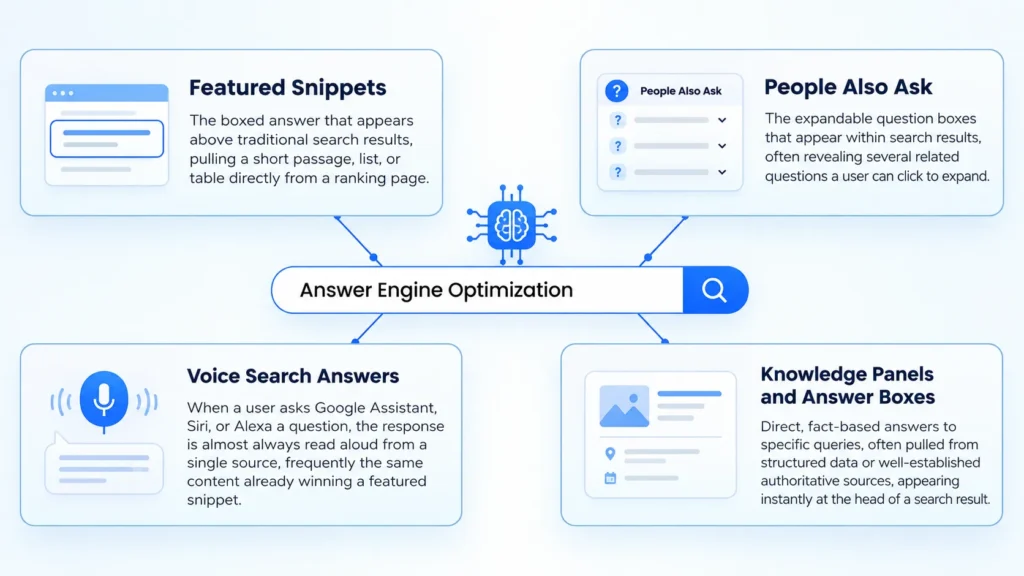
Featured Snippets
The boxed answer that appears above traditional search results, pulling a short passage, list, or table directly from a ranking page. Featured snippets are the single most visible AEO placement and typically capture a disproportionate share of clicks even when they do appear.
People Also Ask
The expandable question boxes that appear within search results, often revealing several related questions a user can click to expand. Ranking here requires content structured around the exact phrasing of common follow-up questions in your topic.
Voice Search Answers
When a user asks Google Assistant, Siri, or Alexa a question, the response is almost always read aloud from a single source, frequently the same content already winning a featured snippet. Voice search has made concise, spoken-friendly answer formatting a genuine ranking consideration, not an afterthought.
Knowledge Panels and Answer Boxes
Direct, fact-based answers to specific queries, often pulled from structured data or well-established authoritative sources, appearing instantly at the head of a search result.
How to Build an AEO Strategy
- Identify question-based keywords – use tools like AnswerThePublic, Google’s “People Also Ask,” and your own customer FAQs to find the exact questions your audience asks.
- Answer the question in the first sentence – lead with a direct, complete answer immediately after the heading, then expand with supporting detail afterward.
- Use clear heading structure – format each question as an H2 or H3, making it easy for both users and algorithms to match the heading to the query.
- Add FAQPage schema – structured data helps search engines identify and accurately extract your question-and-answer content for snippets and voice search.
- Keep answers concise – the ideal snippet answer is typically 40 to 60 words; anything longer risks being only partially extracted or skipped entirely.
- Use lists and tables where appropriate – step-by-step processes and comparison data are extracted into list and table-format snippets more readily than dense prose.
Why AEO Matters for Your Business in 2026
AEO placements sit above traditional organic results, which means winning one gives you visibility even when your traditional ranking position is not yet dominant. For businesses in competitive categories where the leading organic positions are dominated by large, established players, AEO offers a genuine alternative path to visibility, one based on how clearly and completely you answer a specific question, not purely on domain authority accumulated over years.
AEO also increasingly overlaps with a newer discipline: AI SEO, since the same clear, well-structured, question-answering content that wins a featured snippet is exactly the format AI Overviews and chatbots favour when selecting a source to cite. Building AEO into your content strategy today positions you for both today’s search results and tomorrow’s AI-driven ones.
AEO vs SEO vs GEO vs AI SEO: How These Terms Relate
These four terms are used loosely and often interchangeably online, which creates genuine confusion. Here is how they actually relate to one another.
| Discipline | What It Targets | Example Win |
| SEO | Traditional ranking position in organic search results | Ranking #2 for a competitive keyword |
| AEO | Featured snippets, voice answers, People Also Ask boxes | Your answer read aloud by a voice assistant |
| GEO | Citation inside AI-generated answers (AI Overviews, ChatGPT, Perplexity) | Your page cited as a source in an AI Overview |
| AI SEO | The umbrella practice covering AEO and GEO together, built on core SEO | Comprehensive visibility across all search surfaces |
All four disciplines are built on the same foundation, genuine expertise, technical health, and content clarity, which is why a business investing seriously in one should not treat the others as unrelated projects requiring separate strategies.
Real Examples of AEO in Action
Seeing AEO applied to real queries makes the concept concrete.
- Example 1 – a search for “how long does SEO take to show results” typically surfaces a featured snippet quoting a specific timeframe, drawn from content that answered this exact question in a clear, standalone sentence early in the page.
- Example 2 – asking a voice assistant “what is the difference between SEO and PPC” often returns a concise, spoken definition sourced from a page that structured this comparison as a direct, well-formatted answer rather than burying it inside a long narrative.
- Example 3 – a “People Also Ask” box for “is SEO worth it for small businesses” expands to reveal a short, confident answer, again pulled from content that addressed the question head-on rather than hedging across several paragraphs.
How DigitalArka Approaches AEO
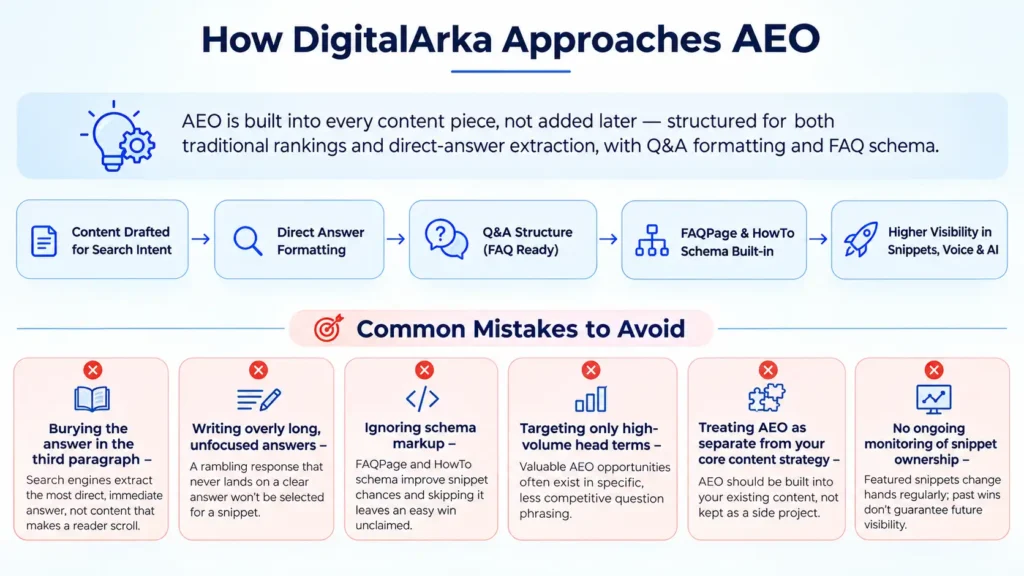
At DigitalArka, AEO is never sold as a disconnected add-on. Every content piece we produce as part of our SEO Agency engagements is structured from the first draft to satisfy both traditional ranking intent and direct-answer extraction, question-and-answer formatting, concise definitional passages, and FAQPage schema built in as standard, not retrofitted after the fact.
For businesses specifically prioritising snippet, voice, and AI citation visibility together, our Full SEO + AEO + GEO Service bundles all three disciplines into one coordinated strategy with pricing starting from Rs. 15,000 per month, since building AEO in isolation from the rest of your search visibility strategy leaves real, compounding value on the table.
- Burying the answer in the third paragraph – search engines and voice assistants extract from the most direct, immediate answer available, not content that makes a reader scroll to find it.
- Writing overly long, unfocused answers – a rambling response that never lands on a clear answer will not be selected for a snippet regardless of how accurate it eventually becomes.
- Ignoring schema markup – FAQPage and HowTo schema significantly improve the odds of a snippet win, and skipping this step leaves an easy win unclaimed.
- Targeting only high-volume head terms – many genuinely valuable AEO opportunities exist in specific, less competitive question phrasing that large competitors have not bothered optimising for.
- Treating AEO as separate from your core content strategy – AEO should be built into your existing content, not maintained as a disconnected side project.
- No ongoing monitoring of snippet ownership – featured snippets change hands regularly as Google re-evaluates sources, and a snippet won six months ago is not guaranteed to still belong to you today.
Conclusion
AEO is not a replacement for SEO; it is the layer of SEO specifically built for a search landscape where the answer often appears before the click. Businesses that structure their content to directly, clearly, and concisely answer the questions their audience actually asks capture visibility that competitors chasing only traditional rankings are leaving on the table. As search continues shifting toward instant answers and AI-generated summaries, AEO is quickly becoming a core, non-optional part of any serious search strategy in 2026.
The businesses that win the most AEO visibility over the next few years will not necessarily be the ones with the biggest content libraries; they will be the ones whose content answers questions with the most clarity, the most precision, and the least friction between the question a user asks and the answer they receive. That is a genuinely achievable standard for a well-run small or mid-sized business to meet, and often more achievable than out-competing an established rival for a dominant traditional ranking
Frequently Asked Questions
AEO stands for Answer Engine Optimization, the practice of structuring content to be extracted and displayed as a direct answer in featured snippets, voice search responses, and answer boxes.
No, though they share the same foundation. SEO optimises for ranking position in a list of results; AEO optimises specifically for being the extracted, direct answer shown above or within those results.
Answer the target question directly and completely within the first sentence or two after a matching heading, keep the answer to roughly 40-60 words, and add FAQPage or HowTo schema markup to help search engines identify the content as a genuine answer.
Yes. Voice assistants typically read aloud the same concise, direct-answer content that wins a featured snippet, making strong AEO content a direct advantage for voice search visibility as well.
AEO, GEO, and AI SEO all reward the same underlying qualities, clear structure, genuine expertise, and complete answers, but target different surfaces: AEO targets snippets and voice answers, GEO targets AI-generated citations, and AI SEO is the broader practice covering both alongside traditional rankings.
Yes, often more easily than for a dominant traditional ranking. Featured snippets and answer boxes are won by whichever source answers a specific question most clearly and completely, a standard that does not require the years of accumulated domain authority a leading traditional ranking often does.