
OpenAI now runs an advertising business that crossed $1 billion in annualised revenue run rate in under 200 days, a pace few ad platforms in history have matched. At the centre of that business sits ChatGPT Ads Manager, the self-serve platform OpenAI opened in May 2026 that turned “advertising inside ChatGPT” from a closed pilot with six-figure minimum commitments into something any business can sign up for directly. This article looks at what Ads Manager actually is, how it fits alongside OpenAI’s growing partner ecosystem, and what its rapid expansion, most recently into India, Europe, the Middle East, and North Africa, signals about where AI-native advertising is heading.
What ChatGPT Ads Manager Actually Is
ChatGPT Ads Manager is OpenAI’s direct, self-serve advertising platform, accessible at ads.openai.com, where a business creates an account, sets a budget, builds ad creative, and launches campaigns without needing an agency or ad-tech intermediary in between. Before Ads Manager existed, the only way into ChatGPT’s ad inventory was through OpenAI’s original pilot programme, invite-only, agency-mediated, and reportedly requiring minimum spend commitments in the tens of thousands of dollars. Ads Manager removed that gatekeeping entirely: no minimum spend, direct account creation, and a campaign-building interface OpenAI has deliberately built to feel familiar to anyone who has used Google Ads or Meta Ads before, organised around campaigns, ad groups, and individual ads.
The interface itself is still officially in beta and changes on something close to a monthly cadence. Bidding started as CPM-only at launch, cost-per-click bidding was added in May alongside the self-serve rollout, and OpenAI has confirmed a cost-per-action model, where payment ties to a completed purchase or defined action rather than a click, is already in development. Businesses evaluating this platform in September 2026 are looking at infrastructure that is actively being built in front of them, not a finished product.
Two Ways In: Self-Serve Ads Manager vs. the Partner Ecosystem
A detail that surprises a lot of first-time advertisers: Ads Manager is not the only door into ChatGPT’s ad inventory, and for some businesses it is not even the best-suited one. OpenAI has spent 2026 building out a parallel partner ecosystem that runs alongside direct self-serve access.
Agency Partners
OpenAI has formal relationships with four of the largest agency holding companies in the industry, Dentsu, Omnicom, Publicis, and WPP, letting their client accounts buy and manage ChatGPT ad inventory through processes those agencies already run for their clients across other platforms.
Technology Partners
Five ad-tech platforms currently connect directly to ChatGPT ad inventory: Adobe, Criteo, Kargo, Pacvue, and StackAdapt. Criteo was first, confirming its integration in March 2026 and connecting roughly 17,000 existing advertiser clients to ChatGPT’s ad inventory in one move. Each technology partner brings a different strength: Pacvue is built for retail media and cross-channel performance work (the kind of thing brands already run on Amazon or Walmart); StackAdapt extends existing programmatic buys across CTV, native, and display into ChatGPT as one more channel; Adobe plugs into Experience Cloud workflows already familiar to enterprise marketing teams; and Kargo adds a premium, creative-led programmatic angle.
The practical distinction between the two paths: partners handle budgeting, bidding, and creative work through interfaces you may already use, while OpenAI’s own ad system retains full control over delivery decisions regardless of which door you came through. Choosing between them is less about which is “better” and more about whether ChatGPT should be a new, standalone channel in your workflow (Ads Manager) or one more inventory source inside a media-buying stack you already run (a technology partner).
| Path | Best Suited For | Who Controls What |
|---|---|---|
| Self-Serve Ads Manager | Businesses treating ChatGPT as a new, standalone channel | You manage budget, bidding, creative directly; OpenAI controls delivery |
| Agency Partners (Dentsu, Omnicom, Publicis, WPP) | Businesses already served by one of these agency groups | Agency manages on your behalf; OpenAI controls delivery |
| Tech Partners (Adobe, Criteo, Kargo, Pacvue, StackAdapt) | Brands folding ChatGPT into an existing retail media or programmatic stack | Partner platform manages budgeting/bidding/creative; OpenAI controls delivery |
What Ads Manager Actually Measures
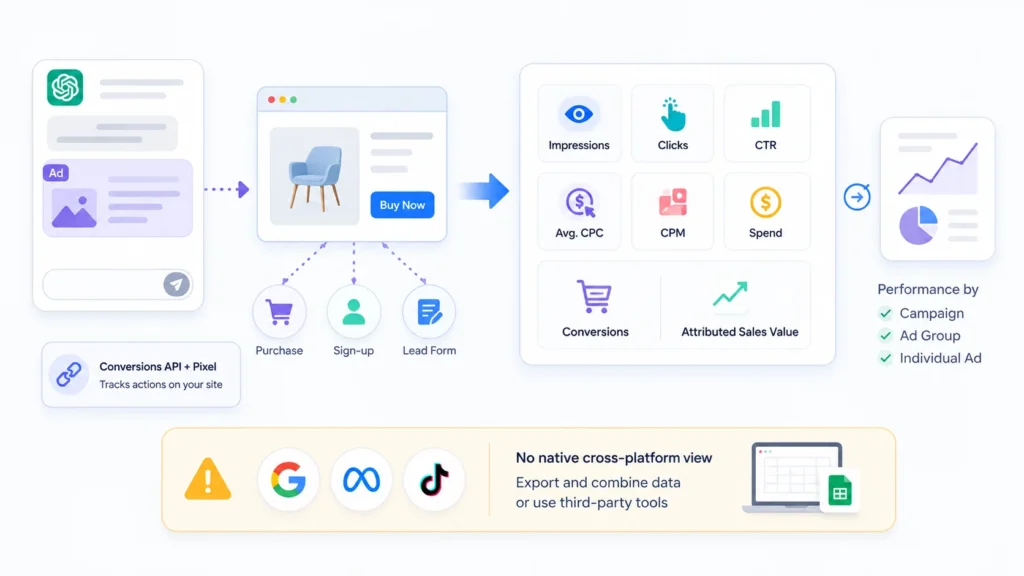
OpenAI added a Conversions API and pixel-based measurement alongside the self-serve launch, letting advertisers close the loop between a click inside a ChatGPT conversation and a downstream action on their own site, a purchase, a sign-up, a submitted lead form. Reporting inside Ads Manager breaks results down by campaign, ad group, and individual ad, covering impressions, clicks, CTR, average CPC and CPM, spend, and, once conversion tracking is live, conversions and attributed sales value.
One current limitation worth planning around: there is no native way to view ChatGPT Ads performance side by side with Google, Meta, or TikTok inside one dashboard. Ads Manager only shows its own data. Some third-party reporting tools have begun adding ChatGPT Ads support specifically to solve this, but as of now, cross-platform comparison means exporting and combining data yourself, or working with a partner or agency that already does this as part of their service.
A New Format Built for Commerce: Product Feeds
Beyond the standard business-name-image-headline-description ad unit, OpenAI is developing a product feed format specifically for retail and e-commerce advertisers, aimed at the moment a user asks ChatGPT for product recommendations, gift ideas, or “what should I buy for X.” Rather than a single static ad, this format pulls sponsored product listings directly from a retailer’s existing product catalogue, similar in spirit to Shopping ads on Google. Criteo is currently OpenAI’s first ad-tech partner supporting this format, with at least one retail brand reported to have tested the workflow through Criteo’s platform. OpenAI has not announced a public launch date for product feed campaigns generally, so this remains a capability to watch rather than something every advertiser can access today.
Early Performance Signals: Encouraging, But Read Them Carefully
Criteo has published early figures from its ChatGPT ad placements showing conversion rates running close to double, and click-through rates roughly triple, what the same advertisers see from comparable formats on traditional search and other channels. Categories cited as early outperformers include consumer electronics, lifestyle and wellbeing, and home and garden.
Treat these figures as a genuinely promising early signal, not a guarantee. They come from a small number of advertisers, in specific categories, during a period when very few competitors were bidding for the same attention, auction dynamics that shift as more advertisers enter the platform. OpenAI itself has been explicit that it has not published performance benchmarks across industries or campaign types, meaning there is no independent, platform-wide baseline yet to confirm whether early numbers like Criteo’s generalise beyond the specific advertisers and categories where they were measured.
The India, Europe, and MENA Expansion
OpenAI’s most significant recent move was opening self-serve Ads Manager access across India, Europe, the Middle East, and North Africa in the last days of August 2026, alongside confirmation that the platform had already reached $1 billion in annualised revenue. India specifically launched through managed agency access on August 28-29 via WPP and Omnicom, with full self-serve access following on September 4. Given how directly this affects Indian advertisers, we cover the India rollout, budgets, eligibility, and timing in full detail in our companion article, How to Make ChatGPT Ads: A Practical 2026 Playbook.
The scale of this expansion is worth sitting with for a moment: OpenAI grouped four regions, one of them among its largest user bases globally, into a single rollout wave, rather than the slower, market-by-market pilot approach used for earlier countries like the UK, Canada, and Australia. That shift in pace suggests OpenAI’s confidence in the underlying ad infrastructure has grown considerably since the cautious February pilot.
Why OpenAI Built This At All
For most of ChatGPT’s public life, Sam Altman described advertising as a “last resort” business model, worried publicly that ads could erode the trust users place in the product’s answers. That position softened through 2025: Altman acknowledged OpenAI would likely try ads eventually, OpenAI hired Fidji Simo, who previously ran Meta’s enormous advertising business at Facebook, as CEO of Applications, and by January 2026 OpenAI published a formal set of advertising principles ahead of the February launch.
The underlying economics are straightforward: serving inference to hundreds of millions of free-tier users is genuinely expensive regardless of how much subscription revenue OpenAI collects from paying users, and an advertising-supported free tier is the standard way large platforms fund a non-paying user base without cutting it off. ChatGPT now reports more than one billion weekly active users, and OpenAI has been explicit that keeping a high-quality free tier available at that scale needs a sustainable revenue model behind it beyond subscriptions alone.
What OpenAI Says Ads Will Never Do
OpenAI has repeated a consistent set of commitments since the January 2026 principles announcement, and they are worth stating plainly since they shape what this platform can and cannot be used for.
- Answer independence – advertiser payment never influences what ChatGPT actually says in response to a question; sponsored content is generated and ranked entirely separately from the model’s own answer.
- Clear labelling – every ad appears in a visually distinct, clearly marked “Sponsored” placement, never blended into the organic response.
- No conversation access – advertisers never receive a user’s actual chat history, conversation content, or personal details; targeting runs on OpenAI’s side using aggregated, anonymised signals only.
- Age and context exclusions – no ads are shown to accounts OpenAI predicts belong to users under 18, and ads are withheld from conversations touching sensitive or regulated subjects.
What This Means for Marketers Right Now
- Treat it as a genuine early-mover opportunity, not a wait-and-see channel – auction competition is still comparatively low relative to ChatGPT’s attention and usage volume, a gap that closes as more advertisers arrive.
- Match your entry path to your existing stack – a business already running retail media through Pacvue or programmatic through StackAdapt may find the partner route faster to activate than starting fresh in Ads Manager.
- Do not over-index on published early performance figures – category-specific, small-sample results from a handful of advertisers are a reason to test, not a guarantee of your own results.
- Watch the roadmap, not just the current feature set – cost-per-action bidding and product feed campaigns are both in active development and could meaningfully change what “good” campaign structure looks like within months.
- Build measurement discipline in from day one – install the Conversions API and pixel immediately, and maintain independent UTM tracking, since cross-platform comparison tools for ChatGPT Ads are still immature.
Conclusion
ChatGPT Ads Manager represents something genuinely new in advertising infrastructure: a self-serve buying platform built directly into a conversational AI product, arriving alongside a parallel ecosystem of agency and technology partners rather than replacing them. Its rapid evolution, CPC bidding added within three months of CPM-only launch, a billion-dollar revenue run rate reached in under 200 days, four major regions opened in a single wave, suggests OpenAI is treating advertising as a serious, permanent pillar of its business model, not an experiment it might quietly abandon. For marketers, the practical takeaway is straightforward: this is infrastructure worth understanding now, while the auction is still comparatively uncrowded and the platform is still actively shaping what “best practice” even means here.