
A video circulated recently showing a flash flood tearing through a valley in Nepal. Homes, shops, vehicles, entire structures were swept away in minutes. And in the middle of the destruction, one house stood. Floodwater tore through its ground floor and ripped away its doors and windows, but the structure itself held, and the people inside survived.
Engineers who examined the footage afterward pointed to specific reasons, not luck. The house had been built with a continuous, reinforced-concrete frame, steel rebar tying its columns, beams, and foundation into one rigid skeleton, unlike the traditional masonry construction common nearby. It also stood on marginally higher ground, slightly apart from the main channel of the flood, letting the torrent divide around it rather than strike it head-on. Good engineering and a reasonable position. Neither alone would have been enough.
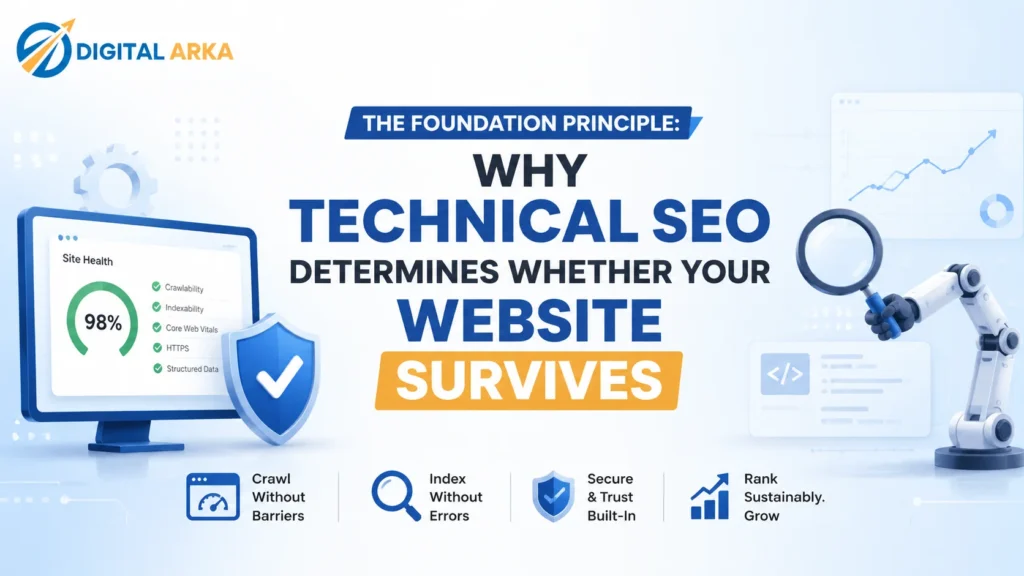
The same principle governs whether a website survives search engine scrutiny.
The Core Analogy: A House and a Website Fail the Same Way
A house is not judged by its paint, its furniture, or its curb appeal when the water arrives. It is judged by what was engineered before anyone could see it: how deep the foundation goes, whether the frame is genuinely tied together, whether water can drain away instead of pooling against the walls. A website faces an equivalent, quieter version of the same test every time a search engine crawls it.
| Physical Foundation | Technical SEO |
|---|---|
| ✓ Soil testing, structural engineering | ✓ Crawlability & indexability |
| ✓ Load-bearing walls | ✓ Site architecture |
| ✓ Drainage systems | ✓ Site speed / Core Web Vitals |
| ✓ Building codes compliance | ✓ Schema markup & structured data |
| ✓ Reinforcement bars | ✓ Security (HTTPS, backend integrity) |
None of these elements are visible to a visitor admiring your homepage design, in the same way no visitor to a finished house can see the rebar inside its columns. But remove any one of them, and the whole structure becomes vulnerable to a force it was never actually tested against until the moment it mattered.
What Technical SEO Actually Holds Up

A website is not one structure but a set of interdependent ones, each doing a different job, each capable of failing independently even while the others look fine.
Content – The Roof
Content is the reason the structure exists at all, the purpose the whole building serves. But a roof with nothing holding it up is just debris waiting to fall. Genuinely excellent content published on a technically broken site, pages search engines cannot crawl, index, or render correctly, never gets the chance to matter, the same way a beautifully finished roof means nothing once the walls beneath it give way.
On-Page SEO – The Interior Fittings
On-page elements, titles, headings, internal links, are what make a space usable once someone is inside it. A structurally sound building with no doors, no signage, no logical layout still fails the people trying to use it. A page that ranks but confuses or fails to guide the visitor once they arrive has solved only half the problem.
Off-Page SEO – The Surrounding Support
Backlinks and external authority function like the ground and structures around a building, what holds firm nearby, what gives the whole area stability. A house can be perfectly built and still be undermined if everything supporting the land around it is weak. A page with genuine content and flawless technical health still struggles to rank without any external signal that the wider web considers it credible.
User Experience – How People Move Through It and Survive It
This is not decoration. It is whether the people inside can actually move, find an exit, and stay safe under stress, the same test a building faces when conditions turn genuinely difficult. A site that is slow, confusing, or difficult to navigate under real-world conditions, a mobile connection, a distracted visitor, a stressful decision, fails this test regardless of how it performs in a calm, ideal walkthrough.
Local SEO – The Property’s Placement in Its Neighbourhood
Where a building sits relative to the surrounding land, on a flood plain or on higher ground, determines its exposure before a single brick is laid. A business’s local SEO, an accurate Google Business Profile, consistent location signals, is the equivalent placement decision: whether it stands where its actual customers are searching, or somewhere the map simply cannot find it.
Content Strategy – The Blueprint Before Construction
No engineer starts pouring concrete without a plan for how loads will be distributed and where the structure’s weak points might be. Content published without a genuine strategy, no topic architecture, no plan for how pages relate to and reinforce each other, is construction without a blueprint: it might stand for a while, but nobody actually knows where it is weak until something tests it.
Analytics & Monitoring – Structural Inspections Over Time
A sound building still needs periodic inspection, since ground shifts, materials age, and stresses accumulate in ways invisible from the outside. A website without ongoing analytics and monitoring is a structure nobody has checked since the day it was built. Problems compound quietly long before they become visible in a ranking drop, the SEO equivalent of a foundation crack nobody noticed until the wall above it failed.
Backend & Security – The Reinforced Core No One Sees
This is the rebar itself, the part with the least visual presence and the most structural consequence. HTTPS, backend integrity, clean code, secure infrastructure: none of it is visible to a visitor, and all of it determines whether the rest of the structure holds together when something pushes against it. The Nepal house’s continuous steel frame was invisible in every photo of it standing peacefully before the flood. It was the only reason there was still a structure left to photograph afterward.
A Composite Case Study: What “Before” Usually Looks Like
The specifics below are a composite drawn from patterns we see repeatedly across client audits, not one single, identifiable engagement, and the figures are described directionally rather than as precise guaranteed outcomes. Every site is different, and results vary by starting point, competition, and category.
A recurring “before” state looks something like this: a website with genuinely good content and a reasonable design, but an unaddressed technical layer underneath it. Common findings in this pattern include a meaningful share of pages blocked from indexing by an overlooked robots.txt rule, no XML sitemap submitted or one that had gone stale, Core Web Vitals failing on mobile due to unoptimised images and render-blocking scripts, and no structured data anywhere on the site, meaning zero eligibility for rich results or clean citation by AI systems summarising search results.
The fix sequence in cases like this typically follows the same priority order, because the dependencies are real, not arbitrary: resolve crawl errors first, since nothing else matters if search engines cannot reach the pages; confirm indexation second, since a crawlable page that is still excluded from the index is still invisible; add schema markup third, since structured data helps both traditional rich results and AI citation once pages are actually indexed; and address Core Web Vitals and speed throughout, since performance problems compound at every other stage rather than sitting in their own isolated lane.
The honest “after” state is a site where the existing content and design finally get a fair chance to perform, measured in cleaner indexation coverage, passing Core Web Vitals, and schema-eligible rich results, rather than a specific promised percentage lift, since that number depends entirely on competition and starting point in ways no audit can responsibly guarantee in advance.
The Cost of Ignoring the Foundation
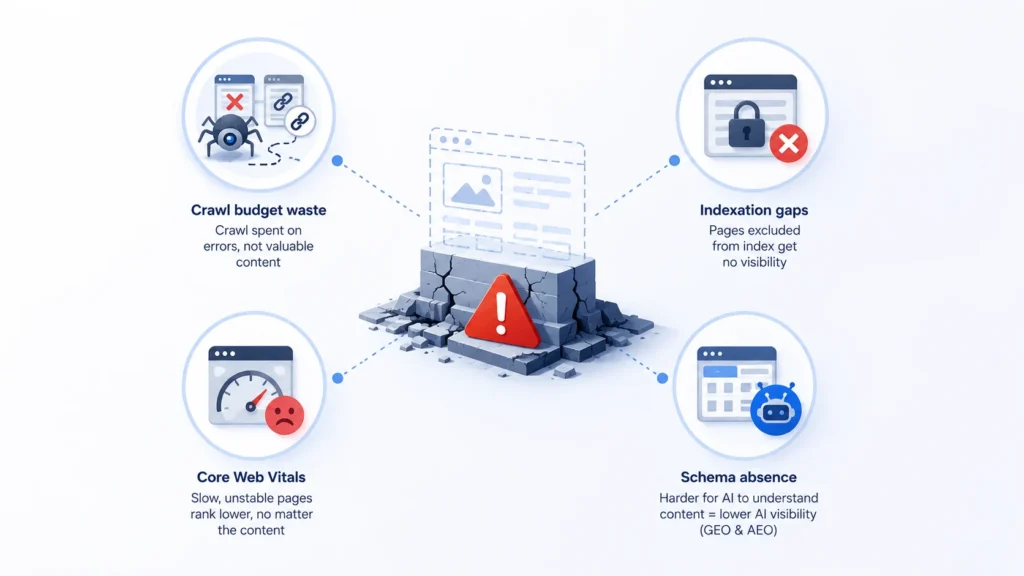
A weak technical foundation does not just underperform quietly. It actively wastes every other investment built on top of it.
- Crawl budget waste – search engines spend limited crawl attention on broken redirects, duplicate pages, and dead ends instead of the content genuinely worth indexing.
- Indexation gaps – content and link-building investment poured into pages that are technically excluded from the index never has the chance to earn a single impression.
- Core Web Vitals suppressing rankings – genuinely strong content on a slow, unstable page competes at a structural disadvantage against a technically healthier, less impressive competitor.
- Schema absence hurting AI visibility – without structured data, AI Overviews, ChatGPT, and Perplexity have a harder time correctly parsing what a page actually offers, directly weakening GEO and AEO visibility regardless of how well-written the content is.
This last point matters more with each passing month. As AI systems increasingly determine whether a business gets cited at all, technical soundness has stopped being a ranking nicety and become the precondition for a site being legible to an AI system in the first place. A page an AI crawler cannot properly access or parse cannot be cited, no matter how genuinely good the content sitting on top of it is, the same way no amount of interior design saves a building whose frame has already failed.
A Practical Foundation Checklist
A starting list any site owner can act on directly, roughly in the order a technical audit would prioritise them.
- Robots.txt – confirm it is not accidentally blocking pages you actually want indexed.
- XML sitemap – present, current, and correctly submitted in Search Console.
- HTTPS – active sitewide, with no mixed-content warnings.
- Mobile-first indexing readiness – the mobile version of every page carries the same content and structured data as desktop.
- Core Web Vitals – Largest Contentful Paint, Cumulative Layout Shift, and Interaction to Next Paint all passing, not just close.
- Structured data – Article, FAQPage, LocalBusiness, or Product schema implemented and validated wherever genuinely applicable.
- Log file review – confirm how search engines and AI crawlers are actually spending their crawl budget on your site, not just how you assume they are.
Closing: Built Before the Flood, Not Repaired After
The buildings that survive are not the ones repaired after the water arrives. They are the ones engineered properly before anyone knew a flood was coming, when reinforcing a column or deepening a foundation felt like an unnecessary, invisible expense nobody would ever see or thank you for. The same is true of a website. Technical SEO is not the part of a project anyone gets excited about, no client has ever asked to see a robots.txt file, and no one photographs a rebar frame before the concrete goes in. But it is the part that determines, quietly and in advance, whether everything built on top of it is still standing the day it actually gets tested.
If you are not certain your site’s foundation would hold, that is precisely what a technical audit is for. DigitalArka’s Technical SEO Services start with a full site crawl and fix issues in documented, prioritised order, the same sequence used in the case study above: crawl errors, indexation, schema, then speed.