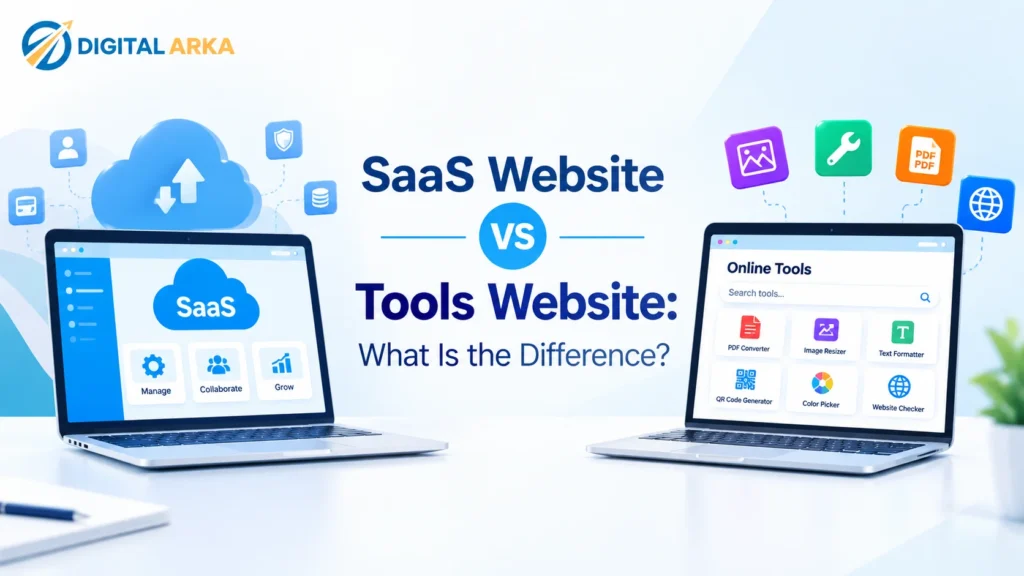

A project management platform and a free PDF converter can both live on a “software” website, both run in a browser, and both solve a genuine problem for the visitor. But treat them as the same type of site for marketing or SEO purposes, and both will underperform. A SaaS website and a tools website are built around fundamentally different relationships with the user, and that difference should shape everything from site structure to how success gets measured.
The Core Difference: Ongoing Relationship vs One-Off Task
A SaaS website exists to start and sustain an ongoing relationship. The visitor signs up, usually for a free trial or freemium tier, and the business succeeds only if that person keeps coming back, eventually pays, and ideally stays subscribed for years. A tools website exists to complete one task, convert this file, calculate this number, generate this password, right now, with no expectation the visitor will ever return, let alone pay anything.
That single distinction cascades into nearly every other difference between the two.
Business Model
SaaS revenue comes from subscriptions: monthly or annual recurring payments tied to an account and usually a tiered feature set. A tools website typically monetises through advertising, affiliate placements, or a freemium upsell to a paid tier for higher usage limits or advanced features, but the free tool itself usually asks nothing of the visitor beyond using it.
Content and Page Structure
A SaaS website is organised around a relatively small number of deeply developed pages: a handful of core features, a pricing page, comparison pages against named competitors, and integration pages. A tools website is typically organised around a large number of narrow, single-purpose pages, one per specific conversion, calculation, or generation task, often numbering in the hundreds, each targeting a distinct, specific search query.
The SEO Priorities Differ Accordingly
SaaS SEO centres on comparison and alternative content (“[You] vs [Competitor]”), feature pages, and moving a reader toward a trial signup. Tools website SEO centres on programmatic content differentiation at scale, avoiding thin or duplicate content penalties across near-identical pages, and technical indexing for interactive, JavaScript-driven functionality.
| Dimension | SaaS Website | Tools Website |
|---|---|---|
| User relationship | Ongoing account, repeat visits | One-off task, often anonymous |
| Revenue model | Subscription (recurring) | Ads, affiliate, or freemium upsell |
| Page structure | Fewer, deeper pages | Many narrow, near-identical pages |
| Primary SEO risk | Weak comparison/feature content | Thin or duplicate content at scale |
| Conversion goal | Trial signup or demo request | Task completion, sometimes ad view |
| Technical SEO focus | JS-rendered marketing site indexing | JS-rendered interactive tool indexing |
Where the Two Categories Overlap
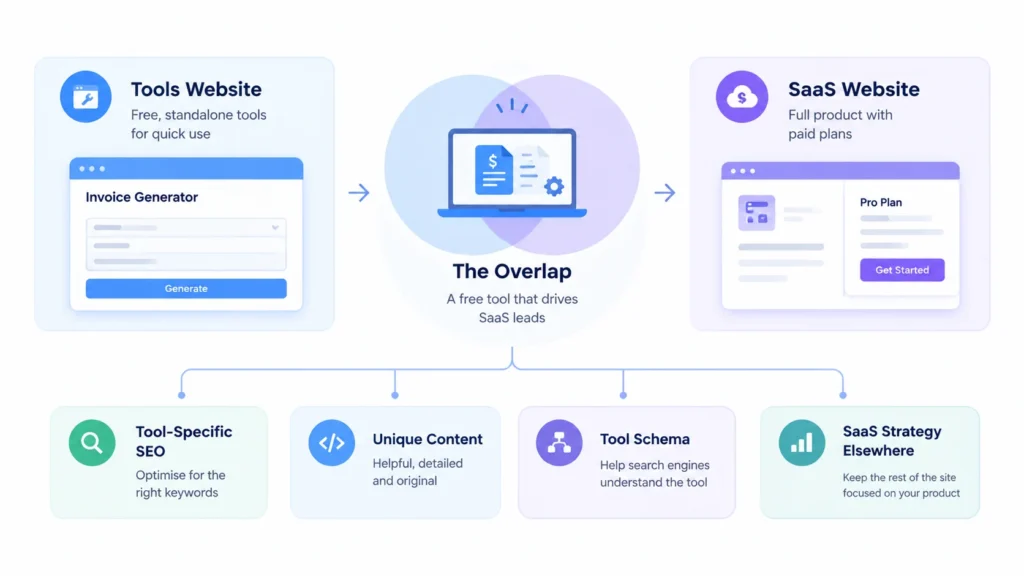
Some products genuinely sit in between. A SaaS company might publish a handful of genuinely free tools (a “free invoice generator,” for example) as a lead-generation tactic, essentially borrowing the tools-website playbook to feed its own SaaS funnel. When this happens, those specific pages should still be built with tools-website SEO principles, differentiated content, tool-specific schema, even though the rest of the site follows SaaS SEO strategy.
How to Tell Which One Your Product Actually Is
Ask three questions honestly. First, does a visitor need an account to get real value, or can they use the core function anonymously? Second, does your revenue depend on someone returning next week, or does one successful visit already count as a win? Third, are you building a small number of feature-rich pages, or could you plausibly generate hundreds of narrow, single-purpose pages from your core functionality? Answering these honestly, rather than assuming your product is SaaS just because it runs in a browser, is the first real step toward the right SEO strategy.
Common Mistakes When You Treat One Like the Other
- Applying SaaS-style comparison pages to a tools site – a free converter rarely benefits from a “[You] vs [Competitor]” page the way a subscription product does, since the buying decision that content is built for does not really exist here.
- Applying programmatic scale thinking to a SaaS site – a SaaS company generating hundreds of near-duplicate landing pages to chase long-tail keywords risks exactly the thin-content problems tools sites have to manage carefully, without the natural justification a genuine tool variation provides.
- Measuring a tools site by trial signups – if there is no trial to sign up for, usage sessions and, where relevant, ad revenue or upgrade conversions are the metrics that actually reflect success.
- Measuring a SaaS site by raw traffic volume – a SaaS marketing site can carry substantial traffic and still fail commercially if none of it converts to a trial, since traffic was never the actual goal.
If your product is a subscription platform with accounts and recurring billing, our SaaS Website SEO service is built around your actual funnel.
If your site is a free utility, or a large library of them, our SEO for Tools Website service addresses the programmatic scale and technical indexing challenges specific to that format.
Conclusion
The visual difference between a SaaS product and a free tool can be minor, both might look like a clean, modern web app. The strategic difference is not minor at all. One is built to keep a visitor coming back and eventually paying; the other is built to solve one problem well enough that the visitor never needs to think about it again. Getting the SEO strategy right starts with being honest about which one you actually are.