
Yes, by every standard definition, ChatGPT is SaaS, and a genuinely instructive one to study. It also sits at the edge of a newer category, AI as a Service, that is reshaping what “software” even means. Understanding exactly where ChatGPT fits, and where the label gets complicated, is useful both as a definitional exercise and as a real example of product-led SaaS growth done at a scale few companies will ever match.
Checking ChatGPT Against the SaaS Definition
Go through the core characteristics of a genuine SaaS product, and ChatGPT satisfies every one of them clearly.
- Subscription-based pricing – ChatGPT offers tiered subscriptions, Free, Go, Plus, Pro, alongside Business, Enterprise, and Education plans for organisations, the defining SaaS revenue structure.
- Cloud hosting – the underlying models run entirely on OpenAI’s infrastructure; nothing is installed or processed locally on a user’s device.
- Browser or app-based access – ChatGPT is used through a web browser or a mobile/desktop app, with no local software installation required to access the core product.
- Centralised updates – OpenAI updates and improves the underlying model for every user simultaneously; individual users never manage a version upgrade themselves.
- Multi-tenancy – the same underlying infrastructure and models serve millions of separate user accounts simultaneously, with each account’s data and conversations kept separate.
On every count that defines SaaS, ChatGPT qualifies without ambiguity.
Where It Gets More Complicated: AI as a Service
ChatGPT is also commonly described using a newer, more specific term: AI as a Service, or AIaaS, a subcategory of SaaS specifically for products where the core deliverable is an AI model’s output, rather than a traditional software feature set like a spreadsheet or project tracker. This is not a contradiction of the SaaS classification, AIaaS is best understood as SaaS with a more specific descriptor attached, the way “vertical SaaS” describes SaaS built for one specific industry. ChatGPT is SaaS; it is also, more specifically, AIaaS.
| OpenAI Product | Category | Why |
|---|---|---|
| ChatGPT (Free/Go/Plus/Pro) | SaaS / AIaaS | Subscription, cloud-hosted, finished consumer application |
| ChatGPT Business/Enterprise | SaaS / AIaaS (B2B) | Same model, sold as a per-seat subscription to organisations |
| OpenAI API | Closer to PaaS | Raw model access for other companies to build their own products on top of |
The API Layer Complicates the Picture Further
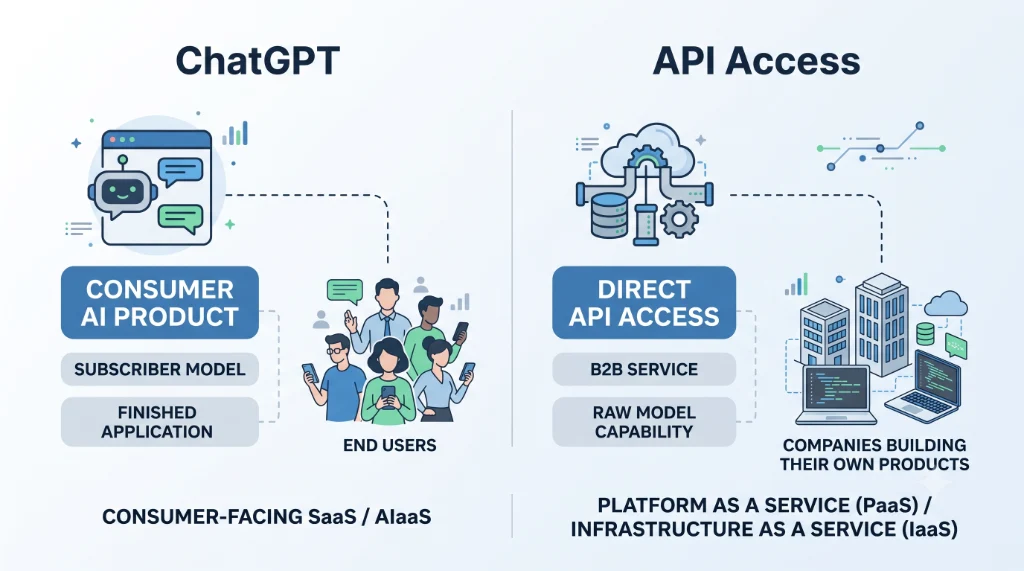
Beyond the consumer ChatGPT product, OpenAI also sells direct API access, letting other companies build their own products on top of the same underlying models. This API business looks less like traditional consumer SaaS and more like a form of Platform as a Service (PaaS) or Infrastructure as a Service (IaaS), depending on how it is used, since a company building a product on the API is consuming raw model capability, not a finished, end-user application the way a ChatGPT subscriber is. OpenAI, as a company, therefore actually spans multiple categories at once: consumer-facing SaaS/AIaaS through ChatGPT, and something closer to PaaS through its API business.
Why ChatGPT Is a Genuinely Useful SaaS Case Study
Beyond the classification question, ChatGPT is worth studying as an example of product-led SaaS growth executed at enormous scale, a generous free tier driving adoption, a genuinely useful core product doing the work of convincing users to upgrade, and tiered pricing matched to distinct user segments from individual consumers through large enterprises. The same underlying principles, letting the product itself drive the funnel rather than relying purely on sales outreach, are exactly what our SaaS Website SEO service is built to support through comparison content, feature pages, and trial-focused optimisation.
Conclusion
ChatGPT is SaaS, clearly and by every standard definition, subscription pricing, cloud hosting, browser-based access, centralised updates, and multi-tenant infrastructure. It is also, more precisely, AIaaS, a newer subcategory built around AI model output rather than traditional software features. Its API business sits in a genuinely different category, closer to PaaS, which is a reminder that a single company can operate across more than one software delivery model at once, even when its most famous product fits neatly into one specific box.