
Who I Am
I’m Yash Gupta, an SEO Content Writer at Digitalarka. I joined the company on 16 August 2025, and since then, I’ve had the opportunity to work across a wide range of websites, industries, and SEO challenges.
My work is mainly focused on creating content that isn’t just written well, but is written with a clear purpose behind it. I work on understanding what users are searching for, what competitors are covering, what information is missing, and how we can create content that has a genuine opportunity to perform in search.
Over time, my role has expanded from simply writing content to becoming more involved in the overall SEO content process. I work on research, topic selection, competitor analysis, search intent, content planning, writing, optimisation, and improving content based on performance.
One of the things I like most about working at Digitalarka is that I don’t get restricted to one type of website. I’ve worked across travel, hospitality, SaaS, e-commerce, finance, automotive, healthcare, beauty, B2B manufacturing, entertainment and publishing. Every project requires a slightly different way of thinking, and that has helped me become much more adaptable as an SEO content professional.
How My Journey Started
Before joining Digitalarka, I started my content-writing journey through an online content-writing internship.
At that stage, I was still developing my understanding of professional content writing and looking for an opportunity where I could work on actual websites and learn how content works in a real SEO environment.
While searching for a job, I came across Digitalarka’s opening for an SEO Content Writer.
The role matched what I was looking for, so I applied and eventually joined the company on 16 August 2025.
I came into the role primarily as a content writer, but working on real client websites quickly showed me that SEO content is much broader than writing.
A good article can still fail if the topic is wrong.
A good keyword can still fail if the search intent is misunderstood.
And even well-written content can struggle if the website, structure, internal linking, competition or overall SEO strategy isn’t considered.
That realisation changed the way I approached content.
My Beginning at Digitalarka
My first few days at Digitalarka were quite unusual.
When I joined, some of the employees were on leave, so during my first six days, it was essentially just me and my manager working together.
My manager introduced me to the company, explained the objectives and goals, and shared the credentials and project information I needed to get started.
What made the experience different was the amount of freedom I received from the beginning.
I wasn’t constantly being told exactly what to do or how to complete every task. I was given the opportunity to understand the projects, try things, experiment, and figure out solutions myself.
Whenever I needed something for a project, my manager was also quick to provide it. If I made a mistake or took the wrong approach, I was corrected directly but politely.
That working relationship helped me become comfortable taking ownership of my work quite early.
What I Actually Do as an SEO Content Writer
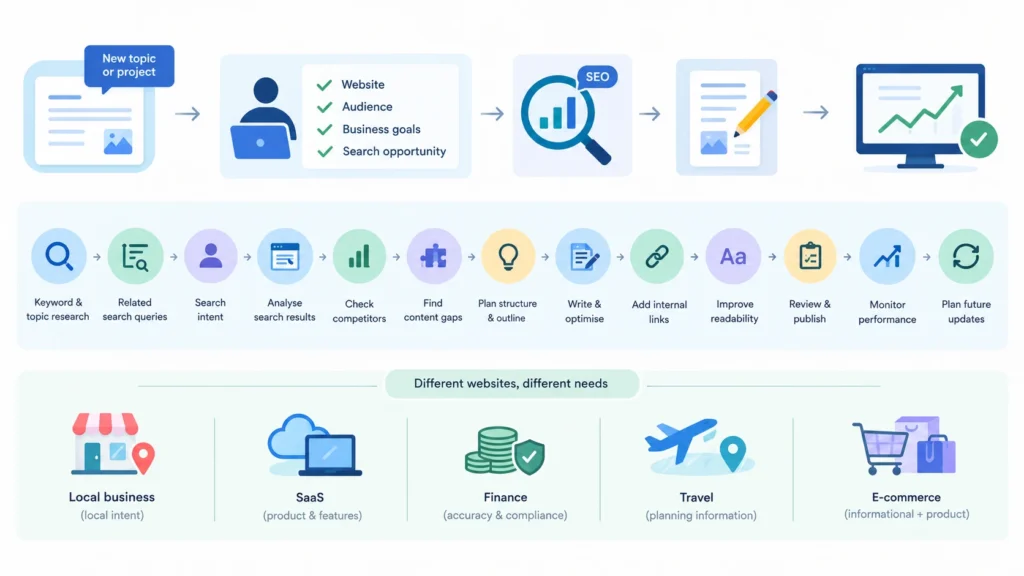
My role isn’t limited to sitting down and writing whatever topic appears in a content calendar.
For me, the actual work starts much earlier.
When I receive a new topic or project, I first try to understand what the website does, who the audience is, what the business is trying to achieve, and what kind of search opportunity exists.
From there, I look at the topic from an SEO perspective.
Depending on the project, this can involve:
- Understanding the primary topic and keyword
- Identifying related search queries
- Understanding search intent
- Studying the current search results
- Looking at competing pages
- Identifying content gaps
- Finding supporting topics
- Understanding what information users actually need
- Planning the structure of the content
- Creating content outlines
- Writing the article or page
- Optimising headings and important sections
- Adding relevant internal links
- Improving readability and topical coverage
- Reviewing the finished content
- Monitoring how published content performs
- Identifying opportunities for future updates
I don’t follow exactly the same process for every website because every project is different.
A local business, for example, requires a different approach from a SaaS website. A finance website needs more attention to accuracy and compliance. A travel website needs useful planning information. An e-commerce website needs content that can connect informational searches with products.
Understanding that difference is an important part of my work.
The Types of Content I Work On
One of the biggest advantages of working on multiple projects is that I don’t have to write the same type of content repeatedly.
Depending on the project, I’ve worked with or explored opportunities around:
SEO Blog Content
Informational blogs are a major part of my work.
These include educational articles, how-to content, guides, comparisons, FAQs, industry topics, destination guides, product-related topics and problem-solving content.
I don’t like creating articles simply to increase the number of pages on a website. I prefer understanding whether the topic actually has a reason to exist and whether it can answer something useful for the target audience.
Service Pages
I’ve also worked with service-focused websites where the objective is to create pages that explain what the business offers while also targeting relevant search demand.
These pages require a different approach from blogs because the user is often much closer to taking an action.
The content needs to explain the service clearly, address common questions and establish why the service is relevant without making the page unnecessarily complicated.
Location-Based Content
Several of the projects I’ve worked on have local or multi-location elements.
This means content needs to consider searches involving specific cities, areas, neighbourhoods, or destinations.
For these pages, I try to avoid simply replacing a city name throughout the same template. The content needs to make sense for the actual location and provide information that is useful to someone searching from or for that area.
E-commerce Content
I’ve worked with e-commerce projects where content plays a role in helping users discover products as well as understand them.
This can involve product-related articles, collection content, comparisons, buying guides, gifting content and informational topics connected to product searches.
SaaS Content
SaaS projects have been particularly useful for developing my understanding of product-focused content.
For software websites, users often want answers to very specific questions:
What does the software do?
Who is it for?
How does a particular feature work?
What problem does it solve?
What alternatives exist?
How does it compare with another product?
This makes SaaS content very different from general blogging because I need to understand the actual product before I can write useful content around it.
B2B Content
I’ve also worked with B2B businesses where content needs to be more practical and solution-oriented.
Instead of targeting only broad informational keywords, content can focus on applications, technical questions, buying considerations, product explanations and industry-specific problems.
Projects Across Different Industries
A major part of my experience at Digitalarka has been working across different industries.
Here are some of the projects I’ve worked on or contributed to:
Bharati Tours & Travels
Industry: Travel & Tourism
Bharati Tours & Travels is a travel business focused on destinations including Bhutan, Sikkim and Darjeeling.
The project involves content around travel planning, destinations, itineraries and questions that travellers may have before making a booking.
Travel SEO can look simple from the outside, but there is a lot of competition. Generic destination content is everywhere, so the challenge is finding specific queries and creating information that actually helps someone make a travel decision.
For this type of project, I focus on making content practical rather than filling pages with generic descriptions.
Hindustan Ekta
Industry: Hindi Digital News
Hindustan Ekta is a Hindi-language digital publication covering a broad range of subjects, including national and international news, society, education, career, automobiles, politics and public-interest topics.
Working in a digital publication environment requires a different understanding of content.
Topics can be time-sensitive, search demand can change quickly, and the content needs to be clear enough for readers while also being structured properly for search.
The variety of topics also means research and adaptability are important.
Coverstall
Industry: E-commerce / Mobile Accessories
Coverstall is an e-commerce website selling mobile phone covers, cases and related accessories for a large range of smartphone models.
This project opened up several different content opportunities.
Instead of looking only at product pages, I also look at the wider search ecosystem around mobile phones — phone-related searches, case types, buying decisions, comparisons, gifting ideas and other topics that can eventually connect users with relevant products.
This is a good example of how content and e-commerce can work together rather than treating a blog as a completely separate part of the website.
Illusionist Tyson
Industry: Entertainment / Personal Brand
Illusionist Tyson is a personal-brand website for a professional illusionist with extensive performance experience, including corporate events.
This project requires content that communicates the value of an experience rather than simply describing a service.
Content opportunities include corporate entertainment, event-related searches, performance information, city-specific pages, event experiences and case-study-style content.
The challenge here is understanding the intent behind someone searching for entertainment for an event and then presenting the service in a way that feels relevant to that audience.
Millennials Hotel

Industry: Hospitality
Millennials Hotel is a hospitality project based in the Bommasandra Industrial Area of Bengaluru.
The target audience includes both business and leisure travellers.
For a hotel website, SEO content can go well beyond generic travel blogs. Location-based searches, nearby companies, business travel, local attractions, transportation questions and guest-related information can all become useful content opportunities.
This project has helped me think about hospitality content from the perspective of what a traveller actually needs before choosing accommodation.
Orbit Imaging
Industry: Dental Diagnostic Imaging
Orbit Imaging is a diagnostic dental imaging centre in Vancouver, offering services including CBCT imaging.
This is a more specialised project because the subject matter is healthcare-related and the audience can include both patients and professional referrals.
The content needs to be informative and easy to understand while remaining careful with medical information.
Topics can include patient FAQs, explanations of imaging services, referral-related information and practical questions around diagnostic imaging.
Wellness Story
Industry: Skin, Hair & Aesthetic Clinic
Wellness Story is a clinic-based project covering skin, hair and aesthetic treatments in Gurugram.
The content opportunities include treatment-specific topics, FAQs, what-to-expect information, patient questions and local SEO content.
Working on this type of website reinforces the importance of responsible content writing. When the subject involves health, content needs to prioritize accurate information rather than simply chasing keywords.
RingMoney
Industry: Finance / Mutual Funds / SIP
RingMoney is a financial platform focused on mutual funds, SIPs and related financial topics.
Finance content requires a strong focus on accuracy because users can make important decisions based on the information they read.
The project involves opportunities around financial education, comparisons, tax-related topics, SIPs, investment concepts and other questions users may have.
This kind of project has helped me understand that SEO writing isn’t only about ranking. The information itself has to be reliable and responsibly presented.
Royal Royce Detailing
Industry: Automotive
Royal Royce Detailing is a car-detailing business operating across multiple cities, including Delhi NCR, Mumbai, Bengaluru and Hyderabad.
Content opportunities include topics around:
- Ceramic coating
- Paint protection film
- Waxing
- Car detailing
- Vehicle maintenance
- Product and service comparisons
- City-specific car-care searches
- Different detailing solutions for different vehicles
Automotive content is interesting because users often arrive with a specific problem and are comparing several possible solutions.
The content therefore needs to help them understand the differences rather than simply promote a service.
Saanjh Stays
Industry: Hospitality / Homestays
Saanjh Stays is a boutique accommodation brand in Nainital and Uttarakhand.
The content approach combines property information with destination content.
Instead of only writing generic articles about Uttarakhand, opportunities can come from answering practical questions around where to stay, what to do nearby, how to plan a trip and what makes individual properties different.
Travelicious Bites
Industry: Travel & Lifestyle Publishing
Travelicious Bites is a travel and lifestyle content website covering destinations, travel guides, yoga retreats, beaches, Airbnb-related content, food and travel trends.
This is one of the projects where content production itself is a major part of the website’s growth.
It provides opportunities to work on different formats of travel content, from destination guides to listicles and experience-focused articles.
Comfort Enterprises — A Project I’m Proud Of
Among the projects I’ve worked on, Comfort Enterprises is one that stands out to me the most.
The business focuses on invisible grills in the Mumbai MMR region, and the project gave me an opportunity to see the impact of SEO content more directly.
Almost every piece of content I worked on ranked on page one.
The content also appeared in AI Overviews and generated a significant number of clicks.
What made this project important to me wasn’t simply the rankings.
It was the fact that I could see the result of the entire process — researching topics, understanding the competition, creating the content, optimising it and then watching users actually find and click on it.
It gave me more confidence that content doesn’t have to be treated as something separate from SEO. When the research, intent and execution are aligned, content can become an important part of a website’s organic growth.
Subzcanvas
Industry: Beauty, Fashion & Lifestyle
Subzcanvas is a broader beauty and lifestyle business covering areas such as salons, spas, beauty education, photography, wedding services, model portfolios, grooming and retail.
The challenge with a project like this is that the website covers multiple business areas, and each one can have a completely different audience.
Content therefore needs to be separated according to services, user intent and search behaviour.
Opportunities include service pages, beauty and bridal content, academy/course content, grooming topics and supporting SEO blogs.
CRMJio
Industry: SaaS / CRM / POS / Billing
CRMJio provides software solutions for repair businesses, including CRM, POS and billing functionality.
This is one of the types of projects where I have to think much more about the product itself before writing.
Content opportunities include:
- Feature pages
- Use-case pages
- Comparison content
- Alternative pages
- Localised landing pages
- Product education
- Case studies
- Blog content
- Help-oriented content
SaaS users often search with a specific problem in mind, so understanding that problem is essential before deciding how the content should be structured.
St Anne’s Housekeeping
Industry: Cleaning & Housekeeping
St Anne’s Housekeeping is a London-based housekeeping and cleaning service serving residential and commercial customers.
Because the website already has a relatively mature content base, the opportunity isn’t simply to publish generic articles.
More specific opportunities include local borough pages, seasonal cleaning topics, buyer guides and practical content that answers customer questions.
This project has helped me think more about content maturity — sometimes improving and expanding an existing content ecosystem is more valuable than simply publishing more pages.
Kandarpa Foods
Industry: Food & E-commerce
Kandarpa Foods is an e-commerce business selling traditional preserves, condiments and related food products.
Content opportunities include recipes, product-focused content, festival and gifting topics, and content that helps users understand how products can be used.
For food-related websites, the content also needs to be careful about nutritional or health-related claims.
Live Nu Life
Industry: Wellness & Lifestyle
Live Nu Life is a wellness and lifestyle-focused content website.
This project involves topics where content quality and presentation matter significantly.
The website provides opportunities to improve existing content, develop structured topic series and create more useful wellness resources.
Because some topics are health-adjacent, the content needs to be approached carefully rather than making unsupported claims.
OnShoppie
Industry: Forex Trading Tools & Education
OnShoppie is a specialised e-commerce and educational platform around algorithmic Forex trading tools, expert advisors, indicators and courses.
This is a niche where content needs to be particularly clear and responsible.
Rather than using exaggerated language around trading results, the content needs to explain products, features, concepts, risks and use cases properly.
Opportunities include educational articles, product descriptions, comparisons and trust-focused content.
SmokinMe
Industry: B2B Manufacturing
SmokinMe manufactures and supplies designated smoking zones and smoking cabins.
This is a B2B project where users may be looking for a very specific solution for a workplace, commercial property or organisation.
Content opportunities include technical FAQs, product explanations, industry-specific applications, buying guides and case-study-style content.
The content has to be practical and solution-oriented rather than written like a general consumer blog.
Pilgrims Habitat
Industry: Hospitality / Pilgrimage Tourism
Pilgrims Habitat, including Hotel Royal Badri, is focused on accommodation for visitors travelling to Badrinath and the Char Dham region.
The content combines hospitality and pilgrimage tourism.
Useful content areas include accommodation-related searches, seasonal travel information, destination guides, pilgrimage planning and practical questions travellers may have before visiting the region.
This is another example of how understanding the audience changes the way I approach SEO content.
What Working Across These Projects Has Taught Me
Working across these projects has probably taught me one of the most important lessons about SEO:
There is no single content strategy that works for every website.
A travel website and a SaaS website may both need blog content, but the reason users search, the way they consume information, and the action they want to take can be completely different.
The same applies to e-commerce, finance, hospitality, local services and B2B businesses.
Because of this, I’ve learned to look at the business first, the audience second and the keyword third.
The keyword tells me what people are searching for.
The business tells me why that search matters.
And the audience tells me what the content actually needs to provide.
My Interest in AEO and GEO
One area I’m particularly interested in right now is the changing relationship between SEO and AI-driven search.
I’ve become increasingly interested in AEO — Answer Engine Optimisation — and GEO — Generative Engine Optimisation.
Search is no longer limited to a traditional list of blue links. Users are increasingly getting direct answers and summaries from AI-powered search experiences.
That raises a lot of interesting questions for content writers:
How should information be structured?
What makes a source useful enough to be referenced?
How can content provide clear answers while still covering a topic comprehensively?
What signals actually matter in AI-driven search?
I don’t want to simply follow trends or repeat whatever someone says is the latest “SEO trick.” I want to test things myself and understand what actually works.
That’s one of the areas where I want to develop further in my career.
My Growing Interest in Technical SEO
Although content is my primary role, I increasingly want to understand what happens beyond the content itself.
I’m interested in learning more about technical SEO because I believe a good content strategy becomes much more powerful when you understand the technical environment in which that content exists.
Website structure, crawling, indexing, internal linking, page performance, structured information and other technical elements can all influence how content is discovered and understood.
I’m still developing in this area, but it is one of the directions I want to take my career.
How I Work With the Team
SEO content doesn’t happen independently.
At Digitalarka, I work with the other SEO team members to exchange ideas, discuss strategies, share things we’ve discovered and solve problems.
I also collaborate with the developer when something requires development-side involvement.
Sometimes I work as a tester for the developer, checking whether something behaves correctly from a practical user perspective.
I also don’t hesitate to ask questions.
If another team member understands something better than I do, I’d rather ask and learn than spend unnecessary time trying to figure everything out alone.
At the same time, I like bringing my own ideas to the table and experimenting when I think there is an opportunity worth testing.
My Working Relationship With My Manager
I’ve always appreciated the amount of trust my manager gives me. I’m generally not micromanaged, which allows me to take responsibility for my own work.
If I have an idea or suggestion, I’m able to communicate it directly.
And if something isn’t right, I’m corrected quickly and clearly.
For me, that’s a good working environment because I don’t want someone to simply tell me that everything I’m doing is correct. I want feedback when something can be improved.
The combination of freedom and accountability has helped me become more independent in my work.
What I’ve Learned Since Joining
When I first started, I was primarily focused on becoming better at content writing.
Today, I’m much more comfortable thinking about content as one part of a larger SEO process.
I’ve learned how to take responsibility for a significant amount of content work, manage projects independently, identify mistakes and improve my approach.
I’ve also learned something important about myself:
I can handle things that initially look much bigger or more difficult than I expected.
Being part of a small team means there are times when you have to take ownership rather than wait for someone else to handle a problem.
That experience has made me more confident in my ability to learn something new and eventually become good at it.
What I Like About Digitalarka
Since joining Digitalarka, the thing I appreciate most is the variety of work. I don’t feel like I’m writing about the same subject every day.
One project might involve travel. Another might be SaaS. Another could be automotive, hospitality, e-commerce, finance, beauty or B2B manufacturing.
That diversity keeps me learning. It also means that I constantly have to change the way I think about content.
A strategy that works for one client might not work for another, and that’s exactly what makes the work interesting to me.
Over time, Digitalarka has become more than just a workplace. It has become a regular part of my professional life, and the variety of projects has given me room to keep developing.
Outside My Core Work
Outside my client projects, I maintain my own website where I write about SEO.
I use it as a place to learn and experiment with SEO, particularly as I continue developing my understanding of the technical side.
I find that implementing something myself often teaches me more than simply reading about it.
And when I’m not thinking about SEO, writing content or experimenting with websites, I usually spend my free time playing Free Fire or scrolling through reels.
Where I’m Heading
My immediate goal isn’t simply to become someone who can write more content.
I want to become someone who understands why content performs, how SEO works technically, how search behaviour is changing, and how websites can adapt to AI-driven search.
I want to keep improving my technical SEO knowledge, experiment more with AEO and GEO, and become better at connecting content with actual business and search outcomes.
For now, I’m enjoying the process — working on different projects, testing ideas, learning from mistakes and gradually becoming better at something that I once thought was much more difficult than it actually was.
That’s the journey I’m continuing at Digitalarka.
Frequently Asked Questions
I enjoy the problem-solving side of SEO, especially when I have to find a new angle or figure out why something isn’t working. I like the process of testing an idea and learning from the outcome.
A difficult topic usually makes me more curious. I like breaking it down, researching it properly, and seeing whether I can find an approach that makes the problem easier to solve.
I think curiosity is extremely important. Search keeps changing, so being willing to question assumptions, research deeper, and keep learning can make a big difference.
I learn by combining reading with practical experimentation. Working on my own website also gives me a place to test SEO ideas and understand what happens beyond theory.
I keep it pretty simple — I enjoy playing Free Fire and scrolling through reels. Sometimes stepping away from SEO for a while is the easiest way to come back with a fresh perspective.
About the Author
Yash Gupta is an SEO Content Writer at Digitalarka who enjoys turning research, search intent, and creative ideas into content that performs. He works across diverse industries and is particularly interested in technical SEO, AEO, and GEO, while continuously experimenting and learning through real-world projects.