
5 Surprising Truths About AI Coding Assistants in 2026
The common narrative around AI coding assistants is that they’re straightforward productivity boosters. But the reality in 2025 is far more complex, presenting a series of professional paradoxes for developers and engineering leaders. AI can make your best developers slower, yet produce more performant code than they would. It offers unprecedented power for free, yet demands more human oversight than ever.
This article distills key takeaways from recent technical studies, product documentation, and expert comparisons to explore these dissonances. We’ll reveal what’s really happening with tools like Gemini Code Assist, GitHub Copilot, and their underlying models, moving beyond the hype to uncover the surprising truths shaping modern software development.
1. Your Senior Devs Might Actually Be Getting Slower
A startling finding from a rigorous July 2025 METR study defies conventional wisdom: while AI coding assistants can boost the productivity of newer developers, they might be slowing down your most experienced engineers. The study found that experienced open-source developers using AI tools took 19% longer to complete their tasks. The most jarring part? The same developers believed they were 20% faster.

This cognitive disconnect points to an “expert verification tax.” A senior developer, whose expertise allows them to write correct, idiomatic code from muscle memory, must now pause to read, verify, and often correct complex AI suggestions. This review process can take more time than simply writing the code themselves, even if the interaction feels faster.
For engineering managers, this finding has critical strategic implications. It suggests that the highest ROI from AI tools may come from pairing them with junior and mid-level developers to accelerate their learning and output. This could shift the role of senior developers toward more architectural planning and reviewing AI-augmented pull requests from their junior colleagues, rather than using the tools for tasks where their own intuition is already highly optimized. Productivity gains are not universal; they are a function of experience.
2. AI Writes More Efficient Code Than Humans
The Expert's Paradox: Faster Belief, Slower Reality
While AI might slow down an expert on familiar ground, it has a surprising edge in a critical domain: algorithmic efficiency. A master’s thesis comparing GPT-4o, Gemini 1.5 Pro, and human programmers on LeetCode problems revealed that AI-generated code is significantly more performant.
While the study found GPT-4o solved a greater number of problems correctly, both LLMs demonstrated a clear superiority over humans in a different, critical dimension: code efficiency. To quantify this, the study measured the average distance from the best possible execution time for each problem. The results were stark:
- Gemini 1.5 Pro: 1.156 (closest to the best time)
- GPT-4o: 1.468
- Humans: 2.235 (slowest on average)
This is a powerful finding. For performance-critical functions, an AI assistant might generate a more optimized solution than the average developer would produce on their first attempt. This creates a fascinating dilemma for development teams: the very tool that can slow down a senior developer’s workflow might produce a more algorithmically performant result, forcing a re-evaluation of where human expertise is best applied.
3. The "Free Lunch" Is Bigger Than You Think
In the world of premium software, a truly generous free tier is a rare sight. This makes the offering for Gemini Code Assist for individuals a genuine shock, providing a massive allowance that dwarfs its main competitor.
The free tier for individuals offers 180,000 free completions per month—a staggering 90 times more than GitHub Copilot’s free tier. This breaks down to a daily limit of 6,000 completions and 240 chat requests. Crucially, this isn’t a stripped-down version. Advanced features like Agent Mode, which can perform complex, multi-step coding tasks, are included at no extra cost.
This is a game-changer for students, learners, and developers working on personal or open-source projects. It effectively removes the cost barrier to accessing some of the most powerful and futuristic AI coding capabilities available today.
4. The Future Isn't Autocomplete; It's Autonomous Agents
The paradigm of AI coding assistance is rapidly shifting from simple line-by-line completion to high-level, goal-oriented direction. The flagship feature driving this evolution is “Agent Mode.”
Unlike traditional autocomplete, Agent Mode tackles complex, multi-step tasks that span multiple files. The developer describes a high-level goal, and the AI agent proposes a detailed, step-by-step plan. The developer can then review, edit, and approve this plan before a single line of code is changed, giving them complete control. Concrete examples include refactoring a feature across its model, view, and controller files or performing intelligent issue triage on a GitHub repository by analyzing new bug reports.
For enterprise users, this capability becomes even more powerful. An organization can customize the model on its private codebases, allowing the AI agent to learn and apply internal best practices and architectural patterns. This marks the next evolution in software development, where the developer’s role shifts from a writer of code to an architect providing the blueprint for a crew of tireless AI agents to construct.
5. AI Won't Save You From Environment-Specific Bugs
The Deployment Blind Spot
For all their power, AI coding assistants are not a silver bullet. They can generate perfectly logical code that still fails spectacularly due to subtle differences in deployment environments—a classic problem that requires human oversight.
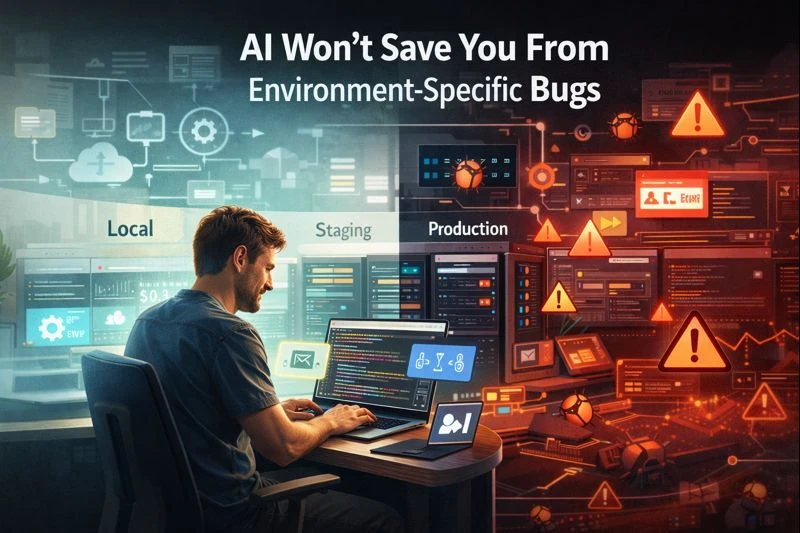
A Google Codelabs tutorial perfectly illustrates this limitation. A developer used Gemini Code Assist to build a Python application that worked perfectly when tested on their local machine. However, when deployed to Google Cloud Run, it consistently failed with a vague “internal server error.”
The root cause had nothing to do with the AI’s logic. The project contained a file named calendar.py, which conflicted with Python’s standard calendar module. This naming collision only became an issue in the isolated Cloud Run environment, which loaded modules differently than the local machine. It’s a critical reminder: even with flawless AI-generated code, a deep understanding of the deployment context is irreplaceable. As Google’s own documentation warns:
As an early-stage technology, Gemini Code Assist can generate output that seems plausible but is factually incorrect. We recommend that you validate all output from Gemini Code Assist before you use it.

Conclusion
AI coding assistants have matured far beyond simple productivity hacks. They are complex tools with surprising benefits, like generating hyper-efficient algorithms, and counter-intuitive drawbacks, such as the expert’s dilemma where seniors can be slowed down. They are democratizing access to powerful features while simultaneously highlighting the irreplaceable value of human context and oversight.
The trajectory is clear: these assistants are evolving from helpful copilots into semi-autonomous partners. This leaves us with a critical question to ponder. As these tools evolve from code completers to autonomous agents, how will the very definition of a software developer’s job change with them?

