
The Algorithm Now Reads Your Brand, Not Just Your Content
Two articles published within 24 hours of each other on Search Engine Land in mid-July 2026 crystallised something the SEO community has been circling for two years. The first, by David Carrasco Pamies on July 13, argued that your strongest traffic signals may be reinforcing the wrong brand identity — that the gap between what your brand says about itself and what the internet says about it is now a measurable SEO liability. The second, by Laura Abreu on July 15, showed that the first decision users make is often emotional, and Google increasingly becomes the place where they validate it.
Together, these two pieces describe a single, coherent shift: brand is no longer separate from SEO. Your brand reputation, brand consistency, and brand entity clarity are now direct inputs into how Google and AI search systems rank, cite, and present your content. This blog post explains how that works, what you can measure, and what Digital Arka does about it for our clients.
What Brand SEO Actually Means in 2026
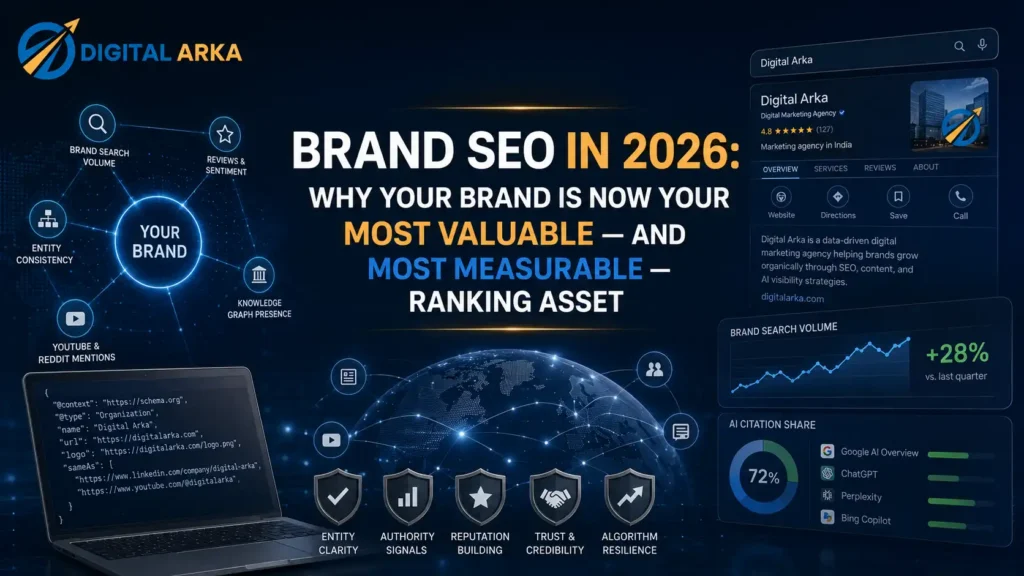
Brand SEO is the practice of managing the signals that search engines and AI systems use to identify, classify, and evaluate your brand — independently of the content on any individual page. These signals include:
- Entity consistency: whether your brand name, address, phone number, founding date, key people, and service descriptions are identical across your website, Google Business Profile, LinkedIn, Wikipedia/Wikidata, and directory listings.
- Brand search volume: how many people search for your brand name directly each month, and how that volume trends over time. Rising brand search volume is the strongest leading indicator of AI citation share growth.
- Third-party brand mentions: whether credible external sources — industry publications, news sites, Reddit threads, YouTube videos — reference your brand by name and in what context.
- Brand sentiment: the aggregate tone of reviews, forum mentions, and social posts about your brand, which AI systems use to assess whether to recommend you to users.
- Knowledge Graph presence: whether Google has resolved your brand into a Knowledge Panel entity, which indicates that Google has a high-confidence entity model of your business.
“Google updates primarily affect websites with a lot of organic traffic but a relatively weak brand. An extensive digital footprint signals to Google that it’s a relevant brand.” — Evergreen Media, SEO Trends 2026, April 2026
Why Brand Signals Became a Core Algorithm Input
The March 2024 core update introduced a structural change that is still playing out in July 2026: Google began evaluating site-level quality signals — the overall reputation and credibility of an entire domain — more heavily than page-level signals like keyword placement. Sites with strong brand presence survived and gained in the update. Sites with thin brand presence, even if individual pages were technically well-optimised, lost significant ground.
The reason is systemic. When AI systems generate synthesised answers, they preferentially cite sources they can confidently identify as credible. A brand with a Knowledge Panel, consistent NAP data across directories, a verified Google Business Profile, active LinkedIn presence, and editorial mentions in industry publications is a brand the system can confidently classify. A brand that exists only on its own website, with inconsistent naming across directories and no external validation, creates entity disambiguation problems that cause AI systems to skip it.
Evergreen Media’s April 2026 SEO trends analysis states this directly: sites with strong brand signals are measurably more resistant to Google core updates. Brand investment is no longer just marketing — it is algorithm insurance.
6 Brand SEO Actions That Build Algorithm Resilience
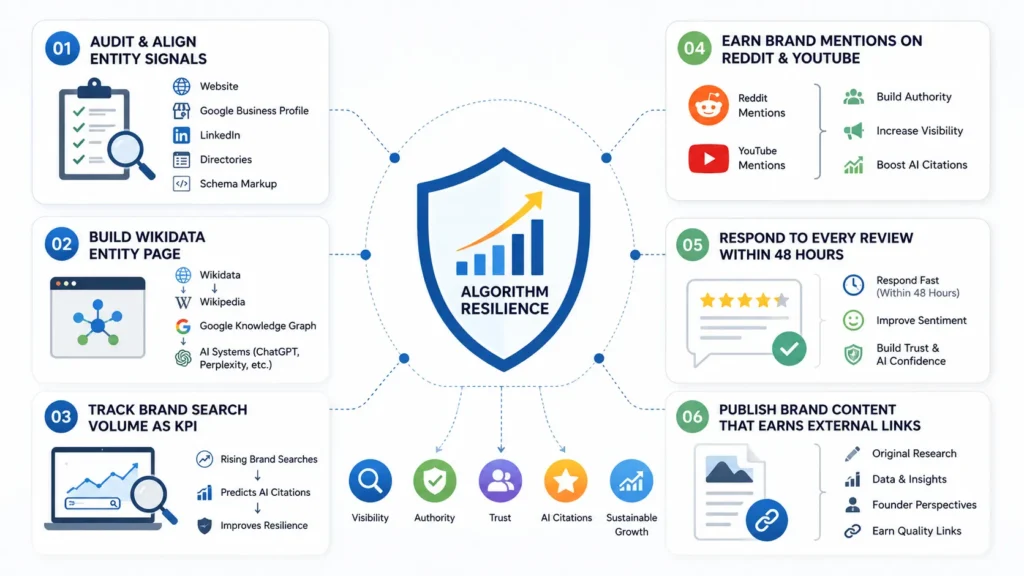
01 Audit and Align Your Entity Signals
Conduct a full entity audit: compare your brand name, address, phone number, founding year, and key people as they appear on your website, Google Business Profile, LinkedIn, all directory listings, and your schema markup. Every discrepancy is an entity disambiguation problem. The most common issues are abbreviations (Digital Arka vs. Digitalarka vs. Digital Arka Agency), outdated addresses, and phone numbers that differ between mobile and desktop versions of your site. Fix the most authoritative platforms first: Google Business Profile, LinkedIn, and your website.
02 Build a Wikidata Entity Page
Wikidata is the open knowledge base that feeds entity information to Wikipedia, Google’s Knowledge Graph, ChatGPT, and multiple other AI systems. Any real-world entity — a business, a person, a product — can have a Wikidata entry. Creating one for your business provides a central, machine-readable reference point that helps AI systems confidently resolve your brand identity. A Wikidata entry significantly improves your chances of earning a Google Knowledge Panel. Digital Arka recommends every client with more than 3 years of documented history create a Wikidata entity.
03 Track Brand Search Volume as a Leading KPI
Brand search volume — the monthly count of direct searches for your brand name in Google Search Console — is the most sensitive leading indicator of brand SEO health. Rising brand search volume predicts AI citation growth, direct traffic increases, and core update resilience. Falling brand search volume predicts AI citation loss before it shows up in organic traffic data. Set brand search volume as a primary KPI in your monthly analytics review alongside impressions, CTR, and AI performance data.
04 Earn Brand Mentions on Reddit and YouTube
Ahrefs’ research from December 2025 found that YouTube mentions correlate 0.737 with AI visibility — the strongest single signal measured in their study of 75,000 brands. Reddit mentions are cited in 46.7 percent of Perplexity responses. Both signals outperform backlinks for AI citation influence. For most businesses, earning genuine Reddit and YouTube presence means: participating authentically in relevant subreddits, creating original YouTube content that earns organic mentions, and building relationships with creators who cover your industry.
05 Respond to Every Review Within 48 Hours
AI systems aggregate review sentiment as a brand quality signal. Google’s systems, ChatGPT, and Perplexity all incorporate review data when assessing whether to recommend a business. Review response rate is itself a quality signal — businesses that respond to reviews (including critical ones) signal accountability and active management. Set a 48-hour response target for all reviews across Google Business Profile, G2, Clutch, and industry-specific platforms. A template response framework reduces the time cost to under 15 minutes per week for most businesses.
06 Publish Brand Content That Earns External Links
High-quality backlinks remain important in 2026, with AI-powered search placing greater emphasis on links from authoritative sites according to the Circles Studio SEO trends report. The key is that the most effective link-earning content in 2026 is brand content: original research, proprietary data reports, founder insight pieces with first-hand observations, and case studies with specific client results. These content types earn links not because of keyword optimisation but because they provide unique value that other publishers want to reference.
Measuring Brand SEO: The 5 Metrics That Matter
- Metric 1: Brand search volume (Google Search Console — Queries filtered by brand name)
- Metric 2: Knowledge Panel presence and verification status (search your brand name in Google)
- Metric 3: Review velocity and average rating across all platforms (monthly review count and score trend)
- Metric 4: Third-party brand mention count (Google Alerts, Ahrefs Mentions, or Brand24)
- Metric 5: AI citation share for branded and semi-branded queries (GSC AI performance report)
Conclusion: Brand Is SEO in 2026
The phrase “brand is not SEO” was never completely true, but it was close enough to be useful until 2024. In July 2026, it is simply wrong. Brand entity clarity, brand search volume, third-party brand mentions, and brand reputation signals are direct inputs into how Google, AI Mode, ChatGPT, and Perplexity rank, cite, and recommend your business. Building your brand is building your SEO.
At Digital Arka, every SEO engagement includes a brand signal audit as a standard component. We measure your entity consistency, Knowledge Graph presence, review velocity, and third-party mention profile, and we build a brand SEO roadmap alongside the technical and content strategy. Contact us at digitalarka.com to learn how brand SEO can make your rankings algorithm-proof.
Frequently Asked Questions (AI-Driven Queries)
These questions reflect real queries people ask AI search engines — Google AI Mode, ChatGPT, Perplexity, and Bing Copilot — about this topic. Each answer follows passage-first structure for maximum citation eligibility.
Q1. What is brand SEO and why does it matter in 2026?
A: Brand SEO is the practice of managing the signals that search engines and AI systems use to identify and evaluate your brand — entity consistency, brand search volume, third-party mentions, review sentiment, and Knowledge Graph presence. In 2026, these brand signals are direct inputs into Google’s core ranking systems and AI citation decisions. Sites with strong brand signals are measurably more resistant to core algorithm updates. Brand SEO is no longer separate from technical or content SEO — it is a foundational layer of every effective search strategy.
Q2. How does brand search volume affect SEO and AI visibility?
A: Brand search volume — the monthly count of direct searches for your brand name — is a leading indicator of algorithm resilience and AI citation share. Rising brand search volume signals to Google’s systems that your brand is recognized and trusted by a growing audience, which feeds authority signals into ranking systems. Brand search volume also predicts AI citation growth: brands that users search for directly are brands that AI systems are more confident recommending in synthesised answers.
Q3. What is a Google Knowledge Panel and how do I get one for my business?
A: A Google Knowledge Panel is a sidebar information box that appears when users search your brand name, powered by Google’s Knowledge Graph entity model. Earn one by: implementing Organisation schema on your homepage, verifying your Google Business Profile, creating a Wikidata entity page, and earning editorial mentions in credible external sources. Verified Knowledge Panels — claimed through the ‘Claim this Knowledge Panel’ feature — indicate that Google has high confidence in your brand entity and consistently improve AI citation rates.
Q4. Why do third-party brand mentions matter more than backlinks in 2026?
A: Third-party brand mentions — on Reddit, YouTube, news publications, and industry forums — outperform backlinks as AI citation signals in 2026. Ahrefs’ December 2025 research found YouTube mentions correlate 0.737 with AI visibility (the strongest single signal in their 75,000-brand study). Reddit mentions appear in 46.7% of Perplexity responses. AI systems learn which brands are trusted from the broader internet conversation, not just from link graphs. Brand mentions signal organic community recognition that AI systems use as a credibility proxy.
Q5. How does brand reputation affect Google AI Overviews?
A: Google AI Overviews preferentially cite brands with strong, consistent reputation signals: positive review scores, responsive review management, consistent entity data across the web, and editorial mentions in credible sources. Google’s systems aggregate everything the internet says about your brand and use it as a citation confidence signal. A brand with a 4.8-star Google Business Profile, active G2 presence, and industry publication mentions earns AI Overview citations at higher rates than an equivalent brand with no third-party validation.
Q6. What is entity consistency and why does it affect SEO?
A: Entity consistency means your brand name, address, phone number, founding date, key people, and service descriptions are identical across every platform where your brand appears. Inconsistencies — different business names on different directories, outdated phone numbers, abbreviated brand names — create entity disambiguation problems where search systems cannot confidently resolve multiple listings to a single real-world business. This reduces AI citation confidence and Knowledge Graph eligibility. Entity consistency audit is the first step in any brand SEO programme.
Q7. How do I build brand SEO for a small business in India?
A: Build brand SEO for an Indian small business by: verifying and completing your Google Business Profile with accurate NAP, service descriptions, and weekly posts; building citations on JustDial, Sulekha, IndiaMart, and Bing Places; creating a Wikidata entity page; participating authentically in relevant LinkedIn and Reddit communities; earning at least five Google reviews per month with consistent responses; and publishing original content (case studies, local data, founder insights) that earns external mentions. These steps compound over 6 to 12 months into measurable AI citation share.
Q8. What is the relationship between E-E-A-T and brand SEO?
A: E-E-A-T (Experience, Expertise, Authoritativeness, and Trustworthiness) is Google’s content quality framework, but its ‘A’ and ‘T’ components — Authoritativeness and Trustworthiness — are fundamentally brand signals. Authoritativeness is measured by what other credible sources say about your brand (links, mentions, citations). Trustworthiness is measured by review sentiment, site security, accurate information, and contact transparency. Improving brand SEO — third-party mentions, review management, entity consistency — directly improves your E-E-A-T scores on these two dimensions.
Q9. Does social media presence help brand SEO in 2026?
A: Social media presence helps brand SEO in 2026 primarily through the brand mention and third-party citation signals it generates. LinkedIn is the most valuable B2B social platform for AI citation — AI systems index LinkedIn company pages and posts when building entity models of businesses. YouTube is the most valuable for AI visibility overall (0.737 correlation). Instagram and X (Twitter) contribute brand mention signals but have weaker direct AI citation influence. Prioritise LinkedIn for B2B brand SEO and YouTube for broad AI visibility.
Q10. How do I know if my brand SEO strategy is working?
A: Measure brand SEO effectiveness through five metrics monitored monthly: brand search volume in Google Search Console (should rise 5-10% quarter over quarter for a healthy brand SEO programme); Knowledge Panel presence (should appear and should be verifiable within 6-12 months of consistent brand building); review velocity (target 10+ new reviews per month across key platforms); third-party mention count (track via Google Alerts or Brand24); and AI citation share for branded queries in GSC AI performance reports. All five should trend upward over a 6-month brand SEO engagement.