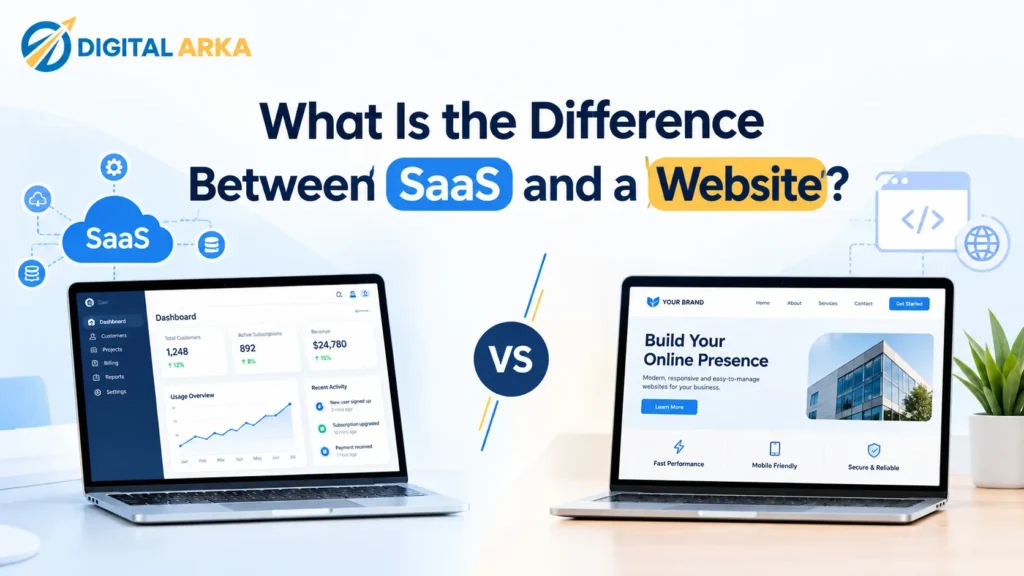

This question gets asked constantly, and it deserves a direct answer: SaaS and a website are not two competing categories of the same thing. A website is a delivery mechanism, pages accessible through a browser. SaaS is a business and software delivery model, a way of packaging and selling software as an ongoing subscription service. Almost every SaaS product has a website. Not every website is SaaS. Comparing them directly is a bit like asking the difference between a restaurant and a delivery van, one is a business, the other is one possible way that business reaches its customer.
What “a Website” Actually Means
A website, in the broadest sense, is simply a collection of pages accessible at a domain. That definition covers an enormous range of genuinely different things: a personal blog, a company’s brochure site, a news publication, an online store, a portfolio, a government information page, and, yes, the marketing site in front of a SaaS product. Having a website says nothing about the business model behind it.
What Makes a Product “SaaS” Specifically
Software as a Service describes a specific way of delivering and selling software, regardless of what the website in front of it looks like. A genuine SaaS product typically has all of the following:
- Subscription-based pricing – ongoing monthly or annual payment, rather than a one-time purchase.
- Cloud hosting – the software runs on the provider’s servers, not installed locally on the user’s device.
- Browser or app-based access – no download or local installation required to use the core product.
- Centralised updates – the provider updates the software for everyone at once; users do not manage version upgrades themselves.
- Multi-tenancy – the same underlying software and infrastructure serves many different customers simultaneously, with each customer’s data kept separate.
A Simple Way to Think About the Relationship
Every SaaS product needs some kind of website, at minimum a login page and usually a full marketing site to attract new customers. But a website with none of the characteristics above, no accounts, no subscription, no ongoing service being delivered, is simply a website, not SaaS. A restaurant’s brochure site, a news outlet’s homepage, and a photographer’s portfolio are all genuine, useful websites. None of them are SaaS, because none of them are delivering an ongoing software service through a subscription.
| Example | Is It a Website? | Is It SaaS? |
|---|---|---|
| A company’s brochure/About Us site | Yes | No – no ongoing service delivered |
| A project management platform (e.g. Asana-style) | Yes (the marketing/login site) | Yes – subscription, cloud-hosted, accounts |
| An online newspaper | Yes | No – content delivery, not software service |
| A free online PDF converter | Yes | Debatable – see our tools-website comparison article |
| An e-commerce store | Yes | No – selling physical or digital goods, not access to software |
Why This Distinction Matters for SEO
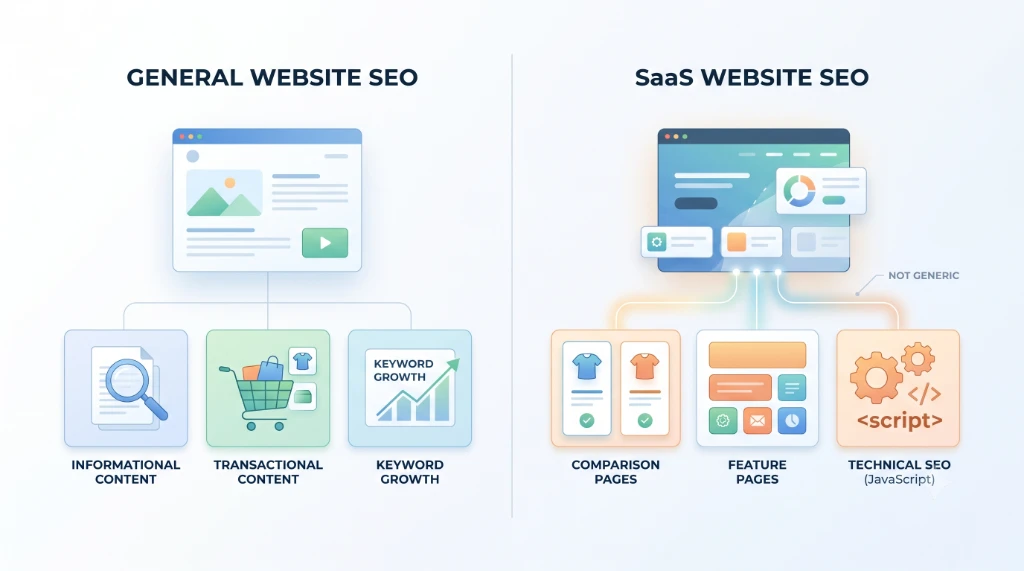
The distinction is not just semantic, it directly changes how a site should be optimised. A general website is typically optimised around informational or transactional content matched to what the business sells. A SaaS website needs a fundamentally different structure: comparison pages, feature pages, and technical SEO built for the JavaScript-heavy frameworks SaaS marketing sites commonly run on. Our SaaS Website SEO service is built specifically around that distinction, not a generic website SEO package relabelled for software companies.
A Note on “Web App” and Other Adjacent Terms
Two related terms often add to the confusion. A “web app” describes an interactive, application-like website, something that behaves more like software than a static page, but does not by itself imply a subscription business model; a free calculator can be a web app without being SaaS. “Cloud software” is often used loosely as a synonym for SaaS, and in practice the two terms usually do describe the same thing, though “cloud software” sometimes gets applied more broadly to enterprise infrastructure services that are not sold directly to end users the way typical SaaS products are.
Conclusion
A website is the “what,” the pages a visitor actually sees. SaaS is the “how,” a specific business and delivery model that a website might sit in front of, or might not. Every SaaS company has a website. Most websites are not SaaS. Once that relationship is clear, the more useful question stops being “what is the difference” and becomes “does my website sit in front of a genuine SaaS product, and is it optimised accordingly.”