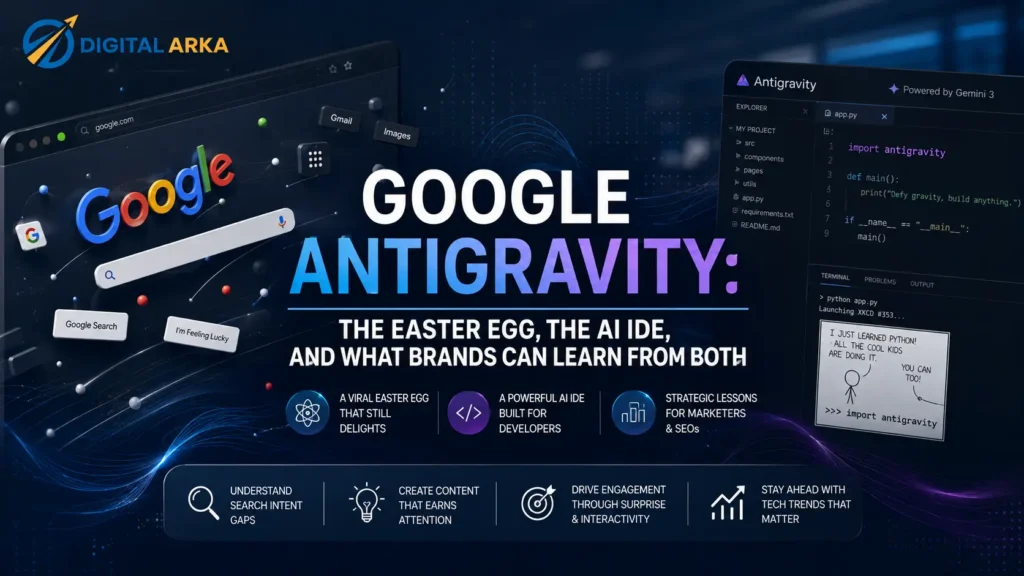

What Actually Is Google Antigravity?
Most people who type “Google Antigravity” into a search bar expect one of two things. Either they want to watch their browser turn into a physics playground — elements tumbling, the Google logo sliding to the floor — or they stumbled onto news about Google’s new AI development platform that borrowed the same name. Both are real. Neither involves literal gravity manipulation, anti-gravity devices, or theoretical physics research by Google.
At Digital Arka, we cover technology trends that actually affect how people search, discover, and connect with businesses online. Google Antigravity touches all three of those areas — and the story behind the name is genuinely worth understanding, even if (or especially because) it keeps confusing people who search for it.
💡 Digital Arka tip: If you are researching Google Antigravity for content marketing purposes, this topic ranks because of search curiosity and the viral nature of Easter eggs — not because of any real-world anti-gravity science. Understanding that intent gap is the strategy.
Part 1 — The Browser Easter Egg (The One That Started It All)
The Origin: Mr. Doob and the Chrome Experiments
In 2009, a developer named Ricardo Cabello — known online as Mr. Doob — created a Chrome Experiment called Google Gravity. It worked like this: you visited Google.com, typed “Google Gravity” in the search bar, and clicked “I’m Feeling Lucky” instead of pressing Enter. The page collapsed. Every element — the logo, the search box, the buttons — fell to the bottom of the browser window under simulated gravity.
Google did not build this. Mr. Doob built it independently and hosted it on Chrome Experiments (chromeexperiments.com), Google’s showcase for creative browser demonstrations. The experiment went viral almost immediately, spread through blogs and forums, and eventually spawned an entire family of variants.
Google Antigravity is that family’s most popular variant. Where Google Gravity makes everything fall down, Google Antigravity makes everything float upward. Elements drift toward the top of the screen, the search bar rises, buttons collide in mid-air. The search function still works throughout. You can drag elements, throw them, and stack them. The whole thing runs in your browser using JavaScript, CSS, and a physics engine called Matter.js or Box2D — no plugins, no downloads, no setup.
How to Activate Google Antigravity Right Now
- Open Google.com in a desktop browser (Chrome, Firefox, Edge, or Safari).
- Type Google Gravity or Google Antigravity in the search bar.
- Click the “I’m Feeling Lucky” button — do not press Enter.
- Watch every element on the page lose its grip and start floating or falling.
- Click, drag, and throw elements to interact with the simulation.
If the Easter egg does not activate, disable ad blockers or browser extensions that might intercept the redirect. The experience works best on desktop — mobile browsers do not render it reliably.
⚡ From Digital Arka: This is a perfect example of zero-click search intent in action. Users who type “Google Antigravity” often want to experience it immediately, not read about it. If you build a page around this topic, lead with the “how to activate it” steps at the top — that is what satisfies the query and earns the featured snippet.
The Technology Behind the Easter Egg
Google Antigravity uses browser-based physics simulation, not actual gravity science. Here is what the script does, step by step:
- DOM Capture — the script identifies every key element on the page: logo, search bar, buttons, navigation links.
- Layout Release — it removes the CSS positioning rules that lock elements in place, freeing them from the normal document flow.
- Physics Mapping — each freed element becomes a physics body with properties: mass, velocity, gravity direction, and collision boundaries.
- Real-Time Simulation — a JavaScript physics engine (Matter.js or Box2D) calculates movement, bouncing, and collision between objects at 60 frames per second.
- Interactive Layer — mouse and touch events let users grab and throw elements, adding tactile interaction to the visual simulation.
The result is a page that looks like Google but behaves like a pinball machine. No server requests, no special access, no actual physics — just JavaScript creativity applied to a recognisable UI.
Part 2 — Google Antigravity the AI IDE (The 2025 Product)
Why Google Named an AI Coding Platform “Antigravity”
In November 2025, Google launched Antigravity — an agentic AI development platform powered by Gemini 3. The name is not accidental. It references two layers of developer culture simultaneously.
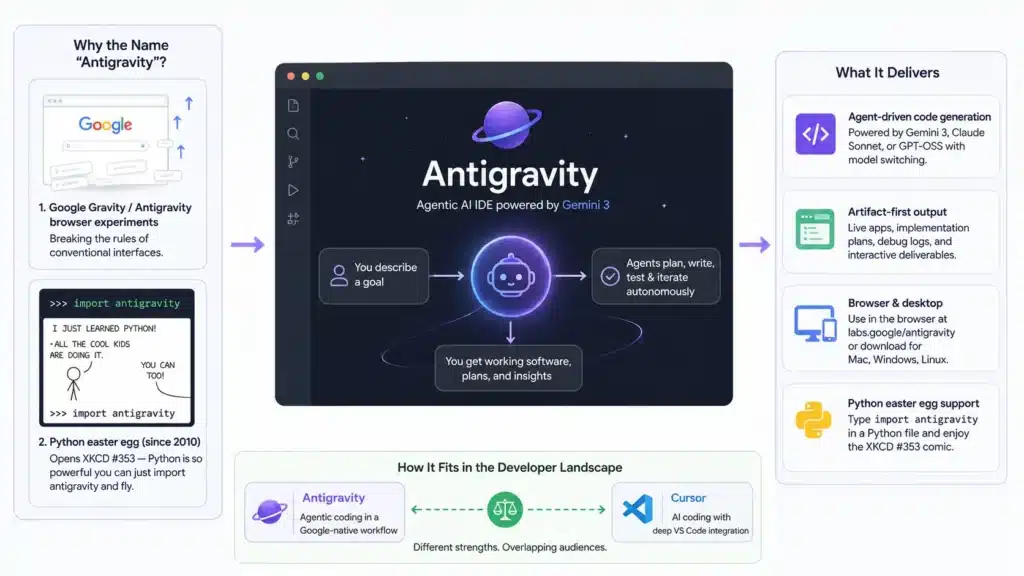
First, it references the Google Gravity / Antigravity browser experiments — a nod to breaking the rules of conventional interfaces. Second, and more specifically for developers, it references the Python standard library easter egg: type import antigravity in any Python 3 interpreter and a browser opens to XKCD comic #353, which shows a stick figure announcing that Python is so powerful you can just import antigravity and fly. Python has included this easter egg in its standard library since 2010. Google named the product to carry that reference forward — the promise that building software can feel effortless, almost weightless.
What the Antigravity AI IDE Actually Does
Antigravity (the product at labs.google/antigravity) operates as an agentic development environment. Instead of asking a chatbot for code snippets and copying them manually, users describe a goal and Antigravity’s agents plan, write, test, and iterate on code autonomously. Key features include:
- Agent-driven code generation — powered by Gemini 3, Claude Sonnet, or GPT-OSS (model switching available)
- Artifact-first output — the system generates live apps, implementation plans, and debug logs as interactive deliverables, not blocks of text
- Browser and desktop — available as a browser tool at labs.google/antigravity and as a downloadable desktop client for Mac, Windows, and Linux
- Python easter egg support — typing import antigravity inside a Python file in the IDE triggers the XKCD comic as a knowing reference
Tech circles debated whether Antigravity the IDE would replace Cursor (a popular subscription AI coding editor) when it launched as a free public preview. As of mid-2026, both tools exist and serve overlapping audiences — developers who want agentic coding inside a Google-native workflow versus those who prefer Cursor’s VS Code integration.
Google Anti-gravity can also help Non-coders those who don’t want to use it for coding purpose.
Part 3 — What Digital Marketers and SEOs Can Learn From Google Antigravity
Easter Eggs as Engagement Strategy
Google Antigravity is not a marketing campaign. It is the byproduct of a developer experiment that Google hosted, shared, and never officially endorsed. Yet it generates millions of searches annually, resurfaces on social media with every new generation of web users, and creates what marketers call “earned shareability” — people share it because it delights them, not because anyone paid them to.
For brands building digital presence, the lesson is direct: surprise and delight outlast promotion. A 15-year-old browser experiment still drives curiosity and search volume because it gives users an unexpected moment of joy. Interactive content — calculators, quizzes, tools, micro-games — performs on the same principle. It earns attention rather than buying it.
The Search Intent Gap Around “Antigravity”
People who search for Google Antigravity arrive with at least three different intents, and most content around this topic satisfies only one:
- They want to activate the Easter egg and play with it (most common — immediate, experiential intent)
- They want to understand what the Google Antigravity IDE is and whether to use it (developer intent)
- They believe Google is conducting real-world anti-gravity or gravitational manipulation research and want information on it (misconception-driven intent — the rarest, but the source of many FAQ searches)
That third group drives a significant portion of the FAQ searches Digital Arka’s team analysed when planning this post. Queries like “companies developing antigravity technology” or “is Google working on gravity control” appear because the name creates a powerful association even for users who have never heard of the browser experiment. A good piece of content on this topic must address and gently correct that association — which is exactly what this post does.
Physics-Based Web Interfaces — The Trend Going Mainstream
The biggest practical takeaway for web developers and digital agencies is that physics-driven interfaces are not just Easter eggs anymore. The principles behind Google Antigravity — DOM manipulation, physics simulation, real-time collision — underpin interaction design trends that are moving into mainstream product design:
- Drag-and-drop interfaces with realistic momentum and bounce (popular in mobile apps and dashboards)
- Particle and physics-based hero animations on brand websites (increasingly common in SaaS and fintech)
- Interactive data visualisations where users physically manipulate chart elements
- Gamified onboarding flows that use physics feedback to guide user attention
Libraries like Matter.js, Cannon.js, and React Spring make these effects accessible without specialist game development knowledge. The gap between “Easter egg novelty” and “product feature” is closing fast.
What Digital Arka Thinks About All This
Here’s the honest summary. Google Antigravity is three things at once: a nostalgic browser trick from 2009 that still delights people, a deliberate product name loaded with developer culture references, and a search query that pulls in users looking for something that does not exist (real anti-gravity research by Google).
That last point is the most interesting one from a digital marketing perspective. A topic can rank, generate clicks, and build audience purely because of the gap between what users expect a term to mean and what it actually is. Smart content strategy fills that gap with honest, useful information — which is exactly what earns trust and earns the citation in Google’s AI Overviews.
At Digital Arka, we help businesses in Delhi NCR navigate exactly these kinds of search intent gaps — whether that means identifying unexpected keyword opportunities, building content that earns AI citations, or understanding why certain searches spike and what to do about them. If your brand is trying to figure out how to appear in Google’s AI-generated answers rather than just the blue links, that is the conversation we specialise in.
📞 Want Digital Arka to audit your site for AI search visibility and content gaps? Visit digitalarka.com or call +91 70110 34858 for a free consultation.
Frequently Asked Questions About Google Antigravity
We reviewed all FAQ queries associated with this topic, merged questions with overlapping intent, and answered each one with the accuracy it deserves — including the ones built on misconceptions.
Q1. What exactly is Google Antigravity — the Easter egg, the IDE, or something else?
A: Google Antigravity refers to two distinct things. First, it is a browser-based physics Easter egg originally created by developer Ricardo Cabello (Mr. Doob) in 2009 as a Chrome Experiment. It makes Google homepage elements fall or float using JavaScript physics simulation. Second, in November 2025, Google launched a product called Antigravity — an agentic AI development platform powered by Gemini 3. Despite the dramatic name, neither involves real-world gravity manipulation or scientific anti-gravity research. Digital Arka recommends reading both sections of this post to understand the full picture.
Q2. What technology powers the Google Antigravity Easter egg?
A: The Easter egg runs entirely in your browser using JavaScript, HTML5, and CSS — no plugins or downloads needed. The script captures DOM elements (logo, search bar, buttons), removes their CSS positioning constraints, and treats each element as a physical body inside a real-time physics simulation. Popular JavaScript libraries used in variations include Matter.js and Box2D. The result is a convincing simulation of gravity or zero-gravity without any actual physics technology.
Q3. Is Google actually conducting anti-gravity or gravitational manipulation research?
A: No. Google has no confirmed anti-gravity research programme. The name “Google Antigravity” comes from a JavaScript Easter egg and a developer culture reference, not from any scientific gravity-control project. No credible report from any major technology company confirms active research into gravity manipulation. Search results that imply otherwise conflate the playful product name with speculative or fictional science. At Digital Arka, we always recommend cross-checking extraordinary technology claims against peer-reviewed sources or reputable science journalism.
Q4. What is zero-point energy and does it relate to Google Antigravity?
A: Zero-point energy is a legitimate quantum mechanics concept — the lowest possible energy a quantum system can possess, even at absolute zero temperature. Some speculative physics writings explore theoretical links between zero-point energy and hypothetical gravity manipulation. However, no practical technology based on zero-point energy for anti-gravity propulsion exists, and Google Antigravity has no connection to this concept whatsoever. The term appears in searches about Google Antigravity purely because people associate the dramatic name with advanced physics.
Q5. Are there companies or startups genuinely developing anti-gravity or advanced propulsion technology?
A: Legitimate research into advanced propulsion does exist, but it sits firmly in the domain of aerospace and defence — not consumer technology. NASA’s Advanced Concepts research has explored theoretical EmDrive and photon propulsion concepts. DARPA funds speculative physics programmes. Several well-funded aerospace startups (Hermeus, Vast, Impulse Space) work on high-velocity propulsion without any gravity-manipulation claims. No startup has credible, peer-reviewed proof of functional anti-gravity technology. Any company making such claims without published, reproducible research warrants extreme scepticism.
Q6. Can I buy anti-gravity devices or gadgets inspired by Google Antigravity?
A: No product on the market provides actual gravity manipulation. Products marketed as “anti-gravity” in India or globally — levitating plant pots, magnetic floating speakers, superconductor levitation kits — use magnetic levitation (maglev) or electrostatic forces, not gravity control. They are genuinely cool products but the “anti-gravity” label is marketing language, not a physics description. No commercial product derives from Google Antigravity research because that research does not exist. Digital Arka advises treating any product claiming “anti-gravity technology inspired by Google” with significant caution.
Q7. Where can I invest in companies developing advanced aerospace or future propulsion technology?
A: Investors interested in the broader aerospace and advanced propulsion sector can research publicly listed companies like Rocket Lab (RKLB), Virgin Galactic (SPCE), and Joby Aviation (JOBY) on stock exchanges. Venture-stage aerospace startups typically raise through Crunchbase-listed rounds rather than public markets. No publicly accessible investment opportunity exists specifically in anti-gravity technology because no credible commercial anti-gravity product exists. Digital Arka does not provide financial advice — consult a SEBI-registered investment advisor before committing capital to any aerospace or deep-tech investment.
Q8. How has Google’s Antigravity project influenced drone technology?
A: Google Antigravity (the Easter egg or the IDE) has no direct influence on drone technology. However, the physics simulation principles behind the Easter egg — real-time collision modelling, object mass and velocity calculations — share conceptual DNA with drone navigation algorithms. Modern drone software uses physics engines to simulate flight stability, obstacle avoidance, and swarm behaviour. The connection is indirect and conceptual, not technological. Google’s actual influence on drone tech comes from Project Wing, its autonomous delivery drone subsidiary, which has nothing to do with the Antigravity name.
Q9. What are the historical claims of levitation or gravity-defying devices?
A: Claimed anti-gravity and levitation devices have a long history. The most notable include: the Hutchison Effect (1980s Canadian inventor John Hutchison claimed random levitation events near Tesla coils — never reproduced under controlled conditions), Dean Drive (1950s — claimed to produce thrust without propellant, debunked by NASA), and various medieval and early modern accounts of levitating saints or monks, which are religious narratives rather than physics claims. Magnetic levitation, demonstrated reproducibly since the 19th century, is the only real-world technology that achieves sustained levitation — and it uses electromagnets, not gravity control.
Q10. Where can I find credible academic papers on gravitational field modification or advanced propulsion physics?
A: Search Google Scholar (scholar.google.com), arXiv.org (the physics pre-print server), and NASA’s Technical Reports Server (ntrs.nasa.gov) using terms like “advanced propulsion concepts,” “gravitational wave detection,” or “quantum gravity.” The American Institute of Aeronautics and Astronautics (AIAA) publishes peer-reviewed propulsion research. Wikipedia’s article on “Gravitational propulsion” provides a good overview of theoretical proposals with citations. Avoid blogs, YouTube channels, or websites that describe gravity manipulation as an achieved technology — no such peer-reviewed evidence exists as of July 2026.
Q11. Where can I find news and updates on advanced propulsion research by large technology or aerospace companies?
A: Reliable sources for advanced propulsion news include: SpaceNews (spacenews.com), Aviation Week (aviationweek.com), NASA’s official news (nasa.gov/news), MIT Technology Review (technologyreview.com), and New Scientist (newscientist.com). For Indian context, the ISRO website (isro.gov.in) covers India’s advanced space propulsion research. Digital Arka also covers technology trends at digitalarka.com — subscribe to our blog for monthly roundups of digital and technology developments relevant to Indian businesses.
Q12. Where can I find patents related to novel propulsion systems or gravity research?
A: Search Google Patents (patents.google.com) using terms like “propulsion system,” “electromagnetic levitation,” or “gravitational wave.” The USPTO (patents.uspto.gov) and the European Patent Office (epo.org) provide full patent text. IP India (ipindia.gov.in) covers Indian patents. Professional patent analysis services include Derwent Innovation, PatSnap, and Anaqua. Note that a patent application for anti-gravity technology does not prove the technology works — patents cover novel ideas, not validated science.
Q13. Can I attend conferences or events about advanced physics, quantum gravity, or propulsion research?
A: Yes. Reputable conferences include: the AIAA SciTech Forum (annual, covers advanced propulsion), the American Physical Society March Meeting (fundamental physics including gravity research), the International Astronautical Congress (global space technology conference), and IEEE Aerospace Conference. In India, the Indian Physics Association (ipa.org.in) hosts annual conferences. For online learning, platforms like Coursera, edX, and MIT OpenCourseWare offer accredited quantum mechanics and theoretical physics courses taught by university faculty. Digital Arka is happy to help your business build a presence at Indian technology and digital marketing events — contact us for sponsorship and speaker placement strategy.
Q14. Are there apps or online tools that simulate the Google Antigravity Easter egg?
A: The original Mr. Doob Google Gravity experiment remains accessible at mrdoob.com/projects/chromeexperiments/google-gravity/. The site elgoog.im hosts multiple Google Easter egg variants including Anti-Gravity, Space, Sphere, Underwater, and Mirror versions. You can also build your own version using the Matter.js documentation (brm.io/matter-js/docs/) — it is a popular beginner JavaScript project that teaches DOM manipulation and physics simulation simultaneously.
Q15. What other Google Easter eggs exist beyond Antigravity?
A: Google maintains a rich tradition of Easter eggs inside Search and its products. Active ones as of July 2026 include: “Do a barrel roll” (spins the search results page 360 degrees), “Askew” (tilts the page), “Zerg rush” (animated O’s attack your search results), “Google Pac-Man” (playable Pac-Man in the Google homepage doodle), and “the answer to life the universe and everything” (returns 42, a Hitchhiker’s Guide reference). In Google Images, searching “Atari Breakout” once triggered a playable Breakout game — though availability varies by browser update cycles.
Q16. How has Google Antigravity influenced web development trends?
A: The Google Gravity and Antigravity experiments demonstrated that browser-native JavaScript could simulate convincing real-time physics without plugins — a capability that felt extraordinary in 2009 and has since become standard web tooling. Their influence shows up directly in: the rise of physics-based UI libraries (Matter.js, Cannon.js, Rapier), the normalisation of interactive canvas and WebGL animations in brand websites, gamified onboarding flows in SaaS products, and interactive data visualisations that users physically manipulate. Ricardo Cabello (Mr. Doob) also created Three.js, now the dominant 3D JavaScript library, which grew from the same Chrome Experiments ecosystem.
Q17. Does Google Antigravity have any connection to drone, delivery robot, or transport technology?
A: No direct connection exists. Google’s actual autonomous transport research happens through Waymo (self-driving cars) and Wing (drone delivery), neither of which uses or references the Antigravity Easter egg or name. The Antigravity IDE (the 2025 AI coding platform) also has no transport application. If you are researching AI and transport technology, Digital Arka recommends following Google DeepMind’s robotics research, Waymo’s technical blog, and Wing’s operational updates as the authoritative sources.
Q18. How do experts and scientists respond to private companies claiming gravity manipulation breakthroughs?
A: The scientific response follows a consistent pattern. Physicists and aerospace engineers ask for three things: peer-reviewed publication in a reputable journal, independent third-party replication of results, and a theoretical mechanism that does not violate known conservation laws (energy, momentum). Claims that fail any one of these tests do not earn scientific credibility regardless of company size, marketing budget, or patent applications. To date, no private company claim of functional anti-gravity or gravity control has passed all three criteria. Respected sceptical resources include NASA’s Innovative Advanced Concepts programme (which funds plausible-but-speculative ideas while rejecting pseudoscience) and the James Randi Educational Foundation’s legacy documentation of debunked extraordinary claims.
Q19. What books cover the future of transportation, personal flight, and advanced propulsion concepts?
A: Worth reading: “The Case for Mars” by Robert Zubrin (practical advanced propulsion for space travel), “Physics of the Future” by Michio Kaku (speculative but scientifically grounded look at future transport), “How to Make a Spaceship” by Julian Guthrie (private aerospace history), and “The Martian” by Andy Weir (fiction with accurate orbital mechanics). For theoretical physics context, “A Brief History of Time” by Stephen Hawking and “Gravitation” by Misner, Thorne, and Wheeler (technical) cover gravitational physics comprehensively. None of these validate anti-gravity consumer products — they contextualise the genuine science that makes anti-gravity an active area of theoretical interest.