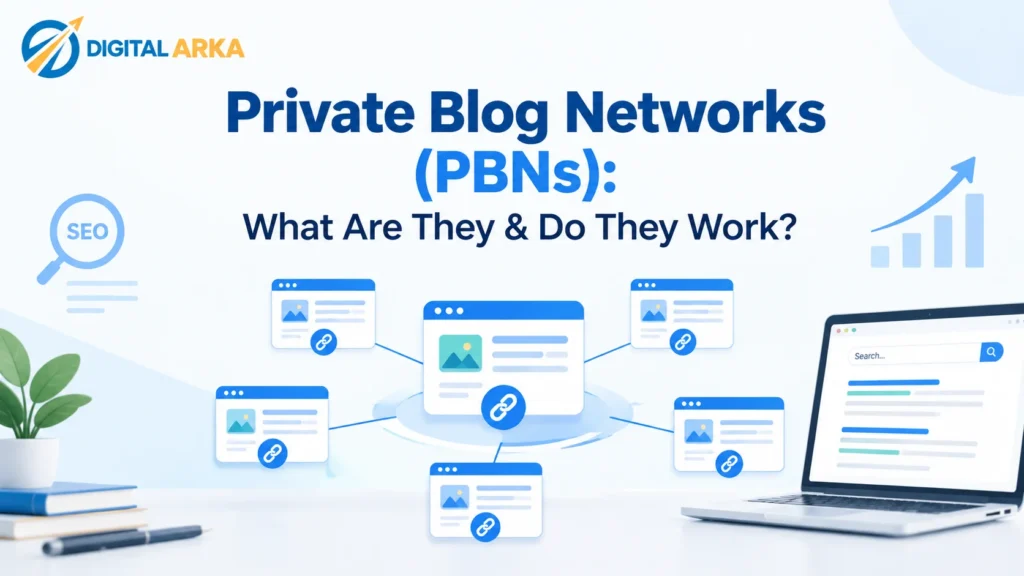

A Private Blog Network, or PBN, is a group of separately owned-looking websites built for one real purpose: linking back to a single “money site” to manipulate its search rankings. The individual blogs often look legitimate on the surface, sometimes built on expired domains that already carry some backlink history, but their actual content exists mainly to host links, not to serve genuine readers. PBNs sit near the top of the list when SEOs talk about tactics that violate search engine guidelines, and understanding why matters more than understanding how to build one.
How a PBN Is Typically Structured
A PBN usually starts with a set of expired or auctioned domains chosen specifically because they already carry backlink history and some accumulated authority from their previous, unrelated life. The operator rebuilds each domain into a small, independent-looking site, different design, different hosting, different registration details, then quietly links from each of these sites back to the actual business site they are trying to rank. From the outside, each individual blog is built to look like an unrelated, organic publisher. In reality, the entire network answers to one owner with one goal.
Why People Still Build Them
The appeal is straightforward on paper: instead of earning links slowly through genuine outreach, content, and relationship-building, an operator who owns the network controls exactly which pages get linked, with what anchor text, and on what timeline. For a business or SEO provider trying to move rankings quickly, that level of control looks like a shortcut around the more gradual, patience-dependent work covered in our own guide on genuine link-building for specific industries.
Do PBNs Actually Work?
This is the honest, uncomfortable answer: PBNs can produce genuine, sometimes substantial ranking movement, at least temporarily, which is exactly why the tactic has persisted despite being against the rules for over a decade. That short-term effectiveness is also precisely what makes PBNs dangerous rather than merely risky in the abstract, a tactic that visibly does not work at all would have died out on its own by now.
The more accurate question is not “do they work” but “do they work reliably, safely, and for long enough to justify the investment,” and on that question the answer is consistently no. Search engines have spent years specifically refining detection methods for exactly this pattern, and the asymmetry between a PBN’s temporary upside and its potential downside is severe.
Why the Risk Is So Asymmetric
- Manual action penalties – a site caught benefiting from a PBN can receive a manual action that suppresses rankings sitewide, not just for the specific pages the network was linking to.
- Full deindexing of the network itself – search engines have deindexed entire PBN networks in coordinated sweeps in the past, erasing the operator’s entire investment in every domain at once, not gradually.
- No reliable early warning – a PBN can appear to be working for months before a penalty arrives, meaning the business has often already built further marketing and growth plans on top of rankings that are about to disappear.
- Difficult, sometimes impossible recovery – recovering from a manual action tied to unnatural links requires disavowing the offending links and formally requesting reconsideration, a process with no guaranteed timeline or outcome.
- Reputational exposure beyond search rankings – a business publicly associated with manipulative link schemes risks the kind of reputational damage that outlasts any ranking recovery.
| Factor | PBN Links | Genuine Earned Links |
|---|---|---|
| Upside | Fast, controllable ranking movement | Slower, compounding authority over time |
| Downside if discovered | Sitewide penalty, possible full deindexing | None, links remain genuinely earned |
| Detection risk over time | Increases as detection methods improve | Not applicable, nothing to detect |
| Recovery path if penalised | Uncertain, disavow + reconsideration request | Not applicable |
| Compounding value | Erased entirely if network is caught | Continues compounding indefinitely |
How Search Engines Actually Catch PBNs
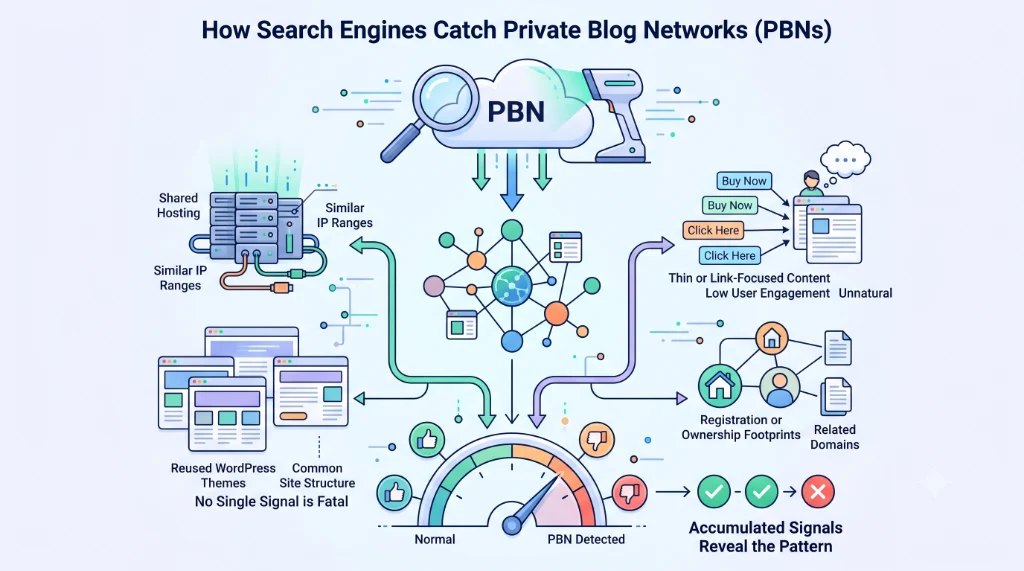
Detection generally works by pattern recognition across signals a manually built site struggles to hide consistently: shared hosting infrastructure or IP ranges across supposedly unrelated domains, similar site structures or WordPress themes reused across the network, thin or clearly link-focused content with no genuine engagement, unnatural anchor text patterns concentrated on the same target pages, and registration or ownership patterns that connect domains that should have no relationship to each other. No single signal alone is usually fatal; it is the accumulation of several that reveals the pattern.
What This Means If You Are Evaluating an SEO Provider
If an agency or freelancer promises fast ranking improvement through a proprietary “network” of sites they control, ask directly whether this involves a PBN or any form of link scheme, and treat evasive answers as a genuine warning sign. The upside they are offering is real in the short term, but you, not the agency, carry the actual penalty risk, since the penalty lands on your business’s domain, not theirs.
⚠ A provider unwilling to disclose exactly where your backlinks are coming from is not protecting a trade secret. They are protecting themselves from a conversation about risk you are entitled to have before committing budget.
The Sustainable Alternative
Genuine authority, built through the kind of trade publication features, award submissions, and digital PR covered in our guide on building SEO backlinks, takes longer to accumulate but carries none of the asymmetric downside a PBN does. It cannot be deindexed overnight, does not depend on hiding ownership patterns from an increasingly sophisticated detection system, and compounds in value the longer it exists rather than resetting to zero the moment it is discovered.
Conclusion
A PBN can move rankings, at least for a while, which is exactly why the tactic refuses to disappear despite years of search engines actively working against it. But “can move rankings temporarily” and “is a sound investment” are different questions, and on the second one, the asymmetry between a limited, uncertain upside and a potentially total, sitewide downside makes PBNs a genuinely poor bet for any business planning to exist in more than the very short term.
For a deeper technical breakdown of how PBNs are structured and detected, see Semrush’s guide to private blog networks, which we gratefully credit as a helpful additional resource on this topic.