
Every “top languages” list eventually turns into a popularity contest between JavaScript and everything else. That is not entirely wrong, JavaScript genuinely is unavoidable for web development, but a useful list should also explain what each language is actually for, not just rank them. Here are ten languages that cover the overwhelming majority of real web development work today, along with what each one genuinely does well.
1. JavaScript
The only language that runs natively in every browser, making it unavoidable for front-end interactivity regardless of what else you use. Modern JavaScript also powers backend development through Node.js, letting teams use one language across the entire stack.
2. TypeScript
JavaScript with static typing added on top, catching a meaningful category of bugs before code ever runs. Most serious JavaScript teams at scale have moved to TypeScript specifically for the maintainability it adds to larger codebases.
3. Python
Genuinely readable syntax and a mature web ecosystem through Django and Flask make Python a strong choice for backend development, particularly where the same codebase also touches data science or AI/ML work.
4. PHP
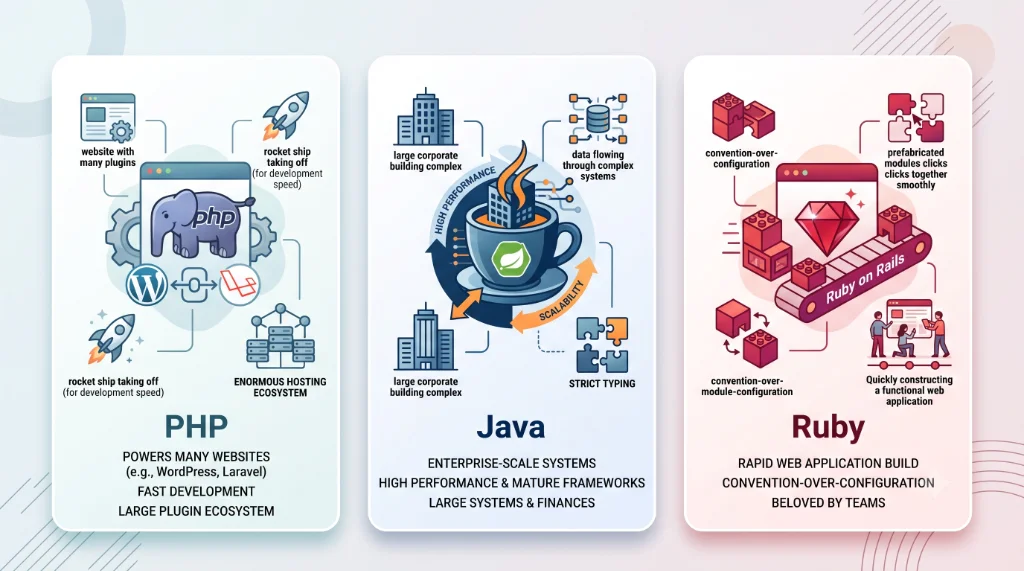
Still powers a substantial share of the web, largely through WordPress and Laravel. Frequently underestimated given its age, but genuinely capable, fast to develop with, and backed by an enormous hosting and plugin ecosystem.
5. Java
A long-standing choice for large-scale, enterprise backend systems, valued for performance, strict typing, and the maturity of frameworks like Spring. Less common for smaller projects, still dominant in large financial and enterprise systems.
6. Ruby
Ruby on Rails popularised convention-over-configuration development, letting small teams build functional web applications unusually quickly. Less dominant than a decade ago, but still genuinely capable and beloved by teams who use it.
7. Go (Golang)
Built by Google specifically for performance and concurrency, Go has become a genuine favourite for backend services that need to handle heavy simultaneous load efficiently, cloud infrastructure, and API-heavy systems.
8. C#
Microsoft’s language, paired with the ASP.NET framework, remains a strong choice for enterprise web applications, particularly in organisations already invested in the Microsoft ecosystem.
9. SQL
Not a general-purpose language, but no web development list is complete without it. Every dynamic website with a database depends on SQL (or a SQL-like query layer) to store and retrieve data, making it genuinely foundational rather than optional.
10. Swift / Kotlin
Grouped together here as the mobile-adjacent entries: Swift for iOS and Kotlin for Android increasingly intersect with web development through progressive web apps and hybrid frameworks, relevant for any team building a connected web-plus-app product.
How to Actually Use This List
A ranked list is a starting point for research, not a decision by itself. The right language for your specific project depends on your team’s existing skills, your performance and scaling requirements, and your timeline, factors covered in more depth in our companion guide, Best Programming Language for Web Development: A Decision Framework.