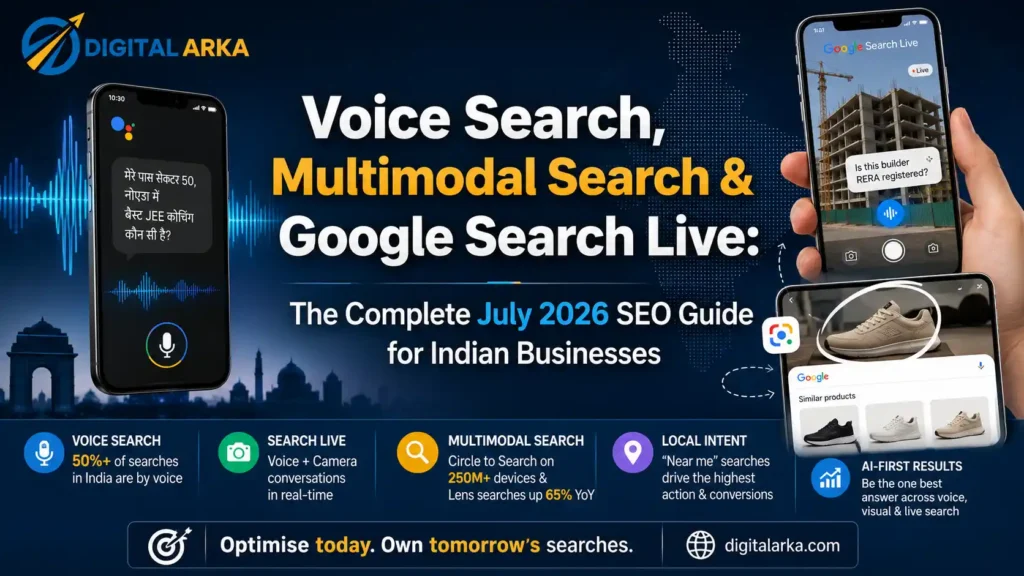

Two of the most consequential changes to how Indian consumers search for businesses online received barely any attention among the flood of Google I/O 2026 coverage: Google Search Live is now expanding to 200+ countries where AI Mode is available, and Circle to Search is now active on more than 250 million devices worldwide — growing faster than any other Google hardware integration in recent history.
Both of these developments represent the maturation of a trend that has been building in India for years. India is fundamentally a voice-first, mobile-first, and increasingly visual-search market. Over 50% of all online searches in India are now conducted by voice. Hindi, Tamil, Telugu, Bengali, and other regional language voice searches are growing at 156% compared to English text searches in Tier 2 and Tier 3 cities. And Google Lens searches have increased by more than 65% year-on-year in India as camera-equipped smartphones become the primary research tool for millions of Indian consumers.
For Indian businesses, this is not a future trend to prepare for. It is the present reality that your SEO strategy must already be addressing. This blog covers everything: what voice search, multimodal search, and Search Live mean for Indian businesses in July 2026, the specific ways Indian search behaviour differs from global patterns, and the complete optimisation framework for capturing the audience that is already searching in these new ways.
The central strategic shift: Search in 2026 is less “10 blue links” and more “one best answer” — delivered by voice, summarised from an image query, or extracted by a camera search. In India, Google is pushing AI Mode plus Search Live (voice + camera), which makes your content compete on clarity, trust, and usefulness — not just rankings.
What Voice Search, Search Live, and Multimodal Search Actually Are in July 2026
Before building the optimisation strategy, it is essential to understand what these three search modes actually are and how they differ — because the optimisation requirements for each are distinct.
Voice Search: The Long-Tail Conversational Query
Voice search is the oldest of the three modes — users speaking queries to Google Assistant, Siri, Alexa, or directly into Google Search on their smartphones. The defining characteristic of voice search is that voice queries are significantly longer and more conversational than typed queries. Where a typed query might be “dentist Rohini Delhi,” the voice equivalent is “Which dentist in Rohini is open on Sunday and accepts Cashless payment?” Where a typed query is “JEE coaching Noida,” the voice equivalent is “What is the best JEE coaching institute near Sector 50 Noida that has good results for students from science background?”
Voice query lengths have tripled inside AI Mode according to Google’s own data from 2026. Follow-up queries (users asking follow-up questions after an initial voice query) are up 40% monthly in the US, with similar patterns emerging in India. This makes voice search not just a different query format but a different user behaviour model: users are having conversations, not submitting single queries.
Google Search Live: Voice + Camera in Real-Time
Search Live is the most significant new development in the voice search category. Launched in the US in 2025, Google Search Live is now expanding to 200+ countries where AI Mode is available — including India. Search Live allows users to have a live voice conversation with Google while pointing their smartphone camera at the real world, asking questions about what they see in real time.
Practical examples of how Indian consumers are using Search Live: a shopper in Lajpat Nagar market points their camera at a fabric and asks Google “is this pure silk or synthetic?” A patient in Hyderabad points their camera at a prescription and asks “what does this medication treat and are there generic alternatives?” A homebuyer visiting a Noida Expressway project points their camera at the construction site and asks “how can I check if this builder has RERA registration?”
For Indian businesses, Search Live means your content must be able to answer real-world visual queries that reference your products, services, location, or category. A clinic that has published detailed specialist profiles, procedure information, and accreditation data is more likely to be surfaced in a Search Live query about that clinic than one with minimal website content.
Multimodal Search: Circle to Search, Google Lens, and Image Queries
Circle to Search is now active on more than 250 million devices — a Google feature that allows users to circle, highlight, or scribble over anything on their screen (in any app) to initiate a Google search about it. A user watching an Instagram Reel featuring a home decor product can circle the item and instantly search for it. A student reading a textbook PDF can circle a diagram and ask Google to explain it. A shopper browsing a competitor’s website can circle a product and search for similar alternatives.
Google Lens searches have increased by more than 65% year-on-year in India, driven by the combination of better smartphone cameras and Google’s investment in visual understanding capabilities. Indian consumers are using Lens to identify plants, foods, dishes at restaurants, clothing items, building materials, jewellery, and thousands of other visual categories where traditional text search would be inadequate.
The SEO implication is fundamental: every image on your website is now a potential search entry point. An image of your restaurant’s signature dish, your clinic’s waiting area, your product’s packaging, or your team at work — all of these can be the starting point for a Google Lens or Circle to Search query that brings a potential customer to your website, or surfaces your business in the AI answer to their visual query.
The Indian Voice Search Landscape in July 2026: What Makes It Different
Indian voice search has characteristics that make it significantly different from voice search in the US, UK, or European markets — and understanding these differences is essential for building an effective optimisation strategy.
Multi-Language and Code-Switching Voice Queries
Indian voice search users do not search in one language. They code-switch — mixing Hindi with English, Tamil with English, Bengali with Hindi in a single voice query. “Best dentist near me in Delhi jo Sunday ko khula ho” (best dentist near me in Delhi that is open on Sunday) is a typical Hindi-English voice query. “Chennai mein best software company kya hai” (what is the best software company in Chennai) blends Hindi question structure with a Tamil city name.
Google’s speech recognition for Indian languages has improved dramatically through 2025 and 2026, with Google’s Indian language models now handling code-switching with high accuracy. This means businesses that optimise their content for code-switched query patterns — Hindi-English for North India, Tamil-English for Tamil Nadu, Telugu-English for Andhra Pradesh and Telangana — capture voice search audiences that English-only content cannot reach.
Near Me Searches Are Dominant and Growing
“Near me” voice searches are disproportionately high in India compared to any other major market. Indian smartphone users have adopted “near me” as a habitual search modifier — “CA near me,” “hospital near me,” “JEE coaching near me,” “pizza delivery near me,” “plumber near me” — because local service discovery via voice has become deeply embedded in daily life.
AI Overviews appear in only about 7% of local searches (compared to 48% of all searches), which means local “near me” voice queries retain high click-through and action rates. This is one of the most important asymmetries in July 2026 SEO: local voice search is one of the categories least disrupted by AI zero-click trends and most valuable for Indian businesses to optimise.
Google has confirmed that agentic restaurant booking in AI Mode has expanded beyond the US to include India — along with Australia, Canada, Hong Kong, New Zealand, Singapore, South Africa, and the UK. This means Google’s AI agents can now complete restaurant reservations in India on behalf of users, directly from voice queries. Indian restaurants with optimised booking integrations and complete Google Business Profiles are now visible to agentic booking flows.
Voice Search Is the Primary Interface for Tier 2, 3, and Rural India
For India’s 500 million internet users in Tier 2, Tier 3, and rural markets, voice search is not a secondary interface — it is the primary one. Many users in these markets have limited English literacy but are comfortable searching in Hindi, Bhojpuri, Rajasthani, or their regional language by voice. Text typing is a friction point; voice removes it entirely.
This has created a massive, underserved search audience for businesses willing to optimise for vernacular voice queries. A hospital in Rohtak, a coaching institute in Panipat, or an agricultural input supplier in Karnal that publishes genuine Hindi voice-optimised content has almost zero competition for Hindi voice query rankings in their category — while their English-optimised competitors are completely invisible to this audience.
The Complete Voice Search Optimisation Framework for Indian Businesses
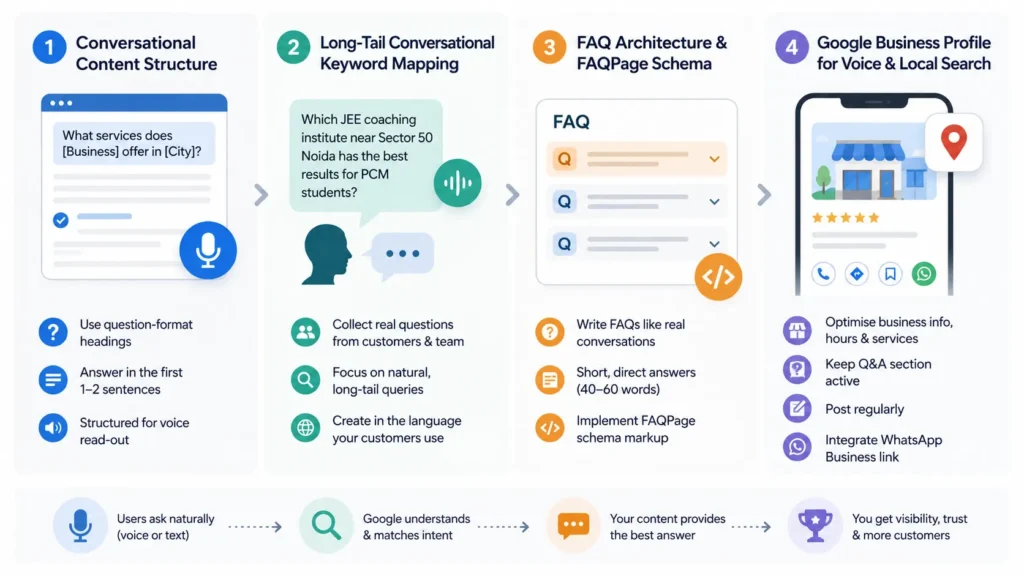
Optimising for voice search requires changes at multiple layers simultaneously: content structure, keyword strategy, technical setup, and local signals. Here is the complete framework, ordered by impact:
Layer 1: Conversational Content Structure
Voice search queries are questions. Your content must answer questions — not present information in the format of a marketing brochure. The fundamental structural change required is converting every section heading from a topic label into a specific answerable question, and placing the direct answer in the first 1–2 sentences after each heading.
The question-heading formula for voice optimisation:
- Instead of heading “Our Services” → use “What services does [Business Name] offer in [City]?”
- Instead of heading “About Us” → use “Why do [City] businesses choose [Business Name] for [Service]?”
- Instead of heading “Pricing” → use “How much does [Service] cost in [City] in 2026?”
- Instead of heading “Contact” → use “How can I book an appointment / consultation / visit?”
These question-format headings directly match the natural language voice queries Indian consumers are using. When Google’s voice interface reads out a search answer, it preferentially extracts the sentence immediately following a question-format heading — making this structure the most reliable way to have your content read aloud as a voice search result.
Layer 2: Long-Tail Conversational Keyword Mapping
Voice search keyword strategy is fundamentally different from traditional keyword research. Where traditional SEO targets “JEE coaching Noida,” voice SEO targets the natural language question “Which JEE coaching institute near Sector 50 Noida has the best results for PCM students?”
The practical approach: interview your sales team, customer service team, and actual customers to collect the exact questions they ask about your business in natural language. These conversations are your voice keyword research. The exact phrasing a customer uses when calling your clinic (“Hello, do you have a skin specialist who does laser treatment for acne scars?”) is a more valuable voice keyword than any tool-generated keyword suggestion.
For Hindi and regional language businesses: conduct this exercise in the language your customers actually use. The questions your patients, students, or customers ask in Hindi when they call you are the Hindi voice queries you should be creating content for.
Layer 3: FAQ Architecture and FAQPage Schema
FAQ sections are the highest-performing content format for voice search optimisation because they mirror the question-answer format of voice query interaction. A user who asks Google a question receives an answer — and the content format most consistently used to generate those answers is an FAQ section with FAQPage schema markup.
Building effective voice-optimised FAQ sections:
- Write questions in exactly the way your customers would ask them — not keyword-optimised variations, but the natural conversational phrasing a real person uses
- Keep answers to 40–60 words each — the ideal length for a voice search read-out is 30–90 seconds, corresponding to roughly 40–80 words
- Answer the question completely in the first sentence — do not start with context or preamble; the answer comes first
- Include location-specific FAQ answers where relevant — “Yes, our Sector 62 Noida branch is open on Saturdays from 9 AM to 6 PM” is a better FAQ answer for local voice queries than “Our branches have extended hours on weekends”
- Mark up every FAQ section with FAQPage schema — this is the technical signal that tells Google’s voice interface that this section contains directly extractable Q&A content
Layer 4: Google Business Profile for Voice and Local Search
For local businesses in India, the Google Business Profile is the single most important asset for voice search visibility. Voice queries for local businesses (“dentist near me,” “best restaurant open now near me”) surface answers primarily from GBP data, not website content.
The voice-optimised GBP checklist for Indian businesses in July 2026:
- Business description in natural, conversational language — write it the way you would describe your business to a friend asking for a recommendation
- Complete and accurate opening hours — voice queries frequently ask “is [business] open now?” or “what time does [business] open?” GBP hours must be accurate and updated for holidays
- Q&A section actively populated — add and answer the most commonly asked questions about your business in the GBP Q&A section; these are directly surfaced in voice search responses
- Regular Google Posts — active posting signals that the business is operational and current, which increases voice search trust signals
- Services section fully completed — with specific service names that match natural language voice query patterns
- WhatsApp Business link integrated — Indian consumers who discover a business through voice search overwhelmingly prefer WhatsApp as the follow-up contact method
Multimodal SEO: Optimising for Google Lens, Circle to Search, and Image Queries
Multimodal search optimisation is the discipline of making every visual element on your website, your Google Business Profile, and your social media presence discoverable through image-based and visual search. In India’s highly visual consumer market — where fashion, food, jewellery, handicrafts, real estate, and healthcare decisions are all heavily influenced by visual assessment — this is a significant, underutilised opportunity.
Image Optimisation for Visual Search Discovery
Every image on your website and GBP is a potential search entry point. Visual search optimisation requires treating each image as a piece of indexed content — not just a design element. Here is the complete image optimisation protocol:
- File names that describe the image accurately: “jee-coaching-class-sector-50-noida.jpg” not “IMG_4523.jpg” — the file name is a signal that helps visual search systems understand what the image depicts
- ALT text that describes the image for both screen readers and visual search systems: “Classroom of JEE Advanced students at our Sector 50 Noida coaching centre during a mock test session” — specific, descriptive, location-inclusive
- Captions near key images: A one-line caption below your most important product, service, or facility images provides contextual text that visual search systems use to categorise the image
- Structured product data for e-commerce: Product schema with price, availability, brand, and image links is the machine-readable signal that connects Google Lens visual searches to your specific products
- High-resolution, well-lit images: Visual search accuracy is directly correlated with image quality — blurry, low-resolution images are harder for Google Lens to classify correctly
The “Screenshot Test” for Multimodal Readiness
Here is a practical test for multimodal search readiness that any Indian business can do today: open your most important service or product page, take a screenshot of the top half of the page (what is visible without scrolling), and ask yourself: “Would a stranger understand what this business does and what it offers in 5 seconds?”
If the answer is no — if your page opens with a generic hero banner, vague tagline, or stock photography that tells the viewer nothing specific about your business — you are failing the multimodal first impression test. Circle to Search users who land on a visual of your page will make an assessment in the same 5 seconds. So will Google’s visual understanding AI when it processes your page for potential visual search results.
The multimodal-ready page opens with: a clear, specific headline that names what you do and where you do it; a high-quality photograph of your actual business, product, or service in action; and an immediate CTA that makes the next step obvious without scrolling.
Video Optimisation for Visual Search — YouTube as Search Engine
YouTube is now the most-cited source in LLM answers overall (per Adweek, January 2026), and YouTube functions as India’s second-largest search engine by query volume. For multimodal SEO, YouTube video optimisation is now a component of a complete visual search strategy — not just a social media consideration.
For Indian businesses, the highest-value YouTube content types for visual search discovery are:
- Process videos: showing how you deliver your service — clinic procedures, coaching teaching methods, product manufacturing, legal consultation process
- Local context videos: content that places your business explicitly in its local context — “Our JEE coaching in Sector 50 Noida: what our classroom looks like and how our batch operates”
- FAQ videos in Hindi or regional languages: answering the most common questions your customers ask, in the language they ask them
Every YouTube video should be optimised with: keyword-rich title (in the language of the target audience), detailed description with the first 150 characters prioritised for search snippet display, chapter markers (timestamps) for each topic covered, and full transcript provided as a closed caption file — which makes the entire spoken content indexable as text.
The Indian Voice and Multimodal SEO Action Plan: July 2026
Given the scope of what voice, Search Live, and multimodal search optimisation requires, here is the prioritised action plan for Indian businesses, ordered by impact and implementation speed:
This Week: Audit Your Current Voice Search Visibility
- Search your 5 most important service queries in natural language voice format (“Which [service] is best in [your area]?”) and observe whether you appear in the result
- Check your Google Business Profile for completeness: hours, Q&A, services, description, and recent posts — these are your voice search data sources
- Conduct the screenshot test on your homepage and top 3 service pages — identify which pages fail the 5-second visual comprehension test
- Audit your top 20 website images: do any have file names like “IMG_1234.jpg”? Do any lack ALT text? Fix these this week — it is the fastest visual search improvement available
This Month: Build the Voice Content Foundation
- Add a FAQ section to every service page and key product page — minimum 5 questions per FAQ, all in natural conversational language your actual customers use
- Implement FAQPage schema markup on every FAQ section
- Rewrite your top 5 service page headings from topic labels to specific answerable questions
- Complete the GBP Q&A section for your business with the 10 most commonly asked questions and clear, complete answers
- Optimise all GBP photos: rename files descriptively, ensure high resolution, add contextual captions, and cover all key visual aspects of your business
This Quarter: Build Voice and Multimodal Content at Scale
- Publish 2 YouTube videos answering the most common questions about your business in the primary language of your audience (Hindi for North India, Tamil for Tamil Nadu, Telugu for Andhra/Telangana)
- Create a dedicated “voice-first” page for each major service: structured as one question and one direct answer per paragraph, with a FAQ section at the bottom
- Build Hindi (or regional language) versions of your top 5 service pages for businesses in markets where vernacular voice search represents 50%+ of potential customer queries
- Implement HowTo schema on any procedural content that explains a multi-step process — these are preferentially cited in voice answers for “how to” queries
The Bottom Line: Voice and Multimodal Are Not Future Trends — They Are Current Reality
When a business owner in Rohini asks Google Assistant “which CA near me has experience with GST for e-commerce businesses?” — that voice query is happening right now, hundreds of times daily. When a patient in Banjara Hills uses Circle to Search on a medication image to find a pharmacy that stocks it — that visual search is happening right now. When a homebuyer in Sector 150 uses Search Live to point at a construction site and ask about the builder’s credentials — that is happening right now.
The question for Indian businesses in July 2026 is not whether voice and multimodal search are important. The data is unambiguous: 50%+ of Indian searches by voice, 65%+ growth in Google Lens, 250M+ Circle to Search devices, Search Live expanding to India. The only question is whether your business is optimised for this reality or whether you are leaving that audience entirely to your competitors.
The businesses that will own voice and visual search visibility in Indian markets are the ones building the content, FAQ architecture, GBP completeness, image optimisation, and YouTube presence that these search modes require — starting now, before every competitor has caught up and the first-mover advantage is gone.
“In a world where AI can read, listen, and see, the content that stands out will always be the content that connects — with clarity, trust, and specific answers to specific questions.”
DigitalArka optimises Indian businesses for voice search, Google Search Live, and multimodal search discovery. Get a free visibility audit at digitalarka.com