

The direct answer first: for most businesses, no, and the SEO community’s own consensus on this has shifted noticeably over the past several years, including in the discussion threads where practitioners have compared notes on exactly this question. A Web 2.0 PBN is a specific variant of the private blog network built on free, third-party platforms, Blogger, WordPress.com, Tumblr, Weebly, and similar, rather than self-hosted expired domains. It emerged as a cheaper, faster alternative to traditional PBNs, and it carries a genuinely different, and in several ways worse, risk profile than the traditional version.
What Makes a PBN “Web 2.0” Specifically
A traditional PBN is built on self-hosted, individually purchased domains, often expired ones chosen for their existing authority. A Web 2.0 PBN instead uses free accounts on established publishing platforms as the network nodes, relying on the platform’s own domain authority (blogspot.com, wordpress.com, and similar) rather than any authority the individual page itself has earned. The appeal is obvious: no domain purchase cost, no hosting to manage, and a fast setup process using platforms that are inherently, individually, genuinely trusted by search engines.
Why the Community Consensus Has Shifted
Discussion among SEO practitioners on this specific question, including on forums like r/SEO, has increasingly converged on scepticism about whether Web 2.0 PBNs still deliver meaningful, durable value, for reasons that go beyond the general PBN risk already well understood in the industry.
Most Links From These Platforms Carry Less Weight
A meaningful share of free Web 2.0 platforms apply nofollow attributes or otherwise limit how much ranking value a link passes by default, specifically because these platforms are common, well-known targets for exactly this kind of link manipulation. Building a network whose primary currency, passed link value, is structurally reduced from the start undermines the entire premise before detection risk even enters the conversation.
The Footprint Problem Is Genuinely Worse, Not Better
A self-hosted PBN at least requires effort to disguise, different hosting, different themes, different registration data. A Web 2.0 PBN sits on the same handful of known platforms by definition, using the same template constraints, the same URL structures, and often the same predictable account creation patterns. This makes cross-network pattern detection considerably easier, not harder, than a well-built traditional PBN, precisely the opposite of what the lower cost and effort might suggest.
You Do Not Actually Own the Nodes
Every account in a Web 2.0 PBN exists at the platform’s discretion, not the operator’s. A traditional PBN owner at least owns the domains outright. A Web 2.0 PBN operator has invested time building content and links across accounts that WordPress.com, Blogger, or any other host can suspend or delete unilaterally, for violating that specific platform’s own terms of service, entirely independent of and in addition to any search engine penalty risk. This is a second, separate point of failure a traditional PBN does not carry.
| Factor | Traditional PBN | Web 2.0 PBN |
|---|---|---|
| Setup cost | Domain purchase + hosting | Free |
| Link value passed | Full, if the domain is genuinely authoritative | Often reduced (nofollow or platform-limited) |
| Footprint detectability | Lower, if genuinely well-disguised | Higher, shared platform patterns are easy to spot |
| Ownership risk | Search engine penalty only | Search engine penalty AND platform account suspension |
| Effort to appear independent | Considerable (hosting, themes, WHOIS) | Limited, constrained by the platform itself |
Where Web 2.0 Platforms Still Make Sense
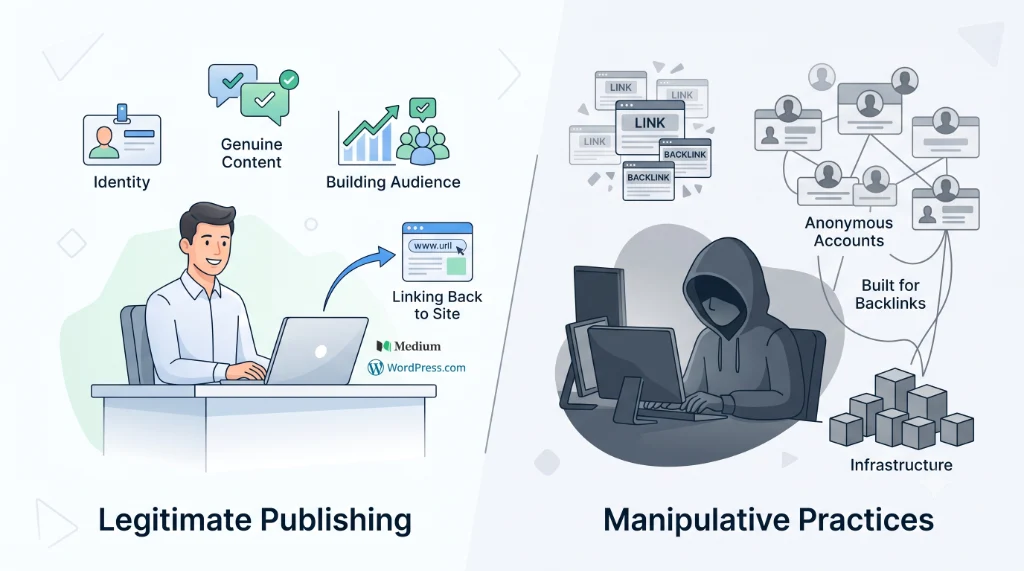
The platforms themselves, Medium, WordPress.com, LinkedIn Articles, are entirely legitimate when used as intended: publishing genuine content under your real identity or brand, building an actual audience, and linking back to your site the way any honest publisher naturally would. The distinction that matters is intent, not the platform. A single, genuinely maintained Medium publication under your real brand is a legitimate content distribution channel. A dozen anonymous, link-focused accounts across a handful of free platforms, built specifically to manufacture backlinks, is the same manipulative pattern a traditional PBN represents, just built on borrowed infrastructure instead of owned domains.
So, Is It Still Worth It?
Weighed honestly against genuine alternatives, a Web 2.0 PBN asks you to accept most of the same penalty risk a traditional PBN carries, while adding a second failure point (platform account suspension) and generally passing less ranking value per link due to nofollow attributes and platform-level restrictions. The lower upfront cost does not offset a worse overall risk-to-reward ratio; it mainly makes the tactic more accessible to people who have not fully priced in what they are actually trading away.
Conclusion
A Web 2.0 PBN is not a safer, lighter version of a traditional private blog network, it is arguably a riskier one, carrying reduced link value, easier detectability, and an added layer of platform-level risk a self-hosted network does not have. The genuine alternative remains the same one covered in our guide on building SEO backlinks, authority earned through real publications, real relationships, and real editorial judgement, which cannot be suspended by a platform or deindexed in a coordinated sweep, because there is no manipulation to eventually uncover.
This topic has also been discussed at length within the SEO practitioner community; see this r/SEO discussion thread on Web 2.0 PBNs, which we gratefully credit for reflecting the practical, on-the-ground perspective this article draws on.