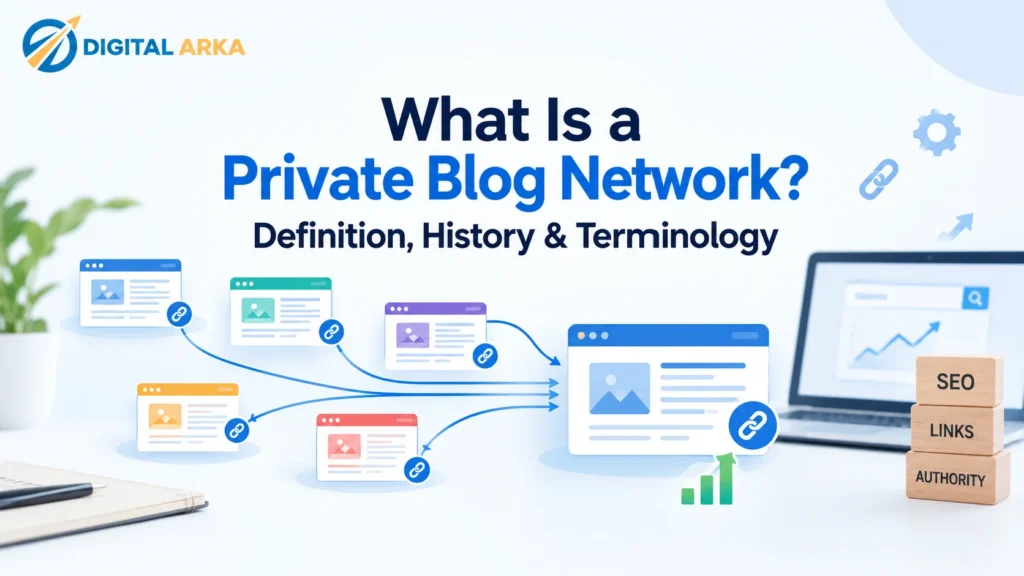

A Private Blog Network, almost always shortened to PBN, is a set of websites secretly owned and controlled by one operator for the sole purpose of linking to a target site and inflating its search rankings. The word “private” refers to that hidden common ownership, on the surface, each site in the network is built to look like an independent, unrelated publisher. The word “network” refers to the fact that these sites exist as a coordinated group serving one owner’s interest, not as genuinely separate publications that happen to link to similar things.
A Brief History: Why PBNs Emerged
PBNs grew directly out of a genuine truth about how early search algorithms worked: a page with more backlinks, particularly from older, more established domains, tended to rank better, largely regardless of whether those links reflected real editorial endorsement. Once that pattern became widely understood, a natural, if rule-breaking, response followed: if backlinks from aged, authoritative domains move rankings, why not simply acquire or build domains with that profile and control the links directly, rather than waiting for genuine third-party sites to link naturally.
Search engines have spent well over a decade responding to this specific pattern. Major algorithm updates targeting manipulative link schemes, most notably Google’s Penguin update, were built substantially around identifying and devaluing exactly this kind of artificial link pattern. Multiple large-scale PBN sweeps since then have resulted in entire networks being deindexed simultaneously, a coordinated response reflecting how seriously search engines treat the pattern once identified.
The Anatomy of a Typical PBN
Most PBNs share a recognisable structure, even though individual implementations vary in sophistication.
- Expired or auctioned domains – chosen specifically because they carry pre-existing backlink history and some inherited authority from an entirely unrelated previous use.
- A “money site” – the actual business or client site the entire network exists to benefit, the one property all the links ultimately point toward.
- Disguised common ownership – different hosting providers, different WHOIS registration details, different visual themes, all intended to make each site appear independently owned.
- Link-focused, thin content – articles that exist primarily to host outbound links naturally, rather than to serve a genuine reading audience with no connection to the target site.
Key Terminology Around PBNs
| Term | What It Means |
|---|---|
| Money site | The actual business site the PBN exists to benefit; the ultimate destination of the links. |
| Expired domain | A previously registered domain that lapsed and became available, often still carrying backlink history. |
| Footprint | Any detectable pattern connecting supposedly unrelated PBN sites, shared hosting, similar templates, linked WHOIS data. |
| Link juice / link equity | The ranking value a link is believed to pass from the linking page to the page it links to. |
| De-indexing | Removal of a site entirely from a search engine’s index, the most severe consequence a discovered PBN typically faces. |
| Link scheme | Google’s formal term for any link pattern intended to manipulate rankings, the category PBNs fall under in official guidance. |
Common Myths About PBNs
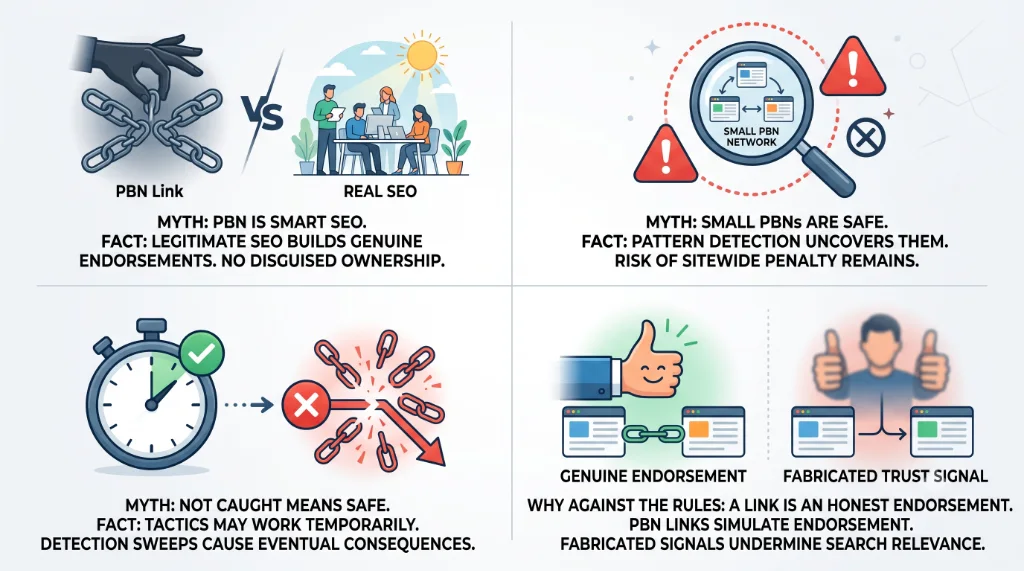
Myth: A PBN Is Just Smart, Aggressive SEO
A PBN is not an aggressive version of legitimate SEO, it is a different category of activity entirely, one built around disguising ownership specifically to simulate an endorsement pattern that does not genuinely exist. Legitimate SEO, even the most aggressive, competitive versions of it, does not require hiding who owns a website.
Myth: Small, Carefully Built PBNs Are Safe
Network size reduces exposure somewhat, but does not eliminate it. Detection methods increasingly rely on pattern recognition across many signals at once, not simply network scale, and a small, carefully built PBN discovered later still carries the same sitewide penalty risk as a larger one.
Myth: If It Has Not Been Caught Yet, It Is Working Safely
The absence of a penalty so far is not the same as safety. PBNs have historically continued appearing to work for months, sometimes longer, before a detection sweep catches up with them, and the eventual consequence does not scale down just because the tactic went undetected for a while first.
Why PBNs Remain Against the Rules
The core issue search engines have with PBNs is not the mechanics of linking itself, it is what the link is supposed to represent. A genuine backlink is meant to function as one website’s honest endorsement of another’s content. A PBN link simulates that endorsement without it actually existing, since the same person controls both the linking site and the site receiving the link. Search engines exist to organise information based on genuine relevance and trust signals, and a fabricated trust signal undermines the basic premise the entire system depends on.
What This Means for a Genuine SEO Strategy
Understanding what a PBN is matters even if you never intend to build one, since it helps you recognise the pattern if an SEO vendor ever proposes something resembling it under a different name. Genuine, sustainable link building, covered in more practical detail in our guide on building SEO backlinks, takes longer precisely because it depends on real editorial judgement from real, independently owned publications, not a network built specifically to remove that judgement from the equation.
Conclusion
A Private Blog Network is, at its core, a coordinated attempt to simulate the appearance of independent editorial endorsement that does not actually exist. Understanding its structure and history clarifies why search engines treat it as a fundamental violation of trust rather than an aggressive but acceptable tactic, and why the practice has remained a target for algorithmic and manual enforcement for well over a decade without disappearing entirely.
For an additional reference on the technical definition and characteristics of PBNs, see Seobility’s wiki entry on Private Blog Networks, which we gratefully credit as a helpful resource on this topic.