
A growing share of research now happens entirely inside an AI conversation. Someone asks ChatGPT to compare software options, asks Google’s AI Overview a question, or asks Perplexity to summarise a topic, and gets a synthesised answer with a handful of cited sources, never visiting ten separate websites the way search used to work. GEO, or Generative Engine Optimization, is the discipline built specifically around earning a place inside those AI-generated answers. If your business is investing in traditional SEO but has never considered whether AI systems actually cite your content, this guide explains exactly what GEO is and how to build it into your strategy in 2026.
Definition: What Is GEO?
GEO (Generative Engine Optimization) is the practice of optimising a website’s content and technical infrastructure so that generative AI systems, Google AI Overviews, ChatGPT, Perplexity, and similar tools, select it as a source to cite when generating an answer to a user’s query. Unlike traditional SEO, which aims for a ranking position a human will scroll to and click, GEO aims for citation inside an answer an AI system has already written on the user’s behalf.
In one line: GEO is the discipline of earning citations inside AI-generated answers, rather than clicks on a traditional search results page.
Why GEO Emerged as Its Own Discipline
Generative AI search tools work by pulling information from multiple sources, synthesising it, and presenting a single, blended answer. Because the AI system chooses which sources to draw from and cite, businesses whose content is technically inaccessible to AI crawlers, or structured in a way AI systems cannot easily extract and verify, are effectively invisible in this entire layer of search, regardless of how well that same content ranks traditionally. GEO exists because this is a genuinely different technical and content challenge from ranking in a traditional list of links.
How GEO Actually Works
AI Crawler Accessibility
Before any content can be cited, the AI system’s crawler needs to be able to access and read it. Bots like GPTBot, PerplexityBot, and Google-Extended each need explicit permission and technical accessibility, and many websites unknowingly block these crawlers entirely through misconfigured robots.txt files, leaving genuinely excellent content invisible to every AI system that might otherwise cite it.
Passage-First Content Architecture
AI systems do not typically cite an entire page; they extract a specific passage that answers the query well. Content written in dense, meandering paragraphs is far harder to extract cleanly than content structured with clear, self-contained passages that each fully address one specific point.
Structured Data and Schema
FAQPage, Article, and Organization schema markup help AI systems understand what a page is about, who wrote it, and how authoritative the source is, all factors that influence whether a system chooses to cite it over a competing source.
Genuine E-E-A-T Signals
AI systems, like traditional search algorithms, weigh demonstrated expertise heavily. Named author credentials, original data, and genuinely first-hand insight give an AI system more reason to trust and cite a source than generic, unsigned content covering the same topic at a surface level.
Multi-Platform Consistency
Google AI Overviews, ChatGPT, and Perplexity each draw on somewhat different indexes and weighting criteria, which means a source cited frequently by one platform is not automatically cited by another. A genuine GEO strategy accounts for this by tracking and optimising for each platform individually rather than assuming a single fix improves visibility everywhere at once.
GEO vs Traditional SEO: The Key Differences
| Factor | Traditional SEO | GEO |
| Goal | Rank in a list of results | Be cited inside a generated answer |
| Success metric | Ranking position, click-through rate | Citation frequency, brand mention volume |
| Technical requirement | Standard crawler accessibility (Googlebot) | AI crawler accessibility (GPTBot, Google-Extended, PerplexityBot) |
| Content structure | Keyword-optimised pages | Passage-first, extractable answer blocks |
| New file type | robots.txt, sitemap.xml | llms.txt (emerging standard) |
How to Build a GEO Strategy
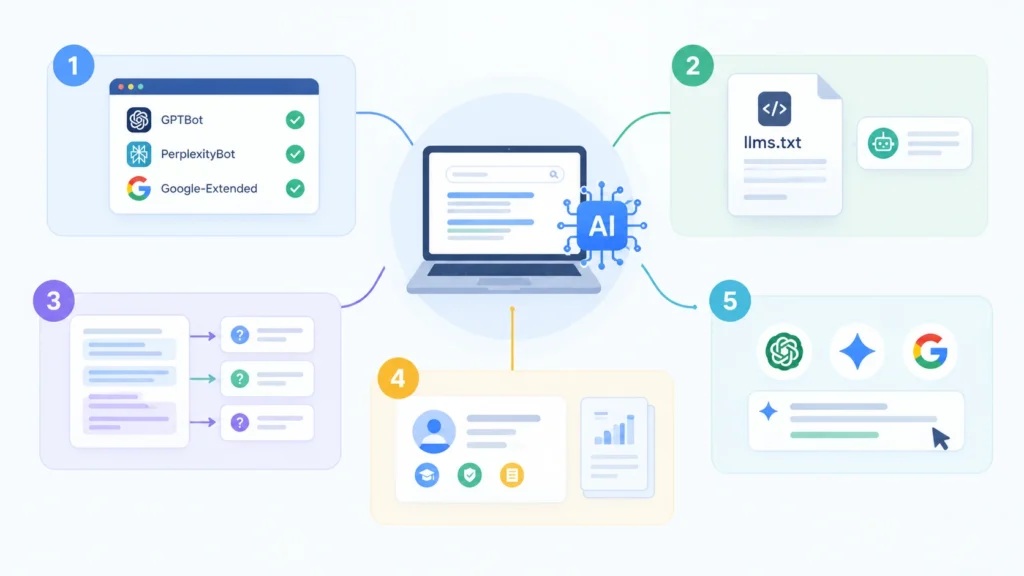
- Audit AI crawler accessibility – confirm GPTBot, PerplexityBot, and Google-Extended can actually access your website; many sites block them without realising it.
- Configure llms.txt – this emerging standard file helps AI systems understand what content on your site is available and relevant for citation.
- Restructure content into extractable passages – break long paragraphs into clear, self-contained sections that each answer one specific question completely.
- Strengthen E-E-A-T signals – add named author bios, credentials, and original research or data that generic AI-written content cannot replicate.
- Track citations, not just rankings – regularly test your target queries directly inside ChatGPT, Perplexity, and Google AI Overviews to see whether and how your content is being cited.
GEO, AEO, and AI SEO: How They Fit Together
GEO is often confused with AEO, but the two target different surfaces. AEO wins featured snippets and voice answers on traditional search engines; GEO wins citations inside generative AI conversations on platforms like ChatGPT and Perplexity, which do not use a traditional search results page at all. Both sit under the broader umbrella of AI SEO, the practice of adapting SEO fundamentals for an AI-driven search era, and both are built on the same foundation of genuine expertise and clear content structure that has always underpinned good SEO.
DigitalArka treats GEO as an extension of sound SEO, never a replacement for it. Our dedicated AI SEO Service includes AI crawler accessibility audits, llms.txt configuration, and multi-platform citation tracking across Google AI Overviews, ChatGPT, and Perplexity, built onto the same technical and E-E-A-T fundamentals that have always driven strong search performance.
Real Examples of GEO in Action
Seeing GEO applied to real scenarios makes the concept concrete.
- Example 1 – a user asks ChatGPT to recommend an SEO agency in Delhi; the response cites two or three specific agencies by name, drawn from content that clearly, specifically, and verifiably described their services, pricing, and credentials rather than vague marketing language.
- Example 2 – someone asks Google’s AI Overview “what is the difference between technical SEO and on-page SEO”; the generated answer cites a source whose content answered this exact comparison in a clean, well-structured passage, not one buried inside a long, unrelated article.
- Example 3 – a researcher asks Perplexity to summarise current guidance for a niche topic; Perplexity favours sources with named authors, publication dates, and original data over anonymous, undated content covering the same ground superficially.
Why GEO Matters More Than Most Businesses Realise
The businesses most exposed to GEO risk are often the ones with the strongest traditional SEO, because they assume their existing rankings automatically translate into AI visibility. They frequently do not. A page can rank on the first page of Google while being entirely invisible to ChatGPT or Perplexity, either because AI crawlers are technically blocked, or because the content, while well-optimised for traditional keyword matching, is not structured in the extractable, passage-first format these systems actually pull from.
This creates a genuine first-mover opportunity in 2026. Most competitors have not yet audited their AI crawler accessibility or restructured their content for GEO specifically, which means a business that addresses this now can establish citation patterns with AI systems before the space becomes as competitive as traditional search rankings already are.
There is also a compounding effect worth understanding: once an AI system establishes a pattern of citing a particular source for a particular topic, that pattern tends to persist across subsequent queries, since the underlying model has effectively learned to trust that source for that subject area. Businesses that establish early, consistent citation now are building an advantage that becomes progressively harder for a later competitor to displace, much like the compounding value of an aged, authoritative domain in traditional SEO.
Common GEO Mistakes
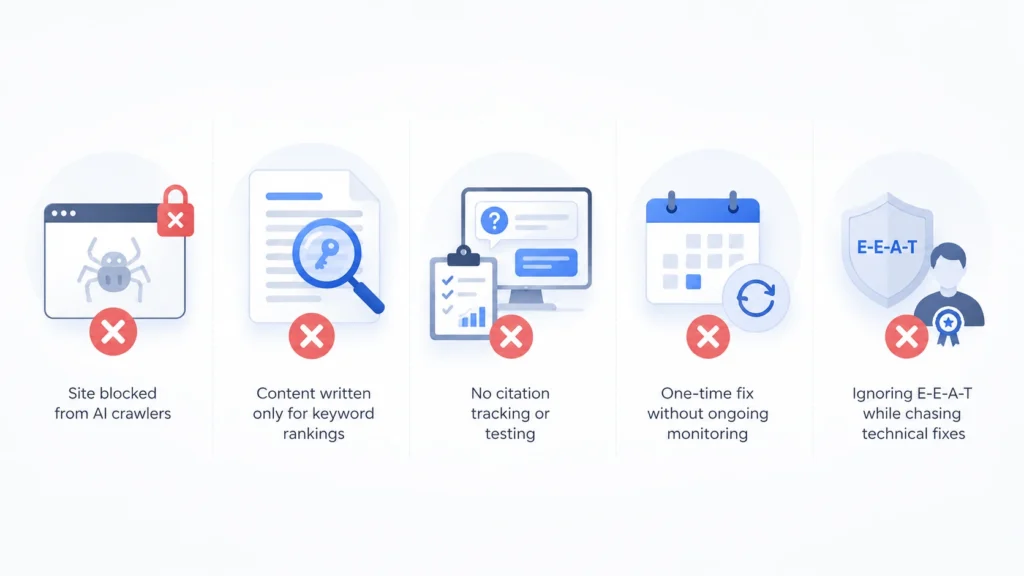
- Never checking AI crawler accessibility – a technically blocked site cannot be cited regardless of how genuinely excellent its content is.
- Writing content only for traditional keyword rankings – this misses the passage-first structure AI systems actually extract from.
- No citation tracking – without regularly testing your target queries inside AI tools directly, you have no way of knowing whether your GEO efforts are working.
- Treating GEO as a one-time technical fix – AI platforms continuously refine which sources they trust and cite, and ongoing monitoring is essential to maintain visibility.
- Ignoring E-E-A-T while chasing technical GEO fixes – technical accessibility alone does not earn a citation; the content still needs to demonstrate genuine expertise worth citing.
Conclusion
GEO is the direct response to a search landscape where a growing share of research happens entirely inside an AI-generated conversation rather than a traditional list of links. Businesses that ignore GEO are not just missing a marginal traffic opportunity; they risk becoming genuinely invisible in an entire, rapidly growing layer of how people now discover information and evaluate options. Getting GEO right means confirming technical accessibility to AI crawlers, restructuring content for clean extraction, and building the same genuine expertise signals that have always separated trustworthy sources from generic ones, now applied to a new and increasingly important audience: the AI systems doing research on a human’s behalf.
Frequently Asked Questions
GEO stands for Generative Engine Optimization, the practice of optimising content and technical infrastructure so that generative AI systems like ChatGPT, Perplexity, and Google AI Overviews select it as a cited source when generating answers.
Traditional SEO optimises for a ranking position a human clicks. GEO optimises for citation inside an AI-generated answer, which requires AI-specific crawler accessibility and passage-first content structure that traditional SEO does not typically address.
llms.txt is an emerging standard file that helps AI systems understand which content on a website is available and relevant for citation, similar in concept to how robots.txt guides traditional search crawlers.
Regularly test your target queries directly inside ChatGPT, Perplexity, and Google AI Overviews to see whether and how your content appears, since there is currently no single third-party dashboard that tracks this automatically and reliably.
GEO is relevant for any business whose potential customers research online, since AI-generated answers already influence purchase decisions across virtually every category, and smaller businesses with genuinely detailed, expert content are not disadvantaged the way they sometimes are in traditional domain-authority-driven rankings.
No. GEO, AEO, and traditional SEO work together rather than replacing one another, since all three draw on the same underlying content quality and technical health, just applied to different search surfaces a potential customer might use.