
A perfectly written, technically flawless page can still fail to rank if the rest of the internet has never heard of it. Off-page SEO is the discipline that builds the external reputation search engines use to decide whether your content deserves to rank above someone else’s equally well-written page. It is also the pillar most frequently misunderstood, and the one most often damaged by shortcuts that promise fast results but carry real, lasting risk. This guide explains precisely what off-page SEO is, how it actually works, and how to build it properly in 2026.
Definition: What Is Off-Page SEO?
Off-page SEO refers to all the activities conducted outside your own website that influence its search engine rankings, primarily earning backlinks from other reputable websites, alongside brand mentions, social signals, and digital PR coverage. Unlike on-page SEO, which optimises content you control directly, off-page SEO is fundamentally about earning trust signals from sources you do not control, which is exactly what makes it valuable: search engines treat independent endorsement as far more credible than anything a website says about itself.
In one line: off-page SEO is the practice of earning genuine endorsement from the rest of the internet, so search engines have independent reason to trust your content.
Why Off-Page SEO Matters
Search engines cannot simply take a website’s word for its own quality and authority. Off-page SEO gives them an independent signal: if genuinely relevant, reputable websites link to your content, that functions as a vote of confidence a search engine can weigh far more reliably than anything found only within your own site. Two pages with identical on-page optimisation and technical health will not rank identically if one has earned significantly stronger external authority than the other.
Off-page SEO also builds real-world brand credibility that extends beyond search rankings alone. A business regularly mentioned and linked to by relevant publications in its industry builds genuine reputation, generating referral traffic, brand recognition, and trust that a purely on-site optimisation effort cannot replicate on its own.
A well-built off-page profile also acts as a form of insurance against algorithm volatility. Sites that rely almost entirely on on-page and technical optimisation, with little genuine external authority behind them, tend to see sharper ranking swings whenever Google adjusts how it weighs content quality signals. A diverse, genuinely earned backlink profile provides a steadier foundation that holds up better through these periodic changes.
Core Elements of Off-Page SEO
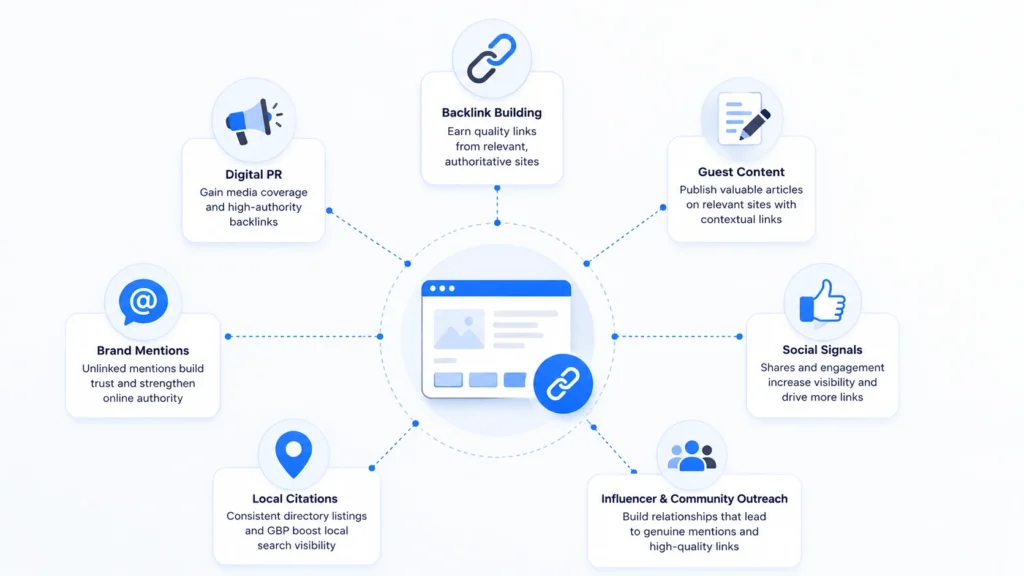
Backlink Building
Backlinks, links from other websites pointing to yours, remain the single most influential off-page ranking factor. Not all backlinks carry equal weight; a link from a highly relevant, reputable, well-trafficked site carries meaningfully more value than dozens of links from low-quality or irrelevant sources.
Digital PR
Digital PR involves pitching original research, data-driven stories, or expert commentary to journalists and publications, earning both media coverage and high-authority backlinks simultaneously. This has become one of the most effective, sustainable off-page strategies, since it builds genuine relationships and citation-worthy assets rather than relying on repetitive, mechanical link requests.
Guest Content
Publishing well-researched articles on relevant, reputable third-party websites earns a contextual backlink within genuinely useful content, while also exposing your expertise to that publication’s existing audience.
Brand Mentions
Even when a mention of your business does not include a clickable link, search engines increasingly recognise and weigh unlinked brand mentions across the web as a trust signal, particularly when those mentions appear on reputable, relevant sites.
Social Signals
While social media shares and engagement are not a confirmed direct ranking factor, genuine social visibility increases the chances that your content is discovered, linked to, and cited by others, creating an indirect but meaningful off-page benefit.
Local Citations
For location-based businesses, consistent listings across relevant directories, alongside a well-optimised Google Business Profile, function as a specific form of off-page authority that directly influences local search visibility.
Influencer and Community Outreach
Relationships with relevant industry voices and communities, forums, niche social groups, and subject-matter influencers, can generate genuine mentions and links that a purely transactional outreach campaign rarely achieves.
Why Off-Page SEO Requires Patience Over Shortcuts
The temptation to buy a large volume of cheap backlinks quickly is understandable, but it remains one of the most damaging mistakes a business can make in SEO. Search engines have grown increasingly sophisticated at identifying manipulative link schemes, private blog networks, and paid link farms, and a site caught with a manipulative backlink profile can lose years of accumulated organic progress in a single manual action. Genuine off-page SEO builds gradually, through real relationships and citation-worthy content, not through volume alone.
How Off-Page SEO Relates to Technical and On-Page SEO
| Pillar | What It Covers | Primary Goal |
|---|---|---|
| Technical SEO | Crawlability, site speed, indexing, structured data | Search engines can access and understand your site |
| On-Page SEO | Content, titles, headings, internal linking | Individual pages match genuine search intent |
| Off-Page SEO | Backlinks, digital PR, brand mentions | External sites vouch for your authority |
Off-page SEO cannot compensate for weak on-page content or a technically broken site; a strong backlink pointing to a page that fails to satisfy the visitor it sends still underperforms. All three pillars need to work together, with off-page SEO providing the authority signal that helps genuinely strong content and a technically sound site actually outrank comparable competitors.
Real Examples of Off-Page SEO in Action
- Example 1 – a SaaS company publishes original survey data about industry trends; several relevant publications cite and link to the research, earning a cluster of high-authority backlinks from one well-executed digital PR campaign.
- Example 2 – a local clinic’s inconsistent NAP (name, address, phone) information across directories is corrected and standardised, directly improving its local map pack visibility within weeks.
- Example 3 – a manufacturing business contributes a genuinely detailed guest article to an industry publication, earning both a contextual backlink and direct enquiries from readers already interested in the topic.
- Example 4 – a business discovers several spammy, irrelevant backlinks pointing to its site from a previous vendor’s questionable tactics; disavowing them removes a lingering risk to its rankings.
How to Vet a Potential Backlink Source
Not every website willing to link to you is worth pursuing. Before accepting or pitching a placement, check whether the site is genuinely relevant to your industry, whether it publishes real editorial content rather than existing purely to sell links, whether it has organic traffic of its own, and whether other reputable sites link to it in turn. A link from a site that fails most of these checks contributes little authority and, in some cases, can even raise a red flag alongside your other genuinely earned links.
Common Off-Page SEO Mistakes
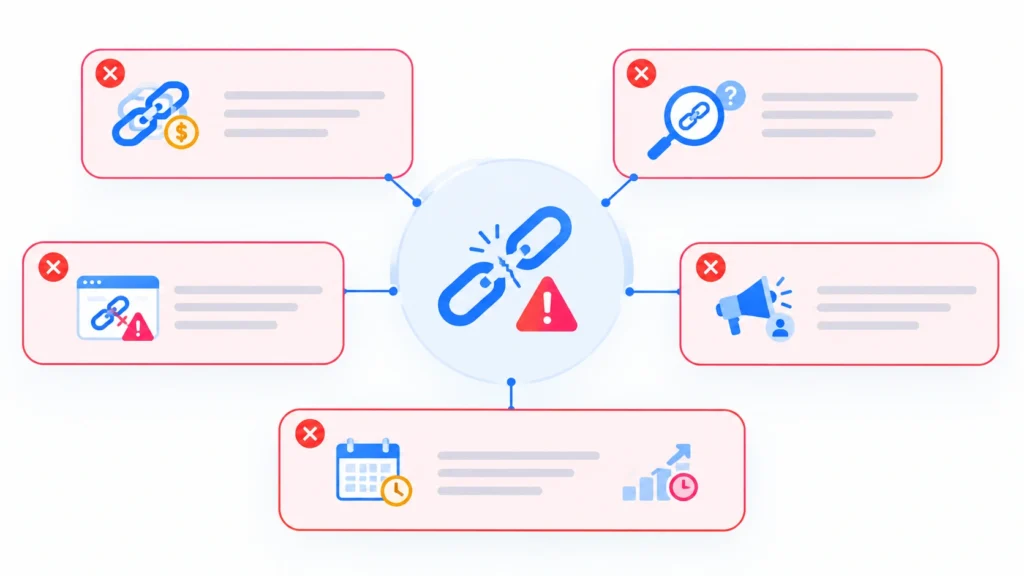
- Buying cheap, high-volume link packages – these frequently come from low-quality or manipulative sources that risk a Google penalty.
- No visibility into where links are actually placed – a provider unwilling to disclose exact link sources is a significant warning sign.
- Ignoring toxic links already pointing to your site – these can suppress rankings even if you never purchased them yourself.
- No digital PR or genuine outreach component – link building without real relationship-building rarely earns links from genuinely authoritative sources.
- Treating off-page SEO as a short-term sprint – genuine authority builds gradually, and promises of overnight results usually signal shortcuts that carry real risk.
How to Approach Off-Page SEO the Right Way
- Audit your existing backlink profile – identify and disavow toxic or spammy links before building anything new.
- Create genuinely citation-worthy content – original research, data, or expert insight gives outreach and digital PR something real to pitch.
- Build relevant industry relationships – genuine outreach to relevant publications and websites earns links that automated tactics cannot replicate.
- Standardise local citations – for location-based businesses, ensure consistent NAP information across every directory and listing.
- Track quality over volume – measure referring domain diversity and relevance, not just a raw backlink count.
If building genuine, ethical authority feels like more than your team has bandwidth for, DigitalArka’s Off-Page SEO Services handle backlink audits, digital PR, and ethical outreach end to end, with full transparency on every placement, and packages starting from Rs. 20,000 per month.
Conclusion
Off-page SEO is the reputation-building pillar of search visibility, the mechanism through which the rest of the internet vouches for your content’s value. Done properly, through genuine relationships, citation-worthy content, and ethical outreach, it builds a lasting competitive advantage that compounds over years. Done through shortcuts, it becomes a liability waiting for the next algorithm update to expose. Businesses serious about long-term search visibility in 2026 treat off-page SEO as a patient, relationship-driven discipline, not a volume game.
The businesses that benefit most from off-page SEO tend to be the ones that stop thinking of it as a checklist item and start thinking of it as genuine reputation management, since every link, mention, and piece of coverage earned this way represents a real relationship or a real piece of value delivered to someone outside your own website. That mindset shift alone tends to produce stronger, more durable results than any purely mechanical link-building tactic ever could.
Frequently Asked Questions
Off-page SEO covers everything done outside your own website that influences its search rankings, primarily earning backlinks, brand mentions, and digital PR coverage from other reputable sources.
Link building is the largest component of off-page SEO, but off-page SEO also includes brand mentions, social signals, local citations, and digital PR, which extend beyond link acquisition alone.
No. Purchased links from low-quality or irrelevant sources violate search engine guidelines and carry real risk of a manual penalty, which can erase years of organic progress.
There is no fixed number. Quality and relevance matter significantly more than raw volume; a handful of genuinely authoritative, relevant links typically outperforms a large volume of low-quality ones.
Initial link acquisition can begin within a few weeks, but meaningful domain authority and ranking improvement generally takes 3 to 6 months, since genuine authority builds gradually rather than overnight.
No. Off-page SEO builds authority for content that already satisfies search intent on a technically sound site; it cannot compensate for weak on-page content or unresolved technical problems.
Digital PR is one specific tactic within off-page SEO, focused on earning media coverage and links through original research and outreach. Off-page SEO is the broader discipline that also includes guest content, local citations, and general brand mention building.