
Every page on your website is a chance to answer a specific search intent clearly enough that Google, and increasingly AI Overviews and chatbots, choose to rank and cite it. On-page SEO is the discipline of making sure that chance is not wasted. Get it wrong, and even a technically flawless, well-linked website fails to convert its visibility into rankings for the terms that actually matter to your business. This guide explains precisely what on-page SEO is, what it includes, and how to do it properly in 2026.
Definition: What Is On-Page SEO?
On-page SEO is the practice of optimising the content and HTML elements of individual web pages, titles, meta descriptions, headings, body content, images, and internal links, to improve their relevance to a target search query and their overall value to a real reader. Unlike technical SEO, which focuses on site infrastructure, or off-page SEO, which focuses on external authority, on-page SEO is entirely about what happens directly on the page itself.
In one line: on-page SEO is the work of making an individual page genuinely deserve to rank for the query it targets, and genuinely useful to the person who lands on it.
Why On-Page SEO Matters in 2026
Older on-page SEO advice focused heavily on keyword density and mechanical repetition. That approach is outdated and can actively hurt rankings today. Google’s systems, and the AI Overviews built from them, reward content that fully and clearly answers what a searcher is actually looking for, regardless of how many times a specific phrase appears on the page. A page that genuinely satisfies search intent, structured clearly and written for a real human reader, consistently outperforms one built primarily around keyword mechanics.
On-page SEO also directly shapes conversion, not just ranking. A page that ranks well but fails to clearly communicate value, answer objections, or guide a visitor toward a next step wastes the traffic it earns. Strong on-page SEO treats ranking and conversion as connected goals, not separate concerns handled by different teams.
Core Elements of On-Page SEO
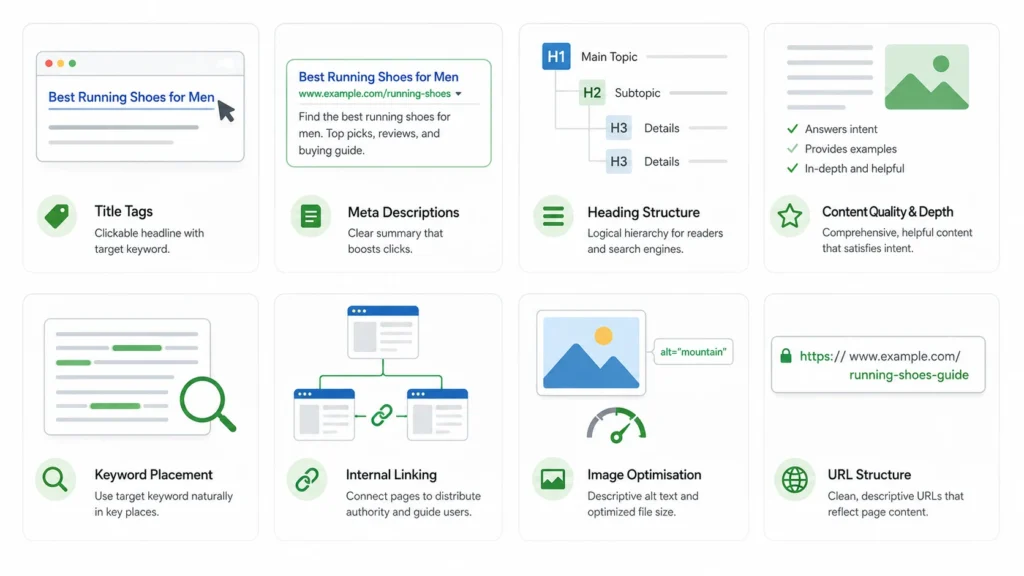
Title Tags
The title tag is the clickable headline shown in search results and browser tabs. It should include the target keyword naturally while genuinely encouraging a click, since a well-optimised page that no one clicks still fails to drive traffic. Titles between 50 and 60 characters typically display fully without being cut off.
Meta Descriptions
While meta descriptions do not directly influence rankings, they strongly influence click-through rate from the search results page. A clear, specific meta description that reflects genuine page content earns more clicks than a vague or generic one, even at an identical ranking position.
Heading Structure
H1 through H3 headings should follow a genuine topic hierarchy, with one H1 per page clearly stating the main topic, followed by H2 and H3 subheadings that break the content into scannable, logically ordered sections. This structure helps both readers and search engines quickly understand what a page covers.
Content Quality and Depth
Content should fully satisfy the search intent behind its target query, not superficially mention a keyword and move on. This means answering related questions a searcher would naturally have, providing specific examples, and offering genuine detail a generic, templated article would not contain.
Keyword Placement
Target keywords should appear naturally in the title, at least one heading, and the opening paragraph, along with related terms and synonyms throughout the body content. The goal is natural, readable inclusion, never forced repetition that damages the reading experience.
Internal Linking
Links from one page on your site to another distribute both authority and navigational value. A deliberate internal linking strategy guides both users and search engines toward your most important pages, while pages with no internal links pointing to them often struggle to rank regardless of their own content quality.
Image Optimisation
Images should include descriptive alt text, both for accessibility and search visibility, along with compressed file sizes that do not slow down page load time. Alt text also gives search engines additional context about page content that text alone might not fully convey.
URL Structure
Clean, descriptive URLs that reflect page content, rather than long strings of numbers or irrelevant parameters, are both more user-friendly and easier for search engines to understand at a glance.
On-Page SEO in the Age of Featured Snippets and AI Overviews
On-page SEO in 2026 increasingly overlaps with a related discipline called AEO (Answer Engine Optimization), since content structured with clear question-and-answer formatting, concise definitional passages, and FAQPage schema is far more likely to win a featured snippet or be cited inside an AI Overview than content written as one long, undifferentiated block of text. Strong on-page SEO today should be built with this extractability in mind from the first draft, not retrofitted afterward.
Real Examples of On-Page SEO in Action
Seeing on-page SEO applied to real scenarios makes the concept concrete.
- Example 1 – a page titled simply “Our Services” is rewritten as “Digital Marketing Services in Delhi | DigitalArka,” immediately clarifying both the topic and the location for both searchers and search engines.
- Example 2 – a blog post covering “SEO tips” superficially in 400 words is expanded to 1,800 words that genuinely address technical, on-page, and off-page SEO with specific examples, moving from page three to page one for its target keyword within a few months.
- Example 3 – a service page with zero internal links pointing to it from anywhere else on the site is linked from three relevant blog posts and the main services page, and its organic traffic grows meaningfully within weeks as both crawl frequency and authority flow improve.
- Example 4 – a product page with generic, manufacturer-supplied descriptions is rewritten with genuine, specific detail addressing common customer questions, improving both its ranking and its conversion rate simultaneously.
How On-Page SEO Supports Conversion, Not Just Rankings
A page that ranks well but fails to convert has only solved half the problem. Strong on-page SEO considers the visitor’s journey after they arrive, ensuring the content answers likely follow-up questions, includes clear calls to action, and builds enough trust and clarity that a visitor feels confident taking the next step, whether that is making an enquiry, a purchase, or simply continuing to explore the site. Treating ranking and conversion as one connected on-page goal, rather than two separate projects, is what separates genuinely effective on-page SEO from a purely mechanical optimisation exercise.
How On-Page SEO Relates to Technical and Off-Page SEO
| Pillar | What It Covers | Primary Goal |
|---|---|---|
| Technical SEO | Crawlability, site speed, indexing, structured data | Search engines can access and understand your site |
| On-Page SEO | Content, titles, headings, internal linking | Individual pages match genuine search intent |
| Off-Page SEO | Backlinks, digital PR, brand mentions | External sites vouch for your authority |
On-page SEO cannot compensate for a technically broken site that search engines cannot properly crawl, and even perfectly optimised pages benefit from the external authority off-page SEO builds. All three pillars work together, and a strategy addressing only one while ignoring the others consistently underperforms one that treats them as connected.
Common On-Page SEO Mistakes
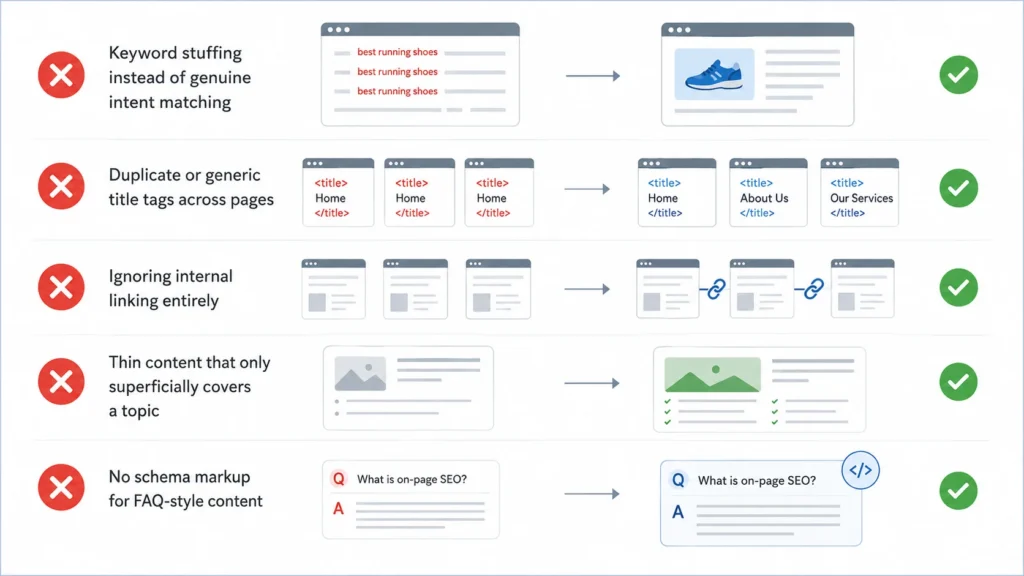
- Keyword stuffing instead of genuine intent matching – this actively hurts rankings today rather than helping them.
- Duplicate or generic title tags across pages – this confuses both search engines and searchers about which page answers which query.
- Ignoring internal linking entirely – pages with no internal links pointing to them rarely rank well regardless of their own content quality.
- Thin content that only superficially covers a topic – this fails to satisfy genuine search intent and loses to more thorough competing content.
- No schema markup for FAQ-style content – this misses a straightforward opportunity to win featured snippets.
How to Approach On-Page SEO Optimisation
- Identify the genuine search intent – understand exactly what a searcher wants before writing or rewriting a page targeting that query.
- Audit existing content against ranking competitors – compare depth, structure, and completeness against pages already ranking well for the target term.
- Rewrite titles and meta descriptions – ensure every page has a unique, compelling title and description reflecting its actual content.
- Restructure headings clearly – organise content under a logical H1-H2-H3 hierarchy that mirrors how a reader would naturally navigate the topic.
- Build internal links deliberately – link to and from the page based on genuine topical relevance, not randomly.
- Add structured data – implement FAQPage or HowTo schema where the content genuinely fits that format.
If reviewing and rewriting every page against these standards feels like more work than your team has time for, DigitalArka’s On-Page SEO Services cover this exact process end to end, with packages starting from Rs. 15,000 per month.
Conclusion
On-page SEO is where search intent meets actual content, the point at which a page either genuinely earns its ranking or falls short despite everything else being in place. Getting it right in 2026 means moving past outdated keyword-density thinking and building pages that fully, clearly, and specifically answer what a real searcher wants, structured in a way that serves both human readers and the search and AI systems increasingly extracting direct answers from the content itself.
Frequently Asked Questions
What is on-page SEO in simple terms?
On-page SEO is the work of optimising the content and structure of an individual web page, titles, headings, body content, and internal links, to make it more relevant to a target search query and more useful to a real reader.
How is on-page SEO different from technical SEO?
On-page SEO focuses on content and relevance signals within a page. Technical SEO focuses on the infrastructure, crawlability, speed, and indexing that allows search engines to access that content in the first place.
Does keyword density still matter for on-page SEO?
Not in the way it once did. Modern on-page SEO prioritises fully satisfying search intent and natural, readable keyword inclusion over mechanical keyword density targets, which can now actively hurt rankings if overdone.
How many keywords should one page target?
A page should target one primary keyword along with closely related terms and synonyms that naturally support the same topic, rather than trying to rank for several unrelated keywords on a single page.
Does on-page SEO help with featured snippets?
Yes. Clear heading structure, concise direct answers, and FAQPage schema, all core on-page SEO practices, are also exactly what helps a page win featured snippets and AI Overview citations.
How often should on-page SEO be reviewed?
Reviewing key pages every 6 to 12 months, or whenever a competitor overtakes your ranking, helps ensure content stays aligned with evolving search intent and competitor content depth.