
If you have searched for “what is SEO in digital marketing,” you have probably landed on a dozen pages that circle the topic without actually answering it clearly. This guide is different. It gives you a direct definition, explains what SEO actually means as a discipline inside digital marketing, breaks down its role, its features, how it is managed day to day, and how it works in 2026, an era where search results now include AI Overviews and chatbot answers alongside traditional blue links. Whether you are a business owner evaluating whether SEO is worth the investment or a marketer building your first strategy, this is the complete answer.
Definition of SEO in Digital Marketing
SEO, or Search Engine Optimization, is the practice of improving a website so that it ranks higher in unpaid, organic search results, and by extension, gets found more easily by the AI-generated answers and voice assistants that now sit alongside those results. In digital marketing specifically, SEO is the channel responsible for earning visibility through relevance and authority rather than through paid placement. In plain terms: SEO is how a business makes sure that when someone searches for what it offers, its website is one of the answers search engines choose to show.
Definition, in one line: SEO in digital marketing is the strategic process of optimising a website’s content, structure, and authority so that search engines rank it higher for relevant queries, driving organic (unpaid) traffic.
Meaning of SEO in Digital Marketing
The meaning of SEO in digital marketing goes beyond the literal acronym. Search Engine Optimization means aligning your website with two audiences simultaneously: the algorithms search engines use to evaluate and rank content, and the actual humans who will read that content and decide whether to trust your business. SEO is not a single action but an ongoing discipline that touches content, technical infrastructure, and reputation, all working together so that your site consistently appears where your potential customers are already looking.
Within the broader digital marketing mix, SEO carries a specific meaning distinct from paid channels like PPC or social ads: it is the only major channel where visibility is earned rather than rented. A paid ad disappears the moment you stop paying for it; a well-optimised page can continue driving traffic for years with comparatively modest ongoing investment. This is precisely why SEO meaning in digital marketing is so often summarised as “the long-term, compounding channel.”
Why SEO Matters in Digital Marketing in 2026
In today’s fast-paced online environment, a strong search presence is not optional; it is foundational to staying competitive. With millions of websites competing for attention, and search results now shared between traditional links, featured snippets, and AI-generated summaries, SEO is what determines whether your business is even part of the conversation. It helps you reach your target audience precisely, drawing in people who are actively searching for what you offer rather than passively seeing an ad.
SEO’s value extends well beyond rankings. It directly shapes user experience: a properly optimised website is faster, easier to navigate, and clearer to read, all of which increase the odds a visitor converts into a customer rather than leaving. Rankings also function as a trust signal. When a business appears near the top of relevant search results, users subconsciously treat that position as an endorsement of credibility, an effect that has only grown stronger as users have become warier of low-quality, AI-generated spam content flooding the web.
SEO also remains one of the most cost-efficient digital marketing channels available. Unlike paid advertising, which requires continuous spend to sustain visibility, SEO builds an asset: once a page earns strong rankings, it can maintain that position with comparatively modest ongoing maintenance. This compounding return is what makes SEO a core pillar of nearly every serious digital marketing budget in 2026.
Contact Us
The Role of SEO in Digital Marketing
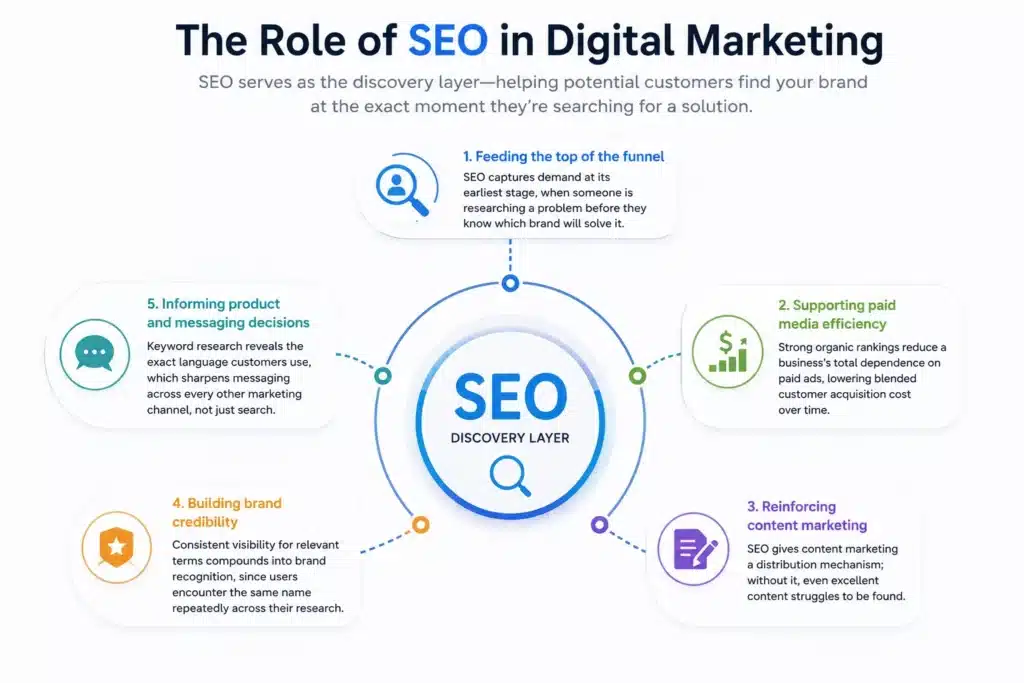
SEO’s role in a digital marketing strategy is to serve as the discovery layer, the mechanism through which potential customers who do not yet know your brand find you at the exact moment they are searching for a solution you provide. Every other digital marketing channel benefits from this role in a specific way.
- Feeding the top of the funnel – SEO captures demand at its earliest stage, when someone is researching a problem before they know which brand will solve it.
- Supporting paid media efficiency – strong organic rankings reduce a business’s total dependence on paid ads, lowering blended customer acquisition cost over time.
- Reinforcing content marketing – SEO gives content marketing a distribution mechanism; without it, even excellent content struggles to be found.
- Building brand credibility – consistent visibility for relevant terms compounds into brand recognition, since users encounter the same name repeatedly across their research.
- Informing product and messaging decisions – keyword research reveals the exact language customers use, which sharpens messaging across every other marketing channel, not just search.
Features of SEO in Digital Marketing
SEO is built from several distinct features that work together rather than in isolation. Understanding each one clarifies what “doing SEO” actually involves in practice.
- AI search optimisation (new in 2026) – structuring content so it can be accurately extracted and cited by AI Overviews, ChatGPT, and Perplexity, a feature that barely existed in SEO strategy before 2025.
- Keyword research – identifying the exact terms and phrases your target audience searches for, and the intent behind each one.
- On-page optimisation – aligning title tags, meta descriptions, headings, and body content with both target keywords and genuine user value.
- Technical SEO – ensuring your site can be crawled, indexed, and rendered quickly and correctly, covering Core Web Vitals, mobile responsiveness, and clean site architecture.
- Off-page SEO and link building – earning backlinks and mentions from other credible websites, which search engines treat as a vote of confidence.
- Content strategy – planning and publishing content that comprehensively addresses a topic, rather than isolated, disconnected pages.
- Local SEO – for businesses with a physical presence, optimising Google Business Profile listings and location-specific content to appear in local search results and map packs.
- Analytics and reporting – continuously measuring rankings, traffic, and conversions to know what is working and what needs adjustment.
Core Elements of SEO: On-Page, Off-Page, and Technical
Search engine optimisation is built from three foundational pillars, and a genuinely complete SEO strategy addresses all three together.
On-Page SEO
On-page SEO focuses on optimising individual pages on your site, ensuring content, keywords, and HTML elements like titles and meta descriptions are aligned to boost relevance and visibility. It includes internal linking, heading structure, and making sure content is genuinely useful and readable, not merely keyword-stuffed. Strong on-page SEO improves both how search engines interpret a page and how favourably a human visitor responds to it.
Off-Page SEO
Off-page SEO covers actions taken beyond your own website that influence how search engines perceive your authority, primarily earning backlinks from other reputable sites. Backlinks function as votes of confidence: the more relevant, high-quality sites that link to you, the more trustworthy your content appears to search engines. Digital PR, influencer outreach, and organic social sharing all contribute to a strong off-page profile.
Technical SEO
Technical SEO ensures search engines can crawl, render, and index your content efficiently. It covers site speed, mobile responsiveness, clean URL structures, HTTPS security, and the elimination of broken links or duplicate content. In 2026, technical SEO has expanded to include AI-crawler accessibility, confirming that bots like GPTBot and Google-Extended can actually access and parse your pages for potential citation in AI-generated answers.
SEO vs AEO vs GEO: The New Layers of SEO in 2026
One of the biggest shifts in digital marketing since 2025 is that “SEO” now sits alongside two closely related disciplines that every marketer should understand.
- AEO (Answer Engine Optimization) – structuring content, using clear question-and-answer formatting, to win featured snippets and voice assistant answers.
- GEO (Generative Engine Optimization) – optimising content specifically to be cited inside AI-generated answers on Google AI Overviews, ChatGPT, and Perplexity.
Importantly, AEO and GEO are not replacements for SEO; they are extensions of it, built on the exact same foundation of genuine expertise, technical health, and clear content structure that traditional SEO has always rewarded. A business practising strong SEO in 2026 without any awareness of AEO or GEO is leaving a growing share of search visibility, snippets, voice answers, and AI citations, completely uncaptured.
Keyword Research: Identifying the Best Terms for Your Audience
Keyword research is the foundation of any SEO strategy, and it starts with understanding the exact language your target audience uses when searching. Begin by listing terms related to your products, services, and common customer questions, then use tools like Google Keyword Planner, SEMrush, or Ahrefs to evaluate each term’s search volume, competition, and relevance.
Balance short-tail keywords, broad, high-volume, high-competition terms, with long-tail keywords, more specific, lower-volume phrases that convert at a higher rate because they reflect clearer intent. A business selling handmade jewellery, for example, benefits from targeting both “jewellery” (short-tail, extremely competitive) and “handmade silver jewellery in Delhi” (long-tail, far more winnable and closer to purchase intent). Once identified, incorporate target keywords naturally into title tags, meta descriptions, headings, and body content, always prioritising natural readability over forced keyword density.

Crafting SEO-Friendly Content: Best Practices for 2026
Producing content that performs well in search starts with genuine user intent, not keyword mechanics. Understand what your audience is actually trying to accomplish with a given search, whether that is answering a question, comparing options, or making a purchase decision, and build content that satisfies that intent completely.
Structure matters as much as substance. Break content into clearly labelled sections with descriptive headings, use bullet points and numbered lists to make information scannable, and include original images, data, or examples that a generic AI-generated article would not contain. This last point has become increasingly important in 2026: search engines and AI systems alike now reward content that demonstrates first-hand experience and genuine expertise over generic, templated coverage of a topic.
SEO Management in Digital Marketing
SEO management is the ongoing process of planning, executing, monitoring, and refining an SEO strategy over time, rather than treating it as a one-time project. Effective SEO management typically follows a repeating cycle.
- Audit – assess current rankings, technical health, and content gaps against competitors.
- Plan – prioritise fixes and content opportunities based on potential impact and effort required.
- Execute – implement technical fixes, publish or update content, and build authority through link acquisition.
- Measure – track rankings, organic traffic, and conversions against the original goals.
- Refine – adjust strategy based on what the data shows, and repeat the cycle.
Whether SEO management is handled in-house or by an agency, the discipline is the same: SEO is never “finished,” since competitors keep publishing, algorithms keep updating, and search behaviour keeps evolving. Businesses that treat SEO management as continuous consistently outperform those that treat it as a one-off project.
What Is SEO in Digital Marketing? With Examples
Seeing SEO applied to real scenarios makes the concept concrete.
- Keyword optimisation example – a business selling handmade jewellery targets “handmade jewellery in Delhi” so it appears when local buyers search that exact phrase, rather than competing for the far more generic and competitive term “jewellery.”
- Content creation example – that same business publishes a blog post on “jewellery trends 2026,” optimised with related keywords, which captures searchers researching before they are ready to buy, and nurtures them toward a purchase over time.
- Link building example – a fashion blog links to the jewellery store’s guide on caring for silver jewellery; search engines interpret this external endorsement as a trust signal and reward the site with improved rankings.
- Technical SEO example – the same store fixes slow-loading product pages, cutting load time from 6 seconds to under 2, directly reducing bounce rate and improving both rankings and conversion rate.
- Local SEO example – the business claims and fully optimises its Google Business Profile, appearing in the local map pack when nearby customers search “jewellery store near me.”
How Does SEO Work in Digital Marketing?
SEO works by aligning your website with the specific signals search engines use to evaluate and rank content. The process begins with keyword research to understand what your audience searches for, followed by on-page optimisation to make your content clearly relevant to those terms. From there, technical SEO ensures your site can be crawled and indexed efficiently, while off-page SEO builds the external authority signals, backlinks and mentions, that convince search engines your content deserves to rank.
These elements do not operate independently. A technically flawless site with weak content will not rank, and brilliant content on a technically broken site will never be properly indexed in the first place. SEO works only when all three pillars, content, technical health, and authority, are addressed together and maintained continuously as competitors and algorithms both keep moving.
Is SEO Part of Digital Marketing?
Yes, unambiguously. SEO is one of the core channels within digital marketing, sitting alongside paid advertising, social media marketing, email marketing, and content marketing. What distinguishes SEO from most of these other channels is that it earns organic, unpaid traffic rather than renting temporary visibility through ad spend. SEO also works in direct support of the other channels: content marketing needs SEO for distribution, paid campaigns benefit from the landing page quality SEO improves, and social media content performs better when built around topics SEO research has already validated as genuinely in-demand.
How Many Types of SEO Are There in Digital Marketing?
There are three foundational types of SEO, though in 2026 a fourth has become increasingly relevant.
- On-Page SEO – optimising content, meta tags, images, and URL structure directly on your website.
- Off-Page SEO – building backlinks and external authority signals beyond your own site.
- Technical SEO – improving site speed, mobile optimisation, crawlability, and indexing.
- AI Search Optimisation (AEO/GEO) – structuring content specifically for featured snippets, voice answers, and citation inside AI-generated search results, the newest addition to the SEO discipline.
Conclusion: SEO in Digital Marketing, 2026 and Beyond
SEO in digital marketing is the discipline of making your website genuinely findable, and genuinely worth finding, for the exact people searching for what you offer. Its definition has stayed consistent over the years, improving organic visibility through relevance and authority, but its meaning has expanded considerably as search itself has evolved to include AI Overviews, voice assistants, and chatbot answers alongside traditional results.
The role SEO plays in a broader digital marketing strategy, feeding the funnel, supporting every other channel, and building lasting brand credibility, has only grown more central, not less, as paid channels have become more expensive and AI-generated content has flooded the web with low-quality noise that search engines are actively learning to filter out. Businesses that invest in SEO’s core features, genuine keyword research, technical health, quality content, and authority building, while staying current with how AEO and GEO extend that same discipline into new search surfaces, are the ones positioned to keep winning visibility well beyond 2026.
Frequently Asked Questions
Q1: What is SEO in digital marketing?
SEO (Search Engine Optimization) in digital marketing is the practice of improving a website’s content, structure, and authority so it ranks higher in organic search results, driving unpaid traffic from people actively searching for relevant products, services, or information.
Q2: What is the meaning of SEO in digital marketing?
The meaning of SEO in digital marketing is broader than the literal acronym: it refers to the ongoing discipline of aligning a website with both search engine algorithms and genuine human user needs, so that visibility is earned through relevance and trust rather than rented through paid ads.
Q3: What is the role of SEO in digital marketing?
SEO’s role is to serve as the discovery layer of a digital marketing strategy, capturing demand at the earliest research stage, reducing dependence on paid advertising over time, and feeding traffic and credibility into every other marketing channel.
Q4: What are the features of SEO in digital marketing?
The core features of SEO include keyword research, on-page optimisation, technical SEO, off-page link building, content strategy, local SEO, analytics and reporting, and, as of 2026, optimisation for AI-powered search experiences.
Q5: What is SEO management in digital marketing?
SEO management is the continuous cycle of auditing, planning, executing, measuring, and refining an SEO strategy over time, rather than treating SEO as a single, one-time project.
Q6: Is digital marketing SEO the same thing as SEO?
They refer to the same discipline. “Digital marketing SEO” simply emphasises SEO’s position as one channel within the broader digital marketing mix, alongside PPC, social media, email, and content marketing.
Q7: How many types of SEO are there in digital marketing?
There are three foundational types: On-Page SEO, Off-Page SEO, and Technical SEO. A fourth category, AI search optimisation (AEO and GEO), has become increasingly relevant since 2025.
Q8: What is SEO in digital marketing with examples?
Examples include targeting a specific long-tail keyword like “handmade jewellery in Delhi,” publishing a blog post that earns backlinks from relevant sites, fixing slow page load times, and optimising a Google Business Profile to appear in local map pack results.
Q9: Why is SEO important in digital marketing?
SEO is important because it delivers long-term, cost-efficient visibility, builds user trust through higher rankings, improves overall website usability, and captures customers at the exact moment they are searching for a solution, before a competitor’s paid ad even has the chance.