
Not every business sells a product you can add to a cart. Plumbers, law firms, consultants, clinics, marketing agencies, and thousands of other businesses sell expertise, time, and outcomes, and Google treats their websites differently than it treats an e-commerce store. This is where service-based SEO comes in. If you run a service business and have wondered why generic SEO advice built for online stores never quite fits your website, this guide explains exactly what service-based SEO is, how it differs from product SEO, and how to do it properly in 2026.
Definition: What Is Service-Based SEO?
Service-based SEO is the practice of optimising a website for businesses that sell services rather than physical products, structuring content, technical elements, and authority signals around the specific way people search for, evaluate, and choose a service provider. Instead of optimising product listing pages, category filters, and shopping schema the way an e-commerce site would, service-based SEO centres on individual service pages, location-specific landing pages, trust signals, and lead-generation conversion paths.
In one line: service-based SEO is SEO built around earning trust and capturing enquiries for a business that sells expertise or outcomes, not inventory.
How Service-Based SEO Is Different From Product SEO
The two disciplines share the same foundation, technical health, keyword research, quality content, and authority, but the emphasis shifts significantly once you move from selling products to selling services.
- Conversion goal – a product SEO strategy optimises toward a purchase transaction; a service-based SEO strategy optimises toward a form submission, phone call, or booked consultation, since the actual “purchase” usually happens offline after a conversation.
- Trust weighs more heavily – buying a service, especially a high-cost or high-stakes one like legal, medical, or financial services, involves far more perceived risk than buying a product, so reviews, credentials, and case studies carry disproportionate ranking and conversion weight.
- Local intent dominates – most service businesses serve a specific geographic area, making Local SEO and Google Business Profile optimisation central to the strategy in a way that a nationwide e-commerce store does not need.
- Content depth over catalogue breadth – a service business typically has far fewer pages than a product catalogue, which means each individual service page needs to work considerably harder to rank and convert.
- Schema markup differs – service businesses rely on LocalBusiness, Service, and Review schema rather than the Product and Offer schema an online store depends on.
Why Service-Based SEO Matters in 2026
Service businesses increasingly compete not just against other local providers but against directory sites, comparison platforms, and now AI-generated summaries that answer “best plumber near me” or “how much does a divorce lawyer cost” directly inside the search results. A service business without a deliberate SEO strategy is invisible at exactly the moment a potential customer is deciding who to call.
Service-based SEO also delivers a fundamentally different return than paid advertising for this category of business. A law firm or clinic paying for every single lead through Google Ads faces a permanently rising cost per acquisition as competition increases; a well-optimised service page, by contrast, continues generating enquiries months and years after it was published, with only incremental maintenance required to hold its position.
The Core Elements of Service-Based SEO
1. Dedicated Service Pages, Not a Single “Services” Page
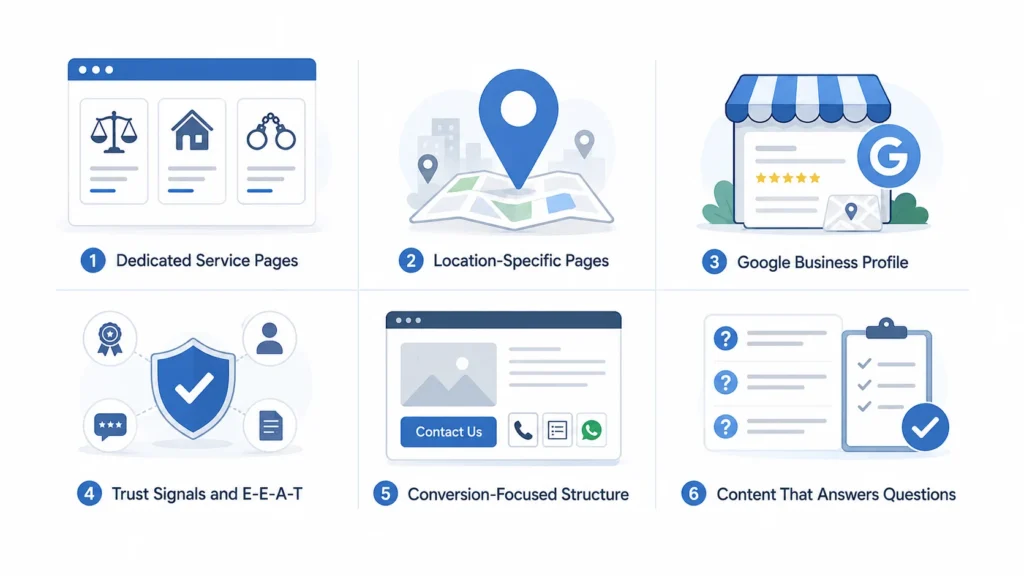
The single most common mistake service businesses make is listing everything they offer on one generic “Services” page. Search engines cannot rank a single page for ten different service intents at once. A law firm should have a separate, fully developed page for “divorce lawyer,” “property dispute lawyer,” and “criminal defence lawyer,” each targeting its own keyword cluster with content specific to that service, not a shared paragraph on a combined page.
2. Location-Specific Landing Pages
For any service business operating across multiple cities or service areas, a dedicated page per location, “plumber in Andheri,” “plumber in Bandra,” rather than one generic page mentioning both areas in passing, consistently outperforms in local search. Each location page should include genuinely local detail: nearby landmarks, area-specific pricing context, and location-relevant testimonials, not the same paragraph with only the city name swapped out.
3. Local SEO and Google Business Profile
For any service business with a defined service area, Google Business Profile optimisation is not optional; it is often the single highest-leverage SEO activity available. A complete, verified, regularly updated profile with accurate categories, service areas, photos, and a steady stream of genuine reviews directly influences whether a business appears in the local map pack, the three-result block that captures a disproportionate share of clicks for “near me” searches.
4. Trust Signals and E-E-A-T
Because service purchases involve more perceived risk than product purchases, trust signals matter more here than almost anywhere else in SEO. This means visible credentials and certifications, named team members with real bios and photos rather than stock imagery, detailed case studies with measurable outcomes, and a steady flow of authentic, responded-to reviews. Google’s own quality systems place particular weight on demonstrated first-hand expertise for exactly this kind of service content, especially in categories like legal, medical, and financial services where inaccurate information carries real consequences.
5. Conversion-Focused Page Structure
A service page succeeds only if it converts, not just ranks. Every service page should include a clear, specific description of what the service actually involves, transparent pricing information or a clear pricing framework where possible, a straightforward way to contact or book (phone number, form, WhatsApp), and social proof positioned near the point of decision rather than buried at the bottom of the page.
6. Content That Answers Pre-Purchase Questions
Service buyers research extensively before committing, often asking questions like “how much does X cost,” “how long does X take,” or “what happens during X.” Building supporting content, FAQ sections, comparison guides, and process explainers, that answers these questions directly both captures additional search traffic and builds the confidence a hesitant buyer needs before reaching out.
Service-Based SEO and AI Search in 2026
A growing share of “which service provider should I choose” research now happens inside AI Overviews and chatbot conversations rather than through a traditional search results page. This makes clear, well-structured, genuinely informative content even more important for service businesses specifically, since AI systems favour sources that demonstrate real expertise and answer a query completely, exactly the standard that strong service-based SEO content was already built around. A service business investing in detailed, expert-reviewed content on its core offerings is positioning itself to be cited by AI systems the same way it earns traditional rankings, through genuine substance rather than thin, templated pages.
Common Service-Based SEO Mistakes
- Combining every service into one page – this dilutes keyword targeting and prevents any single service from ranking well.
- Ignoring Google Business Profile – many service businesses claim their listing once and never update it, missing the single highest-leverage local ranking factor available.
- No pricing transparency – service pages that hide all pricing information frustrate researching buyers and increase bounce rate, a signal that can hurt rankings over time.
- Thin, generic service descriptions – a paragraph that could apply to any competitor in the category fails to build the trust a service purchase requires.
- No location-specific content for multi-area businesses – a single generic page trying to rank for five different cities rarely ranks well for any of them.
- Neglecting reviews – a thin or outdated review profile undermines trust at exactly the stage where a hesitant buyer is deciding whether to make contact.
How to Build a Service-Based SEO Strategy: Step by Step
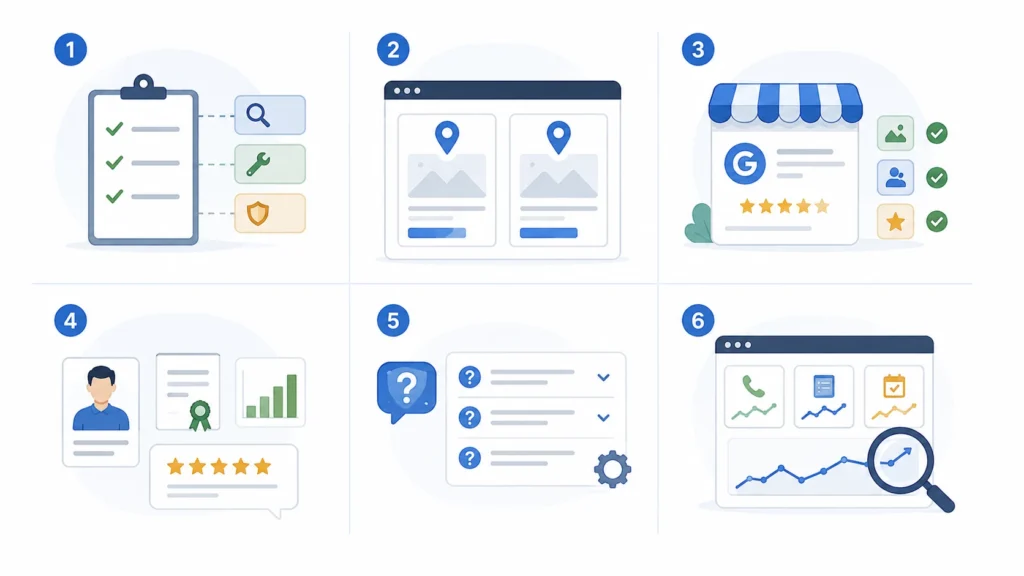
- Map every distinct service – list each service you offer as its own keyword target, rather than treating your offering as one undifferentiated whole.
- Build a dedicated page per service and per location – give each service-location combination its own fully developed page where volume justifies it.
- Claim and fully optimise Google Business Profile – complete every field, upload genuine photos, and set up a system for requesting reviews after each completed job or engagement.
- Add genuine trust content – named team bios, certifications, case studies, and specific outcome data rather than generic claims.
- Build supporting FAQ and process content – answer the pricing, timeline, and process questions your actual customers ask before they contact you.
- Track leads, not just rankings – measure calls, form submissions, and bookings attributed to organic search, since ranking position alone does not confirm the strategy is working.
Conclusion
Service-based SEO is not a smaller or simpler version of product SEO; it is a distinct discipline built around trust, locality, and lead generation rather than transactions and catalogues. A plumber, a law firm, a clinic, and a marketing agency all compete for attention in fundamentally the same way: by convincing a researching, slightly anxious potential customer that they are the right choice before that customer ever picks up the phone. Getting service-based SEO right in 2026 means dedicated service pages, genuine local optimisation, visible trust signals, and content that answers the questions a real buyer actually has, built on the same technical and content fundamentals that have always underpinned good SEO, just aimed at a genuinely different kind of buying decision.
Frequently Asked Questions
Service-based SEO is the practice of optimising a website for businesses that sell services rather than physical products, focusing on dedicated service pages, local search visibility, and trust signals that influence a buyer’s decision to make contact.
E-commerce SEO optimises product listings, categories, and shopping schema toward a direct purchase. Service-based SEO optimises individual service pages, local listings, and trust content toward a lead, such as a call, form submission, or booking.
Yes, in almost every case. Most service businesses serve a defined geographic area, and Google Business Profile optimisation combined with location-specific content is typically the single highest-impact SEO activity for this category of business.
No. Each distinct service should generally have its own dedicated page targeting its own keywords, since a single combined page struggles to rank well for multiple different service intents at once.
Very important. Because service purchases involve more perceived risk than product purchases, reviews function as a critical trust signal that influences both local rankings and whether a visitor actually makes contact.
Technical and Google Business Profile fixes can show improvement within weeks. Building genuine topical authority and trust content for competitive service categories typically takes 3 to 6 months, similar to other forms of SEO.