

You can publish genuinely excellent content and still fail to rank if search engines cannot crawl, render, or index your website properly. Technical SEO is the discipline that fixes exactly this problem, and it is often the single most overlooked pillar of a search strategy, quietly capping the return on every other SEO effort until someone actually addresses it. This guide explains precisely what technical SEO is, what it covers, and how to approach it properly in 2026.
Many business owners assume that SEO begins and ends with keywords and content, and only discover technical SEO exists after months of publishing content that never gains meaningful traction. Understanding this discipline early, before investing heavily in content and outreach, saves considerable wasted effort and gets every other part of an SEO strategy performing at its actual potential from the start.
Definition: What Is Technical SEO?
Technical SEO is the practice of optimising a website’s infrastructure, the code, server configuration, and site structure, so that search engines can crawl, render, and index its content efficiently and accurately. Unlike on-page SEO, which focuses on content and relevance, or off-page SEO, which focuses on external authority, technical SEO focuses entirely on removing the barriers between your content and the search engines trying to evaluate it.
In one line: technical SEO is the work that makes sure search engines can actually find, read, and understand your website in the first place.
Why Technical SEO Matters More Than Most Businesses Realise
A common and costly mistake is investing heavily in content and link building while technical issues quietly limit the return on that investment. A page with genuinely excellent content that loads slowly, returns inconsistent server responses, or sits behind a misconfigured robots.txt file will underperform regardless of how much content or authority work is layered onto it. Technical SEO is the foundation every other ranking signal depends on, not a secondary consideration to address once everything else is finished.
In 2026, technical SEO has also expanded to cover a genuinely new requirement: AI crawler accessibility. Bots like GPTBot, PerplexityBot, and Google-Extended need to be able to access your content the same way traditional search crawlers do, and a site that unknowingly blocks them is invisible to an entire, rapidly growing layer of AI-driven search and citation.
Core Elements of Technical SEO
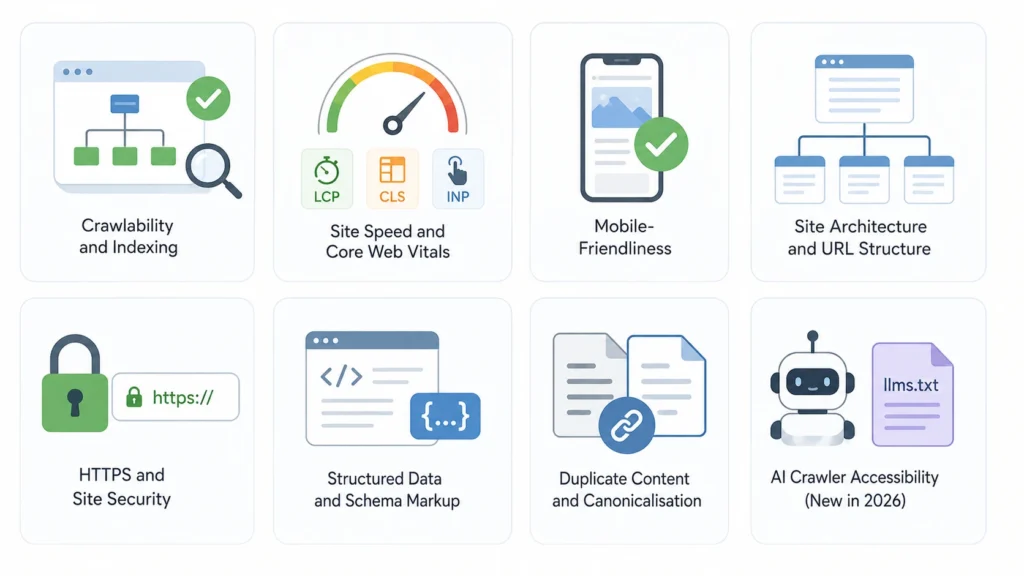
Crawlability and Indexing
Search engines discover your pages through crawling, following links and reading your sitemap, then decide whether to index them. A misconfigured robots.txt file, an incorrect noindex tag, or a broken sitemap can silently prevent even excellent pages from ever appearing in search results, often without any obvious warning sign to the site owner.
Site Speed and Core Web Vitals
Google measures three specific Core Web Vitals metrics, Largest Contentful Paint (loading speed), Cumulative Layout Shift (visual stability), and Interaction to Next Paint (responsiveness), as direct ranking factors. A slow, unstable, or unresponsive page loses both rankings and user patience, since visitors abandon slow-loading pages within seconds.
Mobile-Friendliness
Google evaluates the mobile version of your site as the primary version for ranking purposes, a practice known as mobile-first indexing. A site that renders poorly, loads slowly, or has unusable navigation on a phone is at a genuine disadvantage regardless of how polished its desktop experience is.
Site Architecture and URL Structure
A clean, logical site structure with clear, descriptive URLs helps both search engines and users understand how your content relates to itself. Deep, disorganised architecture buries valuable pages several clicks from the homepage, reducing both crawl efficiency and the internal link equity those pages receive.
HTTPS and Site Security
A secure connection is a baseline expectation for any legitimate website in 2026, and Google has confirmed HTTPS as a ranking signal. Beyond rankings, an insecure site actively damages user trust the moment a browser flags it as unsafe.
Structured Data and Schema Markup
Schema markup, code added to your pages that explicitly labels what different pieces of content mean, helps search engines understand context they might otherwise have to infer. FAQPage, Article, LocalBusiness, and Product schema all help your content qualify for enhanced search features like featured snippets and rich results.
Duplicate Content and Canonicalisation
When the same or highly similar content exists across multiple URLs, search engines can struggle to determine which version to rank, sometimes diluting authority across all of them rather than concentrating it on one. Canonical tags tell search engines explicitly which version is the authoritative one.
AI Crawler Accessibility (New in 2026)
Confirming that AI crawlers can access and parse your content, and configuring an llms.txt file to guide what content is available for AI citation, has become a genuinely new addition to the technical SEO checklist, one most businesses have not yet addressed.
Real Examples of Technical SEO Problems and Fixes
Seeing technical SEO applied to real scenarios makes the concept concrete.
- Example 1 – an e-commerce site has 3,000 product pages, but a misconfigured pagination setup means only the first 200 are ever crawled; fixing the pagination and internal linking structure brings the remaining 2,800 pages into the index within weeks.
- Example 2 – a business blog loads in 6 seconds on mobile due to unoptimised images; compressing and lazy-loading those images cuts load time to under 2 seconds, directly improving both rankings and bounce rate.
- Example 3 – a company migrates to a new domain but forgets to set up 301 redirects from the old URLs; years of accumulated authority are lost overnight until the redirects are properly implemented.
- Example 4 – a services website’s robots.txt file accidentally disallows the entire /blog/ directory after a developer update; fixing this one line restores indexing to dozens of previously invisible articles.
Why AI Crawler Accessibility Deserves Special Attention in 2026
Most businesses have never checked whether GPTBot, PerplexityBot, or Google-Extended can actually access their website, largely because these crawlers did not exist as a consideration until recently. A site that unintentionally blocks them through an overly broad robots.txt rule is not just missing a marginal opportunity; it is entirely absent from citation inside ChatGPT, Perplexity, and Google AI Overviews, regardless of how genuinely excellent its content is. Checking and correcting this is now one of the highest-leverage, lowest-effort technical fixes available, precisely because so few competitors have addressed it yet.
Technical SEO, on-page SEO, and off-page SEO are the three foundational pillars of a complete SEO strategy, and none of them functions well in isolation. Technical SEO ensures your site can be crawled and indexed; on-page SEO ensures the content on those indexed pages is genuinely relevant and valuable; off-page SEO builds the external authority that convinces search engines your content deserves to rank. A technically broken site with excellent content and strong backlinks still fails to perform, because search engines cannot properly access what you have built.
| Pillar | What It Covers | Primary Goal |
|---|---|---|
| Technical SEO | Crawlability, site speed, indexing, structured data | Search engines can access and understand your site |
| On-Page SEO | Content, titles, headings, internal linking | Individual pages match genuine search intent |
| Off-Page SEO | Backlinks, digital PR, brand mentions | External sites vouch for your authority |
Common Technical SEO Issues to Watch For
- Slow page load times – unoptimised images, excessive scripts, and poor hosting all contribute to Core Web Vitals failures.
- Blocked pages in robots.txt – an accidental disallow rule can silently remove entire sections of a site from search visibility.
- Broken internal links and redirect chains – these waste crawl budget and create a frustrating user experience.
- Missing or duplicate meta tags – these confuse search engines about which page should rank for a given query.
- No mobile optimisation – a site not built mobile-first is working against Google’s primary indexing method.
- Unconfigured AI crawler access – many sites unknowingly block the exact bots that would otherwise cite them in AI-generated answers.
How to Approach a Technical SEO Audit
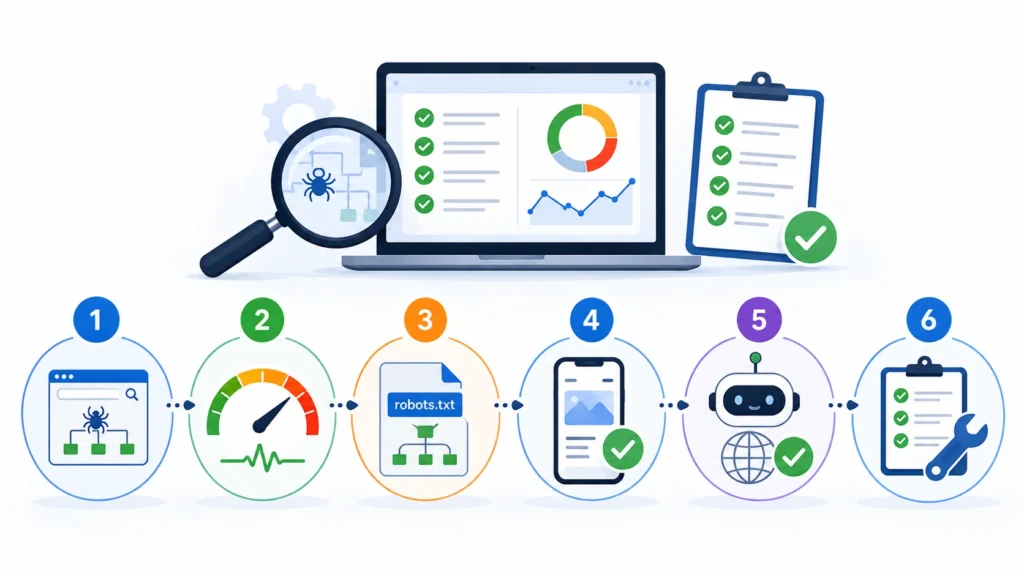
- Crawl the entire site – use a crawler tool to identify every broken link, redirect, duplicate page, and indexing issue across the site.
- Check Core Web Vitals – test key pages against Google’s specific performance metrics, not just a generic speed score.
- Review robots.txt and sitemap – confirm no important pages are accidentally blocked, and that the sitemap accurately reflects your live pages.
- Audit mobile usability – test navigation, load time, and layout specifically on mobile devices, not just desktop.
- Verify AI crawler accessibility – confirm GPTBot, PerplexityBot, and Google-Extended can access your content, and configure llms.txt.
- Fix issues in priority order – resolve indexing and crawlability blockers first, since these carry the highest immediate ranking impact.
If auditing and fixing all of this in-house feels like more than your team has time for, DigitalArka’s Technical SEO Services start with a full site crawl and fix issues in documented, prioritised order, with packages starting from Rs. 18,000 per month.
Conclusion
Technical SEO is not the most visible part of a search strategy, but it is the part everything else depends on. A business can produce genuinely excellent content and earn real authority through backlinks, and still fail to rank if search engines cannot properly crawl, render, or index that content. Getting technical SEO right in 2026 means addressing the established fundamentals, speed, crawlability, mobile usability, structured data, alongside the newer requirement of AI crawler accessibility, since both traditional and AI-driven search now depend on the same underlying technical health.