
Ask ChatGPT to help you plan a kitchen renovation on a tight budget, and the sponsored suggestion that shows up is not a generic home improvement banner, it is often a specific product or service that actually matches the budget, style, and constraints you just described in your own words. That precision is not a coincidence, and it is not magic either. It is the direct result of ChatGPT ads being built around conversational context instead of the keywords, demographics, and browsing history that have driven digital advertising for the last two decades. This article breaks down exactly why that targeting feels so sharp, what is actually happening behind the scenes, and where the “it knows exactly what I want” feeling has genuine limits worth understanding.
The Real Reason ChatGPT Ads Feel So Relevant
Traditional digital advertising has always worked backward from a proxy for intent, a keyword you typed, a page you visited, a demographic bucket you fell into, and made an educated guess from there. A search for “running shoes” tells an advertiser almost nothing about why: training for a marathon, replacing a worn-out pair, buying a gift, recovering from an injury. Advertisers have spent billions trying to close that gap with retargeting, lookalike audiences, and increasingly granular segmentation, and it has always remained a guess dressed up as precision.
A ChatGPT conversation routinely contains the actual answer to “why,” stated plainly, in the user’s own words, because that is simply how people talk to a conversational assistant. Someone does not type “waterproof hiking boots” into ChatGPT the way they might into a search bar; they describe a trip, a budget, foot problems, or a specific trail, and the assistant is already reasoning about that full context to give a useful answer. Advertising layered on top of that same context inherits a genuinely richer signal than keyword or demographic targeting was ever built to capture.
How the Targeting Actually Works, Mechanically
The mechanism behind this is more straightforward than it might feel from the outside, and understanding it demystifies a lot of the “how did it know that” reaction.
Context Hints, Not Keywords
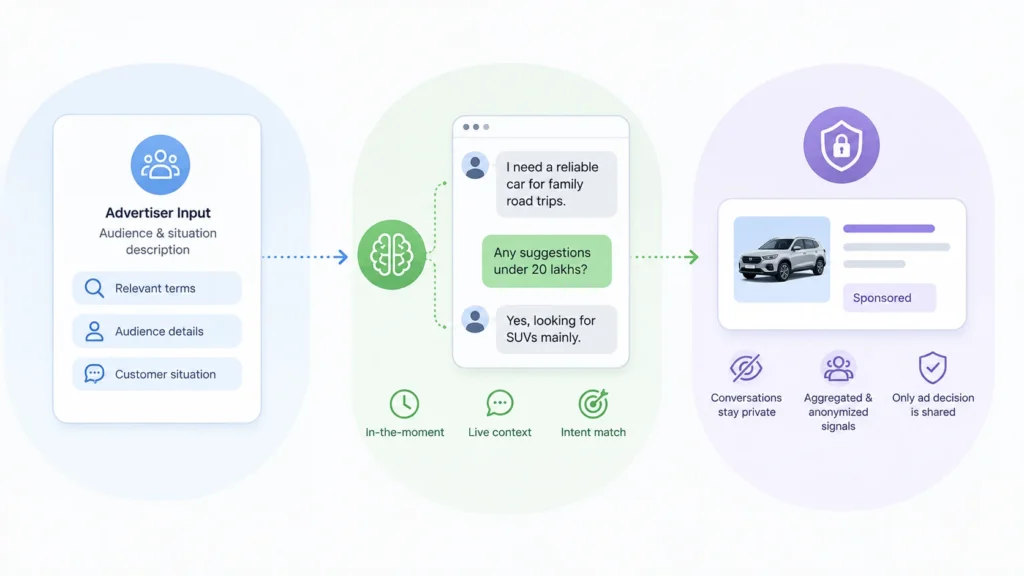
Advertisers do not bid on search terms in ChatGPT. Instead, at the ad group level, they write a freeform description of the audience and situation they want to reach, anything from a short list of relevant terms to a few sentences describing a customer’s circumstances. ChatGPT then matches this description against the live, in-the-moment context of a user’s actual conversation, not a static profile built from past behaviour.
Real-Time Conversational Context
Because matching happens against the current conversation as it unfolds, the ad reflects what a person is thinking about right now, not what they searched for three days ago and have already moved on from. This is a meaningful structural difference from retargeting ads that famously keep following someone around the web for a purchase they already made.
Aggregated Signals, Not Raw Conversations
Advertisers never see the actual conversation. OpenAI’s ad system does the matching entirely on its own side, using aggregated, anonymised signals, and passes only the decision of which ad to show, not the underlying chat content, chat history, or any personal detail, to the advertiser. The precision a user experiences is real, but it is precision without the advertiser ever reading what was actually typed.
| Signal Type | What It Captures | What It Misses |
|---|---|---|
| Keyword search | A specific query at one moment | The underlying reason or situation behind it |
| Demographic/interest targeting | Broad group membership | Individual context, timing, or genuine intent |
| Retargeting (browsing history) | Past behaviour | Whether the need still exists right now |
| ChatGPT context hints + conversation | Stated, in-the-moment intent and situation | Anything the user did not actually express in the conversation |
Real Examples of Intent-Level Precision
- Example 1 – a user asking ChatGPT to help plan a first apartment on a specific monthly budget sees a sponsored suggestion for furniture or services within that stated price range, not generic home goods advertising aimed at anyone who searched “furniture” recently.
- Example 2 – someone describing symptoms of a mild seasonal allergy while asking for general wellness tips may see a relevant, appropriately-scoped consumer product suggestion, an area OpenAI treats with particular caution given its health-content restrictions, rather than an unrelated ad interrupting the conversation.
- Example 3 – a small business owner asking ChatGPT to compare accounting software for a five-person team sees a suggestion sized and positioned for a small business, not enterprise software priced and pitched for a thousand-employee company.
In each case, the relevance comes from the same source: the user already explained their actual situation in plain language, and the ad system read that stated context directly rather than inferring it from indirect signals.
Why This Genuinely Differs From Meta and Google
ChatGPT ads sit conceptually closer to search advertising than to social advertising, but with an important upgrade over both. Google Search matches an ad to a query, a compressed, often ambiguous fragment of intent. Meta matches an ad to predicted interest based on behaviour and declared profile information, without any real-time query at all. ChatGPT ads match against a fuller articulation of intent than either: not a fragment, and not an inference, but the actual reasoning a person just walked through out loud.
This is a structural advantage in how much genuine context is available, not a guarantee of better results for every advertiser. A richer signal only helps if the ad creative and offer are actually built to answer the specific context being matched against, which is exactly why context hint quality is becoming one of the most-tested variables among early ChatGPT advertisers.
The Limits Worth Knowing About
The “it knows exactly what I want” feeling is genuine, but it has real boundaries, and understanding them matters for anyone evaluating this channel seriously rather than reacting to it.
- It reads stated context, not hidden intent – ChatGPT is not inferring anything a user did not, in some form, actually express; it cannot surface a need someone has not articulated in the conversation.
- Matching quality still varies by category – a detailed, well-written context hint from an advertiser produces sharper matching than a vague one; the precision users experience is only as good as the targeting work behind it.
- Ads never touch the model’s actual answer – OpenAI has been explicit that sponsored placements never influence what ChatGPT itself says; the “it knows what I want” feeling applies to the ad matching, not to the organic response.
- No benchmark yet for what “normal” performance looks like – OpenAI has openly acknowledged it has not published performance data across industries, so anecdotally sharp targeting does not yet come with an industry-wide track record to compare against.
- Sensitive and regulated topics are deliberately excluded – health, mental health, political, and several other sensitive categories are kept ad-free by design, so the precision described here does not extend into those conversations at all.
What This Means If You Are Considering Advertising Here
The practical implication of context-based targeting is that the old playbook of writing one generic ad and layering broad demographic targeting on top of it will underperform here. The quality of your context hint, how specifically and genuinely you describe the situations and people your product actually fits, does more work in ChatGPT than a keyword list or an interest category ever could on another platform. Advertisers treating context hints as a genuine writing task, not a box to fill in quickly, are the ones most likely to experience the same “it knows exactly what I want” precision from the advertiser’s side that users experience from the other end of the conversation.
For the full mechanics of setting up context hints, budgets, and your first campaign, see our companion guide, How to Make ChatGPT Ads: A Practical 2026 Playbook.
For a broader look at the platform itself, including the agency and technology partner ecosystem behind it, read ChatGPT Ads Manager: Inside OpenAI’s New Advertising Platform.
Conclusion
ChatGPT ads feel precise because, mechanically, they are working from a genuinely richer signal than keyword or demographic advertising ever had access to, the plainly stated context of what someone is actually trying to do, not a proxy for it. That is a real structural advantage, not a marketing claim, and it explains the “how did it know that” reaction a lot of users have when a sponsored suggestion lands unusually well. It is not mind-reading, and it is not infallible; it reads what is actually said, nothing more, and its precision still depends heavily on advertisers doing the work of describing their audience honestly and specifically rather than treating context hints as an afterthought.
Frequently Asked Questions
Q1: How does ChatGPT know what ad to show me?
ChatGPT matches advertiser-written “context hints,” descriptions of the audience and situations they want to reach, against the live context of your current conversation, using aggregated signals processed entirely on OpenAI’s side. Advertisers never see your actual conversation.
Q2: Is ChatGPT reading my private conversations to target ads?
No. OpenAI states that advertisers never receive a user’s chat history, conversation content, or personal details. Ad matching happens inside OpenAI’s own systems using anonymised signals, and only the resulting ad decision is passed along.
Q3: Why do ChatGPT ads feel more relevant than Google or Instagram ads?
Because they match against a fuller, plainly stated expression of intent: what you actually said you are trying to do, rather than a compressed search query or an inferred interest category built from past behaviour.
Q4: Can ChatGPT show me an ad for something I never mentioned?
No. The system matches against context you have actually expressed in some form during the conversation; it does not infer needs you have not articulated, and it does not use browsing history from outside ChatGPT.
Q5: Does this precise targeting apply to every conversation?
No. OpenAI excludes ads entirely from conversations touching sensitive or regulated subjects such as health, mental health, and political topics, and never targets accounts it predicts belong to users under 18.
Q6: Does better targeting guarantee better ad performance for advertisers?
Not automatically. The precision depends heavily on how specifically and genuinely an advertiser writes their context hints; a vague or generic hint will not benefit from the richer signal the same way a detailed, honest one will.