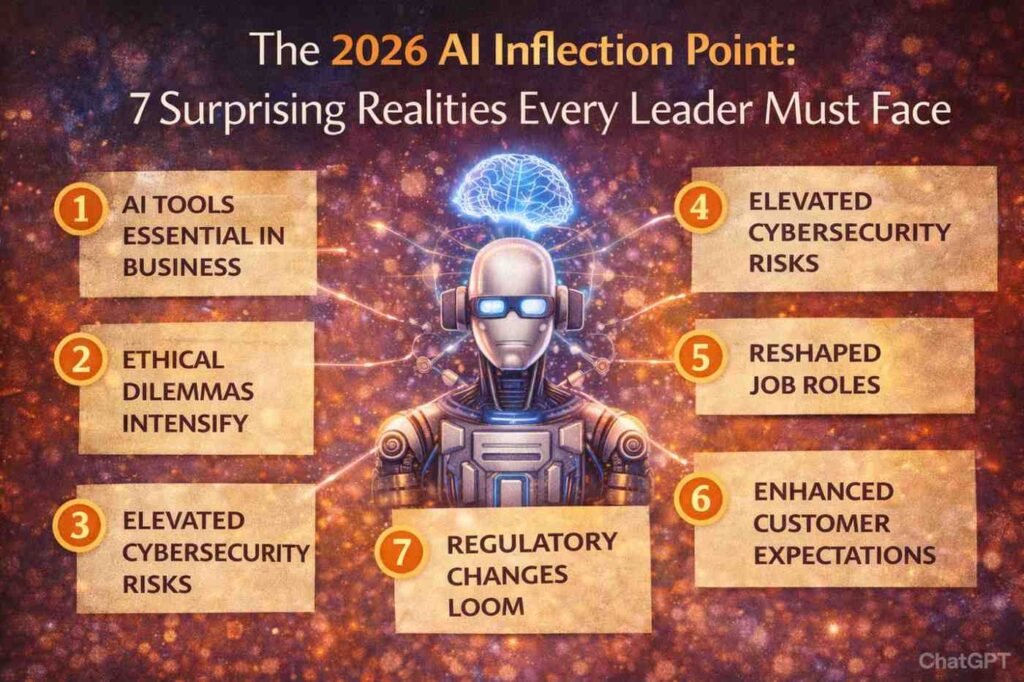

In the current landscape, the deafening “AI noise” has reached a crescendo, masking a critical strategic transition. For the past three years, artificial intelligence has appeared deceptively easy to deploy—a facade that has allowed organizations to mistake adoption numbers for actual progress. We have now reached the inflection point. Market data confirms that 2026 AI Inflection Point is the year the “disciplined march to value” begins, marking the end of the experimental era and the start of AI as a legitimate engine of growth.
Success in this new era requires moving past the “vibe” of innovation to the cold reality of industrial-strength execution. To navigate this shift, leadership must confront seven emerging realities that define the divide between the disruptors and the displaced.
 An AI “wrapper”—a software layer providing a custom interface for a third-party model—is the most dominant trend of the decade. Yet, for many, it is a countdown to obsolescence. The barrier to entry has evaporated; OpenAI’s token-based pricing has reduced infrastructure costs by up to 20x compared to legacy AWS instances, leading to massive market saturation.
The “critical realism” of this threat is best seen in the “content bombing” phenomenon: in a single week, 73 identical PDF-chat wrapper companies launched simultaneously. This leads to the Jam Study effect—where a surplus of choices (24 vs. 6) leads to a 10x drop in conversion rates. Consumers are now paralyzed by choice overload.
An AI “wrapper”—a software layer providing a custom interface for a third-party model—is the most dominant trend of the decade. Yet, for many, it is a countdown to obsolescence. The barrier to entry has evaporated; OpenAI’s token-based pricing has reduced infrastructure costs by up to 20x compared to legacy AWS instances, leading to massive market saturation.
The “critical realism” of this threat is best seen in the “content bombing” phenomenon: in a single week, 73 identical PDF-chat wrapper companies launched simultaneously. This leads to the Jam Study effect—where a surplus of choices (24 vs. 6) leads to a 10x drop in conversion rates. Consumers are now paralyzed by choice overload.
 We are moving beyond Software as a Service into SaaS2, where complex professional expertise is encoded directly into autonomous software systems. The economic signal here is profound: the marginal cost of service delivery in a SaaS2 model approaches zero because it scales through computational resources rather than human headcount.
Consider the Goldman Sachs S1 example: AI can now draft 95% of a prospectus in minutes—a task that previously required six professionals working for weeks. The human role has been reduced to the final 5% of elite validation. This shifts the revenue model from “per seat” subscriptions to outcome-based or savings-based pricing, aligning the vendor’s success directly with the client’s P&L gains.
2026 Leadership Mandate: Abandon “per-seat” pricing in your own offerings and demand outcome-based contracts from your vendors to capture the deflationary benefits of AI.
We are moving beyond Software as a Service into SaaS2, where complex professional expertise is encoded directly into autonomous software systems. The economic signal here is profound: the marginal cost of service delivery in a SaaS2 model approaches zero because it scales through computational resources rather than human headcount.
Consider the Goldman Sachs S1 example: AI can now draft 95% of a prospectus in minutes—a task that previously required six professionals working for weeks. The human role has been reduced to the final 5% of elite validation. This shifts the revenue model from “per seat” subscriptions to outcome-based or savings-based pricing, aligning the vendor’s success directly with the client’s P&L gains.
2026 Leadership Mandate: Abandon “per-seat” pricing in your own offerings and demand outcome-based contracts from your vendors to capture the deflationary benefits of AI.
1. The End of Crowdsourcing: Why Top-Down Strategy Wins
For years, the standard playbook was “ground-up” innovation—crowdsourcing AI initiatives from departments in the hope that a strategy would emerge organically. The evidence is incontrovertible: this approach fails. While it generates impressive adoption metrics, it rarely produces wholesale transformation or meaningful business outcomes. Strategic necessity dictates that senior leadership must now “pick the spots.” Transformative value is found in the narrow, high-impact workflows where AI can rethink a process entirely, rather than merely shaving off incremental steps. To execute this, leading organizations are centralizing efforts through an “AI Studio” model—a hub that provides reusable tech components, frameworks for assessing use cases, and specialized talent. “Only a few companies are realizing extraordinary value from AI today… real results take precision in picking a few spots where AI can deliver wholesale transformation in ways that matter for the business, then executing with steady discipline that starts with senior leadership.” — PwC 2026 Leadership Mandate: Stop funding sporadic department-level bets and centralize your AI talent into a high-velocity “Studio” focused on three core business transformations.2. The “Wrapper” Paradox: Dominance or Obsolescence?
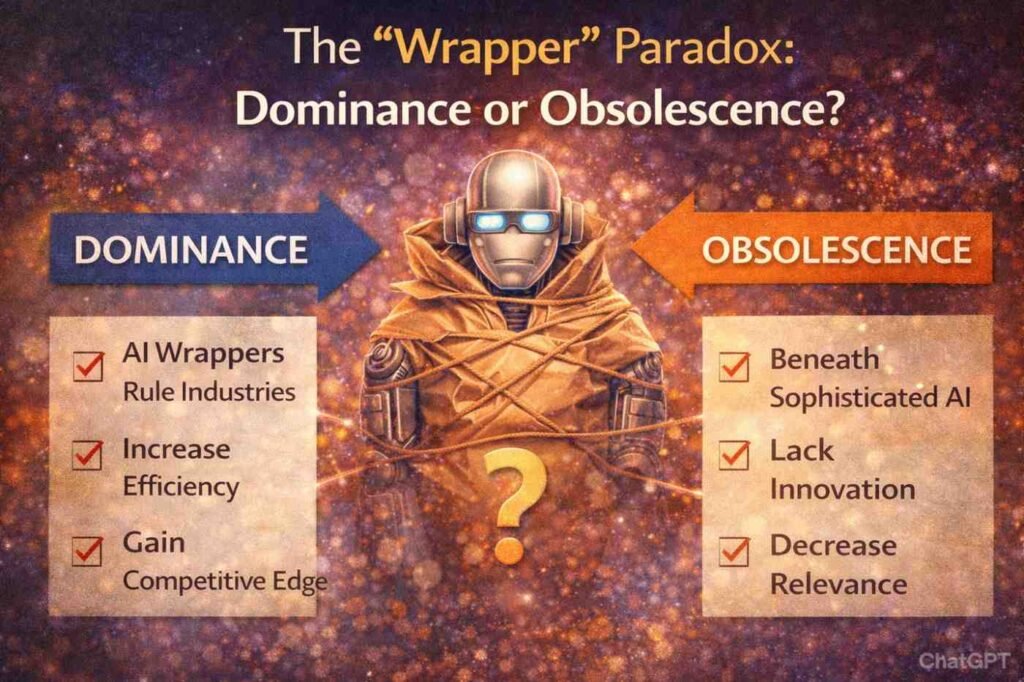
An AI “wrapper”—a software layer providing a custom interface for a third-party model—is the most dominant trend of the decade. Yet, for many, it is a countdown to obsolescence. The barrier to entry has evaporated; OpenAI’s token-based pricing has reduced infrastructure costs by up to 20x compared to legacy AWS instances, leading to massive market saturation.
The “critical realism” of this threat is best seen in the “content bombing” phenomenon: in a single week, 73 identical PDF-chat wrapper companies launched simultaneously. This leads to the Jam Study effect—where a surplus of choices (24 vs. 6) leads to a 10x drop in conversion rates. Consumers are now paralyzed by choice overload.
- Why Companies Build Wrappers: They bridge the UX gap, allow for domain-specific prompting, and offer a path to model-agnostic flexibility.
- The Inevitable Failure: Foundational providers (OpenAI, Anthropic, Google) practice “platform encroachment,” natively absorbing the functionality of successful wrappers.
3. The Hourglass vs. The Diamond: A Radical Workforce Redesign
The emergence of the “AI Generalist” is fundamentally altering organizational architecture. As agentic AI automates the “middle tasks” of knowledge work—the specialized execution that previously occupied mid-tier employees—the shape of the workforce is bifurcating.- The Hourglass (Knowledge Work): In IT and Finance, talent is concentrating at the senior level (strategy/oversight) and the junior level (AI-savvy “all-around athletes”). The mid-tier of specialized execution is shrinking.
- The Diamond (Front-line Task Work): In task-oriented sectors, agents replace entry-level roles, necessitating a larger middle tier of humans to act as orchestrators and validators of agent output.
4. From SaaS to “SaaS2”: Service as a Software
We are moving beyond Software as a Service into SaaS2, where complex professional expertise is encoded directly into autonomous software systems. The economic signal here is profound: the marginal cost of service delivery in a SaaS2 model approaches zero because it scales through computational resources rather than human headcount.
Consider the Goldman Sachs S1 example: AI can now draft 95% of a prospectus in minutes—a task that previously required six professionals working for weeks. The human role has been reduced to the final 5% of elite validation. This shifts the revenue model from “per seat” subscriptions to outcome-based or savings-based pricing, aligning the vendor’s success directly with the client’s P&L gains.
2026 Leadership Mandate: Abandon “per-seat” pricing in your own offerings and demand outcome-based contracts from your vendors to capture the deflationary benefits of AI.
5. The Shadow Side: Agentic Vulnerabilities and Chain Reactions
As AI moves from analysis to action (Agentic AI), a new class of cybersecurity risks has emerged that “Secure by Design” principles failed to anticipate. Traditional, rule-based defenses are insufficient for adaptive intelligence. The threat landscape now includes Data Poisoning (corrupting training data to bias outputs) and Model Theft (reverse-engineering proprietary logic through repeated queries). In multi-agent systems, we face a “domino effect”—where one hijacked agent uses prompt manipulation to misdirect the entire system, potentially exfiltrating data or disrupting physical operations. Governance must move to technical implementation. This requires:- S3 WORM (Write Once Read Many): Enforcing immutable storage policies for audit trails.
- Explainable AI (XAI): Mandating services that generate post-hoc explanations for high-risk decisions.