
Has your Meta ad performance on Facebook and Instagram recently tanked without any clear explanation? Have winning campaigns suddenly stalled, leaving you scrambling for answers? If so, you’re not alone. The reason for this widespread disruption is a quiet but massive update from Meta called “Andromeda.”
In simple terms, Andromeda is not just a minor tweak—it’s a complete rebuild of the algorithm that decides which ads people see. This fundamental shift has changed the rules of the game, making many old best practices obsolete. This article will distill the five most critical and counter-intuitive takeaways you need to understand to adapt and succeed in this new era.
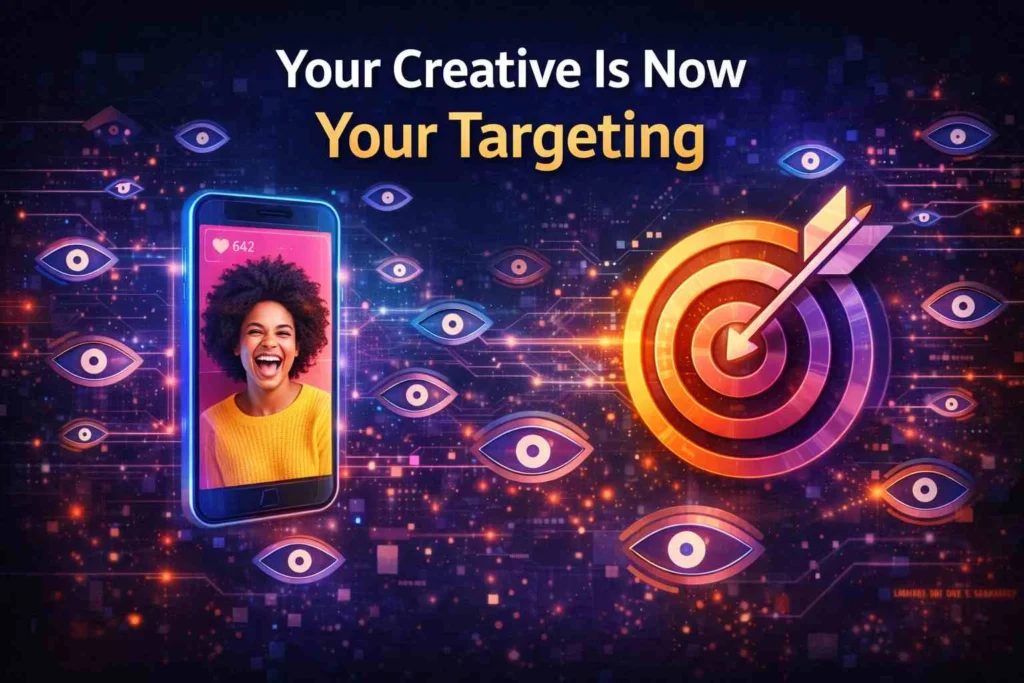 The new reality is that Andromeda uses advanced machine learning to analyze the signals within your ad creative itself. The AI examines the visuals, audio, tone, and text to determine who the ad is for. It looks at who is in the video, what they are saying, and what problems they are solving to build a behavioral profile of the ideal viewer. Think of your creative asset as the targeting brief you are now handing directly to the AI.
Your creative decides the audience, not your adset.
This is a major change because it moves the center of gravity for advertising success. It is no longer about finding technical “hacks” in the Ads Manager but about creating content that clearly and powerfully signals the target persona to the AI. The strategic imperative is to reallocate resources from technical audience management to robust, persona-driven creative development.
The new reality is that Andromeda uses advanced machine learning to analyze the signals within your ad creative itself. The AI examines the visuals, audio, tone, and text to determine who the ad is for. It looks at who is in the video, what they are saying, and what problems they are solving to build a behavioral profile of the ideal viewer. Think of your creative asset as the targeting brief you are now handing directly to the AI.
Your creative decides the audience, not your adset.
This is a major change because it moves the center of gravity for advertising success. It is no longer about finding technical “hacks” in the Ads Manager but about creating content that clearly and powerfully signals the target persona to the AI. The strategic imperative is to reallocate resources from technical audience management to robust, persona-driven creative development.
1. Your Creative Is Now Your Targeting
The most fundamental shift with Andromeda is the move away from manual targeting. The old method of relying heavily on granular interest targeting and complex lookalike audiences is no longer the primary driver of performance.
The new reality is that Andromeda uses advanced machine learning to analyze the signals within your ad creative itself. The AI examines the visuals, audio, tone, and text to determine who the ad is for. It looks at who is in the video, what they are saying, and what problems they are solving to build a behavioral profile of the ideal viewer. Think of your creative asset as the targeting brief you are now handing directly to the AI.
Your creative decides the audience, not your adset.
This is a major change because it moves the center of gravity for advertising success. It is no longer about finding technical “hacks” in the Ads Manager but about creating content that clearly and powerfully signals the target persona to the AI. The strategic imperative is to reallocate resources from technical audience management to robust, persona-driven creative development.
2. Minor Tweaks and Re-Skins Are Now Invisible
In the past, a common practice for extending the life of a winning ad was to make small, iterative changes—a new headline, a different button color, or a slight copy variation. This low-effort “re-skinning” was often enough to register the ad as “new” and keep performance steady. Under Andromeda, this strategy is dead. The system is now intelligent enough to recognize when an ad is fundamentally the same as another. These minor tweaks are now considered the same ad and will not be treated as fresh creative. Meta now treats two ads as “identical” if they share the similar first 3 seconds.. even if the copy, message or CTA is different. In practice, this means ads using the same creator in the same setting, or ads with only slight copy variations, are no longer considered new concepts by the system. The impact of this is significant: it forces advertisers to generate genuinely new concepts and angles. The strategic imperative is to shift budget and effort from low-value iteration to high-value, net-new concept generation.3. It’s a Volume Game—But Diversity Is the Real Prize
The new system thrives on a high volume of creative assets. Experts now recommend launching 15 or more unique creatives per Advantage+ campaign, refreshing them on a weekly basis. However, volume without variety is useless. Pushing dozens of similar ads will not improve performance. True success in the Andromeda era comes from creative diversification. This means feeding the algorithm a wide range of distinct signals so it has more to learn from. The key is to test variety across four core areas:- Concepts: The core story or idea behind the ad.
- Angles: The specific problem or benefit being highlighted.
- Personas: The intended audience for the message.
- Formats: How the message is delivered (e.g., UGC, static, video, carousel).