
Unlock the power of Search Generative AI with our performance reports guide. Discover insights that drive smarter decisions and elevate your strategies.
Understanding Performance Reports in AI
In the realm of Artificial Intelligence (AI), performance reports serve as a critical tool for assessing the efficacy and efficiency of AI models. These reports provide a detailed analysis of how well an AI system performs its tasks, offering insights into accuracy, speed, and overall reliability. For organizations leveraging AI, understanding these reports is paramount to optimizing performance and achieving strategic goals.
Performance reports in AI encompass a variety of metrics and data points, each contributing to a comprehensive overview of the system’s capabilities. From precision and recall to F1 scores and ROC curves, these metrics help in quantifying the success of AI models. By delving into these reports, stakeholders can pinpoint areas of strength and identify potential weaknesses that need addressing.
Moreover, the complexity of AI systems necessitates a structured approach to performance reporting. This involves not only collecting data but also interpreting it in a meaningful way. Performance reports should be tailored to meet the specific needs of the organization, ensuring that the insights derived are actionable and align with broader business objectives. This strategic approach to performance reporting can significantly enhance the decision-making process, leading to more informed and effective strategies.
Key Metrics to Analyze in Performance Reports
When analyzing AI performance reports, there are several key metrics that provide valuable insights into the system’s effectiveness. Accuracy, for instance, measures the proportion of correct predictions made by the AI model out of all predictions. While a high accuracy rate is desirable, it is also essential to consider other metrics to get a complete picture.
Precision and recall are two such metrics that offer deeper insights. Precision measures the number of true positive results divided by the number of all positive results, including those incorrectly identified. Recall, on the other hand, measures the number of true positive results divided by the number of true positives and false negatives. Together, these metrics can help in understanding the trade-offs between different types of errors and the model’s ability to identify relevant instances.
Another critical metric is the F1 score, which is the harmonic mean of precision and recall. The F1 score provides a balance between precision and recall, making it a valuable metric when dealing with imbalanced datasets. Additionally, metrics such as the Area Under the Receiver Operating Characteristic (ROC) Curve (AUC-ROC) can be instrumental in evaluating the performance of classification models. By analyzing these metrics, organizations can gain a nuanced understanding of their AI systems’ performance and make data-driven decisions.
The Importance of Data Interpretation
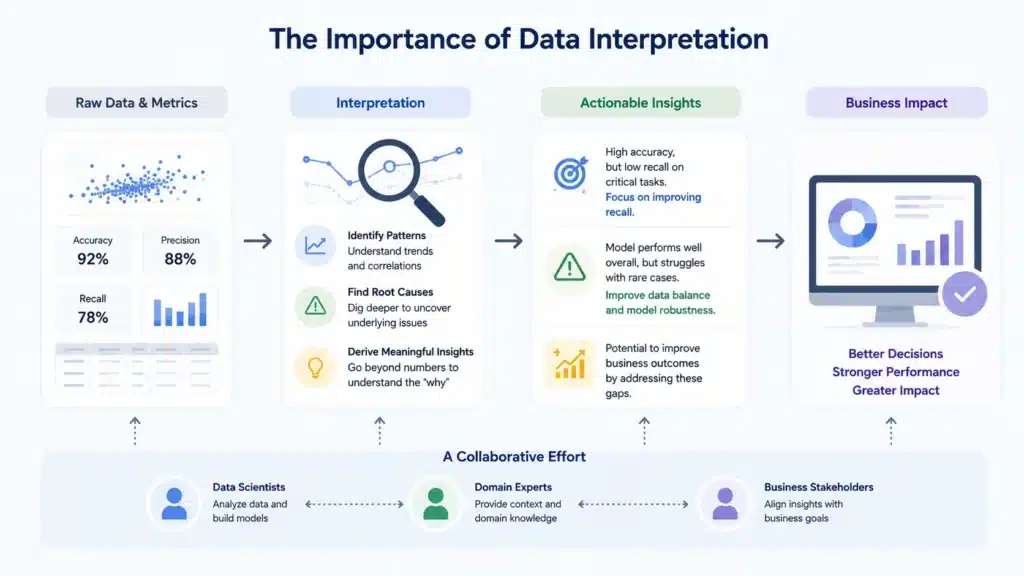
While collecting data and calculating metrics are essential steps in performance reporting, the true value lies in data interpretation. Interpreting performance data correctly can provide actionable insights that drive improvements and innovation. Without proper interpretation, the raw data remains just numbers, devoid of context and meaning.
Effective data interpretation requires a deep understanding of the AI model, the domain it operates in, and the specific goals of the organization. For instance, a high accuracy rate might seem impressive, but if the model fails to perform well on critical tasks, its real-world applicability could be limited. Therefore, interpreting performance reports involves looking beyond the surface metrics and understanding the underlying patterns and trends.
Moreover, data interpretation should be a collaborative effort involving data scientists, domain experts, and business stakeholders. This collaborative approach ensures that the insights derived are relevant and actionable. By translating complex data into understandable and actionable insights, organizations can make informed decisions that enhance the performance and impact of their AI initiatives.
How to Generate AI Performance Reports
Generating AI performance reports involves several steps, each critical to ensuring the accuracy and reliability of the insights derived. The first step is data collection, where relevant data is gathered from various sources. This data needs to be comprehensive and representative of the real-world scenarios the AI model will encounter.
Once the data is collected, the next step is data preprocessing. This involves cleaning the data, handling missing values, and normalizing it to ensure consistency. Preprocessing is a crucial step as it directly impacts the quality of the performance report. Any anomalies or inconsistencies in the data can lead to misleading insights, undermining the effectiveness of the report.
After preprocessing, the AI model is evaluated using the prepared dataset. During this evaluation, various performance metrics are calculated, providing a quantitative assessment of the model’s performance. The results are then compiled into a report, which includes visualizations such as graphs and charts to make the data more understandable. Finally, the report is reviewed and interpreted by experts to derive actionable insights that can drive strategic decisions.
Common Challenges in Analyzing AI Performance
Analyzing AI performance is fraught with challenges, many of which stem from the inherent complexity of AI systems and the data they rely on. One common challenge is dealing with imbalanced datasets, where the number of instances in different classes varies significantly. This imbalance can skew performance metrics, making it difficult to assess the model’s true capabilities.
Another challenge is the dynamic nature of data. In many real-world applications, data is continuously evolving, and an AI model that performs well today might not be as effective tomorrow. This necessitates ongoing monitoring and updating of the model to ensure sustained performance. Additionally, the presence of noisy data and outliers can further complicate the analysis, leading to inaccurate performance assessments.
Interpretability is another significant challenge. Many AI models, particularly those based on deep learning, are often considered “black boxes” due to their complex and opaque nature. This lack of transparency can make it difficult to understand how the model arrives at its predictions, complicating the interpretation of performance reports. Overcoming these challenges requires a combination of robust data handling practices, continuous monitoring, and the use of interpretable AI models where possible.
Best Practices for Effective Reporting
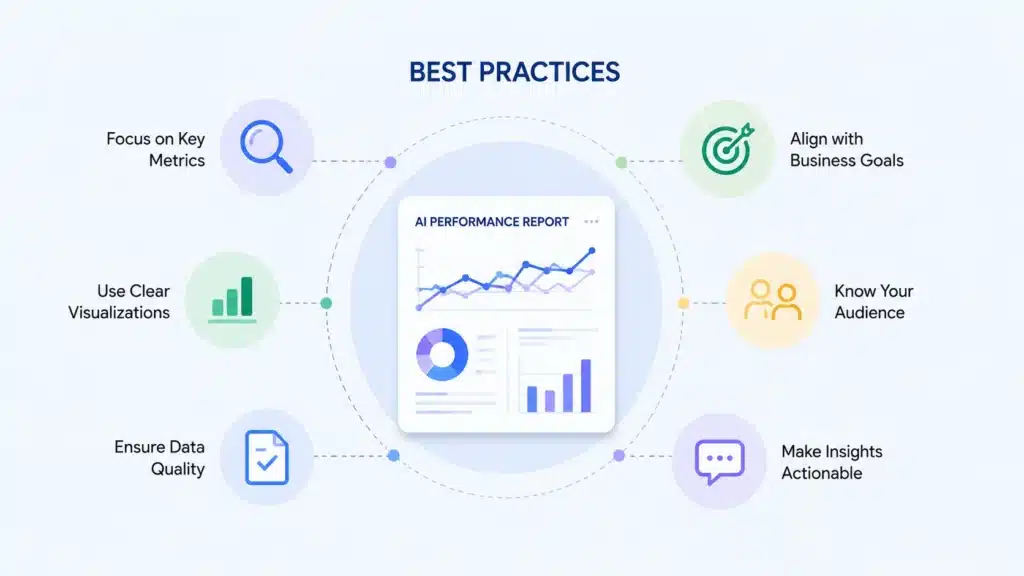
To ensure the effectiveness of AI performance reports, it is essential to follow best practices that enhance accuracy, clarity, and actionability. One such practice is maintaining transparency in the reporting process. This involves documenting the methodologies used, the assumptions made, and any limitations of the data or the model. Transparent reporting builds trust and enables stakeholders to make informed decisions.
Another best practice is the use of visualizations. Graphs, charts, and dashboards can make complex data more accessible and easier to understand. Visualizations help in identifying patterns, trends, and anomalies that might not be apparent from raw data alone. They also facilitate better communication of insights to non-technical stakeholders, ensuring that everyone is on the same page.
Customization is also key to effective reporting. Performance reports should be tailored to meet the specific needs of the organization and its stakeholders. This includes focusing on the most relevant metrics, providing contextual information, and aligning the insights with strategic objectives. By following these best practices, organizations can create performance reports that are not only accurate and informative but also actionable and aligned with their goals.
Tools and Technologies for Performance Reporting
Several tools and technologies can facilitate the generation and analysis of AI performance reports. One widely used tool is Jupyter Notebook, an open-source web application that allows the creation of live code, equations, visualizations, and narrative text. Jupyter Notebooks are particularly useful for data exploration and visualizing AI performance metrics.
Another valuable tool is TensorBoard, a visualization toolkit for TensorFlow. TensorBoard enables users to track and visualize metrics such as loss and accuracy, providing a real-time view of the model’s performance. It also offers features like histograms and graphs that help in understanding the inner workings of the AI model.
For organizations looking for comprehensive reporting solutions, platforms like Microsoft Power BI and Tableau offer robust capabilities. These tools provide advanced data visualization and reporting features, enabling users to create interactive dashboards and detailed reports. By leveraging these tools and technologies, organizations can streamline the process of generating and analyzing AI performance reports, leading to more efficient and effective decision-making.
Case Studies: Successful Use of AI Performance Reports
The impact of AI performance reports can be seen in various industries through successful case studies. One such example is a leading healthcare provider that used AI performance reports to improve diagnostic accuracy. By analyzing metrics such as precision and recall, the organization identified areas where the AI model was underperforming and made targeted improvements. As a result, diagnostic accuracy increased, leading to better patient outcomes.
In the retail sector, a major e-commerce company leveraged AI performance reports to enhance its recommendation system. By continuously monitoring and analyzing performance metrics, the company was able to fine-tune its algorithms, resulting in more personalized and relevant recommendations for customers. This not only improved customer satisfaction but also boosted sales and revenue.
Another notable case is a financial institution that used AI performance reports to detect and prevent fraudulent transactions. By analyzing metrics such as the AUC-ROC curve, the institution was able to assess the model’s ability to identify fraudulent activities accurately. The insights derived from the performance reports enabled the institution to refine its fraud detection model, significantly reducing the incidence of fraud and enhancing security.
AI assistants today even used for coding several AI coding assistants are present in market today.
Conclusion and Future Trends in AI Reporting
As AI continues to evolve, the importance of performance reporting cannot be overstated. Effective performance reports provide the insights needed to optimize AI models, drive strategic decisions, and achieve business objectives. By understanding key metrics, interpreting data accurately, and following best practices, organizations can unlock the full potential of their AI systems.
Looking ahead, several trends are poised to shape the future of AI performance reporting. One such trend is the increasing focus on explainable AI (XAI). As AI models become more complex, there is a growing need for transparency and interpretability. Explainable AI aims to make AI models more understandable, enabling stakeholders to trust and effectively use the insights derived from performance reports.
Another emerging trend is the integration of AI with other advanced technologies such as the Internet of Things (IoT) and blockchain. These integrations can enhance data collection, improve the accuracy of performance reports, and provide real-time insights. Additionally, advancements in automated reporting and real-time monitoring are set to revolutionize the way organizations generate and analyze AI performance reports, making the process more efficient and effective.
In conclusion, AI performance reports are a vital tool for any organization leveraging AI. By embracing the latest trends and technologies, and adhering to best practices, organizations can unlock valuable insights that drive smarter decisions and elevate their strategies. The future of AI performance reporting is bright, promising even greater possibilities for innovation and growth.