

For most of the last decade, Indian businesses approached SEO the same way: find a keyword, write an article, hope it ranks. Some variation of this — write more articles, get more backlinks, tweak more meta tags — defined the entire industry.
That model is no longer effective in July 2026. Google’s March 2026 Core Update crystallised what the search community had been observing for two years: a site with 20 interconnected articles on a specific subject will consistently outrank a site with one 5,000-word guide on the same subject — even if the single article is technically superior in isolation.
This is topical authority — the depth and breadth of your content coverage on a specific subject, as recognised by both search engines and AI systems. It is the dominant SEO signal of 2026, it works for traditional search AND AI citation visibility, and it is extraordinarily difficult for competitors to copy quickly once you’ve established it.
The compounding effect is real: sites that maintain disciplined cluster publishing and internal linking for 12+ months report dramatic improvements in competitive rankings, with multiple cluster pages simultaneously ranking for hundreds of related long-tail queries that no individual article could capture alone.
Why Topical Authority Matters More in July 2026 Than Ever Before
Google’s content quality systems now evaluate two dimensions simultaneously: topical depth (how comprehensively you cover the breadth of a subject) and E-E-A-T signals (evidence of genuine experience, expertise, authoritativeness, and trustworthiness). A site that demonstrates both — through organised content clusters, named expert authorship, and consistent original publishing — now outperforms any amount of keyword-optimised individual articles.
There is also an AI dimension that makes topical authority more valuable than ever. Google’s search team confirmed in July 2026 that AI systems parse content using “chunking” — breaking pages into discrete, extractable sections. A site with genuine topical depth gives AI systems multiple quotable, citable sections. A site with isolated articles gives AI systems almost nothing to work with.
The February 2026 Google Discover update made entity-level authority evaluation explicit: Google now evaluates expertise by content cluster, not by domain overall. A site with strong overall authority but shallow coverage of a specific subject gets no credit in that subject. A site with modest overall authority but deep, consistent coverage of a specific area outperforms the stronger domain in that topical space. This is a fundamental structural shift in how rankings work.
ChatGPT currently represents 17.1% of all digital queries — the biggest threat to Google’s market dominance in 20+ years. When you optimise for topical authority in Google, you also optimise for ChatGPT, Perplexity, and Gemini citation — because all of these systems preferentially cite sources that demonstrate comprehensive, organised coverage of a specific topic.
The Four-Layer Topical Authority Architecture
Building topical authority is not about writing more content. It is about writing organised content with deliberate architecture. Here is the four-layer structure that is working across Indian business SEO in July 2026:
Layer 1: Define Your Topical Territory
Before writing a single word, define your topical territory clearly. A real estate agency in Gurgaon does not own “real estate” as a topic. It can own “Gurgaon luxury residential real estate.” An SEO agency in Delhi does not own “digital marketing.” It can own “B2B SEO for Delhi NCR service businesses.”
The narrower your topical territory, the faster you build authority within it. The mistake most Indian businesses make is trying to rank for everything in their category rather than becoming the definitive source for a specific slice of it. A site with 15 deeply interconnected articles about “JEE coaching in Noida” will consistently outrank a site with 100 generic coaching articles. Specificity is your first strategic decision.
Layer 2: Build the Pillar Page
The pillar page is the central hub of your content cluster. It provides comprehensive coverage of the core topic — 2,000–4,000 words that addresses the topic from multiple angles — and links outward to all supporting articles. It should answer the foundational question completely while pointing readers toward deeper treatment of specific subtopics.
For an Indian coaching institute: the pillar page is “Complete Guide to JEE Preparation in Noida 2026.” For a Delhi law firm: it is “Company Registration in India: Complete Legal Guide.” For a Bangalore SaaS company: it is “What is CRM Software: Complete Guide for Indian Businesses.”
The pillar page should be updated quarterly with fresh examples, new data, and current information. Freshness is now a meaningful ranking signal — not just a new published date but actual content updates with new insights.
Layer 3: Build the Supporting Cluster
Supporting articles explore specific subtopics in depth — each one answering a specific question that relates to the pillar page topic. Each supporting article links back to the pillar page and horizontally to other relevant supporting articles. This internal link architecture is how Google’s systems understand the relationships between your content and assess your topical coverage.
A supporting article should be 800–1,500 words, answer one specific question completely, and have its answer in the first paragraph after the heading. Write the headings as actual questions that your target customers ask — not keyword-optimised headings, but the exact language a person would type into Google.
Turn your sales calls, support tickets, and customer objections into supporting articles. These are the questions your audience is already asking in natural language — and natural language questions are exactly what AI Mode and voice search surface. An Indian B2B company that publishes answers to every question its sales team gets asked will build topical authority faster than any content agency producing generic articles.
Layer 4: Maintain Velocity and Freshness
Even a mature content cluster requires publishing 1–2 new articles per month to signal ongoing expertise to Google. New content creates new internal linking opportunities and keeps the cluster’s freshness signal active. Trend-driven content (“JEE Preparation Strategy for 2027: What’s Changing”) serves dual purposes — it demonstrates current awareness and refreshes the cluster.
Equally important: quarterly refreshes of your most important existing pages. Update examples, add new statistics, revise outdated information, fix broken internal links, and add new FAQ sections. This is the kind of “freshness” that actually improves rankings — not just changing the published date.
Topical Authority and Entity Recognition: The Technical Layer
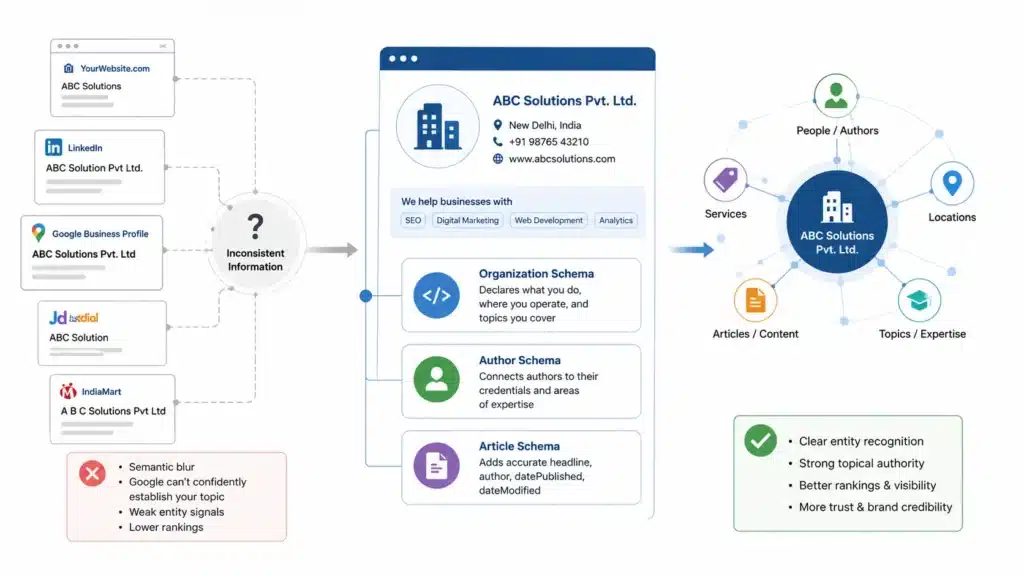
There is a technical dimension to topical authority that most content strategies overlook: entity recognition. Google’s Knowledge Graph maps entities — businesses, people, products, concepts — and their relationships. When your business is clearly identified as the authoritative source on a specific topic cluster, that entity-level association compounds the ranking effect of your content.
Entity clarity is the most common technical weakness in Indian business websites. The homepage says one thing, the LinkedIn company page says another, the About page says almost nothing, and the schema markup is missing or wrong. This semantic blur is why sites with strong content fail to build topical authority efficiently — Google cannot confidently establish what topic the site is the authority on.
Fixing entity clarity is one of the fastest topical authority wins available:
- Consistent brand naming across your website, GBP, LinkedIn, JustDial, IndiaMart — identical name, address, phone in every mention
- Organisation schema on your homepage declaring what you do, where you operate, and what topics you cover
- Author schema on content pages connecting named authors to their professional credentials and the topics they write about
- Article schema on all blog posts with headline, author, datePublished, and dateModified — all accurate
Topical Authority for Indian Businesses: Category-Specific Guidance
The topical territory that builds authority fastest varies by business type. Here is what works for India’s primary business categories:
- Coaching institutes (Delhi, Noida, Kota): Territory = “JEE/NEET preparation in [city].” Cluster = exam strategy, subject guides, study schedules, result analysis, faculty expertise posts. 15 well-structured articles dominate a city’s JEE coaching searches.
- IT companies (Bangalore, Noida, Hyderabad): Territory = one specific technology service in one market. Cluster = solution explainers, case studies, comparison articles, technical tutorials, implementation guides. Wins B2B RFQs by establishing thought leadership before outreach.
- Real estate (Delhi NCR, Mumbai, Hyderabad): Territory = specific localities or project types. Cluster = locality guides, buyer FAQ posts, legal process articles, project comparison content, neighbourhood infrastructure posts. Wins Google Discover placements through local expertise signals.
- Healthcare (all cities): Territory = specific specialty or condition. Cluster = condition explainers, treatment process articles, doctor FAQ content, cost transparency posts, post-procedure care guides. Earns medical tourism traffic through expertise depth.
What to Build This Month
If you are starting from scratch, here is the 30-day topical authority foundation:
- Week 1: Define your topical territory (narrow, specific, ownable). Conduct a content audit — categorise existing content by topical relevance and identify gaps.
- Week 2: Build or identify your pillar page. If it does not exist, create it. If it exists but is under 1,500 words or has outdated information, refresh it completely.
- Week 3: Identify 12 supporting article topics — the specific questions around your pillar topic that your actual customers ask. Write the first 3.
- Week 4: Build internal links between all published content in the cluster. Verify author attribution on all pages. Implement Article schema on all cluster pages.
Best Article writing practice can ensure topical authority and ranking.
The businesses that dominate Indian Google Search in the second half of 2026 are the ones that invested in topical depth when their competitors were still chasing individual keywords. That window is still open — but it closes as the competition wakes up.
DigitalArka builds topical authority content clusters for Indian businesses across 12 cities. Free SEO audit at digitalarka.com