
The most dangerous lie in Indian digital marketing right now is this: “our SEO is working because our organic traffic is stable.”
In July 2026, stable organic traffic is not a sign that SEO is working. It may be a sign that AI Overviews are absorbing your informational query traffic — giving your brand citations without clicks — while your bottom-of-funnel, transactional traffic holds steady. Measuring only the total traffic number misses both the opportunity (you may be getting cited in AI answers without knowing it) and the risk (you may be losing informational traffic you could have captured with better structured content).
The measurement framework for SEO success in 2026 has fundamentally changed. This blog explains the new KPI structure, why traditional metrics are misleading, and exactly how Indian businesses should be reporting and evaluating their SEO performance right now.
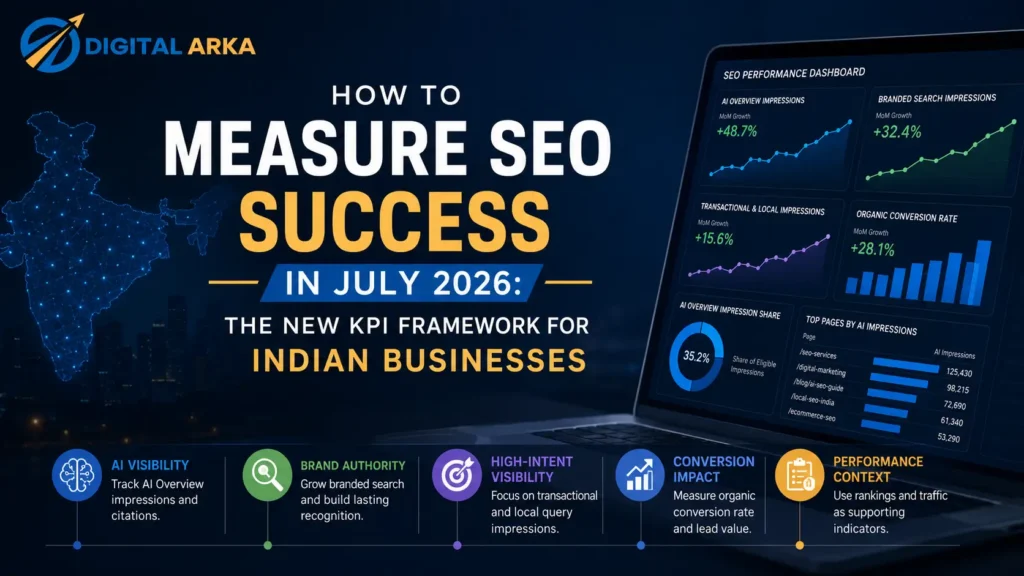
The new primary SEO success metric for 2026: Not organic clicks. Not keyword rankings. The combination of AI Overview impressions + branded search growth + conversion rate from organic traffic + high-intent impressions. Together, these tell you whether your SEO is building the brand authority that drives sustainable revenue.
Why Traditional SEO Metrics Are Misleading in 2026
Before building the new framework, it is important to understand why traditional metrics are now actively misleading — and how misreading them leads to wrong strategic decisions.
Why “Organic Traffic” Is No Longer the Right Primary Metric
AI Overviews reduce organic clicks on the top result by an average of 34.5%. AI Mode shows a 93% zero-click rate for queries where it activates. Search Engine Journal confirms zero-click behaviour keeps rising as AI features answer more queries directly on the SERP.
This means a business whose SEO is performing excellently — appearing in AI Overviews for 50 important queries, building brand recognition with thousands of searchers per month — may show flat or declining organic traffic because the AI answered the question before the click happened.
Reporting to management that “SEO is flat” when AI Overview impressions are growing is both strategically incorrect and a misallocation of decision-making attention. The business is winning visibility; it is just not showing up in the traditional traffic metric.
Why “Keyword Rankings” Alone Are Insufficient
Keyword rankings have always been a lagging indicator. In July 2026, they are additionally misleading for a different reason: a page can rank #1 for a keyword while being invisible in the AI Overview that now sits above that ranking — and the AI Overview may be receiving 3–5x the user attention of the #1 organic result.
Tracking keyword rankings without also tracking AI Overview impression share for the same queries gives you an incomplete and potentially dangerously misleading picture of your actual search visibility.
The New SEO KPI Framework for 2026
Here is the measurement framework that provides an accurate picture of SEO performance in July 2026’s AI-first search environment. Organise your reporting around five layers:
Layer 1: AI Visibility (New — Now Available in Search Console)
What to measure: AI Overview impressions by URL and query type (from Google Search Console’s new AI performance report, available in expanded form from June 2026). Track month-over-month growth in AI impression share for your top 20 pages.
What it tells you: Whether your content is being considered by Google’s AI systems as a credible source. Growing AI impressions = growing machine-level trust in your expertise. This is the leading indicator of future brand authority and branded search growth.
Target: Every service page and blog post targeting a competitive query should accumulate AI Overview impressions within 3–6 months of publication or refresh. A page with zero AI impressions after 6 months is underperforming in the AI-readability dimension.
Layer 2: Branded Search Volume
What to measure: Monthly branded keyword impressions and clicks in Google Search Console (filter by your brand name as a query modifier). Track month-over-month growth.
What it tells you: Whether your total digital marketing activity — SEO, AI Overview citations, social media, paid ads — is building audience-level brand recognition. Branded search is the most valuable organic traffic channel because branded visitors convert at 3–5x the rate of cold organic visitors.
The AI connection: Amsive data shows branded queries get approximately 18% higher CTR in AI Overviews. As your brand appears more frequently in AI answers, branded search should grow — even if informational traffic clicks decline. If AI impressions are growing but branded search is not growing, your brand name is not being surfaced prominently enough in the AI answers.
Layer 3: High-Intent Impressions and CTR
What to measure: Impressions and click-through rate for transactional and local queries in Search Console. Segment by query type: informational (how, what, why) vs transactional (buy, price, hire, best) vs local (“near me,” “[city]” qualifier).
What it tells you: Informational query traffic will decline as AI Overviews absorb more zero-click answers. This is expected and not a failure signal. Transactional and local query impressions and CTR should be stable or growing — these are the queries where users have buying intent and are less likely to accept an AI Overview answer as sufficient.
If transactional and local impressions are declining, this is the genuine alarm signal — it indicates your most commercially valuable pages are losing visibility, not just informational content being absorbed by AI.
Layer 4: Organic Conversion Rate
What to measure: Conversion rate of organic visitors — enquiry form submissions, phone calls from GSC traffic, WhatsApp conversations initiated, appointment bookings from organic landing pages.
What it tells you: Whether the organic traffic you ARE receiving is the right traffic. As AI Overviews filter out casual informational browsers (who were rarely converting anyway), the visitors who do click through should be higher-intent and should convert at a higher rate. If organic traffic declines but organic conversion rate improves, your SEO is becoming more efficient — the business impact of each organic visitor is increasing even as total visitor volume decreases.
This is one of the most misread signals in 2026’s SEO landscape. Businesses that see “traffic down 20%, conversions stable” and report a problem are misreading a likely improvement — they are receiving fewer irrelevant visits and the same number of valuable conversions.
Layer 5: Traditional Rankings and Traffic (Context, Not Primary Signal)
What to measure: Top 20 keyword position tracking for your most commercially important queries. Total organic sessions, segmented by page type.
What it tells you: Context for understanding specific page performance and algorithm update impacts. Rankings still matter — but as a supporting indicator, not the primary one. A page that drops from #3 to #7 in rankings while its AI Overview impressions grow is actually gaining influence, not losing it.
SEO for zero-click searches is the best way to promote your business in this AI landscape.
Building Your Monthly SEO Report: The 2026 Template
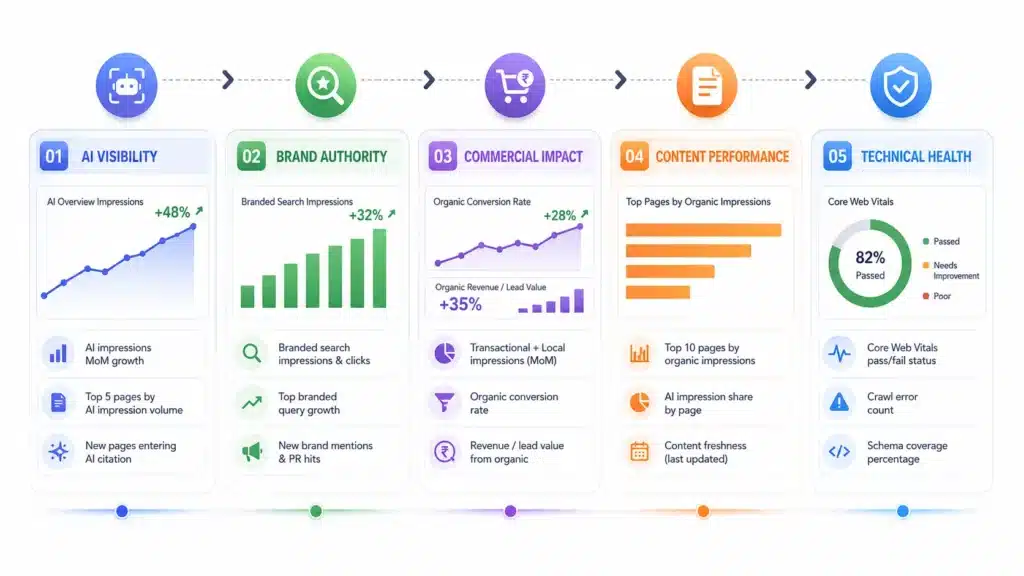
For Indian businesses reporting SEO performance to leadership or clients in July 2026, here is the monthly report structure that accurately reflects performance:
- AI Visibility: AI Overview impressions month-over-month. Top 5 pages by AI impression volume. New pages entering AI citation this month.
- Brand Authority: Branded search impressions and clicks month-over-month. Top branded query growth. New brand mention acquisitions (digital PR hits, editorial citations).
- Commercial Impact: Transactional + local query impressions month-over-month. Organic conversion rate. Revenue or lead value attributed to organic.
- Content Performance: Top 10 pages by organic impressions. AI impression share by page. Freshness status (last updated date for top 20 pages).
- Technical Health: Core Web Vitals pass/fail status. Crawl error count. Schema coverage percentage.
This report tells a complete story: whether your brand is gaining AI-era visibility, whether that visibility is converting into commercial outcomes, and whether the technical and content foundations are in place to sustain and grow both.
Common Measurement Mistakes Indian Businesses Are Making Right Now
- Panicking about declining informational traffic that was never converting — the organic users who asked “how does X work” rarely became customers; losing them to AI Overviews is not a revenue loss
- Celebrating stable traffic without checking conversion rates — stable traffic with declining conversion rate is worse than declining traffic with stable conversion rate
- Ignoring AI impression data — this is the new leading indicator of brand authority building, and it is now available in Search Console for the first time
- Measuring branded and non-branded traffic together — branded traffic performance masks non-branded organic performance; always segment these two in reporting
- Reporting rankings without AI surface context — a #1 ranking for a query where an AI Overview answers 90% of the query need has fundamentally different commercial value than a #1 ranking for a transactional query
The Bottom Line
SEO measurement in July 2026 is more complex than it has ever been — because search itself is more complex. But the fundamental question has not changed: is our digital presence generating the brand authority and commercial outcomes our business needs?
The new measurement framework answers that question more accurately than organic traffic ever did. AI Overview impressions tell you whether machines trust your expertise. Branded search growth tells you whether humans recognise your brand. Organic conversion rate tells you whether the people arriving from search are actually buying. Together, these tell you whether your SEO investment is working — regardless of what is happening to total organic traffic volume.
Measure what creates business value, not what is easy to measure. In 2026, easy-to-measure traffic metrics are increasingly disconnected from business-value outcomes. The businesses that win are those measuring AI visibility, brand authority, and conversion quality — not just click counts.
DigitalArka builds SEO reporting frameworks for Indian businesses that accurately reflect AI-era performance. Get a free SEO audit at digitalarka.com