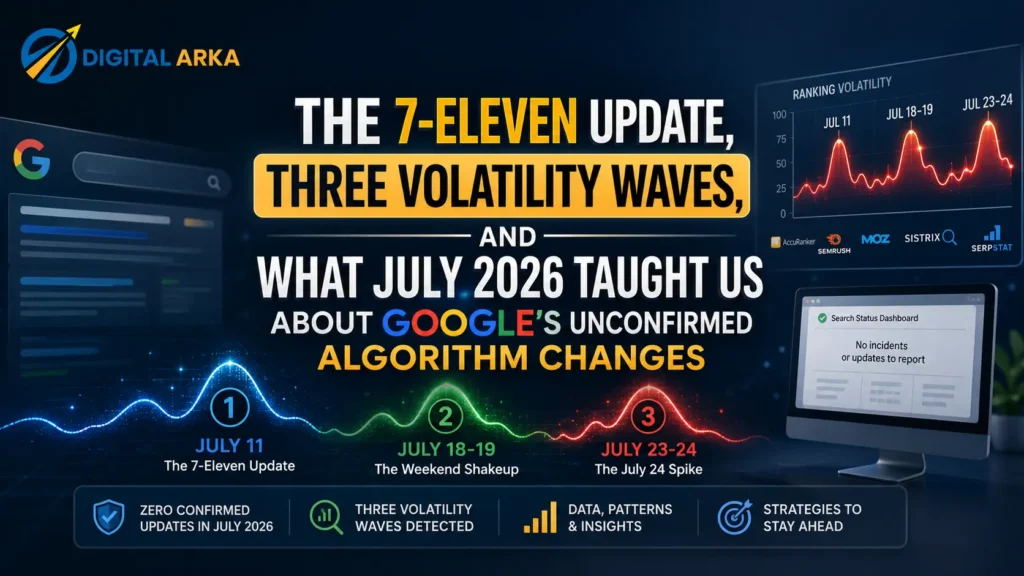

July 2026 Gave SEOs Three Volatility Spikes and Zero Confirmed Updates
July 2026 became the month that made the SEO community recalibrate its relationship with Google’s Search Status Dashboard. Three distinct waves of ranking volatility hit during the month — July 11, July 18-19, and July 23-24 — and Google confirmed none of them. The Search Status Dashboard remained silent. The last confirmed ranking event on record was the June 2026 spam update, which ran from June 14 to June 26 and wrapped before July began.
Barry Schwartz at Search Engine Roundtable named the July 11 event the “7-Eleven update” — a reference to the date, and what he described as a growing sense that unconfirmed volatility was becoming a recurring genre of event rather than an isolated incident. By the time the July 24 wave hit, with AccuRanker, SEMrush Sensor, Mozcast, Sistrix, and 10 other third-party tracking tools all registering simultaneous spikes, the pattern was undeniable: Google runs continuous algorithm adjustments that never appear on the Search Status Dashboard.
At Digital Arka, we monitored all three events in real time across client accounts. This post explains what each wave looked like, what the patterns reveal about Google’s current quality priorities, and the diagnostic framework our team uses to separate evidence-based responses from panic-driven over-reactions.
“Three waves of volatility in July 2026, on top of a core update finishing June 26. Two unconfirmed events inside two weeks, one large and persistent enough to still be active days later, is a pattern, not a coincidence.” — LumienAI / DigitalApplied, July 2026
The Three July 2026 Volatility Events: A Timeline
Event 1 — The 7-Eleven Update (July 11)
Multiple third-party SEO tracking tools registered elevated volatility beginning around July 11. AccuRanker, Algoroo, Mozcast, SEMrush Sensor, Serpstat, and others all documented the surge simultaneously. SEO analyst Barry Schwartz covered the event at Search Engine Roundtable, naming it the “7-Eleven update” for its date. Community forums registered unusually high discussion volume, but the chatter was notably quieter than during named core update cycles — which Schwartz flagged as a sign that the community itself had grown less reactive to unconfirmed events.
Sites most affected: those publishing “commodity content” — generic how-to articles, listicles, and aggregated posts with no original insight or first-hand experience. Sites running scaled publishing bursts also reported significant drops. By the week of July 18, the same Search Engine Roundtable reporting noted that “some SEOs say the 7-Eleven update is now reversing” — a recovery pattern consistent with an algorithmic correction rather than a manual action.
Event 2 — The Weekend Shakeup (July 18-19)
A second wave of volatility hit the following weekend, intensifying through Sunday July 19. Fourteen named third-party tracking tools registered the movement simultaneously. The event landed 22 days after the last confirmed update — a silence that, combined with the July 11 blip, produced what the Digital Applied team described as “a pattern, not a coincidence.” Google confirmed nothing. The event overlapped with the AI Overviews news carousel launch confirmation on July 17, raising the possibility that SERP layout changes contributed to apparent ranking volatility that reflected display changes more than actual position shifts.
Event 3 — The July 24 Spike
The largest and most sustained event hit late July 23, intensifying through July 24 and into the weekend. Reports from LumienAI documented traffic drops of 15 to 25 percent for many sites, with Brazilian publishers reporting losses as severe as 60 to 70 percent. Barry Schwartz covered the event at Search Engine Roundtable on July 26. All major third-party trackers showed a clear spike. Some large publishers began discussing whether to block Google from crawling their sites entirely — a sign that the value exchange between content creators and Google is under genuine commercial strain.
What the July Volatility Pattern Reveals About Google in 2026
Three unconfirmed volatility events in a single month reveals something important about how Google operates in 2026. The Search Status Dashboard is a communications choice, not a measurement instrument. When Google chooses not to confirm a volatility event, it is making a judgment that the event does not meet its internal threshold for a named update announcement — not that nothing happened. The ranking volatility tools measure what actually happened. Both facts are simultaneously true.
What the July pattern suggests about Google’s current quality priorities:
- Commodity content continues to lose ground: generic, aggregated content with no original insight faces stricter filters post-May 2026 core update. Google reported removing 45% less low-quality content from results in 2024 — that process is ongoing and accelerating.
- Scaled publishing is a risk signal: sites where pages appear in sudden bursts trigger spam pattern detection, even when the automation is not obvious. Consistent, moderate publishing cadences are lower risk than publishing binges.
- Site reputation abuse remains in scope: sections where outside parties post content with minimal editorial oversight face active enforcement under the site reputation abuse policies introduced in 2024.
- Repurposed expired domains carry accelerated trust decay: domains reused for new purposes lose trust signals faster in 2026 than in previous years as Google’s entity modelling becomes more granular.
“Google reported 45% less low-quality, unoriginal content after 2024. Sudden ranking drops in July 2026 show stricter filters continuing. Broad ranking drops may show Google’s quality classifiers tightening further.” — SEO Vendor, July 2026
Read More: Topical Authority Is the #1 SEO Strategy in July 2026
The Diagnostic Framework Digital Arka Uses During Unconfirmed Volatility
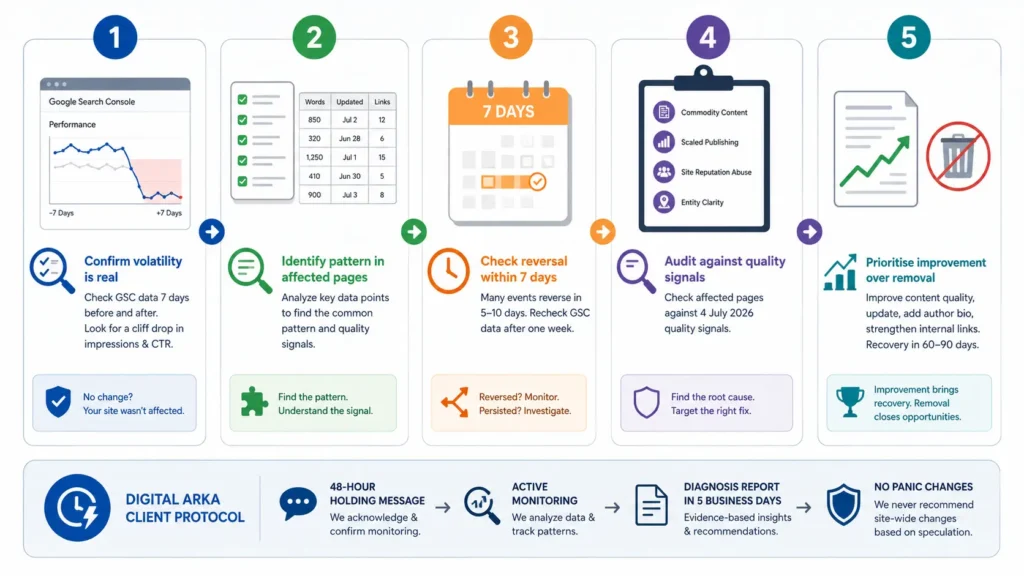
When ranking volatility hits without a confirmed Google update, the right response is evidence-based diagnosis — not immediate site-wide changes based on speculation. Our team at Digital Arka uses a five-step diagnostic that separates affected pages from unaffected ones before recommending any remediation.
Step 1 Confirm the volatility is real for your specific site
Check Google Search Console performance data for the seven days before and after the volatility date. Filter by page and query. A genuine ranking impact shows as a cliff drop in impressions and CTR on specific date ranges — not a gradual decline. If your GSC data shows no change, your site was not affected by this event, regardless of what third-party tools show for the broader web.
Step 2 Identify the pattern in affected pages
For every page that shows a GSC traffic drop, pull the following data: word count, date of last update, number of internal links, author byline presence, and whether the page has original research or first-hand content. Pages that share a pattern — all thin content, all auto-generated, all from a specific template — identify the quality signal Google targeted. Pages with mixed characteristics require deeper investigation.
Step 3 Check whether the event reversed within seven days
Unconfirmed algorithm events frequently reverse within five to ten days as Google’s systems recalibrate. Before undertaking any site changes, wait seven days and recheck your GSC data. If the traffic drop reversed on its own, the event was likely an algorithm over-correction that self-corrected. If it held or deepened, the change is more likely intentional and worth addressing.
Step 4 Audit affected pages against the July 2026 quality signals
For pages that show persistent drops, run a page-level audit against the four signals the July volatility pattern suggests Google is targeting: commodity content (no original insight), scaled publishing patterns (published in a burst with similar content), site reputation abuse (third-party content with minimal oversight), and entity clarity (inconsistent business name or NAP data across the site).
Step 5 Prioritise improvement over removal
Google’s recovery curve from quality-related drops rewards genuine content improvement over page deletion. Improve affected pages by: adding first-hand observations or original data, updating the dateModified timestamp, adding or strengthening the author bio, and improving internal linking from authoritative pages on your site. Removal removes any recovery opportunity. Improvement, when genuine, tends to produce gradual ranking recovery within 60 to 90 days.
⚡ Digital Arka client protocol: During any unconfirmed volatility event, we send clients a 48-hour holding message confirming we are monitoring the situation and will provide a diagnosis report within five business days. We never recommend site-wide changes based on unconfirmed events.
Conclusion: Google’s Silence Is Not Evidence of Nothing
The 7-Eleven update, the July 18-19 weekend shakeup, and the July 24 spike collectively confirm one thing: Google runs continuous quality adjustments that it chooses not to announce. The Search Status Dashboard reflects Google’s communication strategy, not the full scope of its algorithmic activity. Building SEO resilience in 2026 means building for the continuous quality bar — E-E-A-T, original content, entity clarity, consistent publishing — rather than building for named update cycles.
Contact Digital Arka at digitalarka.com or call +91 70110 34858 for a diagnostic audit of any July 2026 ranking changes affecting your site.
Frequently Asked Questions (AI-Driven Queries)
Every question below mirrors real queries people ask Google AI Mode, ChatGPT, Perplexity, and Bing Copilot about this topic. Each answer uses passage-first structure for maximum AI citation eligibility.
Q1. What is the Google 7-Eleven update?
A: The Google 7-Eleven update is the informal name for an unconfirmed ranking volatility event that peaked around July 11, 2026. SEO analyst Barry Schwartz at Search Engine Roundtable named it after the date. Multiple third-party tracking tools including AccuRanker, Mozcast, and SEMrush Sensor registered simultaneous volatility spikes on that date. Google never confirmed the event on its Search Status Dashboard. The name refers to the July 11 date and the growing sense that unconfirmed volatility is becoming a recurring feature of the 2026 search landscape.
Q2. How many Google algorithm updates happened in July 2026?
A: Google confirmed zero ranking updates in July 2026. The last confirmed ranking event before July was the June 2026 spam update (June 14 to June 26). However, three distinct waves of unconfirmed ranking volatility registered across third-party tracking tools during July: around July 11 (the 7-Eleven event), July 18-19 (the weekend shakeup), and July 23-24 (the largest spike of the month, with some sites reporting 60-70% traffic drops). Google has not confirmed any of these events as of July 29, 2026.
Q3. Why does Google not confirm every ranking update?
A: Google uses the Search Status Dashboard as a communications tool, not a comprehensive measurement instrument. Google confirms updates when they meet an internal threshold for significance and public communication value — typically named core updates, spam updates, and product reviews updates. Continuous algorithmic tuning that runs in the background — quality classifier adjustments, spam signal recalibration, query-specific relevance tweaks — happens without announcement. The Search Status Dashboard showing no event does not mean nothing changed. Third-party tracking tools measure actual ranking changes regardless of what Google communicates.
Q4. What types of sites were most affected by the July 2026 ranking volatility?
A: Sites publishing commodity content — generic how-to articles, aggregated posts, and listicles with no original insight or first-hand experience — reported the most significant drops during the July 2026 volatility events. Sites with scaled publishing bursts (many pages published in rapid succession with similar templates) also showed vulnerability. Repurposed expired domains and sites with third-party content sections receiving minimal editorial oversight both showed patterns consistent with site reputation abuse enforcement.
Q5. How do I know if the July 2026 Google update affected my site?
A: Check Google Search Console Performance data for the seven days before and after July 11, July 18, and July 24. A genuine ranking impact appears as a cliff-drop in impressions and CTR on a specific date range, not a gradual decline. Filter by page to identify which specific pages lost visibility. If your GSC data shows no change across any of these dates, your site was not materially affected, regardless of what third-party tracking tools show for the broader web.
Q6. Should I make site changes immediately after an unconfirmed Google update?
A: No. Wait at least seven days and recheck your Google Search Console data before making any changes. Unconfirmed algorithm events frequently reverse within five to ten days as Google’s systems recalibrate. Making site-wide changes based on a volatility event that reverses on its own wastes resources and may introduce new problems. If the traffic drop holds or deepens after seven days, conduct a page-level audit to identify the specific quality signal affected before making targeted improvements.
Q7. What is the June 2026 Google spam update and how does it relate to July volatility?
A: The June 2026 spam update ran from June 14 to June 26, 2026. Google described it as a normal spam update refining existing SpamBrain detection systems rather than introducing new policies. It was broader than a typical spam refresh, with volatility continuing into early July. The June spam update set the context for July’s unconfirmed events — sites already weakened by the June update saw compounded effects during the July volatility windows, making it difficult to isolate which event caused specific traffic drops.
Q8. How long does it take to recover from a Google quality-related ranking drop?
A: Recovery from a Google quality-related ranking drop typically takes 60 to 90 days of genuine content improvement before rankings visibly recover. Google’s systems need time to recrawl and reindex improved pages, reassess quality signals, and propagate changes across its ranking infrastructure. Recovery is faster for pages where the quality issue was isolated (a thin post on a strong domain) than for sites with systemic quality problems across hundreds of pages. Prioritise improvement of individual affected pages over site-wide restructuring.
Q9. What is “commodity content” in Google’s quality assessment?
A: Commodity content is generic, aggregated, or templated content that provides no information users cannot find easily from dozens of other sources. It typically lacks original research, first-hand experience, specific data, named expert commentary, or distinctive perspective. Google has been progressively deprioritising commodity content since the August 2022 Helpful Content Update, and the July 2026 volatility events show continued enforcement. To avoid commodity content classification: include original data points, first-hand observations, author credentials, and specific case examples that make the content unreproducible by another site on the same topic.
Q10. How do SEO tracking tools detect unconfirmed Google updates?
A: Third-party SEO tracking tools like AccuRanker, SEMrush Sensor, Mozcast, Sistrix, Algoroo, and Advanced Web Ranking detect unconfirmed updates by monitoring ranking position changes across large panels of tracked keywords simultaneously. When many tracked keywords across many industries show correlated movement on the same day, it signals a systemic ranking change rather than random fluctuation. The tools aggregate these signals into a volatility score. When multiple independent tools show simultaneous spikes, as they did on July 11, July 18-19, and July 24, 2026, the probability of a genuine algorithm event is high regardless of whether Google confirms it.