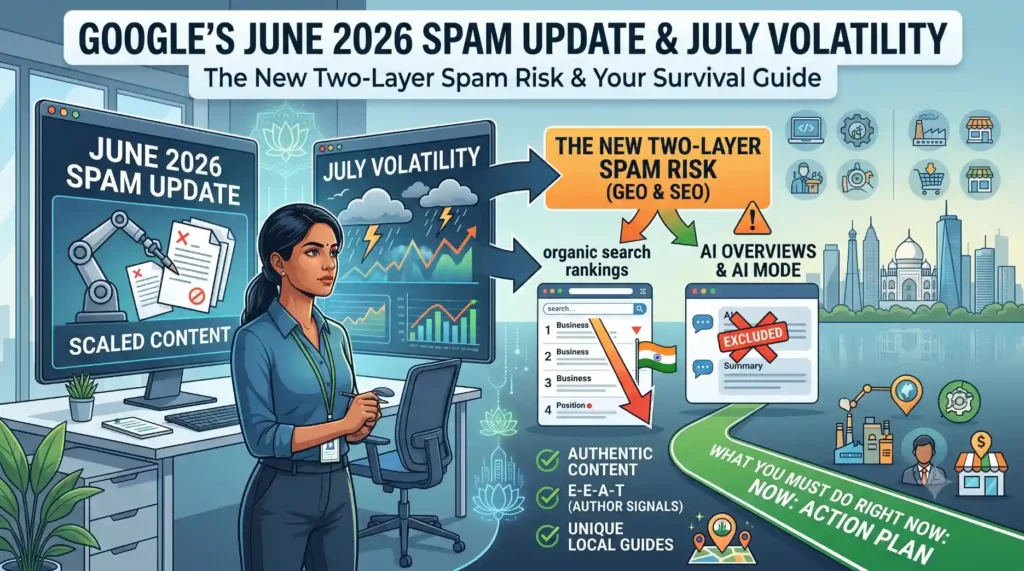

Two things are happening simultaneously in Google Search in July 2026 that every Indian business owner and SEO manager needs to understand.
First: Google’s June 2026 spam update after last may 2026 core update — which started rolling out on June 24 and completed in just two days — has been described by the search community as heavier than the March 2026 spam update that preceded it. Sites that had been quietly relying on scaled AI content, templated location pages, aggressive link acquisition, or site reputation abuse are now seeing the consequences.
Second: unconfirmed ranking volatility is currently active in July 2026. Across SEO agency client accounts, fresh signals are surfacing around trust scores, click behaviour, and rank stability. Though Google has not confirmed a July core update at the time of writing, the pattern is real and calls for close attention.
The critical insight from July 2026: spam risk is now visibility risk across TWO layers — classic SEO rankings AND your eligibility to appear in Google AI Overviews and AI Mode answers. A site that violates spam policies can now lose both organic rankings and AI citation simultaneously.
What Actually Happened in the June 2026 Spam Update
Google released the June 2026 spam update on June 24, 2026 at 09:00 PDT. It was declared global, applying across all languages and regions. The rollout completed in approximately two days — making it one of the faster spam updates in recent history, though short rollout duration does not predict lower impact.
Google officially classified this as a “regular spam update” and named no specific target category. However, third-party SERP tracking services reported movement in the first 24–48 hours that pointed clearly toward one pattern: scaled, templated site networks — mass-produced location pages, comparison page networks, thin service variants — saw the most significant drops.
The context matters here. This update arrived after a dense sequence of Google actions:
- February 2026 Discover update — rewarded locally relevant, in-depth content; reduced clickbait
- March 2026 spam update — fastest spam rollout on record (under one day), hit scaled AI content abuse and expired domain manipulation
- March 2026 core update — introduced holistic Core Web Vitals scoring; sites failing even one CWV metric face compounded penalties
- May 2026 core update — favoured new, original pages over thin rewrites; 80% of top-3 results changed in the most competitive categories
- June 2026 spam update — the most recent confirmed update; heavier than March, targeting policy-violating content at scale
In May 2026, Google also extended its spam policies to explicitly cover AI Overviews and AI Mode — addressing “inauthentic mentions” and “scaled content abuse” inside AI-generated search surfaces. This is the critical development that makes June’s spam update different from all previous ones.
The New Two-Layer Spam Risk: Rankings AND AI Visibility
Before 2026, spam enforcement was a rankings question: does your content rank in organic search? The June 2026 update signals something more consequential: spam enforcement is now also a GEO (Generative Engine Optimization) question.
Google’s AI Overviews and AI Mode are not separate from the search ranking system — they are downstream of it. Content that violates spam policies is now at risk of:
- Losing organic search rankings through SpamBrain enforcement
- Being excluded from AI Overview citation consideration
- Being ineligible to appear in AI Mode answers
Google Search Console expanded access to AI performance reports in June 2026 — allowing site owners to see, for the first time, how often their URLs appear in AI Overviews and AI Mode (initially impressions only, without click and query data). This is reporting, not enforcement — but it signals that by mid-2026, AI surfaces have become a first-class citizen in Google’s search ecosystem with their own measurement and control framework.
Also notable: since June 17, 2026, Google added an opt-out toggle allowing site owners to suppress their appearance in AI Overviews, AI Mode, and Discover. This confirms that AI surfaces now operate independently enough to require their own controls.
Position Digital found 43% zero-click in AI Overviews versus 93% in AI Mode. That gap matters enormously. AI Mode replaces the results page with a chat interface — links largely disappear. AI Overviews keep your links on the page. Being cited in Overviews is strategically different from being excluded from AI Mode.
Who Got Hit — and the Patterns That Reveal Risk
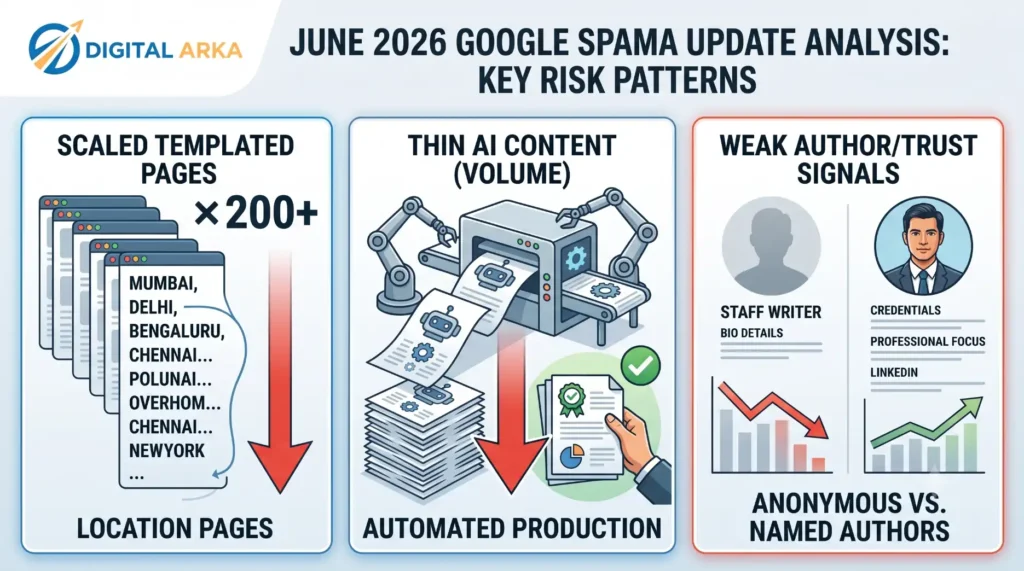
While Google has published no official impact data for the June 2026 spam update, the search community’s observations in the weeks following point to consistent patterns. Understanding these patterns is more valuable than waiting for Google’s delayed disclosures.
Pattern 1: Scaled Templated Pages
The clearest victims of both the June spam update and the July volatility are sites with large numbers of near-identical pages — location service pages (“web development services in [city]” × 200 cities with identical body text), comparison pages built programmatically, and AI-generated service variants that share the same structure with only the target keyword changed.
Google reported 45% less low-quality, unoriginal content after 2024 updates. The June 2026 update continues this trajectory. A sudden drop in rankings for a site with templated page architecture is almost certainly a spam enforcement signal, not a technical issue.
Pattern 2: Thin AI-Generated Content at Volume
Sites that automated content production without genuine expertise, human oversight, or original insight have been progressively penalised across every update since late 2024. The June 2026 update accelerated this. Sites where AI-generated content constitutes the majority of the page count, with no named expert authorship, no original data, and no unique perspective, are at the highest risk.
Google’s Head of Search Liz Reid’s statement from I/O 2026 — “great content to shine in Google Search” — is the public framing. The enforcement mechanism is SpamBrain, Google’s AI-based spam-prevention system, which is now better than ever at distinguishing genuine expertise from automated content production.
Pattern 3: Weak Author and Trust Signals
The unconfirmed July 2026 volatility is pointing to E-E-A-T signals as a factor — particularly author proof. Sites with anonymous authorship (“Staff Writer,” no bio, no credentials, no LinkedIn presence) are showing instability, while sites with named, credentialled authors are holding or gaining.
Data from the post-June analysis: verified experts earn citations that can lift clicks by 35%, while anonymous AI-generated sites lost 60–80% of traffic after 2026 enforcement actions. Strong author bios with training, role, and professional focus are now a ranking signal, not just a content best practice.
We have to do SEO for zero click searches to regain lost clicks.
The July 2026 Unconfirmed Volatility — What We Know
Across SEO agency client accounts in July 2026, fresh ranking signals are surfacing around three areas: weak E-E-A-T signals on service and blog pages, thin template-driven pages that survived June, and zero-click losses from AI Overview absorption.
The zero-click picture deserves specific attention. The updated zero-click report released by Google (in response to the CMA’s order requiring Google to share how its ranking systems operate) confirms what SEOs have been observing: zero-click behaviour keeps rising as AI features answer more queries directly on the search results page. Search Engine Journal notes this trend is accelerating.
For Indian businesses specifically, this means measuring SEO success by website traffic alone is increasingly misleading. A brand that appears consistently in AI Overviews for its key queries may be building significant brand authority even as direct click volume declines — and that brand authority translates into higher-quality direct traffic and branded search over time.
Your July 2026 Recovery and Protection Checklist
Based on what the June spam update targeted and what July volatility signals suggest, here is a prioritised action plan for Indian businesses:
Immediate (This Week)
- Check Google Search Console for drops starting June 24 — segment by page type (blog, service page, location page) to identify patterns
- Identify all templated pages on your site — location variants, service variants, any page where body content is >80% identical to another page
- Verify your author attribution: every blog post and service page should have a named author with credentials, not “Staff Writer” or no attribution
- Check the new AI performance report in Google Search Console to see your AI Overview impression data (if available in your account)
This Month
- Consolidate or rewrite your 10 weakest pages — merging thin location variants into genuinely useful location guides with unique local data, specific client examples, and original insights
- Add author bio pages with professional credentials, LinkedIn links, and demonstrated expertise in the subject area
- Audit for “site reputation abuse” patterns — any section of your site where third-party content appears with minimal editorial oversight
- Clean up any questionable backlink patterns — guest post footprints, paid placement link clusters, or sponsored content without proper disclosure
This Quarter
- Rebuild templated location or service pages as genuinely unique, in-depth content — each page should have content that only makes sense for that specific location or service
- Structure your top 10 content pages for AI Overview citation — answer-first formatting, FAQ sections, clear expert attribution, original statistics or data
- Implement Organisation and LocalBusiness schema if not already done — helps Google verify your entity identity during spam assessment
The most important mindset shift for July 2026: Google’s spam updates are no longer just about rankings. They are now about your eligibility to appear in AI surfaces. A site that fails spam criteria can lose both organic rankings AND AI visibility simultaneously — which is why the stakes of each update are higher than ever.
The Bottom Line
Google’s June 2026 spam update was significant, fast, and a clear continuation of the trajectory that every 2026 update has reinforced: quality, specificity, expert authorship, and genuine helpfulness win. Scaled AI content, templated pages, and weak trust signals lose — more decisively with each update cycle.
The July volatility signals suggest this enforcement is ongoing and tightening. The businesses that are stable or growing in this environment are the ones that invested in genuine content quality before the updates arrived, not after. If you are reading this after seeing a rankings drop, the recovery path is clear: audit for patterns, fix the root causes, and build the trust signals that should have been there all along.
If your rankings held or improved through June and July 2026, treat it as a signal to press the advantage — your competitors who relied on shortcuts are scrambling, and the ground they lost will take them months to recover.
DigitalArka builds SEO strategies built to survive every Google update cycle. Get a free SEO audit at digitalarka.com