
Search has changed more in the last two years than in the previous decade. Google now answers a large share of queries directly inside AI Overviews. ChatGPT and Perplexity have become genuine research destinations in their own right, often replacing a traditional search altogether. AI SEO is the umbrella term for the practice of adapting SEO to this new reality, and if your strategy still assumes success means only ranking in ten blue links, you are optimising for a search landscape that no longer fully exists. Here is exactly what AI SEO means, what it includes, and how to build it in 2026.
Definition: What Is AI SEO?
AI SEO is the practice of optimising a website’s content and technical infrastructure so it performs well across every AI-influenced search surface, traditional Google rankings, featured snippets and voice answers, and citations inside AI Overviews, ChatGPT, and Perplexity, rather than optimising for traditional rankings alone. AI SEO is not a single technique; it is the broader discipline that brings together classic SEO fundamentals with two newer, more specific practices: AEO and GEO.
In one line: AI SEO is the practice of making your website genuinely visible everywhere AI now shapes how people search, not just inside a traditional list of ten links.
The Three Layers Inside AI SEO
Traditional SEO (The Foundation)
Technical health, genuine expertise, keyword relevance, and quality backlinks remain the foundation everything else is built on. AI SEO does not discard traditional SEO; it depends on it, since a technically broken or low-authority site has nothing solid for AI systems to cite in the first place.
AEO (Answer Engine Optimization)
AEO is the layer focused on winning featured snippets, voice search answers, and “People Also Ask” boxes, the direct-answer formats that appear on a traditional search results page above or alongside the normal list of links. Read our full breakdown in What Is AEO? for a complete explanation of this specific layer.
GEO (Generative Engine Optimization)
GEO is the layer focused on earning citations inside AI-generated answers on platforms like Google AI Overviews, ChatGPT, and Perplexity, an entirely different surface from a traditional results page. See our detailed guide, What Is GEO?, for the full picture of this layer specifically.
Why AI SEO Emerged as Its Own Discipline
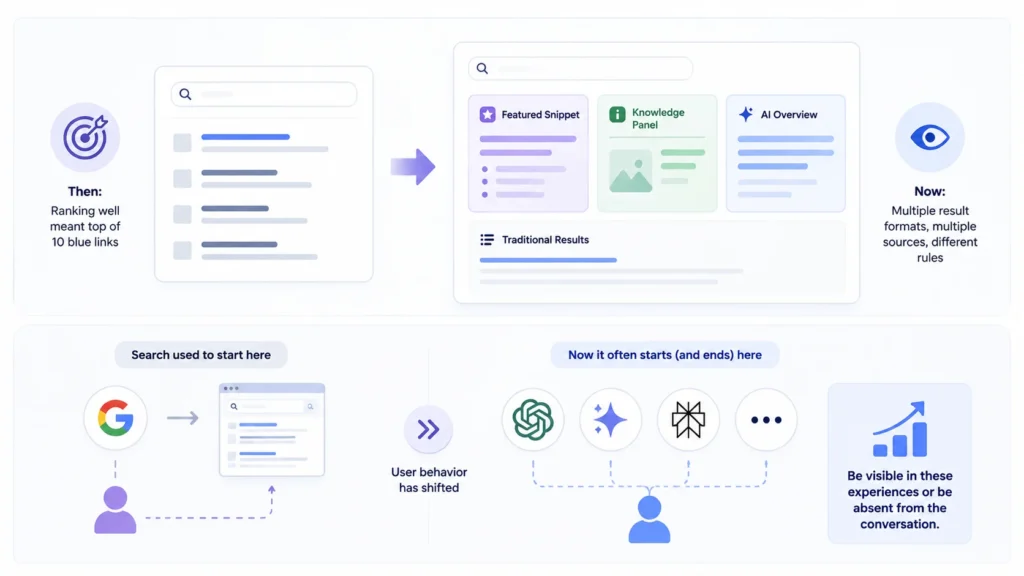
For most of SEO’s history, “ranking well” meant one thing: appearing near the head of a list of ten links. That single-format world no longer exists. A single search query today might trigger a traditional list of results, a featured snippet, a knowledge panel, and an AI Overview, all on the same page, each pulling from potentially different sources based on different evaluation criteria. A business optimising only for the traditional list is now competing for a shrinking share of total search visibility, while ignoring the growing share captured by these other formats entirely.
The shift accelerated further once ChatGPT and Perplexity became genuine research destinations rather than novelty tools. A meaningful share of product research, service comparisons, and general knowledge queries that would once have started with a Google search now start, and often end, entirely inside a chat interface that never shows the user a traditional results page at all. A business absent from that surface is not losing a ranking position; it is absent from the conversation altogether.
Real Examples of AI SEO Working Together Across Layers
Seeing all three layers work together on a single topic makes the concept concrete.
- Traditional SEO layer – a well-optimised, technically sound page ranks on page one of Google for “SEO agency pricing” because it is fast, mobile-friendly, and genuinely relevant to the query.
- AEO layer – that same page wins a featured snippet for “how much does SEO cost” because it answers the question directly and concisely early in the content, formatted clearly.
- GEO layer – when a user asks ChatGPT to explain typical SEO pricing structures, the same page is cited as a source because it is technically accessible to AI crawlers and demonstrates genuine, specific expertise rather than vague generalities.
One well-built page, addressing one topic thoroughly and clearly, can win visibility across all three layers simultaneously. This is the practical payoff of treating AI SEO as one integrated discipline rather than three separate initiatives competing for the same content team’s time.
Core Techniques That Make Up an AI SEO Strategy
- AI crawler accessibility – confirming bots like GPTBot, PerplexityBot, and Google-Extended can actually access and read your content, since a technically blocked site cannot be cited by any AI system regardless of content quality.
- llms.txt configuration – an emerging standard file that helps AI systems understand what content on your site is available for citation.
- Passage-first content structure – writing in clear, self-contained sections that fully answer one specific point each, the format AI systems most readily extract and cite.
- Question-and-answer formatting – structuring content around the literal questions your audience asks, which serves both AEO snippet extraction and GEO citation simultaneously.
- Comprehensive schema markup – FAQPage, Article, Organization, and Review schema that help every system, traditional search, snippets, and AI alike, understand and accurately represent your content.
- Genuine E-E-A-T signals – named author credentials, original research, and demonstrated first-hand expertise, since every layer of AI SEO ultimately rewards the same underlying trust signals.
- Multi-surface tracking – monitoring rankings, snippet ownership, and AI citation frequency together, rather than reporting on traditional rankings alone while remaining blind to the rest.
How AI SEO Changes Day-to-Day SEO Work
In practice, AI SEO does not mean discarding your existing SEO process; it means expanding what “done” looks like for every piece of content and every technical fix. A content brief in 2026 should specify not just the target keyword but also the specific questions the piece will answer directly, the schema markup it needs, and whether AI crawler accessibility has been confirmed for that page. A technical audit should check Core Web Vitals and crawlability alongside AI-crawler-specific accessibility. Reporting should track citation frequency across AI platforms alongside traditional rankings, not as an afterthought appended once a quarter.
AI SEO vs Traditional SEO: A Direct Comparison
| Aspect | Traditional SEO Only | AI SEO (2026 Standard) |
| Success metric | Ranking position, organic traffic | Rankings + snippet ownership + AI citation frequency |
| Content structure | Keyword-optimised long-form pages | Passage-first, question-and-answer structured content |
| Technical scope | Core Web Vitals, crawlability, indexing | All of the above + AI crawler accessibility (llms.txt) |
| Authority signals | Backlinks, domain authority | Backlinks + named author E-E-A-T + original data |
| Reporting | Rankings and traffic dashboard | Unified rankings, snippets, and citation report |
How to Get Started With AI SEO
- Audit your current AI visibility – test your core target queries directly inside Google AI Overviews, ChatGPT, and Perplexity to see whether you currently appear at all.
- Check AI crawler accessibility – confirm your robots.txt is not unintentionally blocking GPTBot, PerplexityBot, or Google-Extended.
- Restructure your highest-value content first – apply passage-first, question-and-answer formatting to the pages already driving the most traffic or leads.
- Add missing schema markup – implement FAQPage and Article schema across content that does not yet have it.
- Strengthen author and expertise signals – add named bios, credentials, and original data wherever content is currently anonymous or generic.
- Set up ongoing multi-platform tracking – monitor rankings, snippets, and AI citations together, since each can shift independently of the others.
How DigitalArka Approaches AI SEO
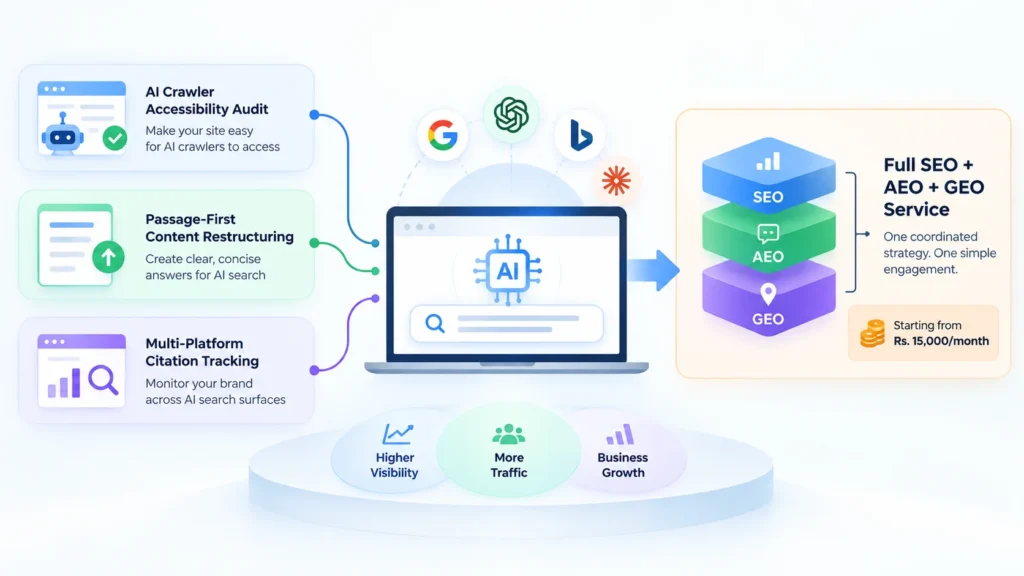
DigitalArka builds AI SEO on the same foundation as every other service we offer: genuine technical health and real expertise, never shortcuts. Our dedicated AI SEO Service covers AI crawler accessibility audits, passage-first content restructuring, and multi-platform citation tracking across every AI-influenced search surface.
For businesses that want traditional rankings, featured snippets, and AI citations addressed together as one coordinated strategy rather than three separate purchases, our Full SEO + AEO + GEO Service bundles all three layers into a single engagement, with pricing starting from Rs. 15,000 per month.
Common AI SEO Mistakes
- Assuming strong traditional rankings guarantee AI visibility – a page ranking well traditionally can still be entirely invisible to AI systems if it is technically inaccessible or poorly structured for extraction.
- Treating AEO and GEO as optional extras – these are now core components of a complete strategy, not a future consideration.
- No AI crawler accessibility check – this single oversight can silently block every AI SEO effort built onto it.
- Reporting on rankings alone – without tracking snippets and citations too, you have an incomplete picture of your actual search visibility.
- Chasing AI SEO tactics without the underlying fundamentals – AI SEO amplifies genuine expertise and technical health; it does not substitute for them.
Conclusion
AI SEO is not a rebrand of traditional SEO with newer buzzwords attached; it is a genuine expansion of what “search visibility” means in 2026, covering traditional rankings, direct-answer formats, and AI-generated citations as three connected parts of the same discipline. Businesses that treat AI SEO as an integrated strategy, built on the same technical health and genuine expertise that has always mattered, are positioned to capture visibility across every surface where their potential customers now search, while competitors still optimising for a search landscape that no longer fully exists fall further behind with each passing month.
Frequently Asked Questions
AI SEO is the practice of optimising a website for traditional search, featured snippets and voice answers (AEO), and citations inside AI-generated answers on platforms like ChatGPT and Google AI Overviews (GEO).
No. GEO is one specific layer within the broader AI SEO discipline, focused specifically on citation inside generative AI answers. AI SEO covers GEO, AEO, and traditional SEO together.
No. Traditional SEO remains the foundation of AI SEO. A technically sound, expertise-driven website is essential for both AEO and GEO.
Track traditional keyword rankings, featured snippet or voice-answer wins, and citation frequency when testing target queries across ChatGPT, Perplexity, and Google AI Overviews.
Technical improvements such as AI crawler accessibility can show results within weeks. Building topical authority that AI systems consistently cite typically takes around 3 to 6 months.
No. AI systems can reward genuine expertise and clear content structure, allowing smaller businesses with detailed, well-organised content to compete for AI citations.