
ChatGPT ads went from “last resort” to a self-serve ad platform in under two years. OpenAI began testing sponsored placements inside ChatGPT in February 2026, opened a self-serve Ads Manager to businesses of every size in May 2026, and by late August 2026 had expanded self-serve access to more than 40 countries, including a fresh rollout across India, Europe, the Middle East, and North Africa, with OpenAI’s ad business crossing a $1 billion annualised revenue run rate in under 200 days. If you have been waiting for a signal that this channel is worth genuine budget rather than a wait-and-see experiment, the self-serve rollout and the roster of early advertisers, including Target, Adobe, Williams-Sonoma, Best Buy, and Lowe’s, is that signal. For Indian businesses specifically, this is a genuinely live opportunity right now: managed access through agency partners began August 28-29, 2026, and full self-serve Ads Manager access is scheduled for September 4, 2026. This playbook walks through exactly how to set up, target, budget, and launch a ChatGPT ad campaign in 2026, along with the mistakes worth avoiding on a genuinely new platform.
Why ChatGPT Ads Are Worth Your Attention Right Now
ChatGPT now handles roughly 2.5 billion prompts a day, a volume of active, intent-driven queries that no other AI platform currently matches. Unlike a social feed where ads interrupt passive scrolling, ChatGPT ads appear inside a conversation the user is already having about a specific need, closer in spirit to search advertising than to display or social advertising. OpenAI has been explicit that ads never influence the model’s actual answer; a sponsored placement appears as a clearly labelled, visually separated box, and the organic response the user reads is generated independently of any advertiser payment.
This is also, genuinely, an early-mover channel. OpenAI itself acknowledges its own platform has no published performance benchmarks yet across industries or campaign types, which means there is no reliable way to know what a “good” result looks like for your category. That uncertainty cuts both ways: it means more testing and guesswork than a mature channel like Google Ads, but it also means the businesses building genuine expertise here now are ahead of competitors who are still waiting for the platform to “prove itself.”
What ChatGPT Ads Actually Look Like
ChatGPT currently uses one primary ad unit built from four elements: a business name, an image, a headline, and a description. OpenAI has two underlying ad types, Static and Product, but both render identically to the person seeing them, appearing as a clearly labelled “Sponsored” box, visually distinct from ChatGPT’s own generated response, typically beneath or alongside the organic answer.
OpenAI has already changed the static ad format once since launch (a July 2026 update), and platform changes like this are expected to continue. Treat any specific format detail as a snapshot, not a fixed spec, and always check the current creative requirements inside Ads Manager before building assets.
Who Actually Sees ChatGPT Ads
Ads are currently limited to logged-in users on the ChatGPT Free and Go tiers. OpenAI does not serve ads to Plus, Pro, Business, Enterprise, or Education tier users, which meaningfully shapes who your ad budget can reach: you are targeting ChatGPT’s free and lowest-cost subscriber base, not its paying power-user segment.
- No ads to minors – OpenAI does not serve ads to any account it predicts belongs to a user under 18, whether the user has stated their age or the system infers it.
- No ads in sensitive contexts – OpenAI excludes conversations it classifies under “inappropriate topics” or “sensitive contexts” from ad serving entirely.
- Privacy-preserving matching – ad matching happens inside OpenAI’s own infrastructure using anonymised signals; advertisers never receive a user’s actual chat history, conversation content, or personal data.
Where You Can Run ChatGPT Ads
Geographic availability has expanded quickly since the February 2026 launch. As of the most recent update available, ChatGPT Ads are live in more than 40 countries, including the United States, Canada, the United Kingdom, Australia, New Zealand, Japan, South Korea, Mexico, and Brazil, with self-serve Ads Manager access now extending across India, Europe, the Middle East, and North Africa as well. You can target campaigns by country, region or state, Designated Market Area (DMA), and, within the US, postal code, and you can exclude locations the same way you include them.
If your target market is not yet on this list, sign up for updates directly through openai.com/advertisers so you are notified the moment your country opens rather than finding out after competitors have already claimed early-mover advantage.
ChatGPT Ads in India: What to Know Right Now
This update matters directly if you are marketing to an Indian audience. OpenAI switched on advertising in India on August 28-29, 2026, initially through managed access via agency partners WPP and Omnicom, with more than 50 brands live in the first wave. Self-serve access through Ads Manager, letting any eligible business set up and run campaigns directly rather than going through an agency partner, is scheduled to open on September 4, 2026.
India is not a minor market for this rollout, it is one of ChatGPT’s largest by user count. ChatGPT reported 330 million unique monthly users in India as of May 2026, up from 297 million in December 2025, and OpenAI has grouped India alongside Europe, the Middle East, and North Africa in this same expansion wave, arriving just months after the platform crossed a $1 billion annualised revenue run rate globally in under 200 days.
- Minimum daily budget in India – Rs. 725, broadly consistent with the $25 global minimum once converted.
- Who sees ads – logged-in users aged 18 and above on the Free and Go tiers; ChatGPT Go costs Rs. 399 per month in India. Plus, Pro, Business, Enterprise, and Education tier users remain ad-free.
- Sensitive categories excluded – OpenAI has specifically confirmed ads will not appear near health, mental health, or political content for Indian users, consistent with the platform’s global sensitive-context exclusions.
- Early access path – until self-serve fully opens, Indian businesses without an existing relationship with WPP, Omnicom, or another OpenAI agency partner may need to wait for direct Ads Manager access rather than launching immediately.
Given how recent this rollout is, treat the September 4 self-serve date as the best publicly available information at the time of writing, and confirm current access status directly at ads.openai.com before planning a launch date around it.
Ad Categories: What You Can and Cannot Advertise
OpenAI groups advertiser categories into three tiers, and the boundaries have shifted since launch, so confirm current status for your category before investing in creative production.
Generally Approved Categories
- Lifestyle and household goods
- Local services
- Travel and experiences
- Digital products
- Education
Limited or Restricted Categories
- Financial services (restrictions apply; confirm current eligibility)
- Healthcare and medicine (restrictions apply; confirm current eligibility)
- Legal services (has served ads despite appearing in restricted lists, indicating category enforcement is still evolving)
- Casino and gambling-adjacent travel (ads must focus on the travel experience itself, not gambling)
Currently Disallowed
- Adult, dating, or sexual content; tobacco; counterfeit goods; unverified health claims; alcohol above 0.5% ABV; drugs; gambling; political content; cryptocurrency; credit repair; and debt settlement or debt assistance services.
OpenAI’s own published category lists have contained inconsistencies, for example listing both healthcare and legal services under multiple tiers simultaneously, and real-world serving has sometimes diverged from the published policy. Read OpenAI’s current ad policy page directly, and if your category sits anywhere near a grey area, apply and test with a small budget before committing significant spend.
How to Set Up a ChatGPT Ads Account: Step by Step
- Go to ads.openai.com – this is the dedicated Ads Manager, separate from your regular ChatGPT login.
- Sign in with an existing OpenAI account, or create one – the same credentials used for ChatGPT itself work here.
- Create your advertiser account – you will be asked for your business name, website, and business address.
- Complete business verification – have your tax ID or EIN ready, since OpenAI verifies real businesses before approving ad accounts.
- Add a billing method – a credit card is the standard option at this stage.
- Upload a favicon – this small icon represents your business inside the ad unit itself, so prepare a clean, recognisable version in advance.
- Prepare a working landing page – you need a live page for whatever you are promoting before your first campaign can go live, not a placeholder.
If you run an agency or manage ads for clients: OpenAI explicitly instructs agencies not to create ad accounts on a client’s behalf. The client needs to create their own account and then invite your team as a user. There is currently no manager account letting an agency operate multiple client accounts from one login, though this is widely expected to arrive as the platform matures.
How ChatGPT Ad Targeting Actually Works
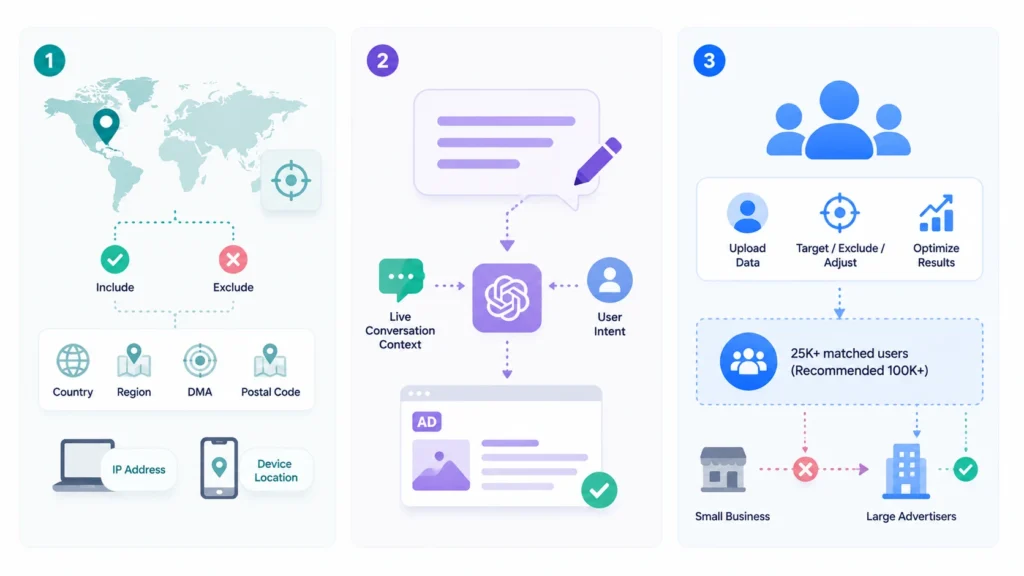
This is the single biggest mental shift for anyone coming from Google Ads: you do not bid on keywords in ChatGPT. There are three targeting mechanisms instead.
1. Geographic Targeting
Standard location targeting by country, region, DMA, and (in the US) postal code, with the ability to both include and exclude specific areas. ChatGPT estimates location from IP address and, where permitted, device location data.
2. Context Hints
This is the core targeting lever on ChatGPT, and it works nothing like a keyword list. At the ad group level, you get a freeform text box where you describe who you want to reach, anything from a short list of relevant terms to a few sentences describing your ideal customer’s situation, to a more detailed prompt-style description. ChatGPT uses this text, combined with the live conversation context, to decide when your ad is relevant enough to show. This is also the area most actively being tested by sophisticated early advertisers, since there is no established playbook yet for exactly how detailed or how conversational a context hint should be to perform well.
3. Custom Audiences (First-Party Data)
You can upload your own customer data, email addresses or phone numbers, to target, exclude, or adjust bids for known contacts. This option currently requires at least 25,000 matched users, with OpenAI recommending 100,000 or more for meaningful results, which puts it out of practical reach for most small and mid-sized businesses at launch. Larger advertisers with substantial existing customer lists should treat this as a genuine option; smaller businesses should plan around context hints and geography instead, at least for now.
|
Targeting Method
|
How It Works
|
Best Suited For
|
|---|---|---|
| Geographic | Country, region, DMA, postal code (US) | Every advertiser, as a baseline layer |
| Context Hints | Freeform description of ideal audience/intent | Most advertisers – the primary lever |
| Custom Audiences | Uploaded email/phone lists, 25k+ matched users | Larger businesses with substantial first-party data |
Budgets and Bidding: What Things Actually Cost
ChatGPT Ads offers three bidding models: Cost Per Click (CPC), Cost Per 1,000 Impressions (CPM), and Cost Per Conversion. The platform runs on a relevance-weighted, second-price auction, meaning creative quality and relevance influence your ranking alongside your bid, so a genuinely well-targeted, relevant ad can outperform a higher bid from a less relevant advertiser.
- Minimum bid – as low as $0.01 technically, though real-world data suggests most advertisers pay at least $2 per click, with wide variation by industry.
- Typical CPM range – roughly $25 to $60 per thousand impressions based on early reporting, though this shifts as the auction matures and more advertisers enter specific categories.
- Minimum daily budget – $25 per campaign.
- Minimum campaign budget (lifetime) – $1, if you prefer a total-spend cap over a daily one.
The $200,000 minimum spend commitment that applied during the invite-only pilot phase was removed entirely when the self-serve platform launched in May 2026, which is precisely what makes this channel realistically accessible to small and mid-sized businesses now, not just the large brands who were part of the original pilot.
Conversion Tracking: Proving ChatGPT Ads Actually Work
Install the ChatGPT Conversion Pixel on your website to track meaningful actions, form submissions, purchases, sign-ups, directly back to specific campaigns, ad groups, and individual ads inside the Ads Manager reporting interface. Once conversion tracking is live, you can also set campaigns to optimise toward conversions directly, rather than just clicks or impressions.
For a second layer of verification, add UTM parameters to every ChatGPT ad URL and track the resulting sessions through Google Analytics or a call-tracking platform. Running both the native pixel and independent UTM tracking side by side is good practice on any new ad platform, since it lets you sanity-check the platform’s own reported numbers against an independent source before trusting them fully.
What Reporting You Actually Get
ChatGPT Ads Manager reports impressions, clicks, click-through rate, average CPC, average CPM, spend, and, once you have conversion tracking configured, conversions, attributed sales value, and sales ROAS, all broken down at the campaign, ad group, and individual ad level.
One meaningful limitation: OpenAI does not expose which actual prompts or conversations triggered your ads, and gives no demographic or behavioural detail about who saw them. You get outcome data, not the qualitative “why,” which makes disciplined A/B testing of your context hints and creative more important here than it might be on a platform offering richer diagnostic detail.
A Practical First-Campaign Playbook
- Confirm your category is eligible – check current ad policy before spending time on creative for a category that may be restricted or disallowed.
- Set up your Ads Manager account – complete business verification and billing before you need to launch, since verification can take time.
- Build one focused landing page – match it tightly to what your ad promises; do not send ChatGPT ad traffic to a generic homepage.
- Write two or three context hint variations – one keyword-style, one conversational-sentence style, one more detailed prompt-style description, and test them against each other rather than guessing which format works.
- Start with a modest daily budget – the $25 minimum is a reasonable starting point for genuine testing without meaningful financial risk.
- Install the conversion pixel and UTM tracking together – before your first click arrives, not after.
- Review after 100+ clicks or 1-2 weeks, whichever comes first – given the lack of published benchmarks, your own early data is the only reliable baseline you have; refine context hints based on what is actually converting.
- Scale gradually – increase budget on what is working rather than assuming platform-wide performance will hold steady as you spend more, since auction dynamics shift as more advertisers enter each category.
ChatGPT Ads vs Google Ads vs Meta Ads
ChatGPT Ads sit conceptually much closer to Google Search than to Meta. Meta is fundamentally a display and social platform: ads are inserted into a feed based on predicted interest, not in direct response to an explicit, real-time query. ChatGPT ads, by contrast, respond to an active conversation in which a user has already articulated a specific need in their own words, arguably a more detailed expression of intent than most search queries provide. That distinction is exactly why context hints, not keywords, are the primary targeting lever: you are not matching a query to a keyword list, you are describing the kind of conversational context in which your business is a genuinely relevant answer.
Common Mistakes to Avoid
- Treating context hints like a keyword list – a handful of disconnected keywords is a weaker context hint than a genuine description of your ideal customer’s situation and intent.
- Sending traffic to a generic homepage – ChatGPT users arrive from a specific conversational context; a landing page that does not immediately match that context loses the advantage the ad just paid for.
- Skipping conversion tracking at launch – without the pixel and UTM parameters running from day one, you cannot tell whether early results are genuinely working or just consuming budget.
- Expecting organic ChatGPT visibility to improve from running ads – OpenAI has been explicit that paid placements never influence the model’s own generated answers; ads and organic visibility (the domain of AEO and GEO) remain entirely separate.
- Assuming pilot-phase minimums still apply – the $200,000 pilot spend requirement is gone; do not let outdated information talk you out of testing at a genuinely small budget.
- Ignoring category policy nuance – given OpenAI’s own inconsistent category documentation, confirm your specific category’s current status directly rather than assuming a broad label like “healthcare” or “legal” automatically applies to your business.
Why Ads Alone Are Not a Complete AI Visibility Strategy
Running ChatGPT ads gets you into conversations you would not otherwise reach, but it is a paid, rented placement, not the same as being the source ChatGPT organically cites when answering a question. That organic layer is built through GEO (Generative Engine Optimization), ensuring your content is genuinely structured and technically accessible enough for ChatGPT to cite it directly in an answer, at zero cost per click. The strongest AI-era strategy in 2026 combines both: ChatGPT ads for immediate, controllable placement, and GEO-strengthened content for the compounding, unpaid citation that continues working long after an ad budget is spent.
DigitalArka’s AI Marketing Agency service covers both sides of this together, AI-optimised paid campaigns (including emerging channels like ChatGPT Ads, now genuinely accessible to Indian advertisers as self-serve access opens) and GEO-strengthened organic content, reported against genuine leads and revenue rather than platform-native vanity metrics alone.
Conclusion
ChatGPT Ads moved from a cautious, invite-only pilot to a fully self-serve platform available to businesses of any size in a matter of months, and geographic and category coverage keep expanding as 2026 continues. The mechanics are genuinely different from Google or Meta: no keyword bidding, a single evolving ad format, and a targeting model built around descriptive context rather than demographic or interest categories. Businesses that start testing now, with modest budgets, disciplined tracking, and a willingness to treat their own early data as the only reliable benchmark available, are building a genuine head start on a channel that is still actively being defined.