
Most backlink advice is written for e-commerce stores and SaaS companies, and it shows. Guest posting on “top 10 lifestyle blogs” or chasing product review sites does nothing for a structural engineering firm or a mid-sized contractor. Architecture, engineering, and construction firms have genuinely different, and in several ways genuinely better, backlink opportunities than most industries, built-in ties to trade publications, award bodies, material manufacturers, and local business communities that most other sectors simply do not have. This guide covers exactly where those opportunities are and how to pursue them properly.
The good news for AEC firms specifically is that most of the raw material for genuine link building already exists inside work you have already done. A completed project, a product specified on a flagship build, a professional association membership sitting unused, these are not hypothetical opportunities you need to manufacture from scratch. They are assets already sitting in your project archive, waiting for someone to actually follow up on them.
Why Backlinks Matter More for AEC Firms Than You Might Think
A backlink is still, functionally, a vote of confidence: when a reputable site links to yours, search engines treat that as independent evidence that your content and your firm are worth trusting. For AEC companies specifically, this matters even more than for most B2B categories, because the buying decision itself, who gets awarded a project, who gets shortlisted for an RFP, is already a trust-driven, reputation-driven process. The same signals that build offline credibility, industry recognition, published project work, professional association involvement, translate directly into the kind of backlinks that also move organic rankings.
This connects directly to the credibility work covered in our guide on AEC SEO Service, where licensing, credentials, and documented project history are described as the actual basis for a buying decision, not just marketing content. Backlinks are the external, third-party version of that same credibility.
Where AEC Firms Should Actually Look for Backlinks
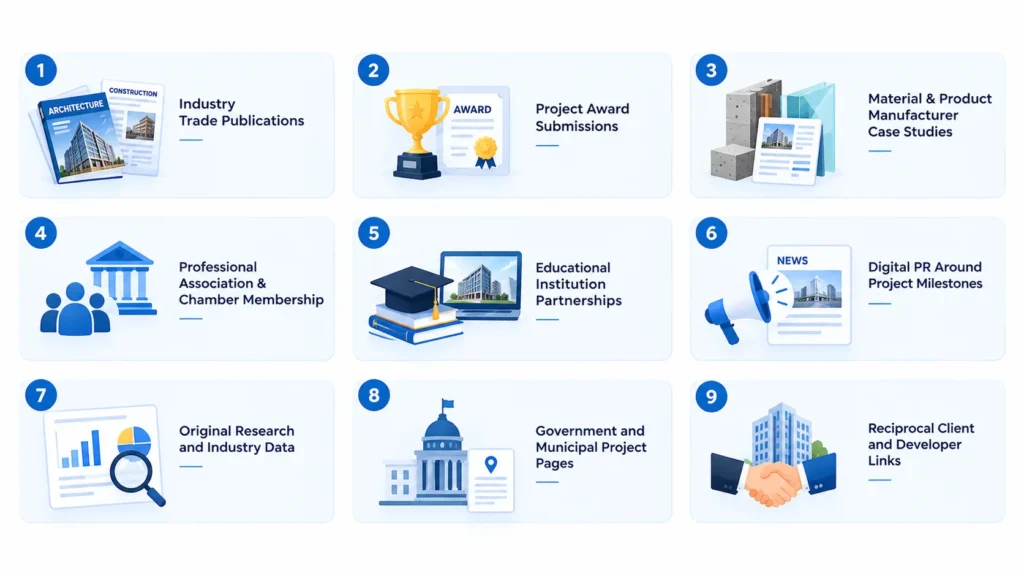
1. Industry Trade Publications
Architecture and construction have a genuinely rich trade media ecosystem: publications covering design, engineering, and construction news at both the international and regional level. Pitch a completed project for feature coverage, submit a technical article on a specific engineering challenge you solved, or offer expert commentary when a publication is covering an industry trend. A single feature on a respected trade publication frequently carries more genuine authority than dozens of generic directory listings combined.
2. Project Award Submissions
Architecture and engineering award programmes, from national bodies to regional and city-level competitions, almost always publish winner and finalist project pages online, frequently with a direct link back to the firm’s website. Award submission is not free, in time or sometimes in entry fees, but it produces a backlink from a genuinely authoritative source alongside real reputational value that a standard guest post cannot match.
3. Material and Product Manufacturer Case Studies
Manufacturers of structural materials, facades, MEP systems, or sustainable building products regularly publish project case studies showcasing their products in real buildings, and these case studies typically credit and link to the architect, engineer, or contractor involved. If you have used a notable product on a flagship project, reach out to the manufacturer’s marketing team directly and offer project photos and details for a case study feature.
4. Professional Association & Chamber Membership
Architecture councils, engineering institutions, builders’ associations, and local chambers of commerce almost always maintain member directories online, and many allow a business description with a linked website. These links carry the specific advantage of topical relevance: a link from an architecture council to an architecture firm is exactly the kind of contextually relevant link search engines weigh most favourably.
5. Educational Institution Partnerships
Universities with architecture, engineering, or construction management programmes frequently publish student project reviews, guest lecture recaps, and case study features involving local practising firms. Offering to guest lecture, host a site visit, or mentor a student project can lead naturally to a feature on the institution’s website, a genuinely high-authority link source most AEC firms never think to pursue.
6. Digital PR Around Project Milestones
Topping-out ceremonies, ribbon cuttings, LEED or GRIHA certification announcements, and other genuine project milestones are legitimate local news, and local business journals and news outlets regularly cover them when pitched properly. This is a repeatable tactic: every major project completion is a fresh opportunity for a new round of local media coverage and links, not a one-time event.
7. Original Research and Industry Data
Content built from genuine original data, a regional construction cost survey, a state-of-the-industry report, or aggregated project timeline benchmarks, earns links the way generic blog content never does, because other publications and firms cite original data as a source. This requires real upfront investment (surveying clients, compiling internal project data) but produces a genuinely durable, repeatedly-cited asset rather than a one-time link.
8. Government and Municipal Project Pages
Public sector and municipal project pages, especially for infrastructure, civic buildings, or public housing, frequently list the architect, engineer, and contractor of record, sometimes with a direct link. This is a genuinely underused source specifically because most firms never think to check whether their public project work has actually been credited and linked correctly.
9. Reciprocal Client and Developer Links
Developers, property owners, and commercial clients frequently showcase “built by” or “designed by” credits on their own project or company pages. This is not a link you buy or artificially manufacture, it is a link you simply need to ask for directly once a project is complete, since many clients are happy to credit their AEC partners but do not think to add the link unless asked.
A Step-by-Step Starting Process
- Audit your current backlink profile first – before building anything new, confirm what links you already have and identify any toxic or low-quality links worth disavowing.
- List every completed project from the last 24 months – each one is a potential award submission, manufacturer case study, milestone PR opportunity, or client link request.
- Identify every material or product supplier used on flagship projects – reach out to their marketing teams directly with project photos and a short case study pitch.
- Confirm your listings in every relevant professional association and chamber – this is the lowest-effort, highest-certainty tactic on this list, and many firms simply never complete it.
- Build a standing media list of trade publications relevant to your specialisation – and pitch newsworthy project completions as they happen, not just once a year.
- Set a realistic cadence – a handful of genuinely high-quality links per month, sourced properly, will outperform dozens of low-quality ones acquired quickly.
What to Avoid
- Private blog networks and link farms – these violate search engine guidelines directly and carry real penalty risk that can undo years of legitimate ranking progress.
- Generic, unrelated directory submissions – a link from an unrelated, low-quality directory does close to nothing and can occasionally do mild harm to your link profile’s overall relevance.
- Buying links from “SEO marketplaces” – these are trivially easy for search engines to identify as a pattern, and purchased-link penalties are difficult to fully recover from.
- Ignoring existing, uncredited project mentions – many firms have unlinked brand mentions sitting in existing press coverage or client pages that simply need a follow-up request to become a genuine link.
- Treating link building as a one-time project – genuine authority compounds from consistent, ongoing effort tied to real project activity, not a single sprint.
A Note on Anchor Text for AEC Backlinks
Resist the temptation to request an exact-match keyword as anchor text every time you ask for a link, “structural engineer Bangalore” repeated across dozens of links looks manipulative to search engines and rarely happens naturally in genuine editorial content anyway. A trade publication crediting your firm will typically use your actual firm name, and that is exactly the right outcome. Natural link profiles for AEC firms are dominated by brand name and URL anchors, with topic-relevant phrases appearing occasionally and organically, not as a repeated, engineered pattern.
How This Fits Into a Broader AEC SEO Strategy
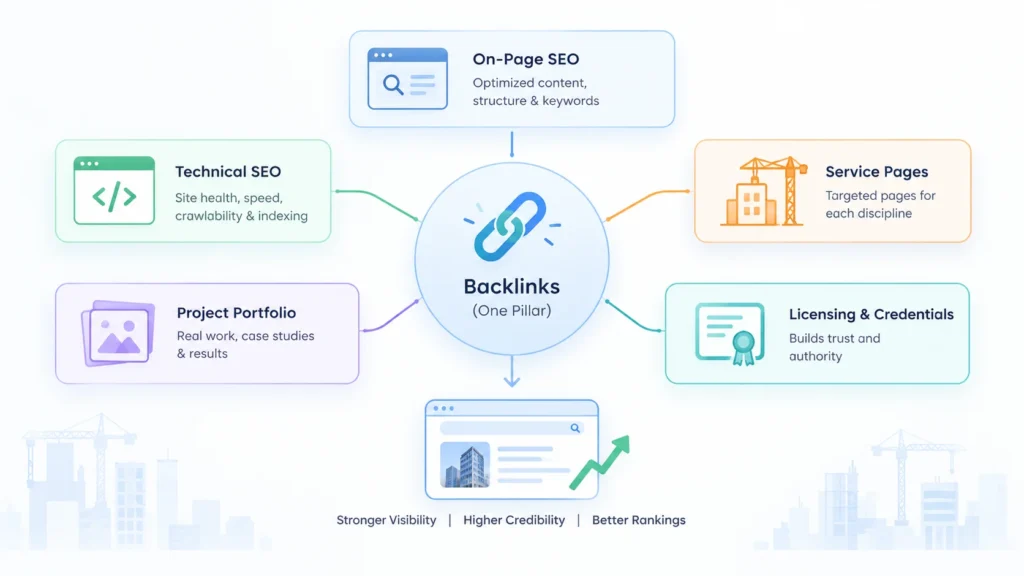
Backlinks are one pillar of a complete strategy, not a replacement for the others. They work alongside the on-page and technical foundations covered in our AEC SEO Service guide, discipline-specific service pages, genuine project portfolio depth, and visible licensing and credentials, since a strong backlink pointing to a thin or poorly structured page still underperforms.
For a broader look at ethical, sustainable link building principles that apply across every industry, including AEC, see our guide on What Is Off-Page SEO?, which covers the fundamentals of link quality assessment and why purchased or manipulative links carry real, lasting risk.
Conclusion
AEC firms sit on a genuine backlink advantage most never use: trade publications actively looking for project features, award bodies that publish and link to winners, manufacturers eager to showcase their products in real buildings, and professional associations built around exactly the kind of topical authority search engines reward most. None of this requires shortcuts. It requires treating every completed project as a marketing asset with several genuine link opportunities attached to it, and following up on each one methodically rather than letting them go unclaimed.