
Ranking well and generating leads are not automatically the same outcome, and nowhere is that gap more visible than in architecture, engineering, and construction. An AEC firm can rank on page one for a competitive term and still watch that traffic leave without a single enquiry, because the page it landed on never actually demonstrated the licensing, project scale, or technical credibility a procurement-driven buyer needs to see before making contact. This guide covers the complete set of AEC SEO best practices for 2026, technical, content, local, and off-page, organised specifically around closing that gap between visibility and genuine pipeline.
Why AEC SEO Looks Different in 2026
Two shifts define AEC SEO right now. First, procurement research has moved decisively online, project owners, developers, and government agencies increasingly shortlist AEC partners based on what they find during independent research, not solely through referral networks and industry reputation built over years. Second, that research increasingly runs through AI systems alongside traditional search, a procurement manager comparing structural engineering firms is as likely to ask ChatGPT to summarise options as to scroll through Google results. Best practices for 2026 need to account for both realities together, not just the first one.
A third, quieter shift matters just as much: the buyers themselves have changed. A younger generation of project managers and procurement leads, comfortable researching independently online before ever picking up the phone, now sits alongside the more traditional, referral-driven decision-makers this industry has relied on for decades. A firm’s website needs to genuinely serve both audiences, the buyer doing exhaustive independent research and the buyer who found you through a referral and is now simply confirming that impression online.
Technical SEO Foundations
Technical health remains the prerequisite for everything else on this list. A firm with outstanding project work and zero technical issues on its site still outranks a firm with equally strong work sitting on a slow, poorly indexed website.
For a deeper walkthrough of the full technical SEO foundation, crawlability, indexing, Core Web Vitals, and structured data, that applies to any website including an AEC firm’s, see our general guide on What Is Technical SEO? The points below focus specifically on where AEC sites tend to fail.
- Core Web Vitals – AEC websites are frequently image-heavy (project photography, renderings), making Largest Contentful Paint and layout stability genuine, common failure points worth auditing specifically.
- Mobile-first indexing – confirm project galleries and portfolio pages render and load properly on mobile, since a meaningful share of research-stage browsing happens on a phone even for high-value B2B decisions.
- Clean site architecture – a logical structure separating disciplines, services, and individual projects into their own indexable pages, not everything flattened into one combined “Work” page.
- AI crawler accessibility – confirm bots like GPTBot and Google-Extended can actually access your site, a 2026-specific technical check most AEC firms have not yet performed.
On-Page Best Practices: Structure by Discipline, Not by Firm
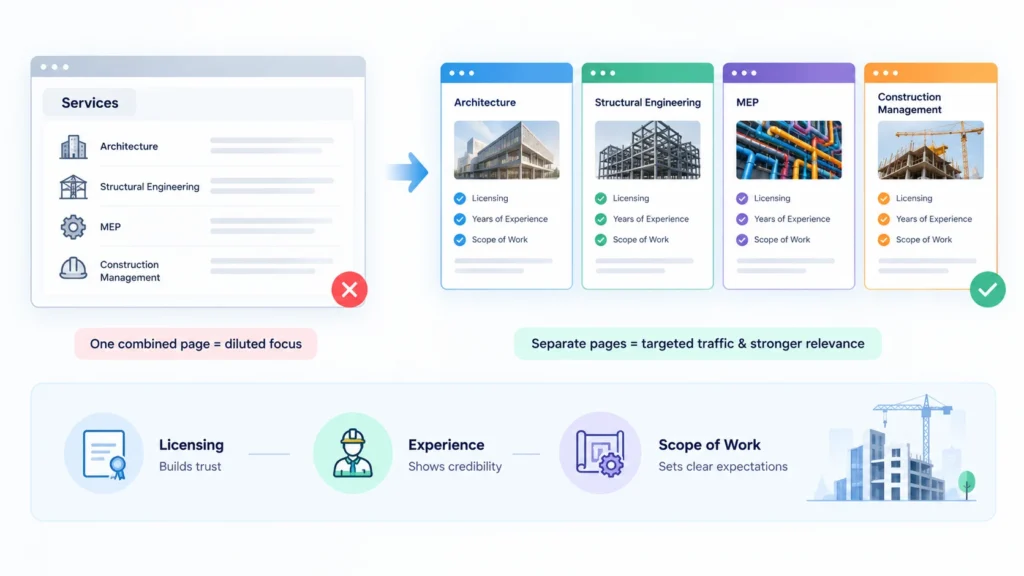
The single most common on-page mistake in this sector is a combined “Services” page trying to rank for architecture, structural engineering, MEP, and construction management all at once. Each discipline should have its own dedicated page, targeting the specific terms a buyer searching for that discipline actually uses, with content depth that genuinely serves that specific search rather than a shared paragraph split four ways.
Within each discipline page, lead with what the buyer needs to evaluate first: relevant licensing, years of experience in that specific discipline, and a clear description of the scope of work you actually handle, before moving into supporting detail. Buyers scanning multiple firms’ sites in the same afternoon reward pages that get to the point.
Content Strategy: Portfolio Depth and RFP-Support Content
Project Case Studies, Not Photo Galleries
A portfolio page with attractive photos and no scope, budget range, or completion timeline fails to build the credibility a procurement team is actually evaluating. Genuine case study content, treated as both an SEO asset and reusable RFP response material, consistently outperforms a gallery approach for both rankings and conversion.
Answer the Research-Stage Questions Directly
Buyers researching an AEC partner ask specific, recurring questions before ever submitting an RFP: typical cost ranges, project timelines, what the design or construction process actually involves. Content answering these directly, cost guides, process explainers, comparison content, captures this research-stage audience and builds trust before the formal tender stage even begins.
License and Credential Content, Prominently Placed
Council of Architecture registration, PE licensure, LEED or GRIHA accreditation, and bonding capacity are not footer disclaimers, they are primary decision-making information for a procurement-driven buyer and should be genuinely visible, not buried in a PDF nobody opens.
Local SEO: The Highest-Leverage Quick Win Most Firms Skip
Google Business Profile optimisation is consistently the single most neglected, highest-leverage tactic across AEC firms we audit. A complete profile, accurate categories, service area, regularly updated project photos, and a steady stream of genuine reviews, directly supports visibility in the local map pack for “[discipline] near me” searches, which capture a disproportionate share of clicks for exactly the kind of location-relevant search many AEC buyers still use.
Off-Page SEO and Backlinks
AEC firms have access to genuinely strong backlink sources most industries do not: trade publication features, project award submissions, material manufacturer case studies, and professional association directories. We cover this in full depth, including a step-by-step process and what to avoid, in our dedicated guide, How to Build SEO Backlinks for AEC Companies.
The 2026 Layer: AEO and GEO for AI Search Visibility
A growing share of procurement research now happens directly inside AI Overviews and chatbot conversations, and this is where most AEC firms currently have zero presence, not because the opportunity is closed, but because almost nobody has addressed it yet.
- AEO (Answer Engine Optimization) – structuring content, especially the RFP-support and process-explainer content covered above, with clear question-and-answer formatting that wins featured snippets and voice search answers.
- GEO (Generative Engine Optimization) – confirming AI crawlers can access your site, and structuring project and credential content so AI systems can accurately extract and cite it when a buyer asks ChatGPT or Perplexity to compare firms.
- Why this matters specifically for AEC – AI systems reward the same genuine expertise signals, named credentials, specific project detail, documented licensing, that procurement buyers already look for, meaning the content built for human trust and the content built for AI citation are largely the same content, done well once.
Turning Rankings Into Leads: Conversion Best Practices
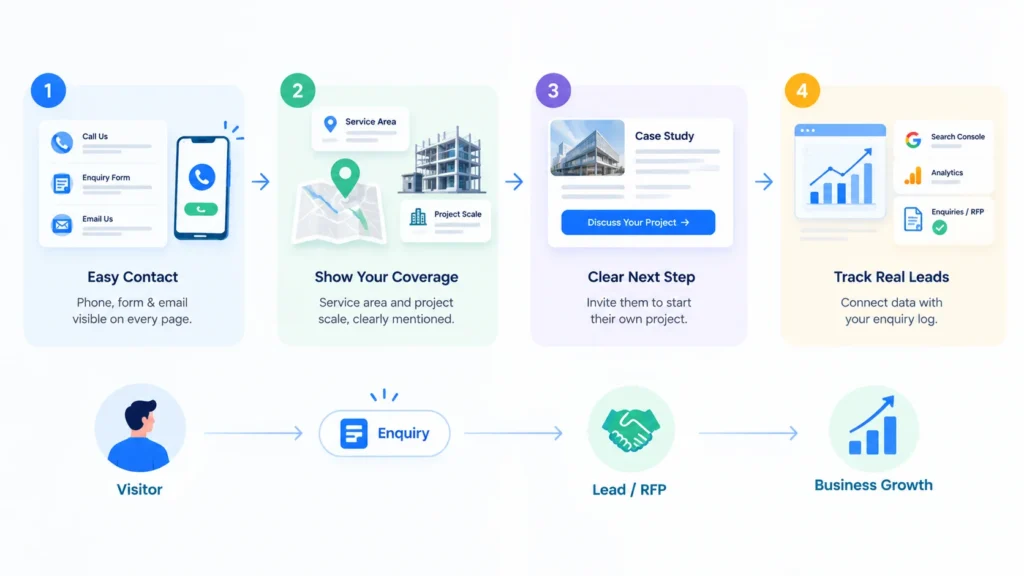
Ranking is only valuable if the page that ranks actually converts a visit into an enquiry or an RFP invitation. A handful of conversion practices matter specifically for this sector.
- Make contact genuinely easy on every page – a phone number, a simple enquiry form, and, where relevant, a direct email, visible without scrolling on every service and project page, not just the homepage.
- State your service area and project scale explicitly – a buyer should not have to guess whether your firm handles projects of their size or in their location; say so directly.
- Include a clear next step on every case study – a case study that ends without inviting the reader to discuss their own project wastes the trust it just built.
- Track enquiries and RFP invitations, not just traffic – connect Google Search Console and Analytics data to your actual enquiry log so you know which pages are producing genuine pipeline, not just visits.
A Prioritised AEC SEO Checklist for 2026
- 1. Complete and fully optimise Google Business Profile (highest-leverage, lowest-effort item on this list).
- 2. Split any combined “Services” page into discipline-specific pages.
- 3. Audit Core Web Vitals and fix image-heavy page speed issues.
- 4. Rebuild portfolio pages into genuine case studies with scope, budget range, and timeline.
- 5. Surface licensing and credentials prominently, not just in a footer PDF.
- 6. Confirm AI crawler accessibility and configure llms.txt.
- 7. Add FAQPage schema to RFP-support and process-explainer content.
- 8. Begin systematic backlink outreach: trade publications, awards, manufacturer case studies.
- 9. Add conversion-focused calls to action across every service and project page.
- 10. Set up enquiry and RFP tracking tied to specific pages, not just site-wide traffic.
Common Mistakes That Undermine Otherwise Good SEO Work
- Treating this as a one-time project – competitor content, licensing status, and completed projects all change continuously; a strategy needs ongoing maintenance, not a single sprint.
- Measuring success by rankings alone – a page ranking well but generating zero enquiries has not delivered the actual business outcome.
- Generic content written without genuine project or technical detail – both human buyers and AI systems increasingly discount shallow, interchangeable content.
- Ignoring AI search entirely – this is currently the single biggest uncaptured opportunity for most AEC firms, precisely because so few competitors have addressed it yet.
Conclusion
AEC SEO in 2026 is not fundamentally different from good SEO anywhere else, genuine technical health, genuine expertise, and genuine authority still drive results, but the specific way those fundamentals show up, discipline-specific pages, licensing content, project case studies, trade publication backlinks, is genuinely sector-specific, and generic advice built for e-commerce or SaaS misses most of it. For a complete, priced breakdown of how DigitalArka approaches this for AEC firms specifically, see our AEC SEO Service page.