
SEO in 2026 is no longer just about ranking on Google. Search now spans traditional blue links, featured snippets, voice assistants, AI Overviews, and platform-specific search engines like YouTube, which itself processes billions of searches every month. Having the right SEO Studio tools in your stack is what separates businesses that guess at their strategy from businesses that measure, adjust, and win. Whether you need to audit a website, research keywords, track backlinks, or rank a YouTube channel, this guide covers the tools that actually move the needle in 2026, including a category most “top SEO tools” lists skip entirely: YouTube SEO tools.
Why SEO Tools Matter More in 2026 Than Ever Before
Search has fragmented. Google now blends traditional rankings with AI Overviews, and a growing share of queries are answered directly inside the search results page, on ChatGPT, and on Perplexity, without a single click reaching a website. At the same time, YouTube has become the second-largest search engine in the world, and businesses that ignore video search are leaving an enormous audience untouched. SEO tools in 2026 need to do more than track keyword rankings; they need to reveal how your content performs across every one of these surfaces.
The importance of SEO tools lies in their ability to provide actionable insights, automate repetitive audits, and surface data-driven recommendations at a scale no human team can match manually. With the volume of ranking signals search engines now evaluate, from Core Web Vitals to E-E-A-T to AI-crawler accessibility, manually tracking performance is simply impractical. The right tools let marketers focus on strategy rather than getting buried in spreadsheets.
SEO tools also help you stay ahead of algorithm updates. Google continues to roll out core updates, spam updates, and AI-related ranking changes multiple times a year, and each one can meaningfully shift your visibility if you are not monitoring it. A strong SEO toolkit flags these shifts early, so you can diagnose whether a ranking drop is a broader algorithm change or a site-specific issue, and respond before the damage compounds.
Key Features to Look for in an SEO Tool in 2026
Choosing the right SEO tool can be overwhelming given how many options exist. A few features matter more than the rest.

- Comprehensive keyword research – search volume, competition, related terms, and, increasingly, whether a query is already being answered inside an AI Overview before a click even happens.
- Robust analytics and reporting – clear, exportable insight into organic traffic, rankings, and conversions, not just raw data dumps.
- Technical SEO auditing – site health checks covering Core Web Vitals, broken links, duplicate content, crawlability, and now AI-crawler accessibility (whether bots like GPTBot and Google-Extended can actually read your pages).
- Backlink analysis – tracking who links to you, who links to competitors, and flagging toxic links before they cause harm.
- Platform-specific coverage – a growing requirement in 2026, since a tool built only for traditional web search cannot help you rank a YouTube channel or optimise for voice search.
Top 10 All-Around SEO Studio Tools for 2026
These ten tools remain the backbone of most professional SEO workflows in 2026, each suited to a different part of the process, from research to technical audits to reporting.

1. SEMrush
SEMrush remains one of the most complete all-in-one platforms available. Its keyword research tool provides search volume, competition, keyword difficulty, and related term suggestions, while its on-page SEO checker gives real-time recommendations for improving content, meta tags, and internal linking. SEMrush’s competitor analysis tools let you track a rival’s keyword rankings, backlinks, and paid campaigns side by side with your own, and its 2026 toolset now includes AI visibility tracking, showing whether your content is being surfaced in AI-generated search summaries.

2. Ahrefs
Ahrefs continues to be the go-to platform for backlink analysis and competitive research. Its Site Explorer shows a domain’s complete backlink profile, organic keywords, and top-performing pages, while its Site Audit tool crawls your website for technical issues like broken links, duplicate content, and slow-loading pages. Ahrefs’ Content Explorer helps you find the most-shared and most-linked content in any niche, making it easier to spot content gaps worth filling.
3. Screaming Frog SEO Spider
For technical SEO, Screaming Frog remains unmatched. This desktop crawler scans your entire website and flags broken links, duplicate content, missing meta tags, redirect chains, and page speed issues. Its integration with Google Search Console and Google Analytics gives you a consolidated view during audits, and its crawl visualisation helps larger sites map and fix site architecture problems that hurt both crawlability and user navigation.

4. Moz Pro
Moz Pro is known for its Domain Authority scoring and approachable interface, making it a strong choice for teams newer to SEO. Its Link Explorer surfaces quality backlink opportunities and flags spammy links, while the MozBar Chrome extension shows real-time SEO metrics while you browse. Moz Academy’s educational resources make this a solid pick for building in-house SEO knowledge alongside the tool itself.

5. Surfer SEO
Surfer SEO is built specifically around content optimisation. Its Content Editor analyses top-ranking pages for a target keyword and gives real-time, NLP-driven suggestions on word count, keyword density, and related terms to include. Its SERP Analyzer and Audit tool help ensure new and existing content matches what Google is actually rewarding for a given query, and its integrations with Google Docs and popular AI writing tools streamline the entire content production workflow.

6. Google Search Console
Google Search Console remains the single most important free tool in any SEO stack, because the data comes directly from Google itself. It shows exactly which queries drive impressions and clicks to every page on your site, flags indexing and crawl errors, and lets you submit sitemaps and request indexing for new pages. In 2026, Search Console has also expanded its reporting to include more detail on how pages perform inside Google’s AI-powered search experiences, making it essential reading before any content update.

7. Ubersuggest
Developed by Neil Patel, Ubersuggest remains a beginner-friendly, budget-conscious option for small businesses and solo content creators. It provides keyword suggestions, SEO difficulty scores, traffic estimations, and basic backlink data, alongside a Site Audit tool that flags common on-page and technical issues. It is not as deep as SEMrush or Ahrefs, but its simplicity and low cost make it a practical entry point.

8. Serpstat
Serpstat is an affordable, all-in-one platform covering keyword research, competitor analysis, and site auditing from a single dashboard. Its keyword clustering feature groups related terms automatically, saving significant manual work when building content strategies, and its search engine result history lets you track how SERPs for a given query have changed over time.

9. Majestic
Majestic focuses exclusively on link intelligence, and its Trust Flow and Citation Flow metrics remain a respected way to assess the quality and quantity of a site’s inbound links. Its visual link maps help agencies and in-house SEO teams identify strong link-building opportunities and understand a competitor’s off-page strategy at a glance.

10. SEO PowerSuite
SEO PowerSuite is a desktop-based suite made up of four modules: Rank Tracker, Website Auditor, SEO SpyGlass, and LinkAssistant. Because it stores data locally rather than in the cloud, it appeals to privacy-conscious teams, and its one-time payment model makes it an attractive long-term option compared to subscription-based competitors.
Best YouTube SEO Tools in 2026
YouTube is the world’s second-largest search engine, and ranking a video or channel requires an entirely different toolkit than ranking a webpage. If you create video content and are only using general-purpose SEO tools, you are missing the metrics that actually determine YouTube visibility: watch time, click-through rate on thumbnails, audience retention, and tag optimisation. Here are the YouTube SEO tools worth using in 2026.
1. TubeBuddy
TubeBuddy is a browser extension and mobile app that integrates directly into YouTube’s own interface. It offers keyword research specific to YouTube search and suggested videos, tag suggestions based on top-ranking competitor videos, A/B testing (TubeBuddy calls this “Tube Buddy Split Testing”) for thumbnails and titles, and bulk processing tools for updating tags and cards across many videos at once. Its Rank Tracker shows exactly where your videos sit for target keywords inside YouTube search results specifically, not just Google.
2. VidIQ
VidIQ is TubeBuddy’s closest competitor and offers similarly deep YouTube-specific analytics. Its standout feature is real-time score-based feedback on individual videos, covering title, description, and tag optimisation, alongside competitor channel tracking that shows which keywords and topics are driving views for similar creators. VidIQ’s trending topic alerts help creators catch rising search demand before it peaks, a genuine edge for time-sensitive content.
3. YouTube Studio Analytics (Native)
YouTube’s own built-in analytics dashboard is free and remains the single most authoritative data source for any channel, since it comes directly from the platform. It shows audience retention graphs, traffic sources (search, suggested, browse, external), and real-time subscriber and watch-time data. No third-party tool can substitute for reviewing this data first, since it reflects exactly what YouTube’s own ranking algorithm is measuring.
4. Morningfame
Morningfame is built specifically for smaller and mid-sized channels trying to grow, offering keyword suggestions ranked by genuine opportunity (search volume weighed against competition) rather than raw volume alone. Its channel audit feature flags underperforming video titles, thumbnails, and descriptions, giving creators a prioritised action list rather than an overwhelming data dump.
5. Rapid Index & Rank Checker Tools
A growing number of creators and SEOs use rapid URL indexing and rank-checking tools to confirm that a newly published video or webpage has actually been indexed and to track keyword position changes day to day, rather than waiting for a weekly report. These lightweight tools are especially useful immediately after publishing, when knowing whether Google or YouTube has crawled and indexed your content can save days of uncertainty. Pair a rapid index checker with Google Search Console’s URL Inspection tool for the clearest picture of your indexing status.
| Tool Type | Best For | Example Tools |
| General SEO Platform | Website rankings, backlinks, technical audits | SEMrush, Ahrefs, Moz Pro |
| YouTube SEO Tool | Video and channel-specific ranking, tags, thumbnails | TubeBuddy, VidIQ, Morningfame |
| Technical Crawler | Site-wide technical issue detection | Screaming Frog, SEO PowerSuite |
| Content Optimisation | On-page content structured for target keywords | Surfer SEO |
| Free Native Tools | First-party performance data | Google Search Console, YouTube Studio |
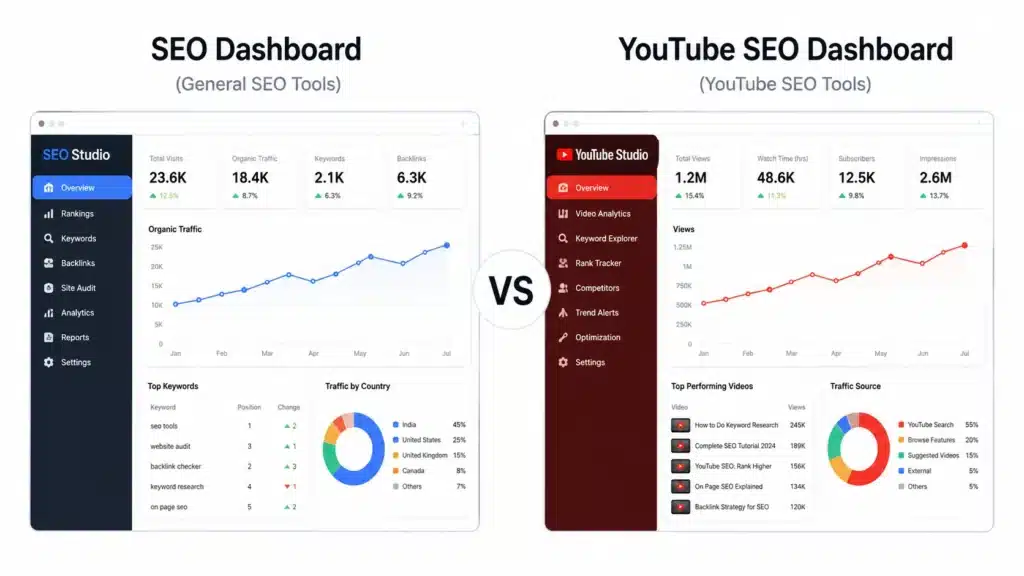
Comparison of the Top SEO Studio Tools
When choosing between these tools, the right choice depends on what you are optimising. For an all-in-one platform covering keyword research, on-page optimisation, and competitor analysis, SEMrush is a strong choice. If backlink analysis and content gap research matter most, Ahrefs leads the field. For technical audits at scale, Screaming Frog remains the specialist tool of choice, particularly for larger websites where crawl efficiency matters. And if video is part of your content strategy, no general SEO platform can substitute for a YouTube-specific tool like TubeBuddy or VidIQ, since YouTube’s ranking factors, watch time, session duration, click-through rate on thumbnails, are simply not things a website crawler measures.
Tips for Choosing the Right SEO Tool for Your Needs
Start by identifying your specific objective. A business focused purely on local visibility has different tooling needs than a content creator trying to rank YouTube videos, and a large e-commerce site auditing thousands of product pages needs different technical depth than a small business blog.

- Match the tool to the platform – a general SEO suite will not optimise a YouTube channel, and a YouTube tool will not audit your website’s Core Web Vitals.
- Prioritise ease of use – the most powerful tool is worthless if your team cannot navigate it; look for intuitive dashboards and available tutorials.
- Weigh cost against genuine need – many tools offer free tiers sufficient for small businesses; reserve premium subscriptions for the specific features you will actually use.
- Check for AI-search reporting – as more searches resolve inside AI Overviews and chatbots, tools that report on this visibility are becoming essential, not optional.
Embracing the Future of SEO Tools in 2026
The importance of choosing the right SEO tools has never been higher. With the top ten platforms covered here for website SEO, and a dedicated set of tools for YouTube specifically, you now have a complete toolkit for competing across both traditional search and video search in 2026. Whether you are auditing technical issues, researching keywords, tracking backlinks, or optimising a YouTube channel for growth, the right combination of tools turns SEO from guesswork into a measurable, repeatable process.
Remember that no single tool covers everything perfectly. Most serious SEO practitioners in 2026 run a combination: one all-in-one platform for overall strategy, a dedicated technical crawler for deep site audits, and, if video is part of the content mix, a YouTube-specific tool running alongside everything else. Choose based on your actual goals, and revisit your toolkit every year as both search engines and the tools themselves continue to evolve.
Also read:
Frequently Asked Questions
Q1: What are SEO studio tools?
SEO studio tools are software platforms that analyse a website’s technical health, content, keyword targeting, and backlink profile to identify issues and opportunities that affect search engine rankings.
Q2: Why are SEO tools important in 2026?
They help uncover site errors, improve page speed, track keyword rankings across both traditional search and AI-powered search experiences, and reveal what competitors are doing that you are not.
Q3: Which is the best free SEO tool?
Google Search Console is the most widely used free tool, providing direct data from Google on indexing status, crawl errors, and exactly which search queries drive impressions and clicks to your pages.
Q4: What features should I look for in an SEO tool?
Look for keyword research depth, site health and technical audit checks, backlink analysis, competitor tracking, and, increasingly, visibility reporting for AI Overviews and chatbot search.
Q5: How often should I run an SEO audit?
A full technical audit every 3 to 6 months is a reasonable baseline, though sites publishing frequently or making regular structural changes should audit more often.
Q6: What is the best SEO tool for YouTube specifically?
TubeBuddy and VidIQ are the two leading YouTube-specific SEO tools, both offering keyword research, tag suggestions, and competitor tracking built around YouTube’s own search and recommendation algorithm rather than Google web search.
Q7: Is there a free SEO tool for YouTube channels?
Yes. YouTube Studio’s native analytics dashboard is completely free and provides the most authoritative first-party data on audience retention, traffic sources, and search terms driving views to your channel.
Q8: What is a rapid index checker tool used for?
A rapid index checker confirms whether a newly published page or video has been crawled and indexed by search engines, letting you catch indexing delays early rather than waiting for a scheduled report.