
Why 85% of Brands Are Invisible to AI — Even the Ones That Rank
Here is the scenario that is playing out in thousands of businesses right now. Your SEO team has done everything right for years. You rank on page one for your most important commercial keywords. Your domain authority is strong. Your technical SEO is clean. You publish consistently. And then a potential customer asks ChatGPT to recommend a service provider in your category, and your brand is not mentioned. Not once.
Loamly’s 2026 AI Traffic report quantified this gap precisely: 85.7 percent of companies that perform well in traditional search score near zero on AI visibility. The reason is that AI systems and search engines use fundamentally different signals to decide who to rank and who to cite. Search engines look primarily at your website — its content, its backlinks, its technical health. AI systems look primarily at what the rest of the internet says about you. Brand mentions. Third-party coverage. Community discussions. The broader digital footprint your brand leaves on platforms you do not own or control.
In our first two articles in this series, we mapped the new SEO journey from foundations to citations and explained the AEO content structure that earns citations from individual pages. This article addresses the off-page dimension: the brand authority signals that make AI systems confident enough to cite you in the first place, before any content on your website is even evaluated.
“85.7% of companies score near zero on AI visibility despite performing well in traditional search. Branded web mentions are 3x more influential than backlinks in driving LLM citations.” — Loamly 2026 AI Traffic Report / NEURONwriter Research
The Difference Between a Backlink and a Brand Mention
For 20 years, the backlink was the primary off-page SEO currency. A link from a high-authority domain passed PageRank to your site. More high-quality links meant more ranking power. The model was explicit, measurable, and gameable — which eventually led to link spam, link networks, and Google’s ongoing war against manipulative link building.
In AI search, the primary off-page currency is the brand mention — a reference to your business name that may or may not include a hyperlink. NEURONwriter’s 2026 research found that branded web mentions are three times more influential than backlinks in driving LLM citations. MaxAEO’s AI citation analysis confirmed the same pattern: AI systems build their entity models of brands from every name mention across the web, weighted by the authority and context of the platform where the mention appears.
The distinction matters because backlinks and brand mentions are not the same thing and do not always co-occur. A journalist who writes about your industry and mentions your brand name without linking to your site creates a brand mention signal with no link equity. An editorial review platform that references your service creates a brand mention with contextual authority. A Reddit thread where users discuss your product creates a community validation signal. All three contribute to AI citation eligibility. Only one of them would have shown up in a traditional backlink audit.
Read More: Link Building in July 2026
The Platforms That Drive AI Citation Most — Ranked by Evidence
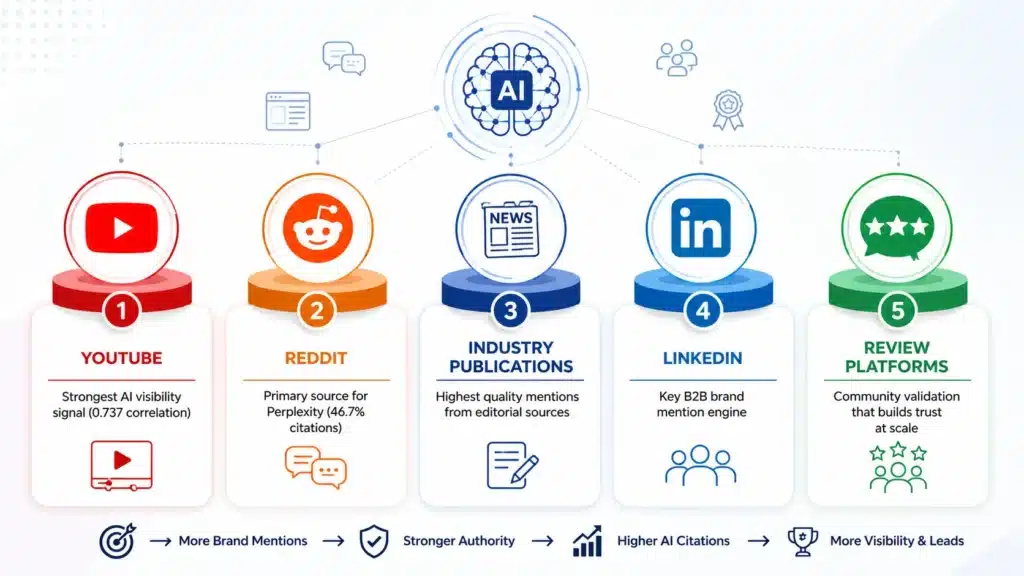
Not all brand mentions are equal. AI systems weight mentions differently based on the authority, relevance, and type of platform where they appear. Here is what the 2026 research data shows about which platforms matter most for AI citation, ranked by documented impact.
① YouTube — The Single Strongest AI Visibility Signal
Ahrefs’ December 2025 research across 75,000 brands found that YouTube mentions correlate 0.737 with AI visibility — the strongest single signal in the entire study, stronger than domain authority, stronger than backlink count, stronger than any on-page factor. The reason is structural: YouTube is a platform Google owns, indexes comprehensively, and uses as a primary source for entity validation. A brand with an active YouTube presence — original videos that earn views, comments, and shares — builds AI citation eligibility that no amount of blog publishing can replicate alone.
The barrier to YouTube presence is lower than most businesses assume. A 3-minute explainer video on a topic you know well, published weekly and promoted once on LinkedIn and in one industry newsletter, builds the YouTube mention footprint that AI systems weight most heavily. The view count matters less than the presence. A video with 200 views and 10 genuine comments on a relevant topic earns more AI citation authority than 10 more blog posts on the same subject.
⚡ Digital Arka recommendation: Commit to one YouTube video per month on your primary topic area. Title it as a direct question your audience asks. Include your brand name in the first 30 seconds. Transcribe the video and embed the transcript on the corresponding blog post for dual-platform entity reinforcement.
② Reddit — The Primary Source Pool for Perplexity
Perplexity cites Reddit in 46.7 percent of its responses — the highest single-source citation rate of any platform in Perplexity’s response corpus. For any query where Perplexity is a material source of customer discovery in your industry (technology, software, marketing services, professional services), Reddit brand mentions translate directly into Perplexity citations.
Authentic Reddit presence does not mean posting promotional content in subreddits. It means participating genuinely in conversations where your expertise is relevant — answering questions in r/SEO, r/digital_marketing, r/startups, r/india, or whichever subreddit community your target audience uses. A single high-quality answer that mentions your brand naturally in the context of solving a real problem earns more citation authority than paid Reddit promotion. The community recognises — and upvotes — genuine expertise, and those upvoted answers become the source material Perplexity pulls from.
For Indian businesses, the relevant subreddits extend to r/indiabusiness, r/bangalore, r/mumbai, and topic-specific communities covering finance, technology, education, and health. Building a track record of helpful contributions in these communities over 90 days creates a brand mention profile that directly feeds AI citation eligibility for Indian-market queries.
③ Industry Publications and Editorial Media
Being named in an editorial piece — a feature, a round-up, an expert interview, or a case study — in a credible industry publication provides the highest quality brand mention signal available. Industry publication mentions satisfy multiple AI citation criteria simultaneously: they are from high-authority domains, they provide contextual description of what your brand does, they are indexed and crawled by Google, and they signal third-party validation that no self-published content can replicate.
Digital PR — the practice of earning editorial coverage through press releases, expert commentary pitches, research publications, and media relationship building — produced a median 239 percent lift in AI citations in a 2026 RankTrends analysis. The lift is so dramatic because editorial mentions are among the most trusted signals in an AI system’s citation confidence calculation. When three independent editorial sources describe your brand the same way, the AI system’s confidence in citing you increases exponentially.
“Earned media and digital PR can increase AI citations by a median lift of 239%. Brands are 6.5x more likely to be cited through third-party sources than their own domains.” — RankTrends Future of SEO 2026
④ LinkedIn — The B2B Brand Mention Engine
LinkedIn carries disproportionate weight for B2B brand mentions because it functions simultaneously as a professional directory, a content platform, and a community discussion space. AI systems that answer B2B queries — “what is the best SEO agency in Delhi,” “which digital marketing consultancy should I use for a startup” — draw heavily on LinkedIn company page content, employee thought leadership posts, and LinkedIn article endorsements.
For Indian B2B businesses, LinkedIn is often the single most actionable brand mention investment available. A consistent publishing cadence of two to three LinkedIn articles per week on your core topic area, a complete and keyword-rich company page, and active participation in LinkedIn industry discussions builds a brand mention profile that AI systems can confidently reference for B2B queries in your category.
⑤ Review Platforms — Community Validation at Scale
Google Business Profile reviews, G2, Clutch, JustDial, Sulekha, and industry-specific review platforms all contribute to the community validation signals that AI systems use to assess brand trustworthiness. According to the optimizeGEO 2026 analysis, 76.1 percent of AI Overview citations come from top-10 organic results, but brand reputation on review platforms influences which of those top-10 results earns the citation over the others. A domain ranking fourth with 250 four-point-eight-star reviews and consistent expert commentary earns more citations than a domain ranking second with no review presence.
Get more: Google’s Antigravity: The Easter Egg, the AI IDE, and What Brands Can Learn From Both
The Brand Mention Compounding Effect — The Flywheel That Builds Itself
The most powerful characteristic of brand mention authority is that it compounds. The Digital Applied 2026 zero-click strategy analysis describes the mechanism precisely: “Sites that Google consistently cites in AI Overviews earn a compounding advantage: each citation reinforces the brand with users, increases branded search volume, and signals authority to Google’s ranking systems — making future citations more likely. This flywheel effect is measurable within two to three months of establishing consistent citation patterns.”
The flywheel works like this: brand mentions build AI citation eligibility. AI citations create brand impressions in users who see the cited answer. Brand impressions drive branded search volume as users follow up on AI recommendations by searching for the brand directly. Rising branded search volume signals to Google’s ranking systems that the brand is trusted and sought after. Higher ranking positions earn more AI citations. More citations create more brand impressions. The cycle accelerates.
Breaking into the flywheel requires consistent investment across at least three of the platforms above over a 60 to 90 day period. One YouTube video and one Reddit answer are not enough. The signal that AI systems respond to is consistency across multiple platforms over time — which is why brand mention building is a programme, not a campaign.
“The flywheel effect is measurable within 2 to 3 months of establishing consistent citation patterns. Each citation reinforces the brand, increases branded search volume, and signals authority to ranking systems — making future citations more likely.” — DigitalApplied, 2026
Building Your Brand Mention Programme: A 90-Day Blueprint
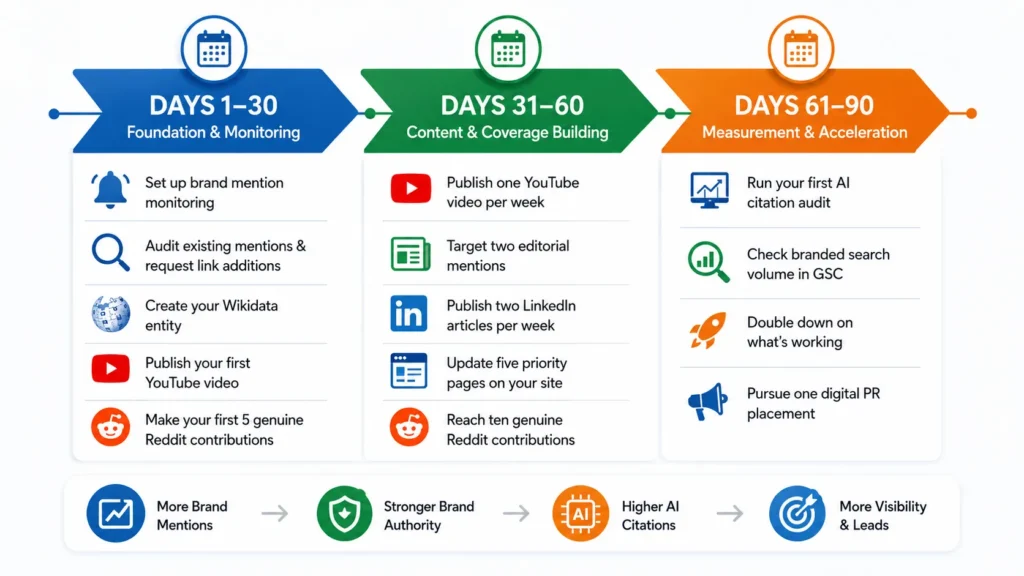
The following 90-day blueprint is the brand mention programme Digital Arka runs for clients who are ranking well but earning too few AI citations. It requires approximately four to six hours of execution per week and produces measurable branded search volume increases within 60 days and measurable AI citation frequency improvements within 90 days.
Days 1 to 30 — Foundation and Monitoring Setup
- Set up brand mention monitoring: Google Alerts for your exact brand name, your founder’s name, and your primary service keywords. Use Brand24 or Ahrefs Mentions for more comprehensive tracking.
- Audit existing mentions: find every existing mention of your brand across the web. For each high-authority mention that lacks a link, email the publisher requesting a link addition.
- Create your Wikidata entity: add your business as a Wikidata item with complete information — founding date, description, service categories, website, and social profile links. This is the single highest-leverage action for ChatGPT citation eligibility.
- Publish your first YouTube video: a 3 to 5 minute explainer on your most important topic. Use your brand name in the first 30 seconds and in the description.
- Make your first five genuine Reddit contributions: answer real questions in relevant subreddits. No promotional language. Pure expertise.
Related: 5 YouTube SEO “Truths”
Days 31 to 60 — Content and Coverage Building
- Publish one YouTube video per week: consistency matters more than production value. Screen recordings with voiceover narration are sufficient.
- Target two editorial mentions: pitch two industry publications with a genuine news angle — a client case study with specific results, original research data, or a founder opinion on an industry development.
- Publish two LinkedIn articles per week: thought leadership on your core topic. Tag relevant industry names and organisations to extend reach.
- Update five priority pages on your site: restructure their opening sections for direct-answer extraction and add dateModified timestamp updates.
- Reach ten genuine Reddit contributions: building a community reputation that earns upvotes and saves creates the persistent, searchable mention record Perplexity cites most reliably.
Days 61 to 90 — Measurement and Acceleration
- Run your first AI citation audit: use Otterly.ai or manual prompt testing across 20 target queries in ChatGPT, Perplexity, and Google AI Overviews. Record which competitors are cited and which queries your brand appears in.
- Check branded search volume in GSC: compare the 30-day branded search volume in Google Search Console against the pre-programme baseline. A 5 to 15 percent increase in 90 days is consistent with programme success.
- Double down on what is working: if YouTube videos on a specific topic are earning comments and discussion, publish more on that topic. If a specific subreddit is generating engagement, participate more there.
- Pursue one digital PR placement: by day 90 you should have enough data from your original research or case studies to pitch a meaningful story to an industry publication with a domain authority of 50 or higher.
Conclusion: Your Brand’s Presence Beyond Your Website Is Your Biggest SEO Lever
The infographic that launched this series shows brand mentions as the second-to-last node on the path to “Cited AND Ranked.” That placement is not accidental. Brand mentions are the penultimate step because they are what convert all the other investments — foundations, AI structure, AEO optimisation, multi-platform citations — into a self-reinforcing competitive advantage.
Backlinks built a moat around your website. Brand mentions build a moat around your brand. The website moat is valuable. The brand moat is unkillable. No algorithm update can take away the brand authority that 100 editorial mentions, a year of YouTube presence, and two years of genuine community participation have built. It exists independently of any ranking change, any SERP layout shift, any AI system update.
At Digital Arka, we build brand mention programmes as a core component of every long-term SEO engagement. We set up monitoring, identify high-leverage mention opportunities, create the content that earns editorial coverage, and track the branded search volume signal that tells us the flywheel is turning. Contact us at digitalarka.com or call +91 70110 34858 to discuss building your brand mention programme this quarter.