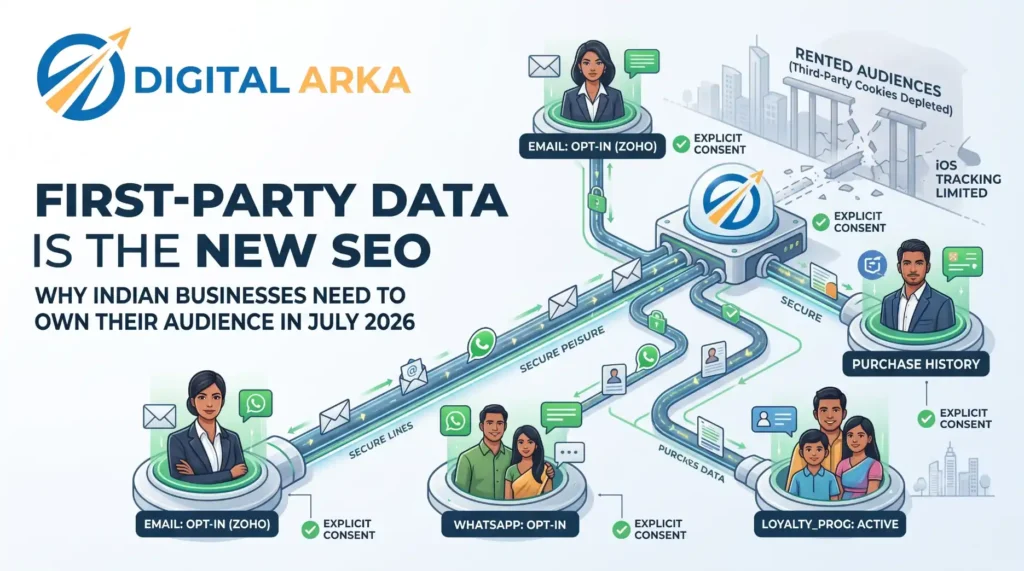

There is a quiet crisis unfolding in Indian digital marketing in July 2026 — and most business owners don’t know they’re in the middle of it.
For years, Indian businesses built their digital marketing on borrowed audiences. Facebook audiences. Google audiences. Third-party data that platforms packaged and sold as targeting options. It felt like owning an audience. It wasn’t. The moment you stopped paying the platform, the audience disappeared.
Now the platforms themselves are removing the data infrastructure those audiences were built on. Third-party cookies are functionally gone. Apple’s iOS privacy updates have broken user-level tracking on Meta for a significant portion of Indian iPhone users. The old system — target by interest, track by cookie, attribute by last click — is collapsing.
The businesses that built owned audience assets alongside their platform advertising are accelerating. The businesses that relied entirely on rented platform audiences are watching their ROAS deteriorate — and wondering why the same budget is producing declining results.
What First-Party Data Is — and Why Reach Is Not the Same Thing
First-party data is information you collect directly from your own customers, prospects, and visitors — with their explicit consent. It includes:
- Email addresses collected from subscribers and customers
- WhatsApp numbers from opted-in contacts and customers
- CRM records from your sales and service interactions
- Website behavioural data from visitors who consented to tracking
- Purchase history, loyalty programme data, and survey preferences
This is fundamentally different from Meta and Google’s “reach.” When you run a Facebook campaign targeting “25–40 year old homebuyers in Delhi NCR,” Meta is lending you access to that audience based on their data. You do not own it. You cannot export it. You cannot contact those people outside of Meta’s platform.
First-party data-seeded look-alike audiences consistently outperform cold interest targeting across every Indian business category — because the AI has a better starting signal. Brands with strong first-party data assets are reporting 40–60% lower customer acquisition costs on paid campaigns.
WhatsApp: India’s Most Underused Marketing Channel
WhatsApp has 500 million active users in India. Response rates average 60–70% — compared to 20–25% for email and 2–5% for push notifications. Brands using WhatsApp Business API for campaign communication, cart recovery, and post-purchase engagement are reporting response rates 8–12 times higher than email for the same message.
What a WhatsApp-based first-party data strategy looks like in practice:
A real estate developer in Noida runs Meta Ads that drive users to a Click-to-WhatsApp button. Every enquiry is captured in their CRM. Monthly broadcasts update construction progress, announce price revisions, invite site visits. After 12 months, they have 8,000 genuinely interested, opted-in prospects — an asset that belongs to their business, not to Meta.
A coaching institute in Delhi sends every admission lead into a WhatsApp broadcast list. New batch announcements, study tips, and exam alerts go out over the academic cycle. Admission rates from WhatsApp-nurtured leads are 3x higher than cold leads because the relationship has been built through consistent, genuinely useful communication.
Email Is Not Dead — It Is Undervalued
Indian marketing conversations have moved to WhatsApp and social, causing email to be overlooked. This is a strategic error.
Email remains the highest-ROI direct marketing channel globally for B2B businesses — IT companies, professional services, consultancies, manufacturers. More importantly, email is uniquely resilient: no platform algorithm controls delivery, no privacy policy change can remove your subscriber list. Indian businesses with email subscriber bases can import those lists into Meta and Google as custom audiences — recovering attribution accuracy that iOS tracking changes have taken away.
Building Your First-Party Data Infrastructure: A Practical Framework
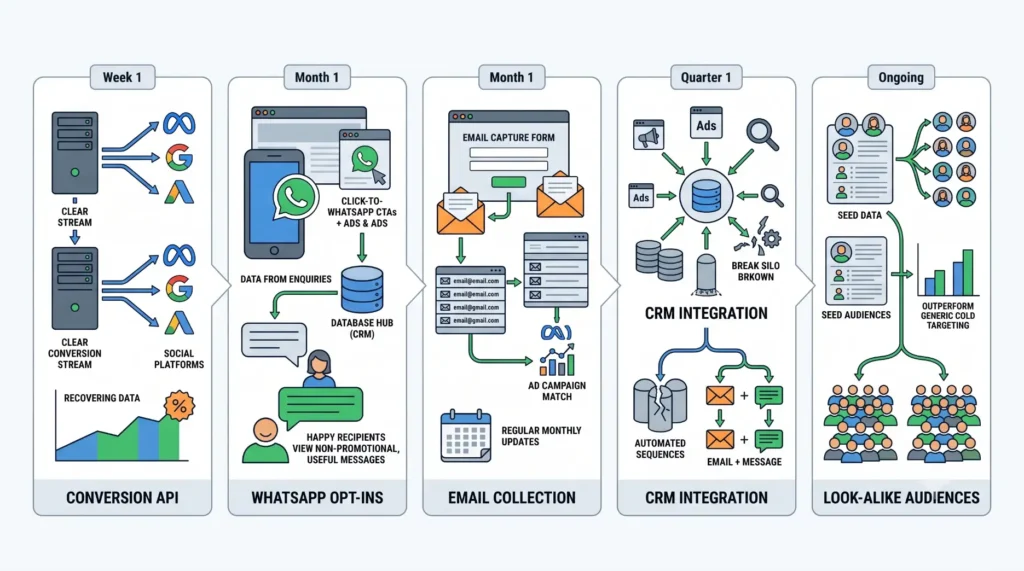
Priority 1: Conversion API Setup — This Week
If you run Meta Ads, implement Meta’s Conversion API (CAPI) server-side alongside your pixel. CAPI sends conversion data directly from your server to Meta, bypassing iOS tracking limitations. Businesses that have implemented CAPI correctly are recovering 15–30% of previously unattributed conversions.
Priority 2: WhatsApp Opt-in Infrastructure — This Month
Set up WhatsApp Business API. Add Click-to-WhatsApp CTAs across Meta Ads, Google Ads landing pages, and your website. Capture every WhatsApp enquiry into your CRM. Begin monthly broadcasts with genuinely useful content — not promotional messages every week.
Priority 3: Email Collection Mechanism — This Month
Every page of your website should have a clear, compelling reason for a visitor to give their email address. Use your existing customer email list as a Custom Audience in Meta Ads and a Customer Match list in Google Ads. Upload monthly to keep the match rate high.
Priority 4: CRM Integration — This Quarter
Connect your lead sources — Meta Ads, Google Ads, organic — directly into a CRM (HubSpot, Zoho, LeadSquared). Build automated follow-up sequences (email + WhatsApp) for every lead category. The fastest-growing businesses in 2026 have broken down the silos between paid media, email, and CRM.
Priority 5: Look-alike Audiences — Ongoing
Upload your customer list, email subscriber list, WhatsApp list, and website visitor list as Custom Audiences in Meta and Google. Build look-alike audiences from each. Test these against cold interest-based audiences. First-party data-seeded look-alikes consistently outperform cold targeting.
The Vernacular Dimension
One dimension most digital marketing guides overlook: language. Tier 2 and 3 cities show 156% higher growth in vernacular content — Hindi, Telugu, Tamil — compared to English-only content. Businesses that communicate with their WhatsApp lists and email subscribers in Hindi or their regional language see dramatically higher open rates, click rates, and conversion rates.
This does not require translating your entire content strategy. It requires identifying the language your specific audience communicates in most naturally — and matching your direct communication channel to that language.
The Long-Term Perspective
First-party data is not a campaign tactic. It is a compounding business asset. Every email address you capture, every WhatsApp opt-in you collect, every CRM record you build — these accumulate over time into a marketing infrastructure that makes every future campaign cheaper and more effective.
The businesses investing in first-party data infrastructure in July 2026 are building something their competitors will spend years trying to replicate. Owning your audience is the most defensible competitive advantage available in Indian digital marketing right now.
DigitalArka builds first-party data infrastructure and marketing automation systems for Indian businesses.