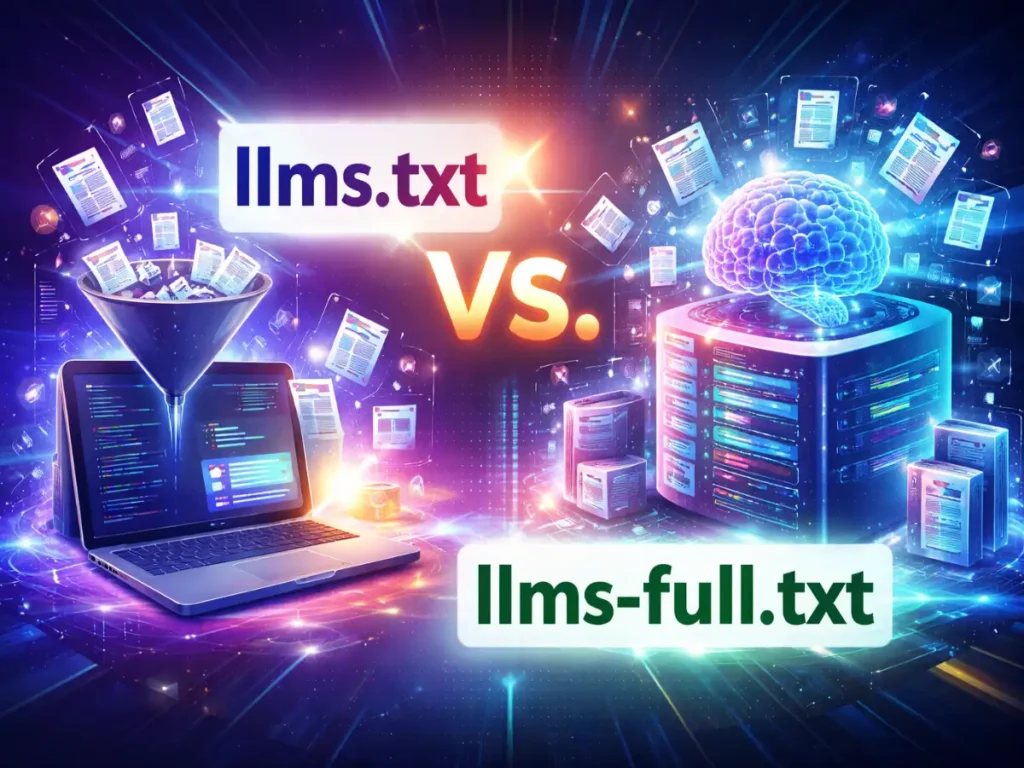

Explore the essential differences between llms.txt and llms-full.txt. This guide breaks down their unique features to help you choose the best for your needs.
Overview of File Formats
In the world of language model management, two file formats often come into play: llms.txt and llms-full.txt. These files are essential for various applications, from machine learning projects to natural language processing tasks. Understanding the differences between these two formats can significantly impact the efficiency and effectiveness of your projects. This guide aims to demystify these file formats, offering a comprehensive comparison to help you make informed decisions about their use.
Both llms.txt and llms-full.txt serve specific purposes in the realm of language models, storing crucial data required for proper functionality. While their structures, content, and use cases differ significantly, these differences can have a major impact depending on your project’s needs. Understanding when to use each format helps teams work more efficiently—especially in collaborative environments like Claude CoWork, where clear documentation and structured data play a key role. By the end of this guide, you’ll have a solid understanding of how to leverage each file type for optimal results.
The importance of choosing the right file format cannot be overstated. Using the wrong format can lead to inefficiencies, errors, and even project failures. Therefore, it’s crucial to delve deep into the characteristics of llms.txt and llms-full.txt to ensure you’re making the best choice for your needs. This guide will provide you with the knowledge you need to navigate these file formats confidently and effectively.
Purpose and Use Cases of llms.txt
llms.txt is a streamlined file format designed for simplicity and efficiency, primarily offering a lightweight solution for storing language model data. This format is especially useful for projects where speed and resource efficiency are critical, as its reduced complexity allows for faster processing and quick data handling. Such clarity and simplicity in structure are also beneficial when presenting topics like E-Marketing vs Digital Marketing, where concise and well-organized information helps users easily understand key differences.
One of the most common use cases for llms.txt is in real-time applications. For instance, chatbots and virtual assistants often rely on this file format to ensure they can respond to user queries without delay. The simplicity of llms.txt allows these applications to function smoothly, providing quick and accurate responses to users. Additionally, llms.txt is often used in scenarios where storage space is limited, as its lightweight nature helps conserve resources.
Another significant use case for llms.txt is in the early stages of language model development, where researchers and developers use it for prototyping and testing. Its simplicity enables rapid iteration and experimentation, making it easier to identify and fix issues early in the process. Once the model becomes more refined, developers can transition to more complex formats like llms-full.txt if required. This step-by-step clarity is similar to how topics like Online vs Offline Marketing are best understood when broken down into simple, structured stages.
Purpose and Use Cases of llms-full.txt
In contrast to llms.txt, llms-full.txt is a more comprehensive file format designed to handle complex and detailed language model data, providing a thorough and exhaustive representation that is ideal for projects requiring high accuracy and depth. This format is especially useful in applications where precision is critical and detailed insights are necessary for performance optimization. Such depth and structured detail are also important when explaining topics like Social Media Marketing vs Digital Marketing, where nuanced comparisons require clear and well-organized information.
One of the key use cases for llms-full.txt is in advanced natural language processing (NLP) tasks. Projects that involve deep learning, sentiment analysis, and other sophisticated NLP techniques often rely on this format to ensure they have access to all the necessary data. The detailed nature of llms-full.txt allows for more accurate and nuanced analysis, which is essential for these complex tasks.
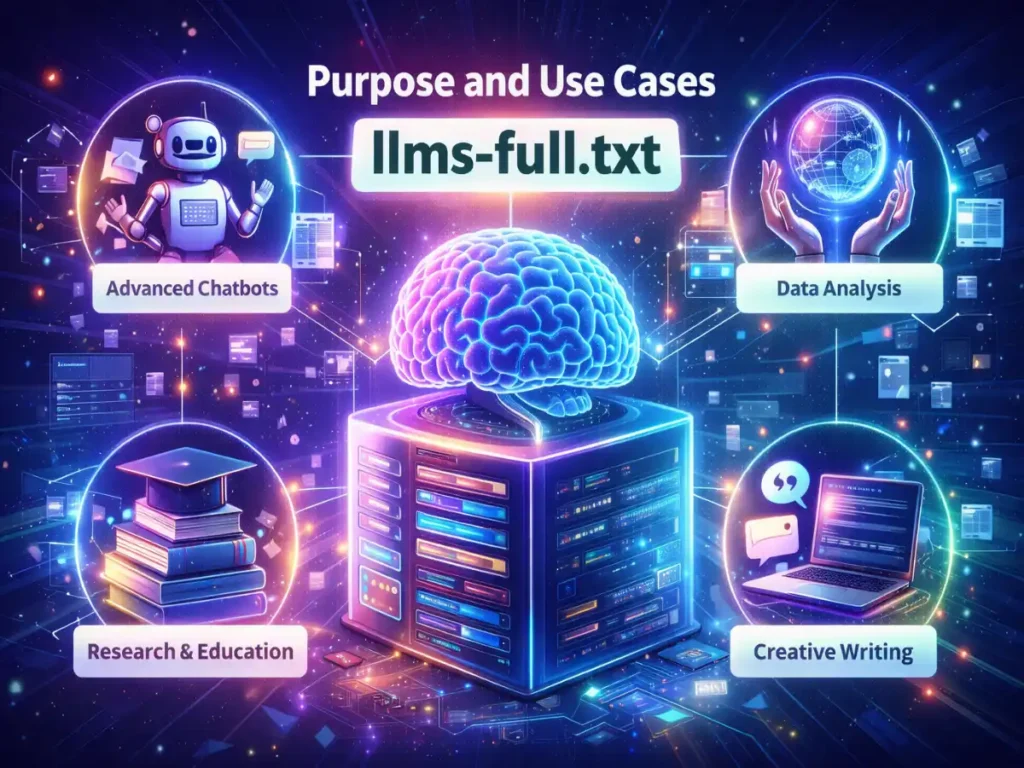
llms-full.txt is also commonly used in academic research, as its comprehensive structure allows researchers to capture and analyze a wide range of data points for in-depth studies on language models. This detailed approach provides a richer dataset, enabling more accurate experiments and meaningful insights, which are essential for advancing the field of language model development. Such depth and clarity are equally important when discussing topics like Digital Marketing vs Online Marketing, where thorough analysis helps in better understanding subtle differences and evolving trends.
Key Differences Between llms.txt and llms-full.txt
The most significant difference between llms.txt and llms-full.txt lies in their complexity and the amount of data they contain. llms.txt is designed to be a lightweight, streamlined file format, while llms-full.txt is more detailed and comprehensive. This fundamental difference impacts their use cases, performance, and suitability for various projects.
llms.txt typically contains a minimal set of data required for basic language model functions. This makes it faster to process and easier to manage, particularly in projects where speed and efficiency are critical. On the other hand, llms-full.txt includes a much broader range of data, providing a more detailed and nuanced representation of language models. This added complexity can be beneficial for projects that require in-depth analysis and high levels of accuracy.
Another key difference is the resource requirements for each format. llms.txt is more resource-efficient, requiring less storage space and processing power, which makes it ideal for real-time applications or projects with limited resources. In contrast, llms-full.txt demands significantly more storage and computational power due to its comprehensive and detailed nature, which can be essential for projects that require high accuracy and depth. This balance between efficiency and detail is also important in fields like Digital Marketing, where choosing the right approach depends on specific goals and available resources.
Performance Comparison: llms.txt vs. llms-full.txt
When it comes to performance, llms.txt and llms-full.txt offer distinct advantages and disadvantages depending on the context. llms.txt is optimized for speed and resource efficiency, making it ideal for applications that require quick processing times and minimal resource consumption. Its streamlined nature allows for faster data handling, which can be crucial in real-time applications where every millisecond counts.
In contrast, llms-full.txt is designed for accuracy and depth, which can impact performance in terms of speed and resource usage. The comprehensive nature of this format means it takes longer to process and requires more computational power. However, this trade-off is often worth it for projects that need detailed and accurate data. The additional information provided by llms-full.txt can lead to more precise and reliable results, which is essential for advanced NLP tasks and academic research.
Ultimately, the choice between llms.txt and llms-full.txt depends on the specific requirements of your project. If speed and efficiency are your primary concerns, llms.txt is likely the better option, while llms-full.txt is more suitable when accuracy and depth of information are critical. By understanding the performance characteristics of each format, you can make a well-informed decision that aligns with your project’s goals—especially during an AI Inflection Point, where selecting the right approach can significantly impact outcomes.
When to Use llms.txt
Deciding when to use llms.txt largely depends on the specific needs and constraints of your project. This format is particularly well-suited for scenarios where speed and resource efficiency are critical. For instance, if you’re developing a chatbot or virtual assistant that needs to provide quick responses, llms.txt is an excellent choice. Its streamlined nature allows for rapid data processing, ensuring that your application can respond to user queries without delay.
Another scenario where llms.txt is beneficial is in projects with limited resources. If you’re working with constrained storage space or limited computational power, the lightweight nature of llms.txt can help you conserve these resources. This makes it an ideal option for mobile applications, embedded systems, or any other context where resource efficiency is paramount.
llms.txt is also a great choice for the early stages of language model development, especially when rapid prototyping and frequent testing are required. Its simplicity allows developers to iterate quickly, experiment efficiently, and identify issues early in the process. As the model becomes more refined and requires deeper insights, transitioning to a more complex format like llms-full.txt becomes beneficial. This step-by-step progression mirrors how concepts like Mastering E-Marketing are best understood through gradual learning and structured improvement.
When to Use llms-full.txt
On the other hand, llms-full.txt is best suited for projects that require a high level of detail and accuracy. If you’re working on advanced NLP tasks such as deep learning, sentiment analysis, or other sophisticated techniques, this format provides the comprehensive data you need for precise and reliable results. The detailed nature of llms-full.txt allows for more nuanced analysis, which is essential for these complex tasks.
Academic research is another area where llms-full.txt truly excels, as its exhaustive structure enables researchers to conduct in-depth studies on language models with a high level of detail and accuracy. The comprehensive data it provides leads to richer datasets, which are essential for producing high-quality research and driving advancements in the field of language model development. For projects that require detailed analysis and precision, llms-full.txt is often the preferred choice—much like how topics such as Internet Marketing vs Digital Marketing benefit from thorough, well-structured comparisons to deliver deeper insights.
llms-full.txt is also valuable for projects that require long-term data retention and analysis. If you need to store and analyze a large amount of data over an extended period, the comprehensive nature of llms-full.txt ensures that you have all the necessary information at your disposal. This makes it easier to conduct longitudinal studies, track changes over time, and generate detailed reports. The added complexity of llms-full.txt can be a significant advantage in these scenarios, providing the depth of information needed for thorough and accurate analysis.
Common Misconceptions About llms.txt and llms-full.txt
There are several common misconceptions about llms.txt and llms-full.txt that can lead to confusion and suboptimal decision-making. One of the most prevalent is the belief that llms-full.txt is always the better choice simply because it contains more data. While it does provide a more comprehensive representation of language models, it isn’t necessarily ideal for every project. In many situations, the simplicity and efficiency of llms.txt make it a more practical option—just as using a Website Archive depends on whether you need full historical data or a lightweight snapshot for quick access.
Another common misconception is that llms.txt is too simplistic for serious language model development. While it’s true that llms.txt is more streamlined, this doesn’t diminish its usefulness. In fact, many developers and researchers start with llms.txt during the early stages of their projects to prototype and test their models. Its simplicity allows for rapid iteration and troubleshooting, making it an invaluable tool in the development process. Once the model is refined, they can then transition to llms-full.txt if more detailed data is needed.
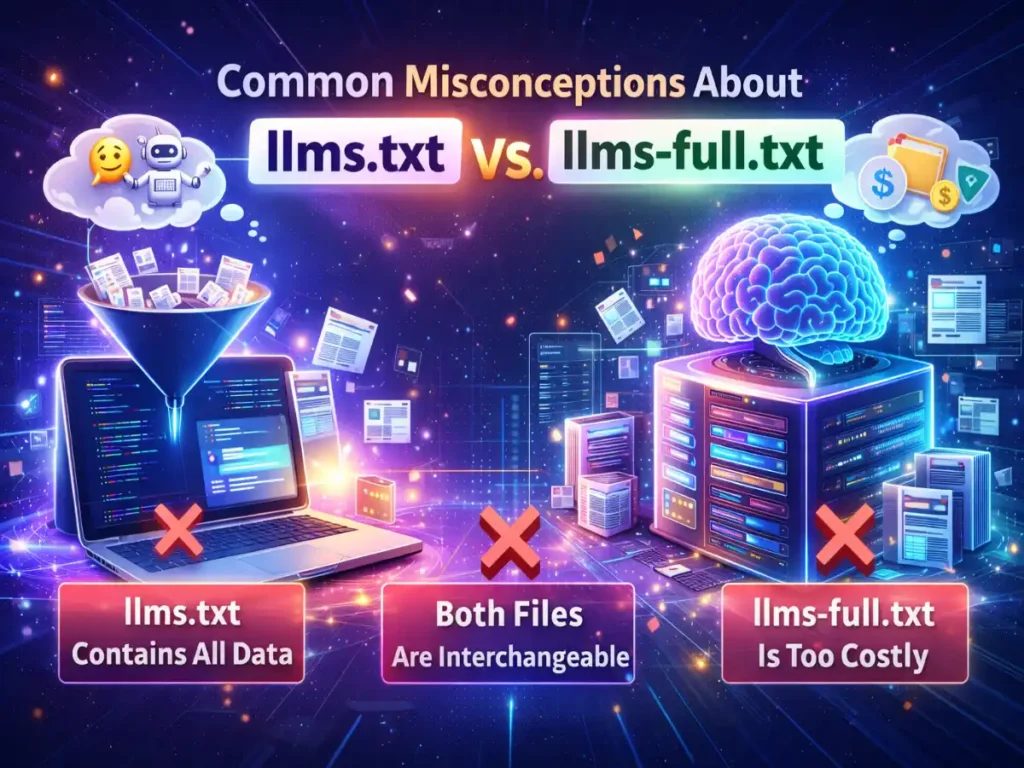
Finally, some people believe that resource constraints make llms-full.txt impractical for most applications. While it’s true that llms-full.txt requires more storage space and computational power, these resource demands are often justified by the benefits of having more detailed and accurate data. For projects that require a high level of precision and depth, the added complexity of llms-full.txt is a worthwhile trade-off. Understanding these misconceptions can help you make more informed decisions about which file format is best suited for your needs.
Conclusion and Final Thoughts
In conclusion, both llms.txt and llms-full.txt have their unique advantages and are suited for different types of projects. Understanding the key differences between these file formats is crucial for making informed decisions that align with your project’s specific requirements and constraints. llms.txt offers simplicity, speed, and resource efficiency, making it ideal for real-time applications, projects with limited resources, and the early stages of language model development. On the other hand, llms-full.txt provides a comprehensive and detailed representation of language models, which is essential for advanced NLP tasks, academic research, and projects that require long-term data retention and analysis.
By carefully considering the purpose and use cases of each file format, you can choose the one that best meets your needs. Whether you prioritize speed and efficiency or depth and accuracy, there’s a file format that can help you achieve your goals. Avoiding common misconceptions about these formats will also enable you to make more informed and effective decisions, ensuring that your language model projects are successful and efficient.
“Is your Google My Business profile playing hide & seek on Google? Digitalarka helps it come out and rank like a star — go check it out!”
Ultimately, the choice between llms.txt and llms-full.txt comes down to the specific demands of your project. By understanding the strengths and limitations of each format, you can leverage their unique features to achieve optimal results. Whether you’re a developer, researcher, or data scientist, this guide provides the knowledge you need to navigate the complexities of language model file formats confidently and effectively.