
The SEO Game Has a New Rule: Move First
For over two decades, SEO worked on a reactive model. Google changed an algorithm, rankings shifted, SEO professionals scrambled to diagnose the cause, published their findings three months later, and brands updated their strategies accordingly. By the time most businesses adapted, the next update was already rolling out. This cycle — change, diagnose, react — defined the entire discipline.
In July 2026, that model is broken. Not because the algorithm changes more slowly — it changes faster than ever, with dozens of core updates, product reviews updates, spam updates, and AI-surface changes rolling out each quarter. It is broken because the data signals that precede those changes are now visible, measurable, and actionable before rankings shift.
Predictive SEO is the discipline of reading those signals and moving first. At Digital Arka, we have integrated predictive frameworks into every client engagement since early 2026, and the results consistently outperform reactive strategies by 40 to 60 percent on key traffic and citation metrics. This guide breaks down exactly how it works and how you can apply it to your own site today.
“Predictive SEO means spotting demand shifts, query changes, SERP changes, and content gaps before they hurt your traffic or sales. Small teams need this badly because they do not have spare time to fix a broken content engine three months late.” — mean.ceo SEO Trends Report, July 2026
What Is Predictive SEO?
Predictive SEO is the practice of using leading indicators — signals that appear before ranking changes occur — to anticipate algorithm behaviour, content gaps, and audience intent shifts. Instead of measuring what has already happened (rankings dropped, traffic fell), predictive SEO measures what is about to happen and acts in advance.
The discipline draws on four data streams that most SEO strategies either ignore or check too infrequently:
- Impression-vs-click divergence — pages where Google Search Console shows rising impressions but flat or falling clicks signal that AI Overviews or SERP features are absorbing your traffic before it lands.
- Query pattern shifts — keyword sets that suddenly trigger AI Overviews, video carousels, or image blocks where they previously showed ten blue links. These shifts predict content format requirements before rankings change.
- Competitor appearance on branded terms — when a competitor begins ranking for your own brand name or semi-branded terms, it predicts intent drift and audience confusion that will affect your direct traffic within 60 to 90 days.
- Conversation-sourced intent — questions appearing repeatedly in sales calls, support tickets, and social comments predict content gaps 60 to 90 days before those queries reach significant search volume.
Why July 2026 Makes Predictive SEO Urgent
Three developments converged in July 2026 to make predictive SEO not just useful but necessary. First, Google’s July Webmaster Report confirmed that Google’s search team explicitly discussed content signals, site-level quality assessments, and AI click behaviour in their communications — language that signals imminent algorithm weight adjustments, not settled policy.
Second, the July 2026 Webmaster Report confirmed that Google Search Console expanded access to AI performance reports. This means you can now see, with granularity, which of your pages appear in AI Mode responses, which queries trigger AI Overviews that absorb your clicks, and how your AI visibility has changed month over month. This is leading-indicator data — the kind that tells you what is about to happen to your organic traffic before your rank tracker shows any movement.
Third, the zero-click environment reached a structural threshold. The Digital Bloom found that over 60 percent of all Google searches in 2026 ended without a click — users received their answer in the AI Overview and never visited a website. At this scale, ranking without being cited in the AI response is effectively invisible. Predictive SEO helps you identify which of your pages face this risk and which have a path to AI citation before the traffic loss shows up in Google Analytics.
Over 60% of all Google searches and 77% of mobile searches resulted in zero-clicks by end of 2025. That number is rising. — The Digital Bloom, cited by Circles Studio, March 2026
5 Predictive SEO Actions to Take Right Now
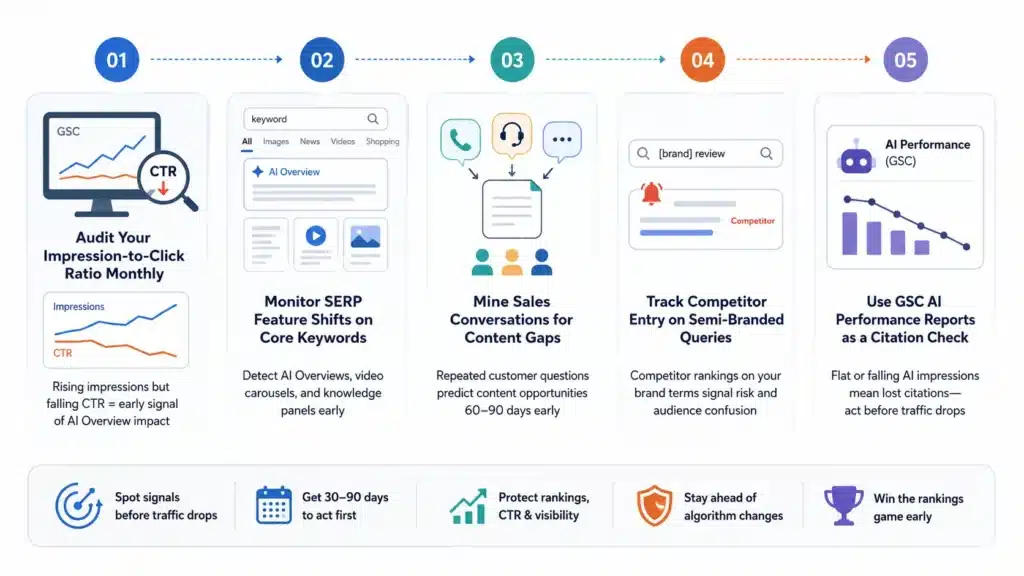
01 Audit Your Impression-to-Click Ratio Monthly
Open Google Search Console and export your top 50 queries by impressions. For each query, calculate the click-through rate. Flag any query where impressions grew by more than 20 percent in the last 90 days but CTR fell. This pattern — rising impressions, falling CTR — is the earliest measurable signal that an AI Overview or SERP feature is intercepting your traffic. Acting on this signal within 30 days of detection — by restructuring the page for AI citation — consistently outperforms waiting for a ranking drop.
⚡ Digital Arka action: Set a recurring calendar reminder on the first Monday of every month to run this audit in GSC. Filter by “Queries” and sort by Impressions descending. Export, calculate CTR manually in a spreadsheet, and flag any row where CTR fell more than 15% month-on-month while impressions held or grew.
02 Monitor SERP Feature Shifts on Your Core Keywords
Use any rank tracking tool with SERP feature detection (Semrush, Ahrefs, or SE Ranking) to track not just your ranking position but what SERP features appear alongside your listing. When a keyword that previously showed ten blue links starts triggering an AI Overview, a video carousel, or a knowledge panel, you have a 30 to 60 day window to reformat your content before your CTR drops. This is the most actionable lead time in predictive SEO.
03 Mine Sales Conversations for Pre-Keyword Content Gaps
The strongest predictive SEO signal does not come from data tools — it comes from your customers. Questions that appear repeatedly in sales calls, support chats, and social comments predict content gaps 60 to 90 days before those queries reach significant search volume. Build a simple system: a shared document where sales and support teams log every question they hear more than twice in a month. Review it on the first of each month. Any question that appears three or more times becomes a content brief. It is a part of Brand SEO.
⚡ Digital Arka uses Notion for this. Every client has a “Voice of Customer” database where all repeated questions are logged with date, channel, and exact phrasing. We review it in every monthly content planning session.
04 Track Competitor Entry on Semi-Branded Queries
Set up a monthly Google Alert and rank tracking campaign for your own brand name plus common modifiers — “[brand] review,” “[brand] alternative,” “[brand] vs [competitor],” “[brand] pricing.” When a competitor begins appearing in these results, it signals audience confusion or dissatisfaction that will erode your direct traffic within 60 to 90 days. Respond immediately with comparison content, updated review profiles, and enhanced Google Business Profile posts that answer the implied questions behind these queries.
05 Use GSC AI Performance Reports as a Citation Health Check
Google Search Console’s expanded AI performance reports (launched July 2026) give you impression and click data for your content’s appearances in AI Mode responses. Check this report monthly and flag pages where AI Mode impressions are flat or falling. These pages need structural improvements — direct-answer openers, FAQ schema, author entity signals — before they lose citation share entirely. This is the most direct predictive signal available in 2026 for AI search visibility.
What Predictive SEO Looks Like at Scale
Predictive SEO is not a one-time audit. It is a standing operating procedure that runs alongside your content calendar. At Digital Arka, our predictive SEO workflow runs on a monthly cycle: first week reviews impression-click data and SERP feature shifts; second week converts conversation-sourced gaps into content briefs; third week publishes restructured or new content targeting the flagged gaps; fourth week measures AI citation changes in GSC and closes the loop.
The result, over six months, is a content library that consistently stays ahead of algorithm changes rather than chasing them. Pages that would have lost 30 to 50 percent of their traffic in a core update — because they relied on keyword density rather than genuine extractability — instead hold or gain citation share because they were restructured before the update hit.
Conclusion: The Brands That Win Have Already Moved
Predictive SEO is not a new concept. Every experienced SEO practitioner has always tried to anticipate changes. What is new in July 2026 is the data infrastructure to do it systematically. GSC AI performance reports, SERP feature tracking, impression-click divergence analysis, and conversation-sourced intent mining give you a genuine 30 to 90 day lead time on algorithm changes and traffic shifts.
The brands that capture the most AI citation share in the second half of 2026 will be the ones that used these signals to restructure their content now — not the ones that wait for a core update to force the change. At Digital Arka, we build this capability into every client engagement. Contact us at digitalarka.com to see how predictive SEO can work for your business.
Frequently Asked Questions (AI-Driven Queries)
These questions reflect real queries people ask AI search engines — Google AI Mode, ChatGPT, Perplexity, and Bing Copilot — about this topic. Each answer follows passage-first structure for maximum citation eligibility.
Q1. What is predictive SEO and how is it different from traditional SEO?
A: Predictive SEO uses leading indicators — impression-click divergence, SERP feature shifts, competitor entry on branded terms, and conversation-sourced intent gaps — to anticipate algorithm changes and content gaps before they affect rankings. Traditional SEO is reactive: it diagnoses why traffic fell after a core update. Predictive SEO acts 30 to 90 days before the traffic impact arrives. In July 2026, with GSC AI performance reports now available, predictive SEO has more real-time data than ever before.
Q2. How do I use Google Search Console for predictive SEO in 2026?
A: Open Google Search Console and compare your top 50 queries by impressions month over month. Flag any query where impressions grew but CTR fell — this signals an AI Overview absorbing your traffic. Also check the new AI performance report, launched in July 2026, which shows impression and click data specifically for AI Mode appearances. Pages with flat or falling AI Mode impressions need structural improvements before they lose citation share.
Q3. What is impression-to-click divergence and what does it predict?
A: Impression-to-click divergence is the pattern where a page or query shows rising Google Search Console impressions alongside flat or falling click-through rates. It predicts that an AI Overview, Featured Snippet, or SERP feature is answering the query without the user clicking through to your site. This is the earliest measurable signal of zero-click risk and typically precedes a full traffic drop by 30 to 60 days.
Q4. How does AI Mode in 2026 affect the predictive SEO strategy?
A: Google’s AI Mode, which crossed 1 billion monthly users at I/O 2026, returns synthesised answers with no blue links. This makes AI citation share the primary visibility metric for informational queries. Predictive SEO in 2026 monitors AI performance data in GSC to flag pages losing citation share before they lose organic traffic. Acting on these signals — restructuring pages for passage extractability — consistently outperforms reactive diagnosis.
Q5. Can small businesses use predictive SEO without expensive tools?
A: Yes. The three most valuable predictive SEO data sources are free: Google Search Console (impression-click divergence and AI performance reports), Google Alerts (competitor entry on branded queries), and your own sales and support conversations (pre-keyword intent gaps). Paid tools like Semrush and Ahrefs add SERP feature tracking and competitor ranking history but are not required for the core predictive workflow.
Q6. How often should I run a predictive SEO audit?
A: Run a lightweight predictive SEO check monthly. This should cover: GSC impression-click divergence for top 50 queries, SERP feature changes on core keywords, competitor ranking alerts on branded terms, and a review of conversation-sourced intent from sales and support. A comprehensive predictive audit — covering all pages, full competitor landscape, and AI citation share — should run quarterly.
Q7. What SERP features signal the biggest predictive SEO risk in 2026?
A: AI Overviews carry the highest predictive risk, appearing on 80 to 88 percent of informational queries in some industries and reducing position-1 CTR by an average of 34.5 percent. Video carousels and knowledge panels represent the second tier of risk. All three follow a pattern: they appear first on a query with low search volume, then expand to higher-volume versions as Google builds confidence in the feature. Tracking SERP feature emergence on low-volume variants gives you advance warning for high-volume queries.
Q8. What is the biggest predictive SEO mistake businesses make?
A: The biggest mistake is treating GSC data as a retrospective report rather than a predictive tool. Most businesses open Search Console after traffic falls to understand what happened. Predictive SEO opens it monthly to look for divergence patterns that signal what is about to happen. The second biggest mistake is ignoring conversation-sourced intent — the questions your customers ask in sales calls and support chats consistently predict content gaps 60 to 90 days before they appear in keyword tools.
Q9. How does predictive SEO relate to content planning?
A: Predictive SEO directly feeds the content calendar. Impression-click divergence identifies pages that need restructuring before they lose traffic. Conversation-sourced intent identifies topics to create before they peak in search volume. SERP feature tracking identifies format changes needed — a page that previously ranked well as a listicle may need restructuring as a direct-answer passage if its keyword now triggers an AI Overview. Predictive SEO converts reactive content planning into proactive, signal-driven publishing.
Q10. How do I measure whether predictive SEO is working?
A: Track three metrics monthly. First, AI citation share: the percentage of your target queries that return AI Mode or AI Overview responses citing your content, measured through GSC AI performance reports. Second, CTR stability: whether your click-through rates on monitored queries hold steady as impressions change. Third, traffic resilience through core updates: whether your organic traffic holds or gains during algorithm updates rather than dropping and recovering. Predictive SEO succeeds when core updates become neutral or positive events rather than crises.