
Your Customers Are Searching on Platforms You Are Probably Ignoring
Digital Arka manages SEO for businesses across Delhi NCR, and in August 2026 we see the same gap in almost every audit we run: clients obsess over Google rankings while their target audience searches for their services on YouTube, Reddit, ChatGPT, Instagram, and TikTok simultaneously. Google still processes 14 billion queries per day compared to ChatGPT’s 37.5 million — a ratio of 373 to 1 in Google’s favour, per SparkToro. But the users who bypass Google for those 37.5 million daily ChatGPT queries are often the highest-intent, highest-value segment in the market.
Search Everywhere Optimisation — the practice of building visibility across every platform where your audience searches, not just Google — defines the most sophisticated SEO strategies of August 2026. Users now explore multiple platforms before making decisions. Their search journey involves AI chatbots, YouTube videos, Reddit discussions, voice assistants, and Instagram reels, all before they type a query into Google. Businesses that only optimise for Google’s blue links miss every earlier touchpoint in that journey.
“Users increasingly turn to ChatGPT, Bing Copilot, and Perplexity for certain queries. Search journeys involve AI chatbots, YouTube, TikTok, Reddit, and voice assistants — all shaped by emerging AI search trends in 2026.” — Evergreen Media / Nonofo Joel SEO Trends 2026
The 6 Platforms That Now Shape Search Behaviour in 2026
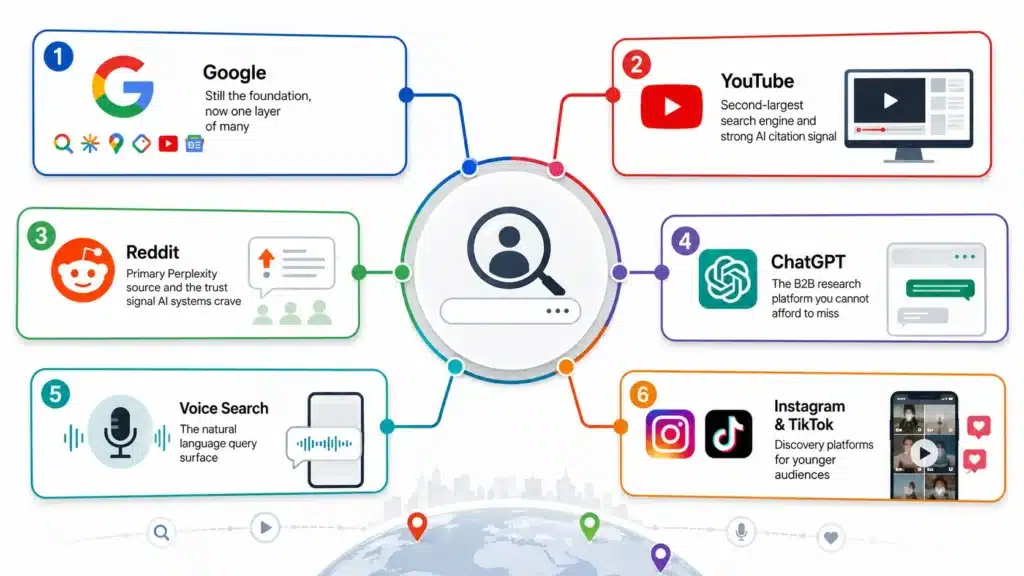
① Google — Still the Foundation, Now One Layer of Many
Google processes 14 billion daily queries and remains the dominant search surface by a factor of hundreds. But Google itself has fractured into multiple surfaces: traditional blue links, AI Overviews, AI Mode, Google Images, Google News, Google Maps, Google Shopping, and YouTube (owned by Google). Optimising for “Google” in 2026 means optimising for all of these surfaces independently. Digital Arka builds separate tracking dashboards for each Google surface in every client account — because gaining on Google Images while losing on AI Overviews is a different problem than the reverse.
② YouTube — The Second-Largest Search Engine and the Strongest AI Citation Signal
YouTube processes over 3 billion searches per month and ranks as the world’s second-largest search engine. YouTube content now ranks in traditional Google search results. According to The Edigital’s 2026 SEO trends research, embedding YouTube videos into blog posts improves those articles’ rankings because “Google sees video as a quality signal.” More critically for AI visibility, Ahrefs’ December 2025 research found YouTube brand mentions correlate 0.737 with AI visibility — the strongest single signal in a study of 75,000 brands. Businesses that publish one YouTube video per week build the multi-platform citation footprint that modern AI systems weight most heavily.
③ Reddit — The Primary Perplexity Source and the Trust Signal AI Systems Crave
Perplexity cites Reddit in 46.7 percent of its responses. Reddit’s upvoted answers represent the kind of community-validated information that AI systems treat as authentic social proof — something that is impossible to fabricate at scale. Businesses that participate genuinely in relevant Reddit communities (r/SEO, r/digital_marketing, r/Delhi, r/india, r/startups) build brand mention signals that directly feed AI citation eligibility. Digital Arka recommends posting five genuinely helpful Reddit answers per week in communities where your target audience seeks advice.
④ ChatGPT — The B2B Research Platform You Cannot Afford to Miss
ChatGPT processes 2 billion daily queries and has crossed 900 million weekly active users as of mid-2026. Critically, 42 percent of CRM software buyers now use AI search as part of their evaluation process, according to HubSpot’s January 2026 research. For B2B businesses, ChatGPT is now a significant research and comparison platform — potential clients ask it to recommend service providers, compare agency capabilities, and identify vendors. Businesses that have no presence on Wikipedia or Wikidata, and no editorial coverage in authoritative publications, are essentially invisible on ChatGPT.
⑤ Voice Search — The Natural Language Query Surface
Voice and conversational search reflect a shift from typed keywords to full, spoken questions. Voice queries are typically longer, more conversational, and more geographically specific than text queries. “Best SEO agency near me” becomes “Who is the best SEO agency in South Delhi for small businesses?” in voice search. Digital Arka optimises for voice search by building FAQ sections that answer exactly these natural language question patterns, using conversational headings, and implementing Speakable schema markup on key content pages.
⑥ Instagram and TikTok — The Discovery Platforms for Younger Audiences
Younger audiences (18 to 34 demographic) increasingly use Instagram and TikTok as their first search platform for product discovery, local business recommendations, and how-to information. For brands in food and beverage, fashion, beauty, hospitality, and education, TikTok and Instagram visibility is now a legitimate component of an integrated search strategy. Yocreativ’s 2026 SEO trends analysis describes video as an asset that “compresses complex topics into digestible experiences, builds emotional trust faster than text, and aligns with voice and multimodal search behaviour.”
The Search Everywhere Content Framework Digital Arka Uses
We build Search Everywhere strategies through a content repurposing model that starts from one strong blog post and extends it across every relevant platform without creating entirely separate content streams. The model works as follows:
- Create the core article: a comprehensive, AEO-structured blog post on your target topic. This is the primary investment. Every other format derives from it.
- Convert to YouTube: turn the core article into a 3 to 5 minute scripted video. Use the article headings as your video chapters. Post it on YouTube with the full article transcript in the description.
- Answer on Reddit: identify three Reddit threads where someone is asking the exact question your article answers. Provide a 200-word genuine answer citing your article as a reference.
- Create a LinkedIn article: adapt the core article into a LinkedIn long-form post targeting the B2B professional audience. Tag relevant industry figures and organisations.
- Build a voice-search FAQ: extract the five most natural-language questions your article answers and add them to your website’s FAQ section with Speakable schema markup.
- Summarise for ChatGPT eligibility: ensure your brand has a Wikidata entity and a Wikipedia presence linking to the article as an authoritative source on the topic.
“In 2026, success is not measured by blue links alone — but by presence inside AI answers, featured snippets, voice search results, video discovery feeds, business profiles, and knowledge panels.” — Yocreativ SEO Trends in 2026
How to Measure Search Everywhere Optimisation
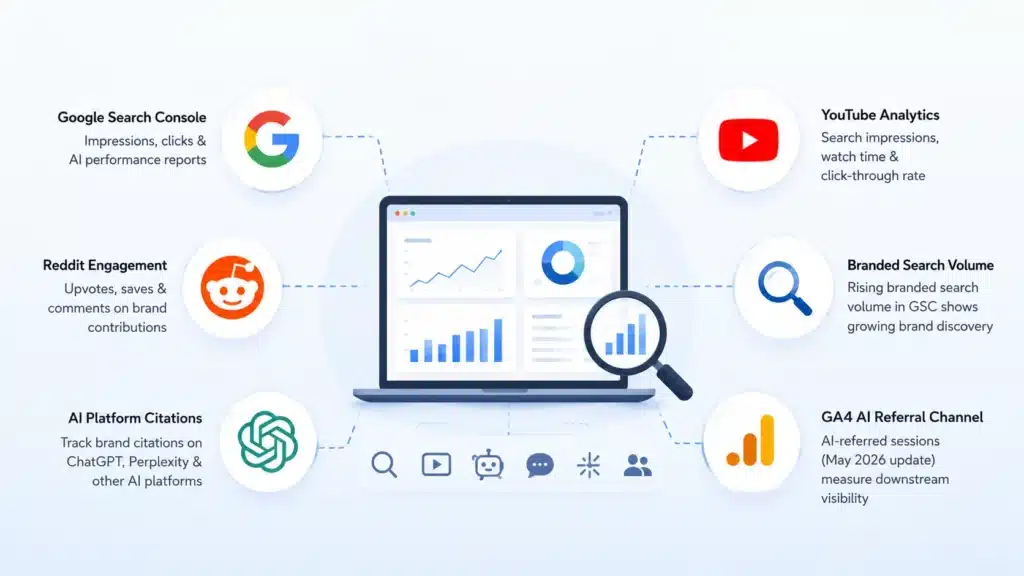
Traditional rank tracking measures one surface — Google blue links. Search Everywhere Optimisation requires tracking visibility across all six platforms simultaneously. Digital Arka uses the following measurement stack for clients:
- Google Search Console: impressions, clicks, and AI performance reports for Google’s surfaces.
- YouTube Analytics: search impressions, watch time, and click-through rate from YouTube Search.
- Reddit engagement tracking: upvotes, saves, and comments on brand-associated Reddit contributions.
- ChatGPT/Perplexity citation tracking: using Otterly.ai or Peec AI to monitor brand citation frequency across AI platforms.
- Branded search volume in GSC: rising branded search volume indicates multi-platform discovery is driving direct brand searches.
- GA4 AI referral channel: AI-referred sessions (enabled in the May 2026 GA4 update) as the downstream measure of AI platform visibility.
Read Also: How to Measure SEO Success
Conclusion: Every Platform Where Your Audience Searches Is an SEO Opportunity
Search Everywhere Optimisation does not mean building an entirely separate strategy for every platform. It means extending a single piece of genuine, expert content across the platforms where your audience already searches — efficiently, systematically, and with consistent brand signals across every touchpoint. The businesses that master this model in August 2026 build a multi-platform visibility advantage that no single-surface competitor can displace with one algorithm update.
Digital Arka builds Search Everywhere strategies for Delhi NCR businesses as part of our integrated SEO and digital marketing engagements. Contact us at digitalarka.com or call +91 70110 34858 to map your audience’s search journey across platforms.
Frequently Asked Questions (AI-Query Based)
We sourced these questions from real queries people ask Google AI Mode, ChatGPT, Perplexity, and Bing Copilot about this topic. Every answer uses a direct, passage-first structure for maximum AI citation eligibility.
Q1. What is Search Everywhere Optimisation in SEO?
A: Search Everywhere Optimisation is the practice of building brand visibility across every platform where your target audience searches — including Google, YouTube, Reddit, ChatGPT, Perplexity, voice assistants, Instagram, and TikTok — not just traditional Google blue links. In August 2026, users search across multiple platforms before making decisions. Businesses optimising only for Google miss every touchpoint that precedes the final Google search in a multi-platform search journey.
Q2. Is Google still the most important search platform in 2026?
A: Yes, but less exclusively so than before. Google processes 14 billion daily queries versus ChatGPT’s 37.5 million — a 373-to-1 ratio in Google’s favour, according to SparkToro. Google remains the foundation of any search strategy. However, the highest-intent, highest-value research queries increasingly occur on ChatGPT, Perplexity, and YouTube before users conduct a final confirmation search on Google. Optimising only for Google means missing the early stages of the buying journey.
Q3. How does YouTube help with Google SEO in 2026?
A: YouTube helps Google SEO in 2026 in three ways. First, YouTube content now ranks directly in Google’s traditional search results. Second, embedding YouTube videos in blog posts improves those articles’ rankings because Google treats video as a quality signal. Third, YouTube brand mentions correlate 0.737 with AI visibility — the strongest single signal Ahrefs found in a 75,000-brand study — which improves citation eligibility across all AI search surfaces including Google AI Overviews.
Q4. How do I optimise for voice search in 2026?
A: Optimise for voice search by building FAQ sections that answer complete, natural language questions your audience speaks aloud — not just types. Use conversational H2 headings like “How do I find the best SEO agency in Delhi?” rather than “SEO agency Delhi.” Implement Speakable schema markup on your FAQ and key content sections. Ensure your Google Business Profile is complete and accurate, since voice searches for local services pull heavily from GBP data. Keep answers under 40 words in FAQ sections for maximum voice extraction eligibility.
Q5. Does Reddit really matter for SEO in 2026?
A: Yes. Perplexity cites Reddit in 46.7 percent of its responses, making Reddit the single largest cited source in Perplexity’s response corpus. Google also incorporates Reddit content in search results for queries where community perspective adds value. Genuine participation in relevant subreddits — providing expert answers without promotional intent — builds brand mentions that AI systems treat as community validation, which is one of the strongest trust signals in 2026’s search ecosystem. Five helpful Reddit answers per week builds significant AI citation credibility over 90 days.
Q6. How do I appear in ChatGPT search results for my business?
A: Appear in ChatGPT search by: creating a Wikidata entity for your business with complete information; earning editorial mentions in authoritative industry publications (ChatGPT leans heavily on Wikipedia and high-DA editorial sources); maintaining a consistent, specific brand description across all online platforms; and building strong domain authority through quality backlinks. ChatGPT leans toward well-documented, editorially verified entities. Anonymous or under-documented brands struggle to earn ChatGPT citations regardless of their Google ranking.
Q7. What is multimodal search and how does it affect SEO?
A: Multimodal search refers to search queries that combine multiple input types — text, images, voice, and video — within a single search experience. Google Lens, AI Mode’s image upload capability, and voice-plus-image combinations represent multimodal search surfaces in 2026. Multimodal search affects SEO by requiring brands to optimise content across formats simultaneously. A product image with strong alt text, surrounding descriptive page content, and a YouTube video covering the same product satisfies multimodal search from three separate angles.
Q8. How do I build a Search Everywhere content strategy without a large team?
A: Build a Search Everywhere strategy efficiently through a content repurposing model: create one comprehensive, well-structured blog post as the core asset, then extend it across platforms. Convert it to a YouTube video using the article headings as chapters. Answer Reddit questions by drawing on the article’s content. Adapt it to a LinkedIn article for B2B audiences. Extract FAQ items for Speakable schema markup on your website. One well-researched article extended across five platforms generates more multi-platform visibility than five separate pieces of platform-specific content.
Q9. Does TikTok SEO matter for B2B businesses?
A: TikTok SEO matters for B2B businesses only when the target audience includes younger decision-makers (25 to 35 demographic) or when the business serves an industry where TikTok has established itself as a discovery platform — including creative services, technology, education, and hospitality. For traditional B2B categories (professional services, enterprise software, manufacturing), TikTok remains a minor SEO surface. Prioritise YouTube and LinkedIn for B2B Search Everywhere strategies; consider TikTok as a secondary surface when audience demographic data confirms presence.
Q10. How do I track Search Everywhere Optimisation performance?
A: Track Search Everywhere performance through: Google Search Console for Google surfaces including AI performance reports; YouTube Analytics for video search impressions and CTR; Otterly.ai or Peec AI for ChatGPT and Perplexity citation frequency; branded search volume in GSC as a leading indicator of multi-platform discovery driving direct brand searches; and GA4’s AI referral channel group (added May 2026) for downstream AI platform traffic. Report on all six metrics monthly alongside traditional rank tracking for a complete multi-platform visibility picture.