

Uncover the hidden engines behind LLM platforms. Discover which search engine powers their insights and how it shapes your AI experience!
Understanding Search Engines: A Brief Overview
Search engines have become an indispensable part of our daily lives, driving the way we access and interact with information on the internet. At their core, search engines are complex systems designed to search for information on the World Wide Web and present it to users in a structured and relevant manner. They function through a combination of algorithms and extensive databases, indexing billions of web pages to provide rapid and accurate search results. The inception of search engines dates back to the early 1990s, and since then, they have evolved dramatically in terms of functionality, efficiency, and intelligence.
In the early days, search engines relied on basic keyword matching techniques to fetch results. However, as the volume of online content grew exponentially, these methods proved inadequate. This led to the development of more sophisticated algorithms that could understand context, user intent, and the relevance of content. Modern search engines utilize advanced technologies like natural language processing (NLP), machine learning, and artificial intelligence (AI) to deliver more precise and context-aware results. They continuously update their algorithms to cope with the ever-changing landscape of the web and to thwart attempts at manipulating search rankings.
Understanding the intricacies of search engines is crucial for appreciating their role in powering Language Learning Models (LLMs). These engines not only index and retrieve information but also rank it based on complex criteria, including relevance, credibility, and user engagement. This ranking process is pivotal for LLM platforms, as it ensures that the insights drawn from search results are both accurate and valuable. Without robust search engines, LLMs would struggle to provide meaningful and contextually appropriate responses, underscoring the importance of these powerful tools in AI applications.
The Role of Search Engines in LLM Platforms
Language Learning Models (LLMs) rely heavily on search engines to augment their capabilities and provide accurate, real-time information. These models, which include popular AI systems like GPT-3, BERT, and others, are designed to understand and generate human-like text based on vast datasets. However, their effectiveness is significantly enhanced when they can access and analyze up-to-date information from the web. This is where search engines come into play, serving as the primary source of fresh data and insights that LLMs use to refine their responses and improve their overall performance.
Search engines assist LLMs by providing access to a constantly updated repository of information. This dynamic access is crucial because it allows LLMs to stay current with the latest facts, trends, and developments across various domains. Whether it’s answering a question about the latest scientific research, providing insights into current events, or offering recommendations based on recent user reviews, the ability to pull in fresh data ensures that LLMs remain relevant and accurate. Moreover, search engines help LLMs by filtering out irrelevant or low-quality information, ensuring that the data used for generating insights is reliable and trustworthy.
Another critical role of search engines in LLM platforms is enhancing the contextual understanding of queries. Search engines use sophisticated algorithms to interpret the intent behind user queries and fetch the most relevant results. This capability is transferred to LLMs, enabling them to generate responses that are not only accurate but also contextually appropriate. For instance, when a user asks an LLM about the “best programming languages,” the search engine can help the model understand whether the user is interested in learning, job prospects, or performance. As a result, the LLM can tailor its response to address the specific context, providing a more useful and personalized answer.
Read More– llms.txt vs. llms-full.txt
Key Features of Search Engines Used by LLMs
The search engines utilized by Language Learning Models (LLMs) come equipped with a range of advanced features that enhance their functionality and effectiveness. One of the most crucial features is natural language processing (NLP). NLP enables search engines to understand, interpret, and generate human language in a way that is both meaningful and useful. This capability allows the search engine to accurately parse user queries, understand the context, and retrieve information that aligns closely with the user’s intent. For LLMs, this means more accurate and relevant insights, improving the quality of responses generated.
Another essential feature is machine learning and AI-driven algorithms. These algorithms are designed to continuously learn and improve from the data they process. By analyzing user behavior, search patterns, and feedback, search engines can refine their algorithms to deliver more accurate and relevant results over time. This adaptive learning process is particularly beneficial for LLMs, as it ensures that the insights drawn from search engines are based on the latest data and trends. Additionally, AI-driven algorithms can identify and prioritize high-quality sources, filtering out spammy or misleading content that could otherwise degrade the quality of LLM outputs.
Real-time data processing and indexing is another key feature of search engines used by LLMs. The ability to quickly index new information ensures that the search engine’s database is always up-to-date. This real-time capability is critical for LLM platforms that rely on current data to provide accurate and timely responses. For example, in the context of news and current events, having access to the latest information can significantly enhance the relevance and accuracy of an LLM’s output. Furthermore, real-time indexing allows LLMs to tap into emerging trends and developments, providing users with the most current insights available.
Popular Search Engines for LLM Insights
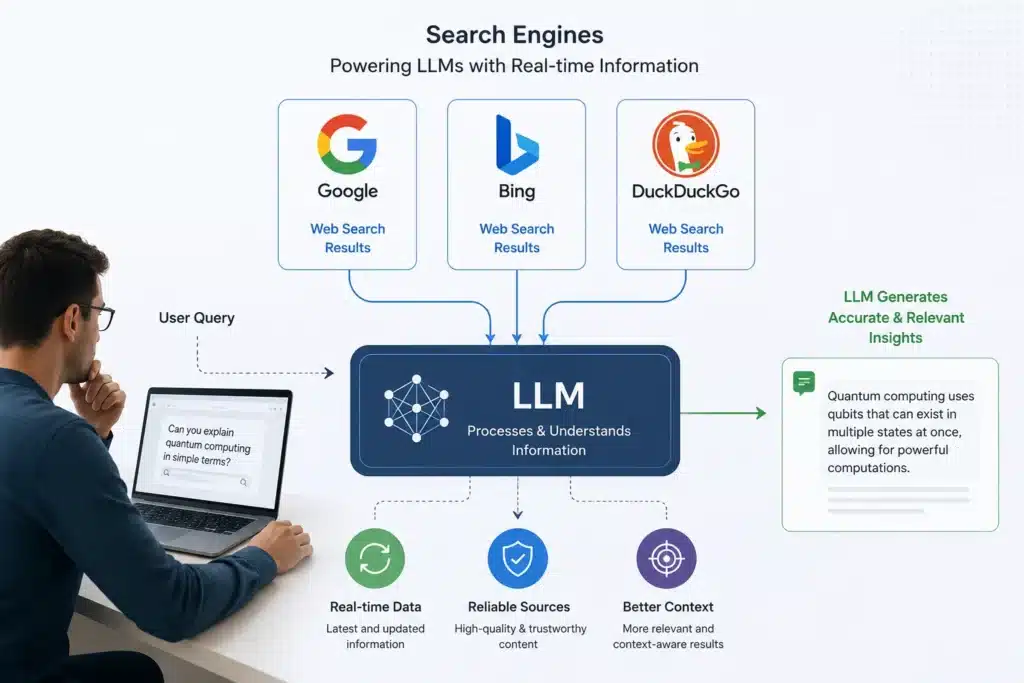
Several search engines have gained prominence for their effectiveness in powering Language Learning Models (LLMs). Google Search, for instance, is one of the most widely used search engines, known for its comprehensive indexing and sophisticated algorithms. Its ability to process vast amounts of data and deliver highly relevant results makes it a valuable resource for LLM platforms. Google’s advanced NLP capabilities and continuous algorithm updates ensure that the information retrieved is both accurate and current, enhancing the overall performance of LLMs that rely on its insights.
Microsoft’s Bing is another popular search engine utilized by LLM platforms. Bing offers a robust set of features, including advanced AI-driven algorithms and extensive indexing capabilities. It provides high-quality search results that are often on par with those of Google, making it a reliable alternative for LLMs. Bing’s ability to integrate with other Microsoft services, such as Azure and Office 365, further enhances its utility in LLM applications. This integration allows for a seamless flow of information and insights across different platforms, improving the efficiency and accuracy of LLM outputs.
DuckDuckGo is also gaining traction as a search engine for LLM insights, particularly for users who prioritize privacy. Unlike Google and Bing, DuckDuckGo does not track user activity, making it a preferred choice for privacy-conscious individuals and organizations. Despite its focus on privacy, DuckDuckGo delivers relevant and accurate search results, thanks to its use of various sources and algorithms. Its commitment to user privacy does not compromise the quality of information, making it a valuable resource for LLM platforms that need to ensure user data confidentiality while still accessing reliable insights.
Comparing Search Engine Algorithms: What Matters?
When evaluating search engines for their effectiveness in powering Language Learning Models (LLMs), several algorithmic factors come into play. One of the most critical aspects is relevance scoring. Relevance scoring determines how well a search result matches the user’s query, taking into account various factors such as keyword presence, context, and user intent. Search engines like Google and Bing use complex algorithms to calculate relevance scores, ensuring that the most pertinent information appears at the top of search results. For LLMs, high relevance scores mean more accurate and contextually appropriate insights, which are crucial for generating meaningful outputs.
Another important factor is the speed and efficiency of indexing. The ability of a search engine to quickly index new content ensures that its database is always up-to-date. This real-time indexing capability is essential for LLMs that rely on the most current information to provide accurate responses. Search engines that excel in this area can offer LLM platforms a significant advantage by ensuring that the insights drawn are based on the latest data and trends. Additionally, efficient indexing helps in reducing latency, enabling LLMs to deliver faster and more responsive outputs.
Algorithm transparency and fairness are also critical considerations. Search engines must avoid biases that could skew search results and compromise the quality of insights. Algorithm transparency involves providing clear information about how search results are ranked and what factors influence those rankings. This transparency is essential for LLM platforms to understand the strengths and limitations of the insights they are using. Fairness ensures that the search engine does not favor certain types of content or sources unduly, providing a balanced view of information. For LLMs, unbiased and transparent algorithms contribute to more reliable and equitable outputs.
Read More– Google Algorithms
Case Studies: Successful LLM Platforms and Their Search Engines
One notable case study is OpenAI’s GPT-3, which leverages multiple search engines to enhance its capabilities. GPT-3 is renowned for its ability to generate human-like text, and part of its success can be attributed to the diverse range of search engines it utilizes. By integrating insights from Google Search, Bing, and other specialized engines, GPT-3 can access a broad spectrum of information. This multi-source approach ensures that the model’s responses are comprehensive and well-rounded, drawing from the strengths of different search engines to provide the most accurate and relevant insights.
Another successful example is IBM’s Watson, which uses a combination of proprietary search algorithms and external search engines to power its insights. Watson’s ability to process and analyze large volumes of data in real-time is enhanced by its integration with search engines like Google and Bing. This integration allows Watson to stay current with the latest developments across various fields, from healthcare to finance. The use of advanced search algorithms ensures that the information retrieved is both high-quality and contextually appropriate, making Watson a reliable tool for businesses and organizations seeking actionable insights.
Microsoft’s Azure Cognitive Services also provides a compelling case study. Azure integrates Bing’s search capabilities to enhance its AI and machine learning services. This integration allows Azure to offer powerful LLM functionalities, including text generation, sentiment analysis, and language translation. By leveraging Bing’s advanced search algorithms and vast indexing capabilities, Azure Cognitive Services can provide accurate and real-time insights that improve the performance of its LLM applications. This synergy between Azure and Bing demonstrates how effective search engine integration can elevate the capabilities of LLM platforms.
Future Trends in Search Engines for LLM Applications
As technology continues to evolve, several emerging trends are poised to shape the future of search engines in Language Learning Model (LLM) applications. One significant trend is the increasing use of artificial intelligence (AI) and machine learning (ML) to enhance search algorithms. These technologies enable search engines to better understand user intent, context, and nuances in language, leading to more accurate and relevant search results. For LLMs, this means even more precise insights, allowing for the generation of highly contextual and accurate responses.
Another trend is the growing importance of real-time data processing and predictive analytics. Future search engines will likely place a greater emphasis on real-time indexing and the ability to predict user needs based on historical data and patterns. This capability will be particularly valuable for LLMs, which rely on the most current information to generate accurate outputs. Predictive analytics can help LLMs anticipate user queries and provide proactive insights, enhancing the overall user experience and making interactions more seamless and intuitive.
Privacy and data security are also emerging as critical considerations for the future of search engines in LLM applications. As concerns about data privacy continue to rise, search engines will need to implement more robust security measures to protect user information. This trend is especially relevant for LLM platforms that handle sensitive data and need to ensure compliance with privacy regulations. Enhanced privacy features, such as anonymized search results and secure data processing, will become increasingly important, providing users with greater confidence in the security of their interactions with LLMs.
Best Practices for Leveraging Search Engine Insights in LLMs
To maximize the effectiveness of search engine insights in Language Learning Models (LLMs), several best practices should be followed. Firstly, it’s essential to use multiple search engines to gather a diverse range of information. Relying on a single search engine can limit the breadth and depth of insights available. By integrating data from various sources, LLMs can provide more comprehensive and well-rounded responses. This multi-source approach helps to mitigate the biases and limitations inherent in any single search engine, ensuring a more balanced and accurate output.
Another best practice is to continuously update and refine the algorithms used to process search engine data. Search engines are constantly evolving, and so should the methods used to integrate their insights into LLMs. Regular updates ensure that the LLMs are leveraging the latest advancements in search engine technology, including improvements in natural language processing, relevance scoring, and indexing. Continuous refinement of algorithms also helps to address any emerging issues or biases, maintaining the quality and reliability of the LLM outputs.
It’s also crucial to implement robust data validation and quality control measures. Not all information retrieved from search engines is accurate or reliable, so it’s important to have mechanisms in place to verify the quality of the data. This can include cross-referencing information from multiple sources, using trusted and reputable databases, and employing AI-driven validation techniques. Ensuring the accuracy and reliability of the data used by LLMs is paramount for generating trustworthy and meaningful insights.
Conclusion: The Future of LLMs and Search Engine Integration
The integration of search engines with Language Learning Models (LLMs) is poised to revolutionize the way we interact with AI systems. As search engines continue to advance in terms of AI, machine learning, and natural language processing, their ability to provide accurate, relevant, and real-time information will only improve. This, in turn, will enhance the capabilities of LLMs, allowing them to generate even more precise and contextually appropriate responses. The synergy between search engines and LLMs holds immense potential for various applications, from customer service and healthcare to education and entertainment.
Looking ahead, the focus will likely shift towards more personalized and secure search engine integrations. As user expectations for privacy and customization grow, search engines will need to adapt by offering more robust privacy features and personalized search experiences. For LLM platforms, this means adopting best practices that prioritize user data security while still leveraging the full potential of search engine insights. The future will also see greater emphasis on real-time data processing and predictive analytics, enabling LLMs to provide proactive and anticipatory insights.
In conclusion, the integration of search engines and LLMs is a dynamic and evolving field with tremendous potential. By understanding the key features, popular search engines, and best practices for leveraging their insights, we can unlock new levels of efficiency and accuracy in AI applications. As technology continues to advance, the collaboration between search engines and LLMs will undoubtedly lead to more intelligent, responsive, and user-centric AI systems, shaping the future of human-computer interactions.