Unlocking Success: A Comprehensive Guide to Mastering Search Engine Marketing
In today’s digital landscape, mastering search engine marketing (SEM) is no longer just an option—it’s a necessity for businesses seeking to thrive and grow. With shifting algorithms and increasing competition, navigating the SEM terrain can feel overwhelming. However, unlocking success is entirely within reach when you equip yourself with the right knowledge and strategies. This comprehensive guide will walk you through the essential elements of SEM, from crafting compelling ad campaigns to understanding keyword tactics and optimizing your budget. Whether you’re a seasoned marketer or just starting out, prepare to dive into actionable insights that will elevate your marketing efforts and drive measurable results. Join us as we explore the dynamic world of search engine marketing, providing you with the tools to transform your digital presence and connect with your audience like never before. Your path to SEM mastery starts here.
Understanding Search Engine Marketing (SEM)
Search Engine Marketing (SEM) is a powerful digital marketing strategy designed to increase a website’s visibility in search engine results pages (SERPs). Unlike traditional advertising, SEM leverages the power of search engines to target users who are actively seeking information related to a business’s products or services. This form of marketing can be incredibly effective because it reaches potential customers at the precise moment they are searching for relevant content. SEM encompasses a variety of techniques, including both paid advertising and search engine optimization (SEO), to drive targeted traffic to a website.
One of the key components of SEM is the use of paid search advertising, commonly known as Pay-Per-Click (PPC) advertising. In a PPC campaign, advertisers bid on specific keywords that are relevant to their business, and their ads appear in the sponsored section of the search results when users search for those keywords. This model ensures that businesses only pay when someone clicks on their ad, making it a cost-effective way to attract potential customers. PPC ads can be highly targeted based on factors such as location, time of day, and user demographics, making them a versatile tool for businesses of all sizes.
In addition to PPC, SEM also involves optimizing a website’s content and structure to improve its organic search rankings. This process, known as search engine optimization (SEO), focuses on making a website more attractive to search engines through the use of relevant keywords, high-quality content, and technical enhancements. By combining PPC and SEO strategies, businesses can create a comprehensive SEM plan that maximizes their online visibility and drives consistent, high-quality traffic to their website.
The Importance of SEM in Digital Marketing
The significance of SEM in the digital marketing landscape cannot be overstated. With billions of searches conducted daily on platforms like Google, Bing, and Yahoo, search engines have become the primary way people find information online. For businesses, this means that having a strong presence in search engine results is crucial for reaching potential customers and driving sales. SEM enables businesses to tap into this vast pool of search traffic, ensuring that their products and services are visible to people who are actively looking for what they offer.
One of the primary advantages of SEM is its ability to deliver immediate results. Unlike SEO, which can take months to show significant improvements, PPC campaigns can generate traffic almost instantly. This makes SEM an ideal strategy for businesses looking to quickly increase their online visibility, launch new products, or promote time-sensitive offers. Additionally, the data generated from SEM campaigns provides valuable insights into customer behavior and preferences, allowing businesses to refine their marketing strategies and improve their overall effectiveness.
Moreover, SEM offers a high level of flexibility and control. Advertisers can adjust their budgets, target specific keywords, and modify their ad copy in real-time to respond to changing market conditions and customer needs. This level of control ensures that businesses can optimize their campaigns for maximum return on investment (ROI). In an increasingly competitive digital landscape, the ability to adapt and respond quickly is essential for maintaining a competitive edge.
Key Components of SEM: PPC and SEO
Search Engine Marketing is built on two fundamental pillars: Pay-Per-Click (PPC) advertising and Search Engine Optimization (SEO). Both components play a crucial role in driving traffic to a website, but they operate in different ways and offer unique benefits. Understanding how to effectively leverage both PPC and SEO is key to creating a successful SEM strategy.
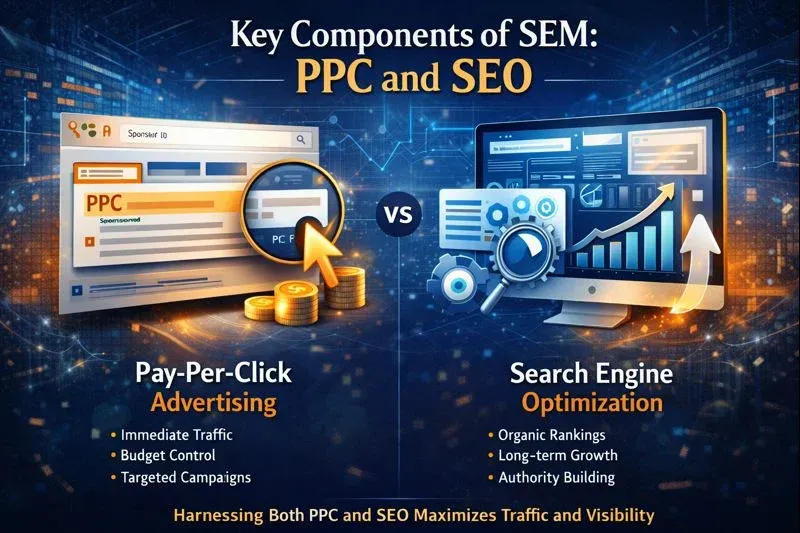
PPC advertising involves bidding on keywords to display ads in the sponsored sections of search engine results. These ads appear above or alongside the organic search results, making them highly visible to users. The primary advantage of PPC is that it provides immediate visibility for targeted keywords, driving instant traffic to the advertiser’s website. Advertisers only pay when someone clicks on their ad, ensuring that the budget is spent on attracting actual visitors. PPC campaigns can be highly targeted, allowing businesses to reach specific audiences based on factors such as location, device, and search intent.
On the other hand, SEO focuses on improving a website’s organic search rankings through a combination of on-page and off-page optimization techniques. On-page SEO involves optimizing the website’s content, meta tags, and internal linking structure to make it more relevant to search engines. Off-page SEO includes building high-quality backlinks from other reputable websites, which signals to search engines that the website is authoritative and trustworthy. While SEO takes longer to show results compared to PPC, it provides long-term benefits by increasing the website’s organic visibility and attracting consistent traffic over time.
Combining PPC and SEO allows businesses to maximize their search engine visibility and reach their target audience more effectively. PPC can provide immediate traffic and quick wins, while SEO builds a strong foundation for sustainable, long-term growth. By integrating both components into a cohesive SEM strategy, businesses can achieve a balanced approach that delivers both short-term results and long-term success.
Keyword Research: The Foundation of SEM
Keyword research is the cornerstone of any successful SEM campaign. It involves identifying the words and phrases that potential customers use when searching for products or services related to a business. By targeting these keywords, businesses can ensure that their ads and content appear in front of the right audience at the right time. Effective keyword research requires a deep understanding of the target audience, their search behavior, and the competitive landscape.
The first step in keyword research is to brainstorm a list of potential keywords that are relevant to the business. This can be done by considering the products or services offered, the problems they solve, and the language that customers use when discussing them. Tools like Google Keyword Planner, SEMrush, and Ahrefs can provide valuable insights into search volume, competition, and related keywords. It’s important to consider both short-tail keywords (e.g., “shoes”) and long-tail keywords (e.g., “best running shoes for flat feet”), as long-tail keywords often have lower competition and higher conversion rates.
Once a list of potential keywords is generated, the next step is to analyze their relevance and competitiveness. High search volume keywords can drive significant traffic, but they are often highly competitive and expensive to bid on. On the other hand, low search volume keywords may not drive as much traffic, but they can be more cost-effective and easier to rank for. Balancing these factors is crucial for creating an effective keyword strategy. Additionally, it’s important to consider the intent behind each keyword—whether users are looking for information, ready to make a purchase, or seeking a specific solution.
Effective keyword research is an ongoing process that requires continuous monitoring and optimization. As search trends and customer behavior evolve, businesses must regularly update their keyword strategy to stay relevant and competitive. By investing time and effort into comprehensive keyword research, businesses can lay a solid foundation for their SEM campaigns and achieve better results.
Crafting Effective Ad Campaigns
Creating compelling ad campaigns is essential for capturing the attention of potential customers and driving clicks. A successful ad campaign starts with well-crafted ad copy that clearly communicates the value proposition and includes a strong call-to-action (CTA). The ad copy should be concise, relevant, and aligned with the targeted keywords. Using action-oriented language and addressing the user’s needs can significantly improve the ad’s effectiveness.
In addition to the ad copy, the visual elements of the ad play a crucial role in attracting attention. High-quality images or videos that resonate with the target audience can enhance the ad’s appeal and increase engagement. It’s important to ensure that the visuals are relevant to the product or service being advertised and that they complement the ad copy. Consistency in branding and messaging across all ad elements helps create a cohesive and professional appearance.
Ad targeting is another critical aspect of crafting effective ad campaigns. Platforms like Google Ads and Bing Ads offer advanced targeting options that allow advertisers to reach specific audiences based on factors such as demographics, location, device, and search intent. By leveraging these targeting options, businesses can ensure that their ads are seen by the most relevant audience, increasing the likelihood of conversions. A/B testing different ad variations and targeting settings can help identify the most effective combinations and optimize campaign performance.
Finally, monitoring and optimizing ad campaigns is essential for maintaining their effectiveness. Regularly reviewing key metrics such as click-through rates (CTR), conversion rates, and cost-per-click (CPC) provides valuable insights into the campaign’s performance. Based on these insights, businesses can make data-driven adjustments to their ad copy, visuals, targeting, and budget to maximize ROI. Continuously refining and optimizing ad campaigns ensures that they remain competitive and deliver the best possible results.
Optimizing Landing Pages for Better Conversions
Driving traffic to a website is only half the battle; converting that traffic into leads or customers is the ultimate goal. Optimizing landing pages is crucial for improving conversion rates and maximizing the effectiveness of SEM campaigns. A well-optimized landing page provides a seamless user experience, clearly communicates the value proposition, and includes compelling calls-to-action that guide visitors towards the desired action.
The first step in optimizing landing pages is to ensure that they are highly relevant to the ad that drives traffic to them. Consistency between the ad copy and the landing page content is essential for maintaining user trust and engagement. The landing page should deliver on the promise made in the ad, whether it’s providing more information, offering a special deal, or facilitating a purchase. Clear and concise headlines, along with engaging and informative content, help capture the visitor’s attention and keep them on the page.
Design and layout play a significant role in the effectiveness of a landing page. A clean and visually appealing design that highlights the key elements and minimizes distractions can significantly improve user experience. The use of high-quality images, videos, and graphics can enhance the page’s appeal and convey the value proposition more effectively. It’s important to ensure that the landing page is mobile-friendly and loads quickly, as slow loading times and poor mobile experience can lead to high bounce rates.
Calls-to-action (CTAs) are critical for guiding visitors towards the desired action, whether it’s filling out a form, making a purchase, or signing up for a newsletter. CTAs should be prominently placed, visually distinct, and use action-oriented language that encourages users to take the next step. Offering incentives such as discounts, free trials, or exclusive content can further motivate visitors to convert. A/B testing different CTA variations, headlines, and layouts can help identify the most effective elements and optimize the landing page for better conversions.
Measuring SEM Success: Metrics and Analytics
Measuring the success of SEM campaigns is essential for understanding their effectiveness and making data-driven decisions. Key performance indicators (KPIs) and analytics provide valuable insights into how well the campaigns are performing and where improvements can be made. By tracking and analyzing these metrics, businesses can optimize their SEM strategies for better results and higher ROI.
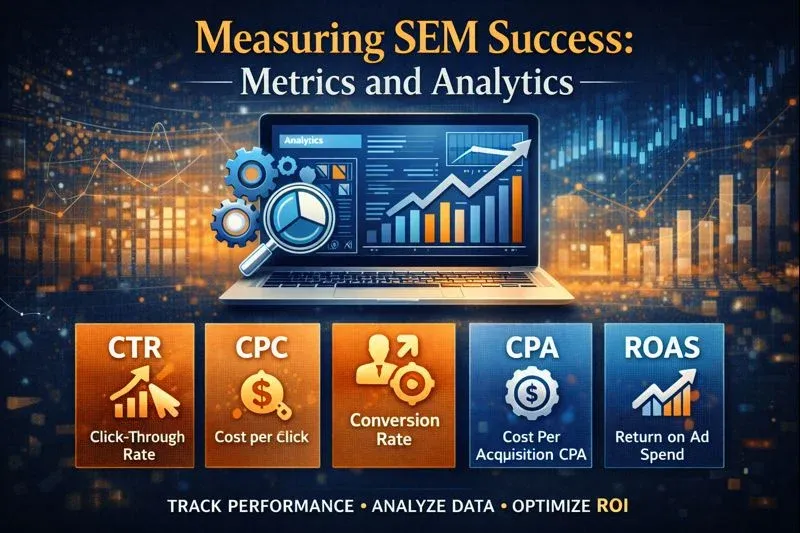
One of the primary metrics to monitor in SEM campaigns is the click-through rate (CTR), which measures the percentage of users who click on an ad after seeing it. A high CTR indicates that the ad is relevant and engaging to the target audience. However, CTR alone does not provide a complete picture of campaign performance. It’s important to also track conversion rates, which measure the percentage of visitors who complete the desired action, such as making a purchase or filling out a form. A high conversion rate indicates that the landing page and overall user experience are effective in driving conversions.
Cost-related metrics, such as cost-per-click (CPC) and cost-per-acquisition (CPA), are also crucial for evaluating the efficiency of SEM campaigns. CPC measures the average cost of each click on the ad, while CPA measures the cost of acquiring a new customer or lead. Keeping these costs within a reasonable range is important for maintaining a positive ROI. Additionally, tracking the return on ad spend (ROAS) helps businesses understand the revenue generated from their SEM investments and identify the most profitable campaigns.
Analytics tools like Google Analytics and the built-in analytics provided by ad platforms offer detailed insights into user behavior, traffic sources, and campaign performance. These tools allow businesses to segment data by various dimensions, such as keyword, ad group, device, and location, to gain a deeper understanding of what is driving results. Regularly reviewing and analyzing this data enables businesses to identify trends, uncover opportunities for optimization, and make informed decisions to improve their SEM strategies.
Common SEM Mistakes to Avoid
While SEM can be highly effective, there are several common mistakes that can hinder the success of campaigns. Avoiding these pitfalls is essential for maximizing the effectiveness and ROI of SEM efforts. One of the most common mistakes is neglecting keyword research. Without thorough keyword research, businesses may target the wrong keywords, leading to low-quality traffic and poor conversion rates. It’s important to invest time in identifying the most relevant and valuable keywords for the target audience.
Another common mistake is failing to optimize ad copy and landing pages. Ads that are not compelling or do not clearly communicate the value proposition are less likely to attract clicks. Similarly, landing pages that are not relevant to the ad or provide a poor user experience can result in high bounce rates and low conversion rates. Ensuring consistency between ad copy and landing page content, as well as optimizing the design and layout of landing pages, is crucial for driving conversions.
Overlooking the importance of tracking and analytics is another mistake that can negatively impact SEM campaigns. Without monitoring key metrics and analyzing campaign performance, businesses cannot identify what is working and what needs improvement. Regularly reviewing data and making data-driven adjustments is essential for optimizing campaigns and achieving better results. Additionally, failing to set clear goals and KPIs can make it difficult to measure success and track progress.
Finally, ignoring the competitive landscape is a mistake that can lead to missed opportunities and wasted budget. Understanding what competitors are doing, including their keyword strategies, ad copy, and bidding tactics, can provide valuable insights and help businesses stay competitive. Regularly conducting competitive analysis and adjusting strategies based on market conditions is essential for maintaining a strong SEM presence.
Future Trends in Search Engine Marketing
As the digital landscape continues to evolve, several emerging trends are shaping the future of search engine marketing. Staying ahead of these trends is essential for maintaining a competitive edge and maximizing the effectiveness of SEM efforts. One of the key trends is the increasing importance of voice search. With the rise of smart speakers and voice-activated assistants, more users are conducting searches using natural language and conversational queries. Optimizing for voice search involves targeting long-tail keywords and creating content that answers specific questions in a natural and conversational tone.
Another significant trend is the growing emphasis on user experience (UX) and page speed. Search engines, particularly Google, are placing greater importance on providing a positive user experience, including fast-loading pages and mobile-friendly designs. Websites that offer a seamless and engaging user experience are more likely to rank higher in search results and drive better engagement. Investing in UX and technical optimization is becoming increasingly important for achieving and maintaining strong search engine visibility.
Artificial intelligence (AI) and machine learning are also playing a growing role in SEM. AI-powered tools and algorithms are being used to analyze vast amounts of data, identify patterns, and optimize campaigns in real-time. From automated bidding strategies to personalized ad targeting, AI is enabling businesses to create more efficient and effective SEM campaigns. Leveraging AI and machine learning technologies can help businesses stay competitive and achieve better results with less manual effort.
Finally, the integration of SEM with other digital marketing channels, such as social media and content marketing, is becoming more important. A holistic approach that combines SEM with other channels can create a more cohesive and impactful marketing strategy. For example, using SEM to drive traffic to high-quality content on a website can enhance both SEO and social media engagement. By integrating SEM with other marketing efforts, businesses can create a more comprehensive and effective approach to reaching their target audience.
Conclusion and Next Steps for SEM Mastery
Mastering search engine marketing is a continuous process that requires a deep understanding of both the fundamentals and the evolving trends in the digital landscape. By focusing on the key components of SEM—PPC and SEO—businesses can create a strong foundation for their marketing efforts. Effective keyword research, compelling ad campaigns, optimized landing pages, and data-driven analytics are essential for driving traffic and conversions.
Avoiding common mistakes and staying ahead of emerging trends is crucial for maintaining a competitive edge. As voice search, user experience, AI, and integrated marketing strategies continue to shape the future of SEM, businesses must adapt and innovate to stay relevant and effective. Investing in ongoing learning, staying updated with industry developments, and continuously optimizing campaigns are essential steps for achieving SEM mastery.
Whether you’re a seasoned marketer or just starting out, the journey to SEM success is an ongoing process of learning, experimenting, and refining strategies. By equipping yourself with the right knowledge and tools, you can transform your digital presence, connect with your audience, and drive measurable results. Your path to SEM mastery starts here—embrace the dynamic world of search engine marketing and unlock the potential for growth and success.
Contact Us
Read More Related Articles