5 YouTube SEO “Truths” That Are Actually Hurting Your Channel
You’ve done everything right. You spent days scripting, shooting, and editing a high-quality video. You crafted the perfect thumbnail, uploaded it to your channel, and waited for the views to pour in. And then… nothing. A handful of views, a few likes, but the viral success you hoped for feels miles away. It’s a frustratingly common story for countless creators, and it leads to one burning question: “What am I doing wrong?”
The problem might not be your content. More often than not, the issue lies in a fundamental misunderstanding of how YouTube’s algorithm actually works. The internet is flooded with “best practices” for YouTube SEO that are outdated, misleading, or just plain wrong. Following this advice can feel like you’re spinning your wheels, focusing on trivial details while ignoring the factors that truly move the needle.
This article cuts through the noise. We’re going to debunk five of the most pervasive YouTube SEO myths and replace them with practical, data-backed strategies that align with what YouTube
actually wants. Prepare to shift your focus from chasing algorithm hacks to building a genuinely successful channel.
1. You’re Obsessing Over Video Tags, But YouTube Isn’t
For years, the conventional wisdom was to stuff the tags section with dozens of keywords. Creators would spend hours trying to find the perfect combination of broad and long-tail tags, believing it was the key to unlocking search visibility. The reality is, that era is long over.
YouTube has explicitly stated that tags now play a very small role in video discovery. While they aren’t completely useless, their importance has been drastically reduced. In an official YouTube Help document, they state:
“Tags can be useful if the content of your video is commonly misspelled. Otherwise, tags play a minimal role in your video’s discovery.”
So, what are tags actually for in the modern YouTube ecosystem? Their primary function now is to help YouTube categorize your video and place it in the “related videos” sidebar. When the tags on your video match the tags of a video someone is currently watching, it increases the chance that your content will be recommended next.
The takeaway is simple: stop wasting time agonizing over tags. Add your main keyword, a few relevant variations, and maybe even a key competitor’s channel name to increase the chances of appearing as a suggested video after their content. Then, move on. Your time is far better spent on the factors that carry real weight.
2. Your Favorite SEO Tools Are Just Making Educated Guesses
Tools like TubeBuddy and vidIQ are staples for many creators, offering keyword scores that promise to reveal the “perfect” low-competition, high-volume search terms. While these tools can be helpful for brainstorming and spotting trends, their scores should not be treated as absolute, scientific truth.
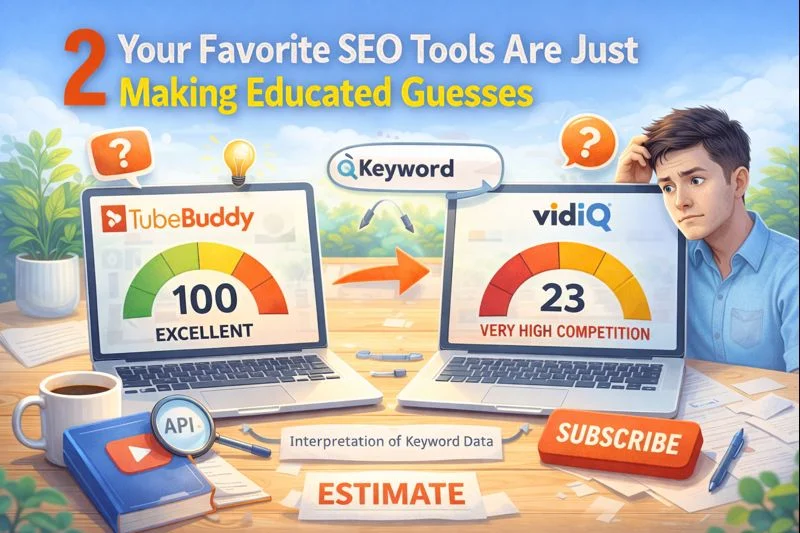
Consider this common scenario described by a user on Reddit: for the exact same keyword, TubeBuddy returned a score of “100/Excellent” with “no competition,” while vidIQ flagged it as having “very high competition.” How can two leading tools provide completely contradictory data?
A TubeBuddy employee explained that both tools access the same data from YouTube’s API, but they interpret that data using their own separate, proprietary algorithms. The scores are not a direct report from YouTube; they are an estimate. Furthermore, these scores are highly volatile and can change based on your specific channel’s authority in a niche and even your personal watch history. The results you see will be different from the results another creator sees.
The value of these tools isn’t in finding a magic keyword with a perfect score. Instead, use them to get a general sense of what people are searching for and to gather a list of potential topics. They are a starting point for research, not the final word on what video you should make.
3. YouTube Doesn’t Care About Your Video; It Cares About the Viewer’s Session
This is perhaps the most critical mindset shift a creator can make. For years, “watch time”—the total minutes people spent watching a single video—was seen as the ultimate ranking factor. While important, it’s only half the story. The metric that truly matters to YouTube is
session duration.
Remember, YouTube is an advertising platform. Its number one goal is to keep users on the site for as long as possible so they can be served more ads. Since a 2012 algorithm update, YouTube has prioritized videos that contribute to longer overall viewing sessions.
This means if a viewer watches your video and then immediately leaves YouTube, your video is seen as a “dead end,” which hurts its ranking. Conversely, if your video inspires a viewer to watch another video—even if it’s from a competing channel—YouTube sees this as a positive signal. Your video successfully extended a user’s session, and the algorithm will reward you for it by promoting your content more widely.
To put this into practice, stop thinking of videos as standalone assets. Instead, build pathways for your viewers:
- Create video series on a single topic.
- Use end screens and cards to link directly to other relevant videos on your channel.
- Curate playlists that group related content together, encouraging binge-watching.
4. Your Description Is a Mini-Blog Post (And It’s Crucial)
Of all the metadata fields, the video description is the most powerful and tragically underutilized SEO tool at your disposal—far more impactful than tags. Many creators simply write a single sentence and a few links, missing a massive opportunity to give YouTube and Google crucial context about their video’s content.
Treat your description like a mini-blog post. Aim for a detailed summary of at least 300 words. Sources like WireBuzz recommend as many as 500 words to give the algorithm a rich set of contextual keywords. This text-based content is what the algorithm primarily uses to understand what your video is about and who it should be shown to.
For a killer description that maximizes your SEO, follow this structure:
- Lines 1-2 (The Hook): Write a compelling, one-to-two-sentence summary of the video. Crucially, place your main target keyword within the first 150 characters, as this is what Google often uses for the search snippet.
- Line 3 (The Call-to-Action): Place your most important link here, whether it’s to a product, a lead magnet, or a related resource on your website.
- Body (The “Blog Post”): Write a 300-500 word overview of the video’s topic. Discuss the main points, answer key questions, and naturally weave in your target keywords and related phrases.
- Extras (The Value-Adds): Use timestamps to create video chapters, making your video easier to navigate. Add links to any sources or tools you mentioned.
5. Your Script Is Your Most Powerful, Hidden SEO Tool
What you say in your video is just as important as what you write in your description. YouTube automatically transcribes the audio of every video it processes to further understand its content. This means your script itself is a powerful SEO asset.
To leverage this, you must clearly and verbally state your target keywords and related phrases throughout your video. If the algorithm can “hear” you talking about your topic, it becomes another strong signal of relevance. However, relying solely on YouTube’s automatic transcription can be risky. As anyone who has used the feature knows, it can be wildly inaccurate, turning a clear sentence into garbled nonsense.
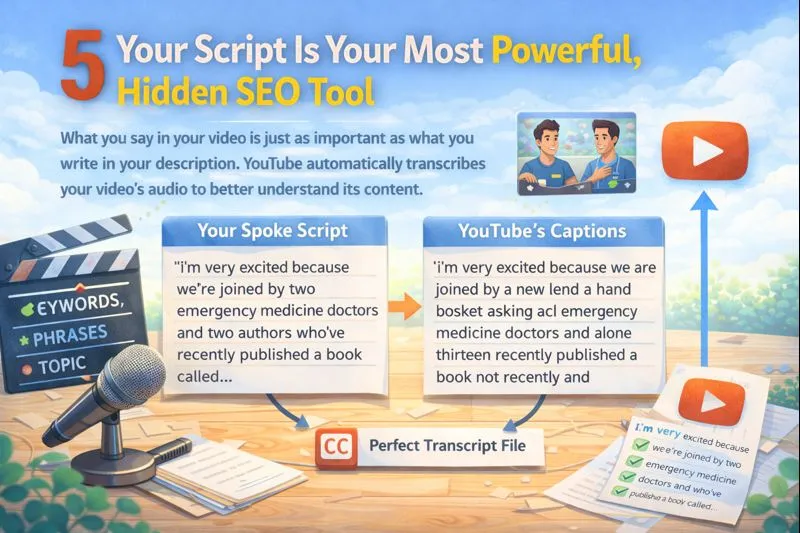
Consider this real-world example of just how wrong it can go:
What the Video Actually Said: “I’m very excited because we’re joined by two emergency medicine doctors and two authors who’ve recently published a book called…”
What YouTube’s Automatic Captions Heard: “i’m very excited because we are joined by a new lend a hand basket asking acl emergency medicine doctors and alone thirteen recently published a book not recently and”
This is why uploading a clean, corrected transcription file via the closed captions (CC) system is one of the simplest and most effective SEO tactics you can employ. By providing a perfect transcript, you remove all ambiguity and ensure YouTube’s algorithm knows
exactly what your video is about, down to the last keyword. This small step gives you a significant advantage over creators who rely on the flawed automatic system.
Conclusion: Stop Chasing Scores, Start Serving Viewers
The underlying theme of modern YouTube SEO is a shift away from technical hacks and toward a holistic, viewer-centric strategy. Success is no longer found by stuffing tags or obsessing over keyword scores. It’s found by creating content that genuinely serves an audience and keeps them engaged on the platform.
Your goal is to provide context through rich descriptions and accurate transcripts, and to create viewing pathways with playlists and end screens. Good SEO will help your video get discovered initially, but it’s only high-quality, engaging content that will make it rank in the long run.
As you plan your next video, challenge yourself to think differently. Instead of asking, “What keywords can I rank for?” what if you started asking, “What video can I create that my audience will watch to the end… and then immediately want to watch another?” That is the question that builds a successful channel.
Contact Us
Read More Related Articles