
For the first time since Google’s AI Overviews launched, Indian business owners and SEO managers now have access to data that shows exactly how often their website content appears in Google’s AI-generated search answers.
In June 2026, Google expanded access to AI performance reports in Google Search Console — showing URL-level impressions in AI Overviews and AI Mode. This data, combined with the updated zero-click report released under the UK’s Competition and Markets Authority (CMA) order, has changed the conversation about what SEO success actually means in the second half of 2026.
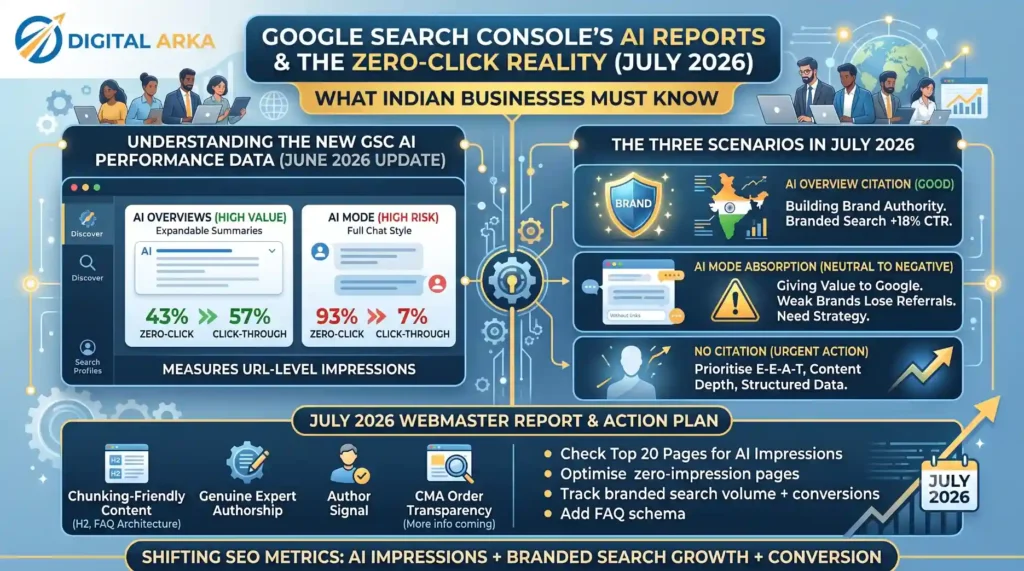
The picture it reveals is both clarifying and challenging. Clarifying, because for the first time you can measure your AI visibility rather than just estimate it. Challenging, because the zero-click data confirms what the SEO community has been observing anecdotally: AI Mode has a 93% zero-click rate. For queries where Google’s AI Mode is triggered, 93 out of every 100 users who see a result never click through to any website.
The zero-click split: AI Overviews show 43% zero-click (57% of users still click through to source pages). AI Mode shows 93% zero-click (only 7% click). Understanding which type of AI surface your content is appearing in is now a critical strategic question.
Understanding the New AI Performance Reports in Search Console
Google Search Console’s AI performance report — currently showing impressions (with click and query data to follow in subsequent rollouts) — measures three distinct surfaces:
- AI Overviews: The expandable summaries that appear at the top of standard search results pages. Your links remain visible below or within these summaries. 57% of AI Overview impressions still result in a click.
- AI Mode: Google’s full chat-style search interface, which replaces the standard results page with a conversational AI response. Links are largely absent from AI Mode answers. Only 7% of AI Mode interactions result in a click to a source website.
- Discover (AI-curated feed): Personalised content surfacing in Google Discover, which received its own update in February 2026 with explicit emphasis on locally relevant, in-depth, original content.
For Indian businesses checking their Search Console data in July 2026: your AI Overview impressions are your most valuable number. An impression in an AI Overview means Google’s AI system found your content credible enough to summarise or cite — which builds brand recognition and authority even when no click occurs. An impression in AI Mode is less commercially valuable because the click-through probability is near-zero.
Google also announced in July 2026 that it has launched Search Profiles — with immediate analytics access for profile owners. This is a new visibility surface that sits alongside traditional search results and AI answers, giving businesses a structured presence in search that goes beyond traditional blue links.
The Zero-Click Reality for Indian Business SEO
The updated zero-click report, released following the UK’s CMA order requiring Google to disclose how its ranking systems operate, confirms a trend that has been accelerating throughout 2025 and into 2026: a growing share of search queries are now being answered directly on the Google results page, without users visiting any external website.
Doing SEO for zero-click searches is the last strategy to pull up the traffic to our website.
This does not mean SEO is failing. It means the definition of an SEO “win” is changing. Three scenarios now define the zero-click landscape for Indian businesses:
Scenario 1: Your Content Is Cited in AI Overviews (Good)
If Google’s AI system summarises a question and cites your website as a source, you are winning — even if the user does not click. Here’s why: the user sees your brand name as an authoritative source, which directly increases the probability that they search your brand name directly, visit you by typing your URL, or recognise your brand when they see it in an ad. Branded search, which is now one of the strongest SEO signals, is directly strengthened by AI Overview citation.
Studies confirm this: branded queries get approximately 18% higher CTR in AI Overviews. Brands that appear in AI Overviews consistently build the branded search volume that protects their overall SEO performance even as zero-click rates rise.
Scenario 2: Your Content Is Being Absorbed by AI Mode (Neutral to Negative)
If your best content is being used to answer AI Mode queries — where 93% of users never click through — you are contributing value to Google’s AI system without receiving commensurate traffic benefit. This is the scenario that justifies Google’s statement that “weak brands lose 60% of referrals” as AI Mode expands.
The strategic response here is not to try to prevent AI Mode from using your content (the new opt-out toggle allows this, but opting out of AI surfaces entirely is rarely the right strategy). Instead, the response is to ensure your content strategy also targets queries where AI Overviews (not AI Mode) are triggered — queries with clear source-citation patterns rather than conversational answer patterns.
Your blog formatting must be AI overview friendly now to get higher ranking.
Scenario 3: Neither (Urgent Action Required)
If your most important pages are not appearing in AI Overviews and not ranking in standard organic search, you are invisible to an AI-first search experience. This is the signal to prioritise E-E-A-T improvement, content depth expansion, and structured data implementation immediately.
What Google’s July 2026 Webmaster Report Tells Us About Content Strategy
The July 2026 Google Webmaster Report — Google’s monthly summary of major search developments — included several signals particularly relevant to Indian businesses:
LLMS.txt Files Will Not Help or Hurt You
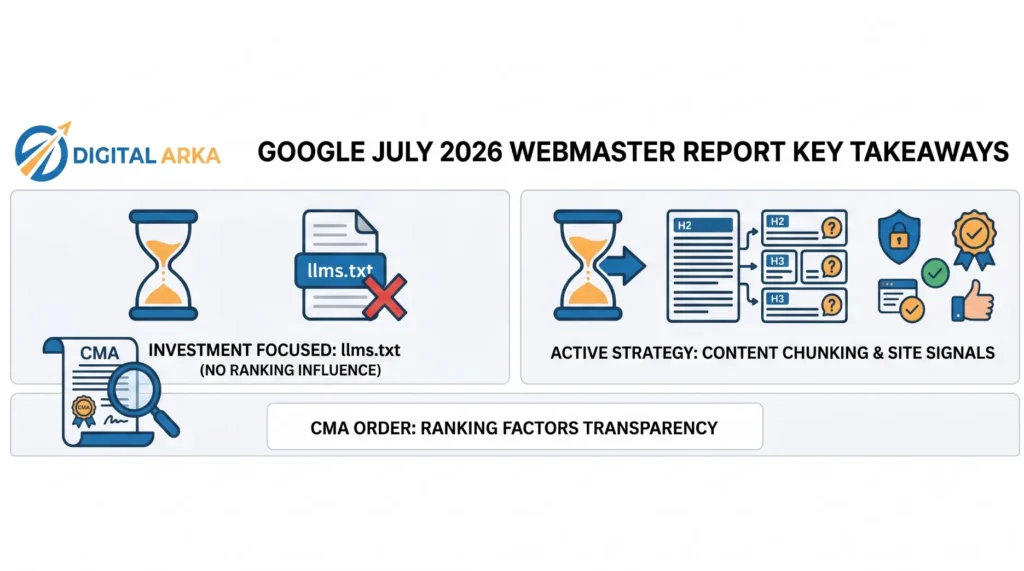
Google officially confirmed in July 2026 that llms.txt files do not influence Google Search rankings. There has been significant discussion in the SEO community about whether adding an llms.txt file (a protocol to guide AI crawlers) would benefit or harm search visibility. Google’s position is clear: for Google’s systems specifically, this file has no ranking impact either way. Invest your technical SEO time elsewhere.
Chunking and Site Signals Are Active Ranking Considerations
Google’s search team discussed “chunking” — the way AI systems break content into discrete, extractable pieces — and site signals as active considerations in how content is evaluated for AI surface eligibility. This has direct implications for content structure.
What “chunking-friendly” content looks like: Each section of a page should be independently valuable and self-contained enough to be extracted and used as an AI answer. A heading like “How much does SEO cost in Delhi?” followed by a clear, specific answer is a chunk. A heading like “Our Services” followed by three paragraphs of generic description is not.
For Indian businesses writing service page and blog content: structure every section so it answers one specific question completely. Use H2 and H3 headings that mirror the actual questions your customers ask. Write the answer in the first sentence after the heading, not after two paragraphs of context.
CMA Transparency Order: Google Must Disclose Ranking Factors
The UK’s Competition and Markets Authority ordered Google to share how its ranking systems operate — the most significant forced transparency disclosure in Google’s search history. While the full disclosure is still being processed, this order changes the accountability landscape for Google’s search systems and is likely to produce more publicly available information about ranking factors over the coming year.
For Indian businesses, this is a longer-term positive development: greater transparency about how Google’s systems work means better-informed SEO decisions based on official information rather than reverse-engineering and community observation.
How to Structure Content for AI Overview Citation in July 2026
Based on everything the new AI performance data, the July 2026 Webmaster Report, and the June spam update enforcement patterns reveal, here is the specific content architecture that earns AI Overview citations:
The Answer-First Structure
Place the direct answer to the page’s primary question in the first 40–60 words after the H1. Google’s chunking systems look for the answer near the top of the relevant section. A service page for “SEO services in Delhi” should answer “what is SEO and how does it work for Delhi businesses” in the opening paragraph — not after 200 words of company background.
The Specific Over the General
AI Overview citation favours specificity. “We increased organic traffic by 340% for a Noida coaching institute over 9 months” is more citable than “we have helped many clients grow their organic traffic.” Original data, specific outcomes, and verifiable claims get cited. Generic claims do not.
The FAQ Architecture
Every service page and blog post targeting competitive queries should include a FAQ section structured with real questions (using actual customer language, not keyword-optimised headings) and clear, specific answers. This is the single most consistently cited content format in AI Overviews across all query types.
The Author Signal
Content written by a named expert — with a bio that establishes credentials, a photo, a LinkedIn link, and demonstrated expertise in the specific subject matter — is significantly more likely to be cited in AI Overviews than anonymous content. This is the editorial E-E-A-T signal made machine-readable.
Your July 2026 Search Console Action Plan
With the AI performance reports now available in Search Console, here is what to check and do this month:
- Log into Search Console and find the AI performance report — check your top 20 pages for AI Overview impressions. Which pages are appearing? Which are completely absent?
- Identify your highest-traffic pages that show zero AI impressions — these are your priority optimisation targets for chunking, FAQ addition, and E-E-A-T strengthening
- Segment your queries by zero-click risk — informational queries (how, what, why) are highest risk for AI Mode absorption; transactional and local queries (best X in Delhi, price of Y, X near me) retain higher click-through probability
- Track branded search volume alongside organic traffic — if AI Overview citation is building brand recognition, branded search should increase even as total clicks plateau. Use Search Console’s brand filter to isolate this signal
- Add FAQ schema to your top 10 pages — this structured data directly signals to Google that your content is structured for AI-readable Q&A extraction
The SEO metric that matters most in July 2026 is not organic clicks. It is the combination of AI Overview impressions + branded search growth + conversion rate from organic traffic. A business appearing consistently in AI Overviews will see branded search grow even as raw clicks plateau — and branded traffic converts at 3–5x the rate of cold organic traffic.
The Bottom Line
Google’s new AI performance reports in Search Console are not just a new metric to track. They represent a fundamental shift in how search visibility should be measured and managed for Indian businesses in 2026.
The zero-click data confirms what businesses with declining traffic have been experiencing: more queries are being answered without clicks. The AI Overview impression data shows which businesses are winning the citation game that now drives brand recognition in an AI-first search environment. And the July 2026 Webmaster Report confirms that Google’s systems are becoming more sophisticated at evaluating content quality, author credibility, and structural extractability.
Indian businesses that adapt their content strategy to the new AI-first measurement framework — prioritising AI Overview citation, chunking-friendly structure, genuine expert authorship, and branded search growth — will compound their advantage through the second half of 2026. Those that continue measuring success by traffic volume alone will increasingly misread their own performance.
DigitalArka optimises Indian businesses for Google AI Overviews, traditional SEO, and GEO (Generative Engine Optimization). Get a free AI visibility audit at digitalarka.com